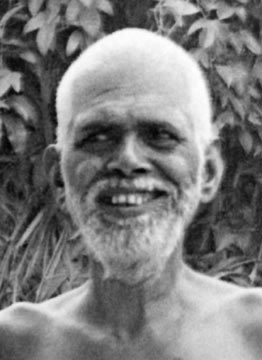
“You may go on reading any number of books on Vedanta. They can only tell you ‘Realize the Self’. The Self cannot be found in books. You have to find it for yourself in yourself.” Sri Ramana Maharshi Continue reading

“You may go on reading any number of books on Vedanta. They can only tell you ‘Realize the Self’. The Self cannot be found in books. You have to find it for yourself in yourself.” Sri Ramana Maharshi Continue reading

Many people are asking how they can help in Haiti relief efforts without being victim of Scams. Here is a listing of major groups that have experience in disaster relief efforts.
http://abcnews.go.com/GMA/haiti-earthquake-relief-effort-avoid-scams/story?id=9555419
The American Red Cross site is given below.
As many of you know there has been a devastating earthquake in Haiti and it has led to a high death toll and horrific suffering among the people there. Continue reading
Why consume food, why breath unless is draws us closer to the Divine? More and more it is revealed to me that everything we do is a form of nutrition. The food we choose to eat will either bring us closer, or carry us away from the Divine. The company we keep, the books we read, the music we choose, our daily routines are all opportunities to collect sparks of the Divine. Every action we select becomes a part of the quest for God Mergence or Deveikut if we stay connected to the Creator. Balancing the desires that detour the journey is a daily task. Some days the battle feels like standing in opposition to a hurricane/gale force wind and other days, there’s is just a gentle breeze blowing, yet always there is wind against my skin. Continue reading
If you know a few things about Chinese herbs, then the title might give you a giggle as you well know that not even the tip of the iceberg can be touched in a few hundred words article. Well, I’m fully aware of that! So, let’s think of this as an intro to the magic kingdom of Chinese herbs. They have changed my life with their wisdom and healing powers, and I think I owe it to them, myself and you to share some facts that might surprise you more than you’ve ever thought.
 First of all, did you know that the phrase Chinese herbs does not necessarily imply that those herbs originate from China, but rather that they are applied through Chinese Medicine concepts? So, here we have our old friend Dandelion – if we call it Pu Gong Ying, it becomes a Chinese herb. True, many of the herbs used in Chinese Medicine today are coming from China and other Oriental countries, but in reality, over the past thousands of years, plants have migrated from a continent to another by different means. Take, for instance, licorice – Gan Cao in Chinese – which is one of the most commonly used herbs for over 2000 years. Does that make it Chinese? Not really, since the Greeks and the Romans have also used licorice since ancient times.
Chinese Herbal Medicine has about 2500 years of written history. However, increased herbal usage dates back at least 5000 years. You might say so what? What has this got to do with me? Maybe people have used herbs since the beginning of humankind. What if I tell you that Chinese Medicine has between 30.000 and 40.000 books written before the turn of the century with thousands additional articles and books written only in the past few years. Of course, Chinese Medicine is more than Chinese Herbs; it also incorporates Acupuncture, tuina (Chinese massage), qi gong, tai chi and nutrition. Continue reading
Our consciousness or self -awareness appears to manifest through the mind/body. At the same time it seems that the mind/body, ego, and indeed all and any related perceptions, only exist within our Awareness. This is a wonderful paradox to meditate on. Continue reading
There are hundreds of wonderful and ancient texts written by great yogis and sages that have come down to us. These include the Upanishads, Bhagavad-Gita, Patanjali’s Yoga Sutras and so many more. If we meditate deeply on the psychology of human truths found in these, the principles of living a successful life and becoming a leader and a benefactor for humanity emerge.
Principles of yoga psychology tell us that human beings, in order to develop their potential, must become fully conscious of their root instinct to survive and channel this phenomenal energy in five areas of life and manage these areas with care. Our understanding of these five fundamental principles and applying them properly determines the extent to which we fulfill our total human potential.
Here are the five principles. These are all tied in some way to our root instinct to survive. When you read any Upanishads, or a classic yoga text, you will find methods either directly or indirectly referring specifically to these. According to yogis, the secret of worldly and spiritual success and becoming a dynamic leader is a function of how well we manage these five areas of our life.
1. Breath. Proper use and understanding of yoga postures (or other physical exercises) and deep yogic breathing to advance one’s intelligence, intuition, strength, and energize and sharpen one’s leadership vision.
2. Nutrition. Proper use of food, air, water, and the sun to attain abundant energy, to become sensitive to the needs of the body, and to empathize with all living beings in order to embrace them. In this way one gains the humility and compassion and can act as a servant and transformational leader to facilitate the personal growth of others.
3. Sensuality. Understanding the attraction to the root (earth) aspect of life that manifest in the desire for the experience of sensuality and pleasure. Proper engagement in the experience of sensuality is important so that it promote mental balance and health and strengthens one’s leadership. The opposite causes confusion for oneself and others.
4. Sleep. Proper engagement in sleep and understanding of sleep states and different states of consciousness and to eventually attain the transcendental and universal vision that is the basis of appearance and phenomena. Lucid dreaming and super conscious states help a leader gain a feel for the right future goals to pursue that are in harmony with the universe.
5. Nonviolence. The fifth principle is that of Ahimsa (nonviolence) and it helps to integrates the other four principles while directly addressing the root instinct to survive. All other rules of conduct are subordinate to it. The ideal of Ahimsa should be held firmly in mind and in practice while one pursues to develop one’s potential through the use of other means.
The leaders at the highest level such as Buddha, Mahavir, Jesus, Gandhi, and others are able to overcome even the root survival instinct through the practice and full development of the ideal of Ahimsa. This makes their compassion for humanity so overwhelming that in the face of very difficult, life threatening, and humiliating circumstances, they have the capacity to forgive without reservation.
While the other principles focus on developing energy, power, and dynamism as a leader, the principle of Ahimsa provides a strong framework for functioning so that the leadership abilities which are developed will be used for the benefit of humanity. Ahimsa is the only way to overcome the fundamental and root fears that every human being has.
See the following article on Ahimsa for a better understanding of its role in removing fear.
https://luthar.com/ahimsa-the-antidote-to-fear
I will continue with part III of this series later.
Namaste.
According to yogic texts, Kundalini Shakti is the great power that is latent in all human beings. Nurturing this hidden intelligence allows one to develop insight into the nature of things and use more fully the powers inherent in the brain, the whole nervous system, and the mind.
Kundalini awakening invariably lead to a variety of evolutionary mental and spiritual experiences in one’s consciousness. When care is taken in understanding this energy and harmonizing it, it makes the individual creative, imaginative, and bestows leadership and visionary qualities.
The main elements of yogic psychology are found in religious texts of Hindus written thousands of years ago. These include the Upanishads (Vedas), Bhagavad-Gita, and Patanjali’s Yoga Sutras among others. Jain, Buddhist, and Taoist works also emerge from the same roots and contain similar systems of thought. That is why many of the meditation and yogic methods as well as offering mantras as prayers tend to be common to these seemingly diverse religious thoughts.
No matter what the spiritual tradition, almost all classic yoga texts emphasize the energizing effect of proper food, yoga, mindful breathing (pranayama), and meditation to create the foundation of success for the awakening and development of the Kundalini. It is this power and mental energy which when used wisely propels one to achieve the goals one undertakes.
In this paper, based primarily on my own experiences, I discuss the factors associated with awakening and developing the Kundalini energy from the perspective of various yogic systems. Further, I explore the enhanced focus and sharp clarity in awareness that comes from the emergence of this power that allows one to exercise visionary leadership. Finally, I conclude with the importance of a moral framework to manage this power for the benefit of humanity.
First, I consider the role of food and drink. In Kundalini Yoga, optimal nutrition is important; especially in the initial stages of awakening and development of this power.
Continued in Part 2.
 Most of us have had the experience where someone tells us, “You are two faced” or “you are speaking from both sides of your mouth”. I recall from watching the old western movies that there was a saying among American Indians in America. Something like, “one should not speak with a forked tongue”.
Being two faced, speaking with a forked tongue, speaking from both sides of the mouth, etc., essentially mean the same thing. It means that the person saying this to us feels we are being tricky and sneaky in some way. The suggestions to act with integrity and honor exist in all cultures.
Interestingly, we perceive much wider gaps between the words and actions of others than ourselves. There is generally a tendency to view our own behavior in a more favorable light than that of others. That is not good or bad but simply one manifestation of the root instinct to survive by avoiding cognitive dissonance.
Psychologists tell us that our perceptions about the world and others in some way are meant to be self-serving. Given the ambiguity present in the world of politics, business, organizations, and our personal life, multiple interpretations of events, situations, and people are possible. We tend to pick those views and outlooks which in some way satisfy or confirm our biases. That is just how it is.
Philosophically, when we accuse others of being duplicitous, two faced, wearing a mask, and lacking integrity in their actions, we are essentially trying to say something meaningful about our perceptions. The assumption that our perceptions are objective, free from error, and right on mark is always taken for granted.
If we reflect carefully, we find that we can only see the masks of others through our own mask. Just as others are prisoners of their conditioning which affects their outlook, the same is true of us. Even with the most minimum observation and basic analysis, we can conclude that the illusion of freedom only covers up the puppet like and predictable behavior that is common to human beings.
Having said all that, my observation is that there are indeed tangible differences between human beings that are inherent in their nature. According to ancient yogic psychology, people’s behaviors are influenced by the three mental forces that act on them. These three forces are known as “Gunas” in Sanskrit. The theory of Gunas is part of classical Hindu literature and embedded in texts on yogic psychology. Sri Krishna mentions to Arjuna the nature of Gunas and how the combination of various Gunas affect human behavior.
When Sattva Guna predominates in a person, the individual tends to be honest, straightforward, rational, calm, and thinks of the good of others. When Raj Guna (Rajas) dominates, the person tends to be passionate, hard working, goal oriented, excitable, quick of temper, and eager to confront opponents and fight. When Tamo Guna (Tamas) predominates, the person’s behavior tends to be thoughtless, uncaring of others, and there is avoidance of personal responsibility, and the inability to think rationally and logically.
Yogic psychology explains why some some people are more cunning, deceitful, and violent than others. One can infer the nature of persons from their actions and behaviors. So although we are all conditioned in some way to perceive reality through our own special personality lenses, the refinement of our conditioning certainly differs according to the mental forces or gunas that are influencing us.
We do not have to look far in the world of business, politics, and world affairs to find suitable examples of grossly unethical, immoral, and violent actions and decisions. In face of such things, how should a person act or react?
How should we deal with individuals who we perceive as crooked, deceptive, dishonest, cunning, scheming, and bent on causing harm to us or others. This is the most difficult question that perpetually faces us at a personal and national level.
I believe the answer to that is that we face such people or situations by being authentic and true to our nature. When we are grounded in certain basic principles firmly, these influence our actions and bring stability in our life.
In the beginning of the Bhagavad-Gita, Arjuna refuses to fight in the Mahabharata war. Krishna tells Arjuna that his very nature would compel him to fight. Given the circumstances, once the arrows started flying, the warrior in Arjuna would come alive.
So Krishna’s advice to Arjuna was to engage in action but without anger or fear or expectations. Simply do the right thing and leave the rest to the higher power.
Self-Realization makes our actions spontaneous and straight forward. After all, who are we trying to impress? And what will we get if someone is temporarily impressed with us? Surely, the admiration and even adoration of others, like all things, is transient with a beginning and an end.
That is why it is best to ground oneself in the Truth of Being and abide in the authenticity of one’s own self. That is all we can do.
Truth is utterly simple. Sometimes it is difficult to see what is so close, what one actually is. That is why we call Self-Realization a Radical Understanding. Seeing the obvious clearly as the obvious as one’s own Self is the way. Abiding in That, one is consumed by That, and becomes That, and sees One has always been That.
To be totally and utterly free is possible, because Freedom is our very nature.
Love and light to all
Namaste
 Luthar.com
You must be logged in to post a comment.