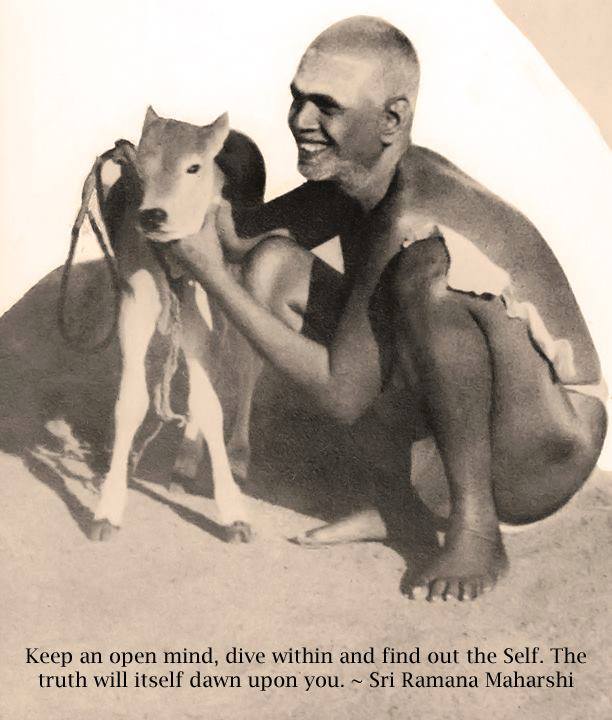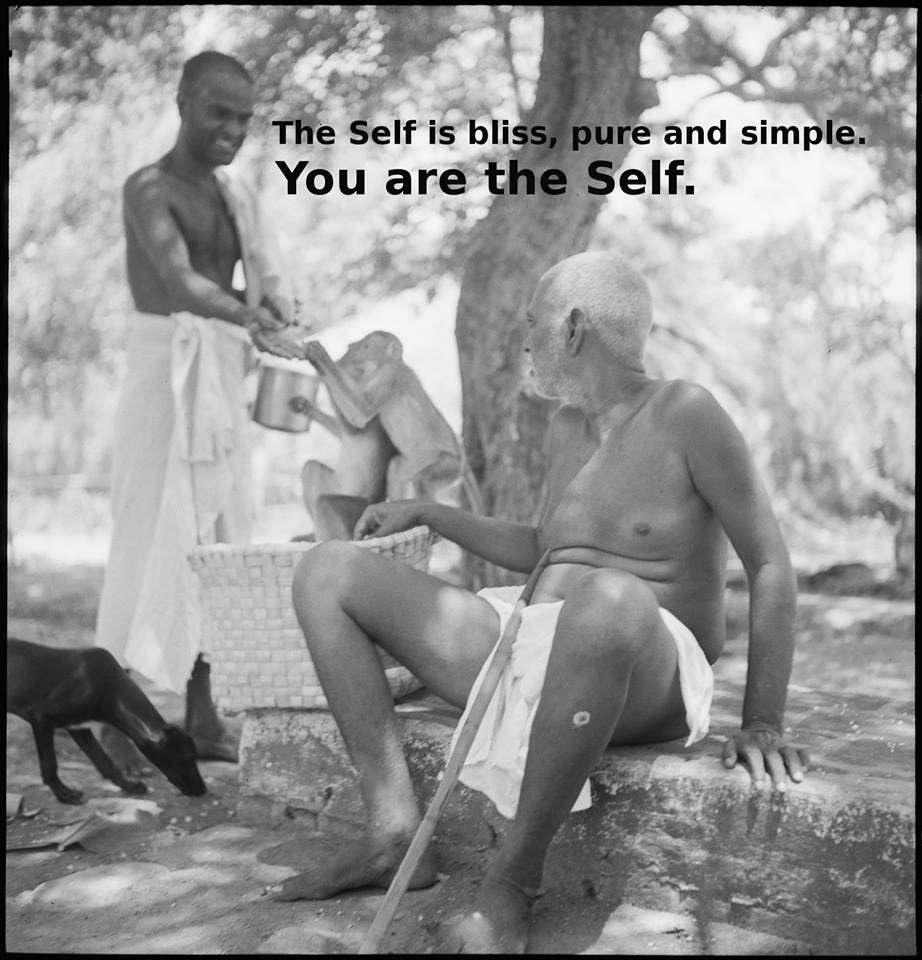
One day on HarshaSatsangh, a very earnest and sincere devotee of Ramana Maharshi posted a message that there is only one way to realize the Truth — only through asking “Who Am I” as taught by Ramana. The following was Harsha’s encouraging reply. In this message Harsha shares how Ramana’s example and teachings were personally transformative for himself and encourages the process of self-inquiry in others.
–The Editors
Tag Archives: Self-Realization
EGODUST: By Frank Maiello

Frank Maiello
Regardless of what you think, say or do, the
perfection of Freedom was, is and always will
be who and what you really are.
A Letter from Harsha (2001)
My Dear and Wonderful friends,
Spiritual methods are useful to an extent and they are prescribed according to the inclinations of people. They are meant to help you accept your own Beauty. Spiritual practices are meant to make you aware of your overwhelming beauty seeping out everywhere.
The final barrier to seeing the Seer, or being the Seer, is an extremely subtle one. Grace allows for self-surrender to the Divine and this bridge is crossed. The Seer, The Seen, and the Process of Seeing merge Here and the Self-Existent, Ever Present Reality Dominates in all its Nakedness. The ancients called this Self-Knowing, Sat-Chit-Ananda. Existence-Knowledge-Bliss. It is Existence Knowing It Self in Pure Bliss.
Ahimsa and Self-Realization: By Dr. Harsh K. Luthar
In Patanjali’s Yoga Sutras, Ahimsa (nonviolence) is considered the first principle of the spiritual life.
Ramana Maharshi, the great sage of Arunachala has clearly stated, “Ahimsa Param Dharma”. Translated this means that nonviolence is the supreme religion.
Perfect Self-Awareness is Ahimsa. Practice of nonviolence with awareness that the same life resides everywhere purifies the mind and allows for the deepest relaxation at the mental, physical, and spiritual level.
Continue reading
Comment on a verse in Ashtavakra Gita: By Dr. Harsh K. Luthar
The nature of the Self is absolute, immutable, taintless. It is not distant, nor is it subject to attainment (being ever attained). This is the Truth. ——-Ashtavakra Gita
Here is my comment on this verse in six sentences. This is the natural approach to stilling consciousness by being simply aware of awareness with one’s awareness.
To see that, which is obvious, look.
Do not look for anything, and do not look at anything.
Nirvikalpa Samadhi and Self-Knowledge: By Dr. Harsh K. Luthar
Sometimes people say that Nirvikalpa Samadhi is a state where there is no knower and known. That is really a half-truth. To capture the essence of Nirvikalpa Samadhi, it is better to say that in Nirvikalpa the KNOWER and the KNOWN are IDENTICAL. It is only pure consciousness that by its very nature is self-revealing and self-knowing.
Nirvikalpa in Sanskrit means “without thought or doubt or mental modification”. It is the absence of mental modification and presence of fullness of consciousness in Nirvikalpa Samadhi which allows for the clear recognition of the Self.
Self is both the Knower and the Known, the Seer and the Seen, without any duality. Self, being one without a second, is always self-knowing. There is no “other” for it to know. That is why we refer to the Self as Nirvikalpa. The reference to Nirvikalpa implies the nondual nature of the Self.


You must be logged in to post a comment.