Harsha's avatar

Mahasivaratri with Arunachala: By Richard Clarke

The night of March 6 – when there was no moon – was Mahasivaratri this year. This night honors Siva, seen in nonduality as Being-Consciousness absolute. It is the association with Siva that makes Arunachala such a holy mountain.

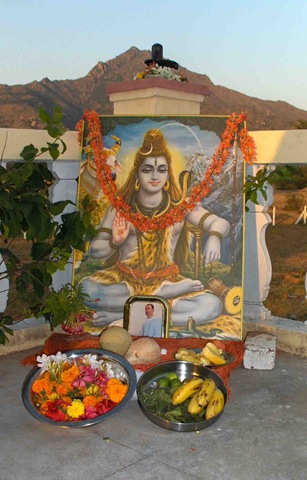
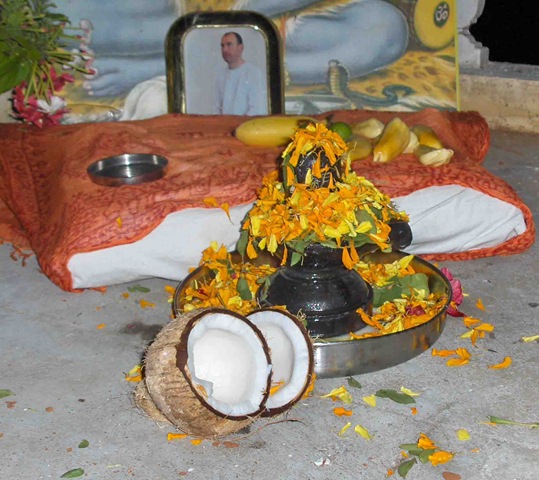
Instead of going into town to a temple, or doing pradakshina – walking around Arunachala – we decided to hold a Siva Puja at our house. Here are some photos.

The Altar set up near sun down

Mahasivaratri altar

The altar has a picture of Siva, a lingam, a photo of Nome, and various puja materials.

Arunachala is is the background.

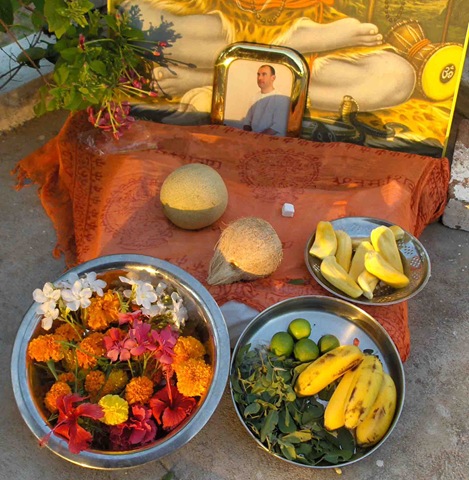
Puja Materials

Puja materials

Fruit and a coconut are common offering.

For Sivaratri it is important to have Bilva leaves as an offering.

Camphor is there for later use.

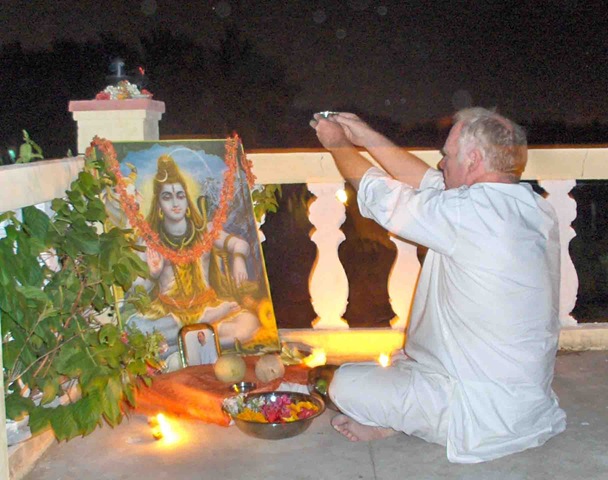
Puja at midnight

Richard at Mahasivaratri Puja

Richard is offering Puja to the Sivalingam.

Coconut milk, cows milk, ghee, bilva leaves and flower petal are offered in turn.

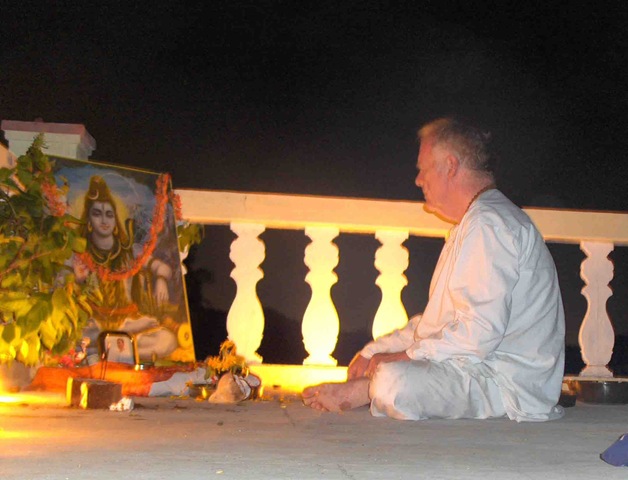
Richard at Puja

Lingam after Puja

lingam after Puja

After the Puja here is the broken coconut.

The lingam is covered with bliva leaves and flowers.

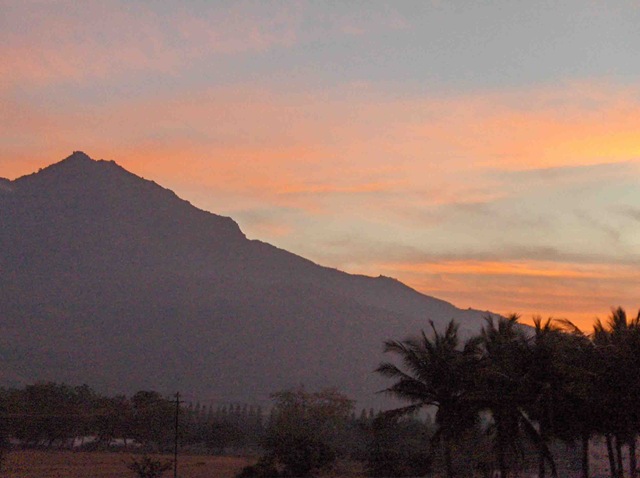
Dawn over Arunachala after Mahasivaratri night

Arunachala Sunrise after Mahasivaratri night

Richard and Carol were up most of the night, listening to recordings of chants, and spiritual discourses from their teacher, Nome.

In quiet times we meditated. For us this is a most holy night.

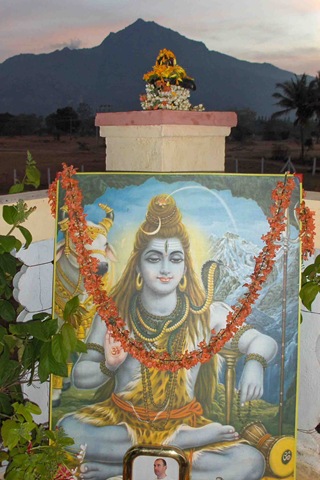
Altar at dawn

Mahasivaratri altar after Pjua at dawn

Here is the altar at dawn. The lingam has been put back in its usual place, and wrapped with a flower mala.

Now we will go downstairs and go to sleep. This is along night, but spiritually fulfilling.

Harsha's avatar

Living in the embrace of Arunachala: By Richard Clarke

Most posts have been about the new life in India that my wife and I experience. There is so much that is new to us that this is easy to write about.

I have written less about the main reason that we are here, Arunachala, the holy mountain of South India. We live so much in its presence each day. It is like the ever present ‘background’ of life here. It is so present that one could forget about it, like the young fish that asked the queen fish, “What is water? I have heard about it all my life, but I have never seen it.”

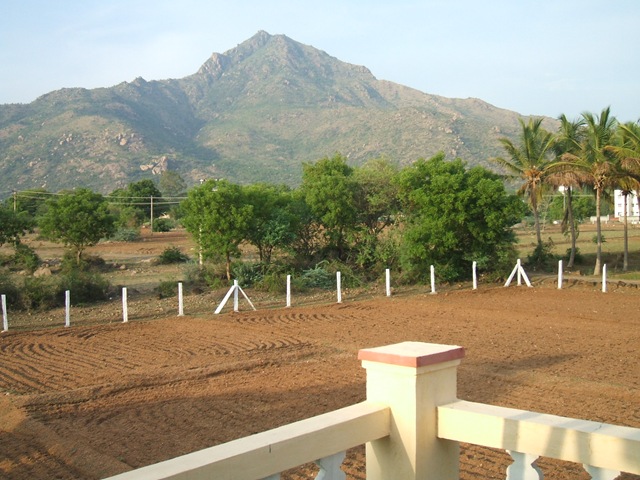
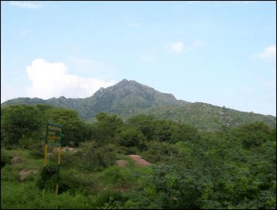
Here is Arunachala from the rooftop of our house (Yenga Veedu in Tamil):
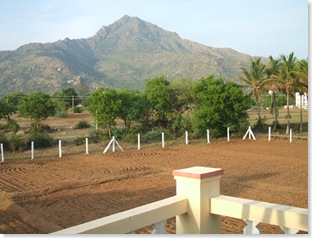
Arunachala from Brindavanam, Tiruvannamalai

Arunachala has been an holy mountain since the dawn of India life. It is written about in the Rig Vedas, purported to be the oldest of the Vedas, which would make it the oldest religious book there is.

That is the holy place! Of all Arunachala is most sacred. It is the heart of the world! Know it to be the secret Heart-center of Siva! In that place He always abides as the glorious Aruna Hill!

Skanda Purana

For many centuries there have been many Indian sadhus and sages associated with the “Red Mountain.” The most well known of these today is Sri Ramana Maharshi, who arrived here in 1896 and never left until the death of his body in 1950. Ramana, who had remarkably few claims of personal actions wrote:

Oh Arunachala, I have exposed your secret doings. Do not be angry. Let your grace be on me.

Necklet of Nine Gems

When we first came to Tiruvannamalai, a small city that has grown around a major Siva temple, Arunachaleswara Temple, over the last 2000 years, I would rise before dawn and go up to the rooftop and just sit and meditate with Arunachala until dawn. I would then watch for a while as the city awoke. After just a few days of this I said to Carol, “We could live here.” She did not treat me like was crazy, though she probably thought I was. Now, several years later I have retired and we have uprooted our nice life the the USA, gotten rid of almost everything we owned, and moved to South India to be with Arunachala.

In the last ten years spiritual practice has become the most important thing in our lives, and we want to use this part of our life where practice is the main focus. Now we are here, ‘living in the embrace of Arunachala.” I still rise before sunrise and go up to the roof, now of our home, named “Brindavanam” by the previous resident who put in the wonderful orchard and garden that surrounds this house. Carol and I are up on the roof with Arunachala several times each day. Even when not on the roof, Arunachala is the dominant presence for miles around. It is always present.

Here is a short poem I recently wrote:

Arunachala,

Silent, still, unmoving.

Arunachala,

Ancient One,

In the form of Dakshinamoorthy

Arunachala,

Quiet this mind.

Arunachala,

Fiery one,

Thy fire burns away ignorance.

Arunachala,

I stand in your Silence.

Arunachala,

Infinite light,

Knowledge of Thee is All.

Arunachala, would that I be as Thee,

Silent, still, unmoving.

Harsha's avatar

Life in India – trip to Pondichery: By Richard Clarke

My wife and I traveled to for a three-day trip to Pondichery. The main reason for the trip was to purchase items not available (or much lower priced due to taxes) in Tiruvannamalai – An Air Conditioner to install before the summer heat, better bikes, some more clothes and personal care items, especially more English books.

Pondy is a nice Indian city on the Indian Ocean with a French flavor (in the few blocks near the ocean) and a beautiful Ocean view. Also, the Auribindo Ashram is here, with many visitors. Many Westerners travel here. What we really noticed is that is the Westerners that were there seemed to be there more to ‘see the sights’, to buy things, and to enjoy the tropical Indian Ocean atmosphere and French flavor. In Tiruvannamalai, Westerners are there mainly for spiritual reasons, drawn in one way or another by Arunachala. We feel more connected to the Westerners we meet in Tiru.

After about two days in Pondy my wife and I both missed Arunachala. I also noticed that two days spent purchasing things was moving my attention away from the spiritual activities that are really the center of this life now.

We are back in Tiru now, and have spent some time with Arunachala. It is good to be home.

In Arunachala,

Richard

Harsha's avatar

Arunachala Full Moon Day January 2008: By Richard Clarke

My wife and I moved to Tiruvannamalai in November 2007. I had recently retired and felt called to Arunachala for spiritual practice “in the embrace of Arunachala.”

I will be writing from time to time on the experiences of a Westerner in South India, and on my spiritual experiences at Ramanasramam and Tiruvannamalai.

Life in South India is filled with God. Business people perform pujas when they open business for the day. Most people have altars at home and perform daily rites there. Also God is a much more a part of daily life. In the West, God is mainly ‘kept in’ churches. temples and synagogues. In India, God is found on the streets. As one example, during religious festivals, they will put the ‘temple Gods’ on ‘chariots’ and pull or carry these around the town or village.

In this area one of the biggest events every month is the full moon night. During this night usually several hundred thousand people from around the world gather for Giri Pradakahina, where they will walk about 15 km around Arunachala. This is in a town of 100,000, so perhaps three times as many people who live in the town make pradakshina. Most do it in the moonlight, barefoot on the road. Traffic is halted for this night or redirected.

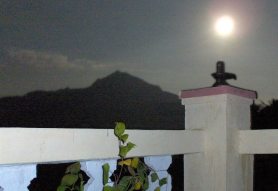
Here is a photo from our house of moonrise the January full moon night.

In Arunachala,

Richard Clarke

Arunachala Moonrise

Harsha's avatar

Lovers Love Completely: The Goddess Mystery. By Dr. Harsh K. Luthar

image

Picture of Arunachala by Gabriele Ebert

Song to the Goddess

Either let me be intoxicated
in your love completely
or put on my robes of joy
and rob me absolutely.
Judge me guilty
in the court of love
or absolve me absolutely;
find me flawed if you like
but never hold me weakly.
No middle ground is possible
for lovers who love completely! 

Love, Consciousness, and Bliss

The great sage of Arunachala, Sri Ramana Maharshi, used to say that all deep thinking people are fascinated by the nature of consciousness. The outer world of time and space is known only through ones’ own mind. Therefore, the mystery of mind and consciousness has been a magnet of attraction for philosopher, yogis, sages, and scientists. Upanishads say that one should know “That” by which all else is known.

What is “That”, which makes all else visible and known? The ancient philosophy outlined in the Upanishads, the sacred Hindu scriptures, refers to “That” as Sat-Chit-Ananda, the core of one’s being which is Absolute Bliss, Absolute Existence, Absolute Consciousness, and we can also say that it is the same as Absolute Love which makes all human love possible. Sri Ramana used to say that “Love is the actual form of God.”

For one irresistibly pulled by the hunger of Self-Knowledge that manifests in one’s own heart, the turning within to “That” Absolute Love and Bliss happens at some point. When consciousness spontaneously starts the process of scanning its own formless form, this churning results in the beauty and self-delight of awareness which underlies all manifestations of energy (Shakti).

Appearance of the Supreme Goddess

In many of the mystical traditions of Hinduism, the manifestations of this energy, resulting from consciousness becoming focused on its own nature, take the forms of Devi. Devi is the Supreme Goddess, who appears in visions and dreams of devotees according to their mental and spiritual condition to nurture, protect, bless, and guide them.

The Goddess is depicted in Hindu art in hundreds if not thousands of ways. This art is part of the Indian history, culture, and Hindu traditions. It comes from the inspired imagination of the artists and is based on the ancient stories about the Goddess and Her powers.

However, no artwork can really capture the form of the Goddess who appears in the mystic eye of the aspirant. She appears to each devotee in a unique way according to what best suits the nature and personality of the person at that time. As the yogi evolves in the spiritual path, the visionary forms of the Goddess can change along with that.

So a relationship develops between the devotee and the Goddess or the Divine Beloved. Like human relationships between lovers, it is not always easy.

Sometimes, the devotee cannot bear the separation and wants immediate union and consummation. He may even blame and question the Goddess as to why She has left him in the middle of the path after taking his hand.

Song of Despair to the Goddess

Play hide and seek
not too much longer
and risk this longing
get even stronger;
when people ask unashamedly
why your love flees from me
what honest answer can I make
and can you also say for sure
that in choosing me as your lover
you have made some grave mistake.

But the Goddess realizes that it is not time and waits for the moment to be ripe for the final liberation. Many of the love poems of mystics to the Goddess have come from this intermediate level of spiritual experiences where the Supreme Beloved appears to plays hide and seek with them.

Sri Ramana and Marital Garland of Letters

In the classic Tamil poem, “The Marital Garland of Letters” the Sage of Arunachala, Sri Ramana Maharshi, chides the Divine Beloved in some of the verses and apologizes for having done so in other verses. He begs Arunachala to fully embrace him (as the devotee) and utterly consume him in love; Because only then he will have peace.

Ramana writes:

Verse 23. “Sweet fruit within my hands, let me be mad with ecstasy, drunk with the bliss of Thy essence, Oh Arunachala!”

Verse 34. “Unless Thou embrace me, I shall melt away in tears of anguish, Oh Arunachala!”

Verse 60. “In my unloving self Thou didst create a passion for Thee; therefore forsake me not, Oh Arunachala!”

Hindu Mystical Bhakti Poetry

The love pattern of alternating between despair and ecstasy (Does She/He love me or love me not), joy and sadness (When will the Goddess/Divine Beloved visit again) is common in the poetry of many Hindu saints and mystics. Even the seeming confusion about the relationship itself, which makes the devotee beg sometimes for love and other times actually blame, chide, and command the Goddess/Divine Beloved, can be seen in some of the poems including the Marital Garland of Letters.

Although the Marital Garland of Letters by Sri Ramana is embedded in the Indian spiritual, historical, and cultural context, the symbolism of a lover who is in complete despair because of an incomplete consummation with her/his beloved is universally understood.

Summary

People who are in love with and fascinated by the mystery of consciousness have felt that mysterious pull of the Heart from within themselves. Who can really explain ways of the Divine and the different forms She/He manifests in.

What is the first step on this path of love? No one can say for sure. Was it the smile and look of a Sage, the grace of the Divine Mother, the kiss of the Goddess, or the kindness of a teacher or a friend? There must be many possibilities that make us aware of the Heart within, whose nature is Sat-Chit-Ananda, that which is the source of the ultimate bliss.

This memory once awakened brings upon the experience of pure being, and attracts the devotee to the truth of her/his own nature. This gentle pull within makes itself felt. It does not let go until the Truth of one’s own Heart is recognized, and there is nothing left to let go.

Some say that it is the Goddess Herself, who takes the devotee into the Heart and then reveals Herself as the Universal Heart. The complete identity between the devotee, the Goddess, and the Heart thus established, everything disappears. There is only that Heart of Love and Fullness, eternal consciousness completely at rest in its own nature.

Knowing That is Self-Knowledge. That is the final consummation.

I came to feed on Thee, but Thou hast fed on me; now there is peace, Oh Arunachala!” Verse 28. Marital Garland of Letters.

NOTE: Some of the verses on the Goddess in this article are from a longer poem on the Goddess by Dr. Harsh K. Luthar.

kurta


Harsha's avatar

My Journey to Arunachala: By Gabriele Ebert

down the hill


O Arunachala!

Thou dost root out the egoity

of those who think

‘I am, verily, Arunachala!’

(Akshraramanamalai, v. 1,

transl. by T.M.P Mahadevan)

Continue reading

Harsha's avatar

In the Place of the Quiet Heart: By Ken Knight

Leave it. Let them go;
The bruising car horns,
The tearing blare of amplified film music,
The town with its currency of coins and noise
Has no hold.
Come away,
Leave it.
Let them go,
Come to where the currency is stillness.

How is it that one’s purse can be filled?
Beneath the benign gaze of Arunachala
Whose peak draws up the heart’s delight
And whose slopes soon veil the town,
Take the winding path to a quieter realm.
See the greens and yellows and reds of trees, bushes and earth.
Catch the perfume of soft flowers on the gentle breeze,
Hear the sound of your tread on the sandy earth.
Be patient.
Listen.
Listen to the sounds of many birds singing.
Listen.
Listen to the sound of one bird singing…
Soon you will come to the place of the quiet heart
Where all may take their rest by the silent water,
For here is the currency of stillness.

Continue reading

Harsha's avatar

Stories About Ramana Maharshi: By Harsha (Harsh K. Luthar, Ph.D.)

Harsha's avatar

Ramana Maharshi on Pradakshina

Talk 212 :

Maharshi observed : Pradakshina ( the Hindu rite of going round the object of worship ) is ” All is within me “. The true significance of the act of going round Arunachala is said to be as effective as circuit round the world. That means that the whole world is condensed into this Hill. The circuit round the temple of Arunachala is equally good; and self-circuit (i.e., turning round and round) is as good as the last. So all are contained in the Self. Says the Ribhu Gita: ” I remain fixed, whereas innumerable universes becoming concepts within my mind, rotate within me. This meditation is the highest circuit ( pradakshina ).”
Harsha's avatar

Ramana: Not Your Traveling Satsang Guru

Bhagavan Ramana

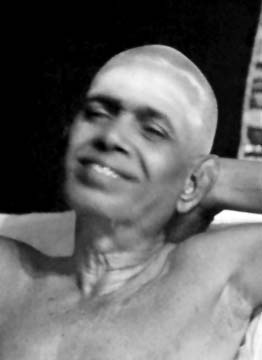
Sri Ramana was immensely attracted to the holy mountain of Arunachala in the South of India. Arunachala has been the home of many ancient and modern Yogis, Siddhas, and Sages, and carries a great mystique.

Once Ramana got to Arunachala around the age of 17, there was no leaving. He stayed in that area for the next 53 years until his death in 1950.

That is why Ramana is called the Sage of Arunachala (and not the traveling Satsang guy). To Sri Ramana, the idea of leading a satsang circus around the world with him as the head (and being proclaimed as the great Maharshi) seemed entirely comical and troublesome.

Given below is Sri Ramana’s comments and views (from Day by Day – 27-6-46) on why he never went anywhere to give darshan or satsang.

—————————- Continue reading