Harsha's avatar

The Method For Self-Realization: By Dr. Harsh K. Luthar

Sometimes we see people debating the language and methodology of Sri Ramana’s teaching. The question is often raised, “What is the purest form of Ramana’s teaching”?

The answer is obvious. That form of the teaching is the purest, which works for you. What bring you to Self-Knowledge and Self-Realization is the highest teaching.

Sri Ramana’s teaching is very straight forward. Despite the volumes of books and hundreds of expert commentaries, the essential teaching is simple. It is all an open secret for everyone to see.

Sri Ramana always emphasized that our nature is that of pure, unstained consciousness. “Awareness is another name for you”, the Sage of Arunachala used to say. Our spirit is of the nature of unbroken awareness that continues regardless of what our physical makeup is or what mental state the mind is in (sleep, dreaming, waking). If we deeply understand this, we have arrived at the central truth of the teaching.

Sometimes the students of Advaita debate which words or terms best describe the process of inquiry. Those who know the nature of the Heart directly become indifferent to argumentation and do not quibble over trivialities.

All of these terms, self-attention, self-awareness, self-remembrance refer to the same process of the subject turning within to itself, the subject. Self-inquiry focuses the mind on its source and the result is clarity of awareness.

Awareness by its very nature is always aware of itself but it is not an object to itself. We cannot understand this except by being in the Heart of Awareness and being the Heart.

In the world of duality, Oneness can only be indicated, but it cannot be known. Oneness cannot be known in duality because it cannot be an object to itself. Oneness cannot be known in duality because it swallows up duality. To know the Oneness intimately, one has to become That and to recognize One Is That! Do you see the beauty of this paradox?

Sri Ramana used to say that there are not two selves where one self is aware of the second self. Similarly there are not two forms of awareness. However, through the duality and agency of the perceptual mind, we can say that awareness being aware of itself is a refined and a subtle form of atma vichara (Self-Inquiry).

Ultimately, even this duality, being that of the mind (that any method necessarily presumes), vanishes as One Awareness shines forth as the Self that is the Heart; that the ancients termed Sat-Chit-Ananda. Existence-Consciousness-Bliss. One whole mass without divisions.

Once Sri Ramana said the whole truth is contained in the words”Be Still”.

So if one is self-aware and still, one has grasped the method.

A quiet, peaceful, and content mind that is awake and turned within to its source has grasped the method and the process of Self-Inquiry. This process itself turns into the goal when the mind merges into the Heart for Self-Revelation.


Harsha's avatar

Path to Realization Leaves No Trace: By Dr. Harsh K. Luthar

When Paul Brunton asked Sri Ramana about when Sahaj Samadhi should be practiced, the sage said and I paraphrase….”right from the beginning….that which is the practice of the Sadhaka is the state of the Siddha.”

Continue reading

Harsha's avatar

Mic’s Visit to India and Meeting Poonja-ji

Papaji_1

Dear Friends,

When the HarshaSatsangh yahoo group started in January 1999, about a hundred or so people joined in the first few months. Here is a post of introduction that came to the group from Mic about his going to India and meeting Poonja-ji (also known as Papa-ji). Poonja-ji visited Sri Ramana and considered Ramana his Sat-Guru.

I don’t know where Mic is now, but his letter has stayed with me over all these years and I wanted to share it with you. I have only made minor edits in his letter to retain the original flavor of Mic’s vital spirit that comes through his words.

Harsha
**************************************
Hello all,

A brief introduction. My name is Mic, though most of my friends here call me Mohan. Advaita found its way in my heart as my heart in the summer of 91.

While wandering India, by chance I encountered Sri Poonjaji, a disciple of Bhagavan Ramana Mahrishi. I stayed with Poonja-ji and the small gathering there for two months. It was a time of great joy, intensity, revelation, and incomprehensible silence.

I mostly recall the great stillness. The presence of this man, Poonja-ji. In this dirty town of swirling dust storms and buildings swimming in the heat before me.

At night candles cast a golden hue upon the Indian markets, dancing in the buzz of bicycle songs and branches of lush red lychees being sold on the dusty streets.

The silence. The torrential flow of humanity, pulsing through the hot polluted streets, watermelon stalls.

The astonishing passion of seekers at Poonja-ji’s house. It was like the sweetness of sugarcane juice. It was the end of seeking itself in the embrace of the always so.

Like many there with Poonja-ji, I had also walked other roads in my search.

I had come to India on a Buddhist yatra, with plans to finish the journey in a Thai monastery. Yet relaxing into this resplendent heart of being, the seeking and the struggle fell.  The seeker and the story melted away as monsoon rains of India drenched me in joy.

And I finally saw the True heart of advaita, as my own.

Leaving India, with the blessings of the mountain, I felt almost drunk on the ringing clarity of these words from the Tripura Rahasya;

” Know yourself as Pure Consciousness, the unaffected witness of the phenomenal world.”

Integrating this with a world that demands commitment and authenticity, I meet with surrender and an open heart.

Some days I struggle, some days I sing. The devotion I feel to Shakti I know is but a reflection within consciousness of this love.

The silence.

And it is in this love I am earthed in freedom, and can play out my role in the theater of this world in peace.

Warm regards,
Mohan (Mic)


Harsha's avatar

Speaking to Chitrabhanu-ji and Pramoda-ji: By Dr. Harsh K. Luthar

Dear Friends:

Last weekend, I had a phone conversation with my teacher Gurudev Chitrabhanu-ji and his wife Pramoda-ji. Both Gurudev Chitrabhanu-ji and Pramoda-ji are on the forefront spreading the message of Ahimsa and how the philosophy of nonviolence brings our focus on caring for all living life, human, animal, plant life, and the environment itself.

Speaking with Chitrabhanu-ji and his wife reminded me of the years I spent with my teacher at the Jain Meditation Center in NYC the late 1970s up to 1980-81.

I used to go to Jain Meditation Center to listen to Gurudev speak. Often, I would stay around after the lecture and listen to the questions asked of Gurudev.  At the end, many people got in a line to ask Gurudev more personal questions. These questions typically focused on health issues, self-improvement, meditation methods, mantras, and at times psychic phenomena. Some of the questions seemed quite far out to me.

I  was very young then and perhaps immature in some ways. I used to sit so closely to Gurudev that I could hear all the questions and answers from the people in the line who came up one by one. When someone tried to whisper the question, I leaned even closer to hear it. Once in a while, someone would give me the look. But I stayed very close so I could hear everything that Gurudev was saying. I felt as if every word of my teacher was a gem and that I did not want to miss a single thing. I did not really think about other people’s privacy. It was an open space in the hall so I felt it was not an issue. Gurudev always looked at me and smiled and never said anything either.

After the talk at the Meditation Center, I often walked Gurudev and Pramoda-ji back to their apartment. During that time, I was able to speak to my teacher freely and ask him any questions on meditation, yoga, chakras, mantras, etc. Gurudev was happy to accommodate and answer me. I learned much from what he said during those conversations and have written about some of the incidents. Those were fun times.

One time when I was walking with Gurudev, another of his students was with us. This person had serious questions about some dreams about dying that he had been having. I could not help but hear the conversation. In that particular case, however, Gurudev said to me in Hindi that he wanted me to run and get something from a store that was on the street and gave me some money. It was unusual because Gurudev and I typically spoke in English (with some sprinkling of Hindi) and he had never sent me on an errand during our walk.

I quickly surmised that Gurudev wanted privacy for this conversation. Of course, I ran to the store to get the food item and then caught up with Gurudev and the other person as they had gone a block ahead of me. By that time, they were done talking and the student was leaving. After that, Gurudev and I walked rest of the way back to Gurudev’s apartment. I bowed to my teacher and said my Namaste and walked back to the place where I could catch the subway to go home.

In those days I was completely immersed in yoga and meditation. In fact, I made my living teaching yoga at the New York Health and Racquet club in NYC in Midtown Manhattan.  Many of the famous actors, actresses, newscasters, and politicians of the 1970s who worked nearbye came to that club.

I remember Mary Tyler Moore, Hope Lange, Gracie Jones, Bella Abzug, Tom Brokaw, and some people from Saturday Night Live coming to the club. There were many others but my memory has now faded. I remember Mary Tyler Moore came to my Yoga class a couple of times. She was very respectful, it seemed to me, of Eastern philosophies and yoga. Hope Lange used to be there often during the time that I was there and she was very unassuming and congenial. I also remember Congress Woman Bella Abzug come to the club. She had a relaxed wonderful style and was easy to talk to. She seemed genuinely interested in yoga and a few times we spoke about reincarnation. She must have known Shirly MacLaine because I recall Bella mentioning her in the context of our conversations on reincarnation. This was all back in 1978-1980 time range.

Most of my free time when I was not teaching yoga at the New York Health and Racquet Club, I spent in contemplation and meditation at my house which I shared with other meditators who were also students of my teacher.

Coming back to my conversation last weekend, I spoke to Pramoda-ji first and we had a nice talk. She will be sending me some articles that she has written to be published on the Luthar.com website. In fact, I have already published one. I will have the webmaster upload another one soon.  Pramoda-ji is the President of the Jain International Meditation Center in Mumbai (Bombay). She is also on the on the Board of Directors for PETA in India (People For Ethical Treatments of Animals).  She works for the Reverence for Life Society and for Beauty without Cruelty which promote animal welfare and the vegetarian way of life worldwide. Promada-ji has also authored a number of books – Foods of Earth; Tastes of Heaven – Jain Symbols – To Light One Candle (co-authored with Clare Rosenfield) – The Book of Compassion (coauthored with Pravin K. Shah). More on Pramoda-ji can be found on the Jain Meditation website.

http://www.jainmeditation.org/pages/pramoda.html

I had a wonderful talk with Gurudev Chitrabhanu after I spoke to Pramoda-ji.  His voice was relaxed and fresh and just as I remember it all the past times that I have spoken to him. He told me that Clare Rosenfield and her husband were there visiting them at the time. Gurudev knows the closeness I feel with the Sage of Arunachala, Sri Ramana Maharshi. He mentioned his visit to Sri Ramana when he was 19 years old. That was one year before he became a Jain Monk.

During the conversation,  Gurudev Chitrabhanu recited some poetry in Hindi to me and then explained it as well several times in different ways. The essence of the poem was that the real meeting is the meeting of the minds and the body only serves as the context. His message was that whether I am able to be in someone’s physical presence is not important but it is the meeting of the minds and the Heart connection that is the most central. Sri Ramana has said exactly the same thing in one of his conversations.

Gurudev will be leaving for India soon. I will be communicating with Chitrabhanu-ji and Pramoda-ji again in the near future. Mamata-ji, Chitrabhanu-ji’s secretary, has done a wonderful job of keeping us all informed of all the different international events taking place with Gurudev and Pramoda-ji playing a leadership role.

Harsha


Harsha's avatar

Aids To Self Enquiry: By Alan Jacobs

“Those who leave the path of Self Enquiry, the way of liberation, and wander off along the myriad forest tracks, will encounter only confusion”. Bhagavan Ramana.

Bhagavan27

Self Enquiry is the Direct Path and Bhagavan’s great contribution for the modern age for all. 

Self Enquiry is the backbone of the main weapon in Bhagavan’s teaching for eliminating the vasanas, tendencies and vrittis, the thought forms which act as a veil and occlude your Real Self. Continue reading

Harsha's avatar

Impressions from Full Moon night pradakshina around Arunachala – April 19, 2008: By Richard Clarke

Saturday night was full moon night again, this time special due to the Tamil New Year. Carol and I had not done pradakshina around Arunachala on such nights and had planned to do so this night.

We have been preparing. This is a big effort for aging Westerner bodies. From our house, Brindavanam, it is between 9 and 10 miles to circuit Arunachala. For the last two weeks we had been doing ‘half pradakshinas’ (about 5 miles from our house along the inner path to the Ramakrishna hotel, where we would stop, get breakfast – vadas and dosa, and Indian milk coffee – then take an auto-rickshaw the rest of the way home. To get ready we have been walking about 25 miles a week on Arunachala, either around it or up and down to one or another of the caves and meditation spots.

It is April now, and the summer heat is starting. Saturday at our house it was 38 C (100 F). When we left about 6:15 PM it had not cooled off much.

We walked out to Bangalore Road, west of where the pradakshina roads turn round the holy hill. The road used for pradakshina is blocked off from traffic, and traffic is rerouted for this night. When we got to Bangalore Road we saw many busses parked along the road, and thousands of people streaming towards the pradakshina route. The foot traffic was light, we found out in a few minutes – only maybe 5 or 6 abreast taking only half the road.

We joined the pradakshina crowd about 2 miles into the route many take. It is common to start at Arunachaleswara Temple, in the center of Tiruvannamalai. We joined after the route has left Tiru and is starting around Arunachala to the West of town.

Since this was a big night there was a big crowd. We heard crowd estimates of 10 – 15 lakhs (1 to 1.5 million people) – this in a city of about 100,000. When we joined the route the road was packed, maybe 10 or 12 abreast and taking up all the (recently widened) road. To get a sizing of this number of people, in the US there is each year a ‘Super Bowl’ championship of American Football. This gets many 70,000. For European football (soccer in the US) the best teams, like Manchester United gets crowds of maybe 75,000. Lesser teams get maybe 20,000. So the crowd is like 15 or 20 Super Bowls or Manchester United matches.

Visitors commonly take busses here. When they arrive they start the walk. When they are finished, they may eat by the bus then get back on the bus and sleep on the drive back home.

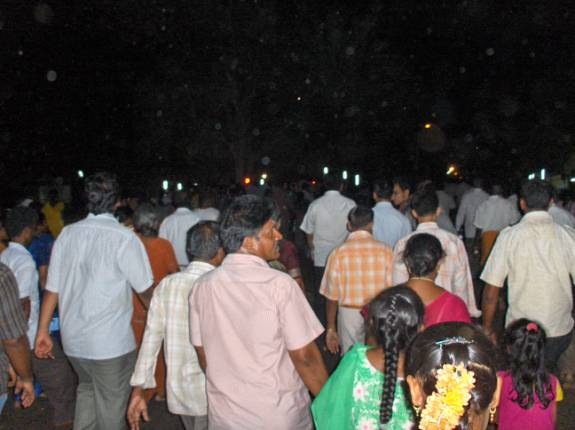
We saw men, women, children, lovers, families, babies asleep being carried over the shoulder and being passed from Dad to Mom along the route. There were small groups of young women walking without parental supervision and human chains of young men, each holding the shoulders of the man in front, pushing their way through the crowd, chanting Siva chants. Many people walked holding hands or in some way staying connected to the people in their group.
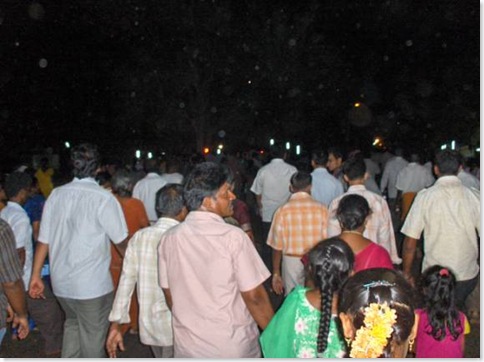
People walking pradakshina

Though we were walking at night, the road was mostly well lit, lit up from all the roadside shops and temple that line the route. Most of the ‘shops’ were temporary, built from poles and erected just for the one day. They supplied everything you can imagine. This included drinking water, green coconuts (for drinking), fruit juice stands, soda stands, food stands, spiritual picture stands, toys, clothes, women’s bags, jewelry (mainly the bracelets that almost all Indian women always wear and color-coordinate with their sarees or salwar suits) food staples like rice and lentils, and many more. I even noticed a motorbike display, showing the latest models. Sometimes it had a bit of the feel of a Western trade show, with all the vendor booths showing off their wares. .

Occasionally there was no light and the crowd was illumined just by the moonlight. I liked this the best.

In the crush of the crowd the walking was not easy. One could not set up a stride and keep it up. People pushed their way past you, crossed the road in front of you, and there was a surprising number of bicycles, motorbikes, and even a few cars and vans going the other way. We were almost hit by an unlighted bike crossing the road against traffic in the dark. Often the most aggressive at pushing their way past us were women.

Though the purpose of the walk is spiritual, it seemed that many making the walk were not really doing so with this approach. We passed many temples. Some walkers were going in. Many were not. Some were chanting as they walked. Most were not. Some were paying attention to Arunachala as they walked. Most were not. Most were talking with the group they came with. Many were chatting on cell phones.
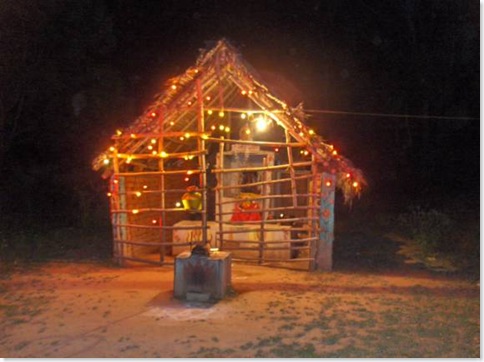
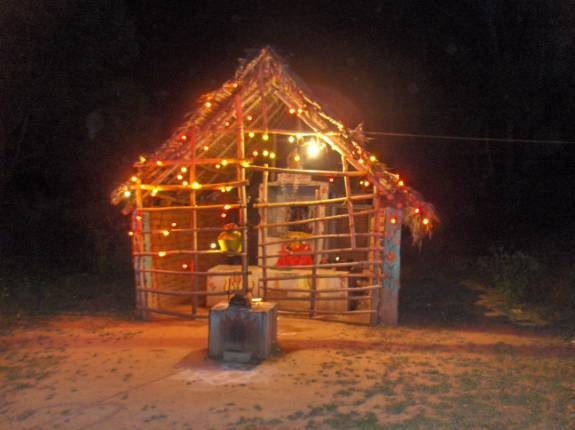
Small simple altar, after Adi Annamalai

Here is a photo of a small, simple temple altar to the side of the road after we passed Adi Annamalai. All the others had many people. This just sat a bit away from the road, lit but mainly unvisited. It looked homemade.

I could track our progress by the changing face of Arunachala as we walked. From our walks on the inner path, I now pretty well know were we are by the view presented by the holy hill. We start on the west side and see the view from our house, the mountain, and to the left side, the hill called Parvati. As we walk then we pass Parvati, then the ‘knob’ (whose name I do not know) that I associate with the Adi Annamalai Temple on the backside of the hill. Then we pass the forest to the right that marks the end of the inner path. This means that we are nearing the road back into Tiruvannamalai.

Finally we walk the three miles through town, passing Arunachaleswara, then Ramanasramam. We stopped at a restaurant, Usha’s just before we came to Ramanasramam, to sit and get a bite to eat. I am so tired by now I can barely take the steps, and much of this body hurts, the lower back, hips, legs and feet all hurt, some parts more than others. To keep going I have to think of near term objectives – it is just one block to Ramanasramam, I can make it one more block – like this I was able to make the last couple of miles.

Emerging from Usha’s, now it is about 11 PM. Though late at night, it still must be 90 or 95 F, still surprisingly hot. The crowd we are with is mainly a new group, just starting out. We thought the road was crowded before, but now there seems to be almost twice as many people. The road is packed from side to side with so many people that the pace has slowed to about half of what it was before. At one point, right before Bangalore split off from the pradakshina route, the crowd actually came to a standstill, too many people to even move.

Finally we could turn off the pradakshina road and continue walking without all the crowds the last half mile back to our house. I can make it to the light, I can make it to the corner, I can see our house, I can make it past the guest house, I can make it across the field, I can make it to our gate, I can make it to our house! In the house, we will fill the shower bucket and wash off all the sweat and grime from the night. My feet are just about as dirty as I have ever seen them. We got to bed around midnight.

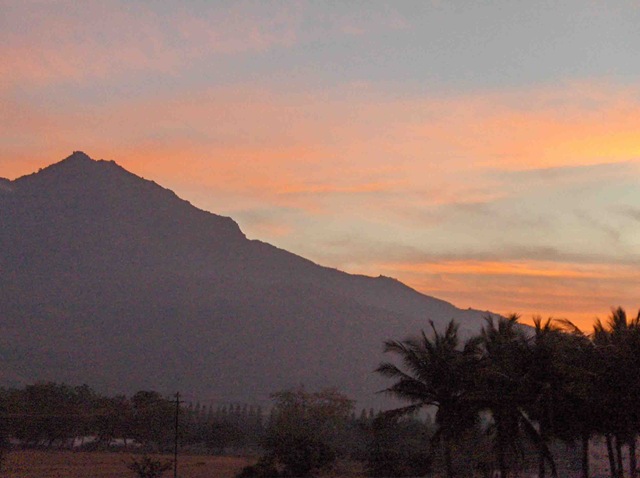
I got up about 4:30 this morning and went up to the rooftop to be with Arunachala and meditate. In our usually quiet country location, there was still much noise from the road. I think a lot of this noise was horns of busses, trying to make their way out, to start back home. And in the dirt road in front of our house, there were, even at 5 AM, many rickshaws (which usually we do not see at all) which were, I guess, carrying walkers too tired to go further, back to their busses.

Harsha's avatar

Living in the embrace of Arunachala: By Richard Clarke

Most posts have been about the new life in India that my wife and I experience. There is so much that is new to us that this is easy to write about.

I have written less about the main reason that we are here, Arunachala, the holy mountain of South India. We live so much in its presence each day. It is like the ever present ‘background’ of life here. It is so present that one could forget about it, like the young fish that asked the queen fish, “What is water? I have heard about it all my life, but I have never seen it.”

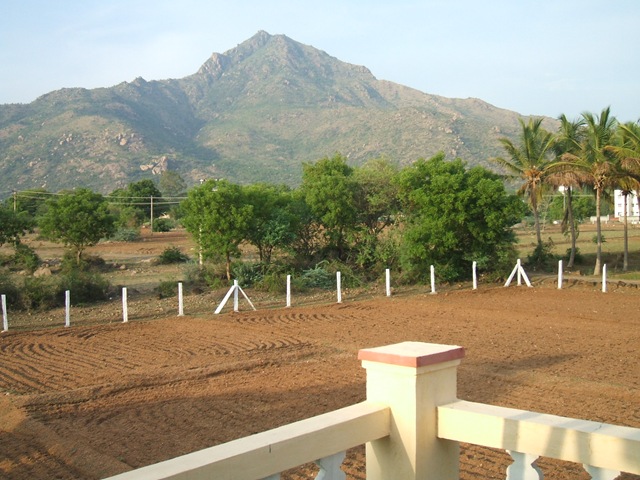
Here is Arunachala from the rooftop of our house (Yenga Veedu in Tamil):

Arunachala from Brindavanam, Tiruvannamalai

Arunachala has been an holy mountain since the dawn of India life. It is written about in the Rig Vedas, purported to be the oldest of the Vedas, which would make it the oldest religious book there is.

That is the holy place! Of all Arunachala is most sacred. It is the heart of the world! Know it to be the secret Heart-center of Siva! In that place He always abides as the glorious Aruna Hill!

Skanda Purana

For many centuries there have been many Indian sadhus and sages associated with the “Red Mountain.” The most well known of these today is Sri Ramana Maharshi, who arrived here in 1896 and never left until the death of his body in 1950. Ramana, who had remarkably few claims of personal actions wrote:

Oh Arunachala, I have exposed your secret doings. Do not be angry. Let your grace be on me.

Necklet of Nine Gems

When we first came to Tiruvannamalai, a small city that has grown around a major Siva temple, Arunachaleswara Temple, over the last 2000 years, I would rise before dawn and go up to the rooftop and just sit and meditate with Arunachala until dawn. I would then watch for a while as the city awoke. After just a few days of this I said to Carol, “We could live here.” She did not treat me like was crazy, though she probably thought I was. Now, several years later I have retired and we have uprooted our nice life the the USA, gotten rid of almost everything we owned, and moved to South India to be with Arunachala.

In the last ten years spiritual practice has become the most important thing in our lives, and we want to use this part of our life where practice is the main focus. Now we are here, ‘living in the embrace of Arunachala.” I still rise before sunrise and go up to the roof, now of our home, named “Brindavanam” by the previous resident who put in the wonderful orchard and garden that surrounds this house. Carol and I are up on the roof with Arunachala several times each day. Even when not on the roof, Arunachala is the dominant presence for miles around. It is always present.

Here is a short poem I recently wrote:

Arunachala,

Silent, still, unmoving.

Arunachala,

Ancient One,

In the form of Dakshinamoorthy

Arunachala,

Quiet this mind.

Arunachala,

Fiery one,

Thy fire burns away ignorance.

Arunachala,

I stand in your Silence.

Arunachala,

Infinite light,

Knowledge of Thee is All.

Arunachala, would that I be as Thee,

Silent, still, unmoving.

Harsha's avatar

Quality of Life Trust – India: By Richard Clarke

My wife and I have started working with Quality of Life Trust – India – http://www.qualityoflife.in/.

They are located right next to Tiruvannamalai and working on village issues. India is going through many changes, and the villages are seeing the most change, so we thing this is a good place for our efforts.

There are two projects they are working on. The first is with the elderly in the village. Some have no place to live and are sleeping on the doorsteps of houses, etc. In some cases it is the doorstep of the house they owned. Then their children got them to give the house to them. Then there was a problem like drinking, and the child lost the house, and the parent had no place to live. The Trust is providing meals to these elders, and helping them with medical treatments. They hope to build some kind of housing in the future. My wife has experience working with the elderly and will help this project.

The other project is for composting toilets. In villages many many people do not have toilets. People will go in nearby fields. Sometimes they are bitten by snakes. Always there is the concern for personal privacy, expecially for the women. There are also problems of disease, etc. This project is building a kind of toilet developed else where in India that does not need water or a sewer connection/septic tank. To add to the appeal, and based on what these local vilages said they are also adding a shower room. This trust has gotten funding from another trust, Bless, and has just started a project to build 50 toilets in the village. I am helping them with project management. These toilets seem to meet a real need, and in addition they produce high quality fertilizer that can be used in the fields.

Working with them this week I got a chance to see the excitement that this was creating in the village. As we were at on house, planning for the foundation (and taking down some banana trees) the neighbor got so excited that he had the crew go to his house and see what kind of site that he had to build on.

These are small things that have a real impact on the lives of the villagers. You should see how proud the man was to be involved in this project, and making life better for his family.

Harsha's avatar

Easy And Natural Is The Way: By Dr. Harsh K. Luthar

Dear Friends,

Sahaj in Sanskrit means easy and natural.

There is saying in Hindi, “Sahaj pake so meetha hoy.”

It means that easy and natural cooking of food leads it to taste sweet.

It is something like the English saying that soup that simmers slowly or the cake that is baked slowly tastes best in the end.

These are metaphors for life. When we do something with care and love, the results are better. Sometimes we even say that, “this is a labor of love.” When we love what we do, it does not feel like work.

Everything has its nature. When we are true to our own nature, an easy authenticity takes over. Then we are not concerned about impressing others nor worried about how others are judging us.

Nature is showing us the way. Seasons are coming and going. Flowers bloom and then wither. We are breathing in and breathing out.

Easy and natural is the way. Anything else makes it appear that somewhere other than where you already are, is more attractive.

All of these teachings of self-improvement, yoga, meditation methods, breathing techniques might have some meaning to someone at some point in time. Truly these are concepts only for the mind to struggle with. The whole premise of these teachings is that you are not OK just the way you are. Ultimately, it is the most splendid nonsense.

To be easy and natural is the way.

How does one become easy and natural? How does one follow the natural path?

To be easy and natural is, well, it is to be easy and natural; and it is best because it is easy and natural.

It is so simple is it not?

What is not easy and natural will produce inner and outer conflicts. We already have enough of those. Of course, for some people making more conflicts may be easy and natural. In that case, go for it (and you can’t help it anyway).

Being easy and natural in awareness allows for the recognition of the Self, which by its very nature is easy being, natural, and wholeness of awareness aware of itself as its own bliss. There is no good way to express it.

My teacher Chitrabhanu-ji (who was a monk for 29 years) once told me that as a young monk he was very very strict with himself. “Sometimes, too much judgment and discipline can be a form of violence with oneself”, he told me.

Another time when we were talking about gurus, I mentioned many names to him and asked his views of them.

Chitrabhanu-ji knew most of the gurus personally. These included J. Krishnamurti, Swami Muktananda, Sri Chinmoy, Rajneesh (Osho), Swami Chidananda, Swami Rama, Swami Satchitananda, etc.

Those gurus whom he liked, Chitrabhanu-ji would only say, “He is a good man.”

One day Chitrabhanu-ji said to me, “You should never follow a guru.” I looked at him puzzled (because he was my guru, you see).

He smiled and said in his thick Bombay accent, “What if the guru goes crazy and tells you to do strange and crazy and weird things…” I had a good hearty laugh! He added, “that does happen you know….”.  I laughed even harder.

Well, it does happen you know.

As Sri Ramana never tired of saying,… the only true guru is your Heart, your own Self.

So wise sages tell the advanced aspirants to be perfectly natural. Make the effort, if natural. Follow a teaching if it is easy and makes sense.

If something makes no sense, there is no point in following it. So what if it is considered the supreme teaching and so on by someone well known. For all you know, what the supreme and well known people say could all be manure.

Think about it. What do they really know? How can they really know? What can anyone really and truly know?

So rest, if it feels natural to rest. Watch the spiritual parade pass by and not be moved by any teaching. Or join the parade and sing your song.

Your nature will make you act in a certain way. That is why you can be at perfect ease.

Self-remembrance, Awareness aware of itself, Self-abidance, all of these mean the same.

Easy and natural is simply being aware of one’s innate wakefulness through the winds of emotions, colors of life, and changes in scenery.

To the extent one can grasp it, simply remain aware and if you become conscious of some intangible cloud of unknowing which you cannot go through, become comfortable with it, stay with it, and breathe it in and out.

If you meditate on this and become aware, it will dawn on you with clarity. You will see.

Easy and natural is the way.

Namaste

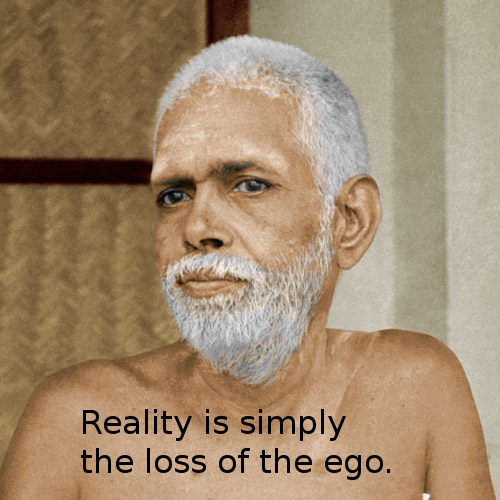
Reality is simply loss of ego - Ramana

Harsha's avatar

A Zen Garden: By Jerry C. Weinstein

Jerry Weinstein, known lovingly to his friends and admirers as Jerrysan Rinpoche, is a retired lawyer. Jerrysan gave up a very lucrative and highly successful law practice many years ago to live the quiet life of a sage and meditate on the mysteries of life. The force of an active kundalini has been with Jerrysan for many years, showing him both the beauty and the agony of being human and aspiring to the divine union.

When Jerrysan speaks to us about his suffering and lays bare his heart, he teaches us about the human condition and our collective suffering and lays bare our own hearts. In revealing himself, he reveals us.

Jerrysan once said something like, “My heart is an ocean, like a love that has no shoreline. Yet this heart must be shattered over and over again as I progress on the path of the unknown. I have been deprived of all comforts of not only outer life but inner life as well — all reliance upon scriptures, teachers and their teachings is gone. All forms of meditation and mystical experience have been given up — in order to fully realize who I am.”

A ZEN GARDEN
By Jerry C. Weinstein

image

I used to go to Asia every year, especially to India, but had never been to Bali. So in August 1992, l scheduled a trip there. It’s such a long flight l decided at the last minute to do a stop-over in Japan for 5 days to break up the trip. Before l left l told my caretaker to get rid of all the weeds in my back yard, which was quite a mess.

Upon arriving in Japan l immediately went to Kyoto, which l knew to be a spiritual center with a lot of zen temples. It was then that l found myself in another world, sensing at once that destiny had guided me there. I’d been doing vipassana meditation pretty intensely for several months and was starting to feel the increased concentration and depth from this practice. In addition, I’ve always had a passionately aesthetic nature. So, l think it was a combination of these things that led to not only the temples, but particularly the zen gardens being probably the most wonderful moment of discovery I’ve ever known. There were many moments of melting in tears of joy, and many others of profound meditative stillness, induced by the sense conveyed of almost perfect harmony with nature.

It was with great reluctance that l left Kyoto for Bali, which, although it has its charms, proved to be an afterthought. Then, after flying home and pulling up in my driveway, l had the sense of being someplace else. My caretaker, instead of being content to get rid of weeds, had also cut down every tree in my backyard, making it unrecognizable.

My upstairs tenant, a staunch environmentalist, was angry at me and ready to move out. The neighbors were furious. l called my caretaker and asked how he’d managed to so misunderstand me do something so unthinkable as this? He had always been a thoughtful and responsible person, and curiously, appeared to have no idea himself.

My first reaction, since l now had a bare yard, was to arrange to have a bunch of trees planted. But somewhere within me the Kyoto experience resonated enough to lead me to postpone doing anything for awhile. The idea of having my own zen garden had an allure — the problem was l was bogged down full time in my law practice and had never even planted a tree or done any gardening in my life. So the notion of my doing anything was totally impractical. My hope was that, hey, maybe something will just evolve or manifest itself out of my meditation practice.

Less than 2 weeks after my return home my kundalini process began, with energy shooting out of my brow chakra and remaining there on a permanent basis (as well as elsewhere). There were 6 months of powerful but mostly pleasant energy sensations — interestingly, every time l looked at a tree my brow chakra would go crazy. Then certain breathing practices led to a long period of continuous headaches and other problems, making any meditation impossible. So much for the idea of a zen garden — that was the least of my concerns. So my yard just deteriorated more and more as first months, then years went by.

My yard became the junkyard of the neighborhood as weeds, beverage cans and dog crap became its main constituents. My neighbors were beyond being upset — l told one of them that someday it was going to be a zen garden, which drew a mixture of disbelief and ridicule.

My kundalini hit bottom in late 95, a time when physically l felt like l was going to die. I separated from my meditation teacher (my guru at the time) and also began winding down my law practice.

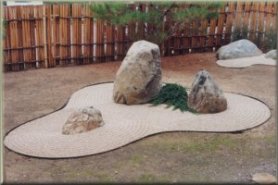
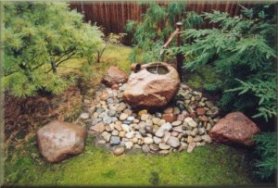
lt was then that l turned all my attention to my yard. l just stood out there, day after day, getting the feel of it and recycling ideas through my system. And so began a process that lasted for over 4 years. First, l did a formal zen sitting garden in the back, with a large area of raked, fine gravel and a meditation platform — enclosed by a fence and bordered by trees, a groove of bamboo, and a small Buddha statue in the rear corner. l often asked myself, why am l doing this? l can’t even meditate and may never be able to again. l just seemed to be driven to do it. What surprised me was that it worked — the effect was magical — friends started coming over to meditate there.

Once the back was finished l figured that was it. But 2 years later l decided to expand the garden from the back to include the side area. Once again l was completely stumped at first, but I eventually came up with a moss garden with a water feature, boulders, Japanese maples and conifers, enclosed by a bamboo fence.

l was amazed at the end result. Then last year l decided to go all the way and do the front yard also. l was just as clueless as before, and again spent day after day in front of my house, as my neighbors nervously looked on. l completely redid my front yard, enclosing it with a bamboo fence on top of a low dry stone wall. l brought in several huge boulders (which required months to select) which l arranged in various combinations surrounded by raked gravel and trees. l also tore up the straight cement walkway from the street and created a curving stone path that leads to the front door and also winds completely throughout the entire garden.

So, if anyone’s still with me here (ha ha), l now have a completely enclosed zen garden which covers my entire property and consists of 3 distinct areas. At the risk of sounding egotistical, l am pretty amazed by the physical transformation that’s occurred. Several landscape architects have wandered in and have been stunned by it. Local garden associations have pestered me to take tours through here, but I’ve resisted that so far — just doesn’t feel right. And my dear neighbors have become humble admirers.

image

Of course, there’s a downside too — l could write a book about all the problems I’ve encountered. Maintaining the zen garden is no small thing. But l think being able to do the garden has been wonderful for my energy process, both in terms of strengthening my connectedness to the earth and in providing an opportunity to be creative in such a fulfilling way.

For all this, l can be thankful that for some mysterious reason my caretaker decided to cut down all my trees. In recent weeks I’ve found that after nearly 7 yrs, my headaches are finally getting better, and the energy is flowing more freely again. Maybe this summer I’ll get to meditate in my garden.

Editor’s note: Jerrysan Rinpoche is a long term member of the HarshaSatsangh community. His article first appeared in the first volume of the old HS Ezine in 2001.