Harsha's avatar

Light From Eternal Lamps: By Swami Sadasivananda

image

“One must make the mind to bear on God”

ENTERING THE PALACE OF LIBERATION…

The One Thing Needful

“The eternal, unbroken, natural state of abiding in the Self is jnana. To abide in the Self you must love the Self. Since God is verily the Self, love of the Self is love of God; and that is bhakti. Jnana and bhakti are thus one and the same…. their purpose is to lead you to dhyana, to meditation, which ends in Self-realization.”  Maharshi’s Gospel I, The Teachings of Sri Ramana Maharshi. p. 17-18.

Sri Ramana Maharshi maintained this ancient form of instruction. The answers he gave to questions represent what has evolved in our modern times as a uniquely universal spiritual teaching that can be taken up by anyone the world over without adopting the limiting constraints of any one religious tradition. It has been said that these teachings were indeed God-given, for they began with the words of grace flowing from Sri Ramakrishna and continued with the blessing of perfection that was embodied as Bhagavan.

As did his predecessor, Bhagavan Sri Ramana Maharshi stressed practice that produces purification (removal of that fog of ignorance, the obstacles and habits of the mercurial mind which diminish our pure vision) as well as the grace of the knowledge of the Self as the eternal companions of those who would be led:

From the unreal to the Real,
From darkness to Light,
From death to Immortality!

NOTES FROM ARUNACHALA…

Devotees present with Bhagavan on this day said that a most important spiritual lesson was transmitted through the actions of Bhagavan as he held Lakshmi’s head during her final moments.

As Bhagavan was stroking Lakshmi’s head, she was gasping for breath in the final moments prior to her passing. Bhagavan, who all knew was capable of removing her pain and causing her spirit to easily exit the body, rather whispered in Lakshmi’s ear to “Tolerate the pain!”.

At a later day, Bhagavan said that, “Suffering is the way to Self-realization.” Our training within meditation prepares us to remain “steady in wisdom” even during the final trial of separation from the body.

image

“Practice is necessary, Grace is there.”
Reprinted from Swami Sadsivananda’s July newsletter.
To subscribe to his newsletter, go to http://www.ramanateaching.org/contact.html
For more information on Swamiji, click here:   About Swami Sadasivananda
Teachings of Bhagavan Sri Ramana Maharshi web site: http://www.ramanateaching.org
Ask your question in relation to Bhagavan’s teachings, meditation and spirituality at:
http://www.ramanateaching.org/faq

Harsha's avatar

Removing the Dross from the Mind in Meditation: By Swami Sadasivananda

Posted by Swami Sadasivananda on his blog and reproduced here with his permission.
For more information on Swamiji, click here:   About Swami Sadasivananda

2

Fiery Gem, shining in all directions,
do Thou burn up my dross, Oh Arunachala!”
Five Hymns to Arunachala

In Talks, Sri Ramana Maharshi is being questioned concerning how to remove the obstacles (dross) within meditation.
D.: Impurities of limitation, ignorance and desire (anava, mayika, and kamya) place obstacles in the way of meditation. How to conquer them?
M.: Not to be swayed by them.
D.: Grace is necessary.
M.: Yes, Grace is both the beginning and the end. Introversion (meditation) is due to Grace: Perseverance is Grace; and Realization is Grace.

divd1

“Significance of Om, unrivalled — unsurpassed!
Who can comprehend Thee, Oh Arunachala?”
Five Hymns to Arunachala


“The purport of prescribing meditation on the pranava (OM) is this. The Pranava is Omkara…the advaita-mantra which is the essence of all mantras such as Panchakshara. In order to get at this true significance, one should meditate on the Pranava. This is meditation which is of the nature of devotion consisting in reflection on the truth of the Self. The fruition of this process is samadhi which yields release moksha  [liberation from all aspects of mental dross, ed. note], which is the state of unsurpassable bliss.” (Collected Works of Ramana Maharshi, 6th edition, Self Enquiry #28 p. 23-24)

divd1
Further in Talks #59, Bhagavan teaches us:
D.: Was Visvamitra a rishi?
M.: When contaminated [dross produced by excessive worldly attachment, ed. addition] he was not a rishi.
D.: Can he become a rishi even afterwards?
M.: Yes. By proper bhakti he could become a good rishi. Repentance and prayer will set him right.
D.: With all your penance for so many years what have you got?
M.: I have got what need be got. I see what need be seen.
D.: Can all see the same?
M.: I see only just what all do. It is immanent in all.
D.: Is this the way for seeing It?
M.: Method may be anything. From whatever directions the pilgrims may foregather, they must enter the Kaaba only by one route (passage) or all gather only to enter the Kaaba.
D.: Please tell me two upadesas on the way to salvation as known by you.
M.: What upadesa do I know? Everything is upadesa. Worship of God is the only upadesa.
india0061

divd1

Harsha's avatar

Love Embracing the Beloved: By Swami Sadasivananda

By Swami Sadasivananda
“In Thy Presence is fullness of joy,
The simplicity that is Christ.”
~
Brother Lawrence

This article contains the Spiritual Maxims of one Nicholas Herman of Lorraine, a lowly born and unlearned man; who, after having been a soldier and a footman, was admitted a lay brother among the Carmelites Deschausses (bare-footed) at Paris in 1666, where he served in the kitchen of the community. He was afterwards known by the name of Brother Lawrence. He died in February 1691, at the advanced age of eighty, after a life the true saintliness of which can be well realized from his words of guidance. ( Almost the entirety of this article is paraphrased or directly quoted from The Practice of the Presence of God, The Complete Book, by Brother Lawrence. )

“Herein you will not find set out a devotion which is merely speculative, or which can only be practiced in a cloister. No, there is an obligation laid on every man to worship God and to love Him, and we cannot carry out this solemn duty as we ought, unless our heart is knit in love to God, and our communion is so close as to constrain us to run to Him at every moment, just like little children, who cannot stand upright without their mother’s arms of love.”

Brother Lawrence, an earnest seeker of God, had a transforming experience at the age of 18. He was a changed person since then and till the last day of his life he was in commune with God to whom he surrendered himself entirely. His experience, and thus his guidance has a special significance as the theme is universal, and so is the endeavor to practice the Presence of God. The practice or sadhana explained herein is referred to thus in the Yoga Sutras of Patanjali; (I-23): “Isvarapranidhanadva”.

Brother Lawrence thus sought “Goodness”, in the highest sense of the word proclaimed by his Lord Jesus: “Only God is Good.” It is necessary to be good, but the good must then progress on to become godlike, to be a deva, a “shining one” filled with the Divine Light. Fixing their mind on God they make themselves living offerings. That is why the Manu Smriti (Laws of Manu) says that the greatest sacrifice is the offering of ourselves (purushamedha). And Patanjali says: “Samadhi is attained by offering our lives to God  (Isvarapranidhana).”

God is the essence and the apex of Consciousness, so Patanjali further says: “In Him is the highest limit of omniscience.” (Yoga Sutras 1:25) In seeking constant abidance with this highest limit of omniscience, Brother Lawrence eventually abandoned all previously set devotions except those prescribed to his station within the Carmelite Society. Often he said: “All that he had heard others say, all that he had found in books, all that he had himself written, seemed savorless, dull and heavy, when compared with what faith had unfolded to him of the unspeakable riches of God and of Jesus Christ. He alone can reveal Himself to us; we toil and exercise our mind in reason and in science, forgetting that therein we can see only a copy, whilst we neglect to gaze on the Incomparable Original. In the depths of our soul, God reveals Himself, could we but realize it, yet we will not look there for Him. We leave Him to spend our time in fooleries, and affect disdain at commune with Him, Who is ever present, Who is our King.”

Not only did Brother Lawrence perceive God as present in his soul by faith, but also in all events of life, whensoever they befell, instantly he could arise and seek the Presence of God. Yet he confessed that it was hard at first, that many a time he had been unmindful of this practice, but that, after humble prayer and confession to God of his failure, he had betaken himself to it again without trouble.

Of his life within God, his failures and attainments, he left a legacy of direction for those who would likewise seek “The Way, the Truth, and the Light (Life) in the Presence of God.” Thus his declaration most central to this undertaking was: “That the Presence of God can be reached rather by the heart and by love than by understanding. In the way of God thoughts count for little, love is everything.” mira30

“We search for stated ways and methods of learning how to love God, and to come to that love we disquiet our minds by I know not how many devices; we give ourselves a world of trouble and pursue a multitude of practices to attain to a sense of the Presence of God. And yet it is so simple. How very much shorter it is and easier to do our common business purely for the love of God, to set His consecrating mark on all we lay our hands to, and thereby to foster the sense of His abiding Presence by communion of our heart with His! There is no need either of art or science; just as we are, we can go to Him, simply and with a single heart.”

He no longer perplexed himself with thoughts of virtue, or of his salvation. He entirely forgot self; he never any longer thought of heaven or hell or his past sins or his deeds of striving for goodness and compassion. In the Presence of God he entered upon a perfect peace; after which he commended himself to God, as he used to say: “For life and for death, for time and for eternity – For we are made for God, and for Him alone.”

His one method of going to God and abiding in His Presence was to do all for the love of Him.

+++++++

When we enter upon spiritual life, we ought to consider thoroughly what we are, probing to the very depth. Though creatures made for God, we are prone to all manner of maladies and subject to countless infirmities, which distress us and impair the soul’s health, rendering us wavering and unstable in our humors and dispositions. We must believe steadfastly, never once doubting, that all such is from God and for our good; that it is God’s will to visit us therein.

“Good when He gives, supremely good;
Nor less when He denies.
Afflictions, from His sovereign hand,
Are blessings in disguise.”

Sri Ramana Maharshi, also declared this truth in conversation with Paramahansa Yogananda, evidenced in Talks #107:

Swami Yogananda: “Why does God permit suffering in the world? Should He not with His omnipotence do away with it at one stroke and ordain the universal realisation of God?”

Maharshi: “Suffering is the way for Realization of God.”

Swami Yogananda: “Should He not ordain differently?”

Maharshi: “It is the way.”

Brother Lawrence entreats us that we: “Must do all things thoughtfully and soberly, without impetuosity or precipitancy, with denotes a mind undisciplined. We must go about our labors quietly, calmly, and lovingly, entreating Him to prosper the works of our hands; thus keeping heart and mind fixed on God.

Sri Ramana Maharshi echoed this same truth when saying in Talks #91:

“The nature of the mind to wander. One must bring one’s thoughts to bear on God. By long practice the mind is controlled and made steady.”

“That useless thoughts spoil all: that the mischief began there; but that we ought to be diligent to reject them as soon as we perceived their impertinence to the matter at hand, or to our salvation; and return to our communion with God. When we are busied, as well as while meditating on spiritual things, even in our time of set devotion, whilst our voice is rising in prayer, we ought to cease for one brief moment, as often as we can, to worship God in the depths of our being, to taste Him though it be in passing, to touch Him though as it were by stealth. Since you cannot but know that God is with you in all you undertake, that He is at the very depth and center of your soul, why should you not thus pause an instant from time to time in your outward business, and even in the act of prayer, to worship Him with your soul, to praise Him, to entreat His aid, to offer Him the service of your heart, and give Him thanks for all His loving-kindness and tender-mercies?”

Brother Lawrence emphasizes that necessity is laid upon us to examine ourselves with diligence and to find out what are the virtues, which we chiefly lack, and which are the hardest for us to acquire. We should seek to learn the failures in virtue that most easily beset us, and the times and occasions, and through which associations we do most often fall. For the world, and association within it, is fraught with danger. So much so that reliance upon God’s grace is paramount.

“A soul is more dependant on grace, the higher the perfection to which it aspires; and the grace of God is the more needful for each moment, as without it the soul can do nothing. The world, the flesh and the association with evil join forces and assault the soul so straitly and so untiringly that, without humble reliance on the ever-present aid of God, they drag the soul down in spite of all resistance. Thus to rely seems hard to nature, but grace makes it become easy, and brings with it joy.”

In this same regard, Sanatana Dharma entreats us to “Seek satsanga…while abandoning dussanga.” (Narada Bhakti Sutras II: 42,43)

A proper understanding of the Sanskrit words satsanga (good association) and dussanga (evil association) is essential. Especially when applying them not only in the context of worldly associations, but as is more precisely scripturally intended, to associations within the mind. Here the spiritual maxim: “As above, so below… As without, so within” is applicable.

Copy (2) of radha-and-gopis-at-night

The gopis in satsangha with Radha, yearning for the Lord

While good association with others enables one to develop purity (sattwa) and is the gateway to Liberation, evil association intensifies distraction and inertia (rajas and tamas), and is the gateway to hellish conditions in life. But even more harmful to the soul is the effect of evil association. There is nothing so disastrous in an aspirant’s life as when evil association nourishes the mental impurities of anger, hate, greed, pride, egoism, selfishness, hypocrisy and passion. Once these mental impurities become strong through external nourishment, they become formidable enemies of the soul in and of themselves. They then no longer need to rely on external sustenance, for through mainly memory, imagination and fantasy they, as Brother Lawrence warns us, “assault the soul untiringly.”

+ + + + + + +

The Spiritual Maxims of Brother Lawrence systematically guides us through the means for attaining unto the Presence of God.

1. The first is a great purity of life; in guarding ourselves with care lest we should do or say or think on anything, which might be displeasing to God.

2. Second is a great faithfulness in the practice of His Presence, and in keeping the soul’s gaze fixed on God in faith, calmly, humbly, lovingly, without allowing an entrance to anxious cares and disquietude.

3. Make it your study, before taking up any task to look to God, be it only for a moment, as also when you are engaged thereon, and lastly when you have performed the same. And forasmuch as without time and patience this practice cannot be attained, be not disheartened at your many falls; truly this habit can only be formed with difficulty, yet when it is so formed, how great will be your joy therein.
4. Let us mark well, however, that this intercourse with God is held in the depth of our being; there it is that the soul speaks to God, heart to heart, and over the soul thus holding converse there steals a great and profound peace. All that passes without concerns the soul no more than a fire of straw, which the more it flares, the sooner burns itself out; and rarely indeed do the cares of the world ever intrude to trouble the peace that is within.

5. It is here therefore, in the heart, that we ought to strive to make a habit of this gaze on God; but that which is needful to bring the heart to this obedience we must do, as has been said, quite simply, without strain or study.

6. When the mind, for lack of discipline when first engaged in this practice, has contracted bad habits of wandering and dissipation, such habits are difficult to overcome, and commonly draw us, even against our will, to things of earth. One remedy for this is to humbly offer prayer to God. A multiplicity of words in prayer is not advised; discursive forms of prayer are often an occasion for wandering.

7. One way to recall easily the mind in time of prayer, and to preserve it more in rest, is not to let it wander too far at other times.

8. This practice of the Presence of God is somewhat hard at the outset, yet, pursued faithfully, it works imperceptibly within the soul most marvelous effects; it draws down God’s grace abundantly, and leads the soul insensibly to the ever-present vision of God, loving and beloved, which is the most spiritual and most real, the most free and most life-giving manner of prayer.

9. Remember that to attain this state, we must control the senses, inasmuch as no soul, which takes delight in earthly things above those in their Creator, can find full joy in the Presence of God; to be with Him we must leave behind the creature.

Thus, Brother Lawrence compassionately entreats us to ‘seek and find’, to ‘knock and the door will be opened unto us’, for his final guidance is:
“All things are possible to him who believes, they are less difficult to him who hopes, they are easier to him who loves, and still more easy to him who practices and perseveres in these three virtues…

Believe me, count as lost each day you have not used in loving God.”
Just prior to the final moment when this lover of the Beloved passed away in the embrace of His Lord, a brother asked him if he was at ease and what his mind was busied with? He said:

“I am doing what I shall do, through all eternity – blessing God, praising God, adoring God, giving him the love of my whole heart. It is our one business, my brethren, to worship Him and love Him, without thought of anything else.”

The brethren then begged him to entreat of God for them to possess the true spirit of prayer. Brother Lawrence, without pain or struggle, without losing in the slightest the use of any of his faculties, in perfect peace and calm replied:

“There was need of labor on his part also
to make himself worthy of such a gift.”

These were his last words.  untitle

You can access Swami Sadasivananda’s website at   http://www.ramanateaching.org/

Harsha's avatar

HarshaSatsangh: The Sri Bhagavan Ramana Maharshi Group on Yahoo

Ramana Maharshi Devotees, please note that Harshasatsangh@yahoogroups.com is the largest Ramana Maharshi internet forum on yahoo with around 1500 members. It has been in existence since January 1999.  Lively discussions on Sri Ramana’s self-inquiry methodology as well as submissions of poetry, essays, and relevant postings by members keep Devotees in touch with Bhagavan Ramana’s teachings on a daily basis. The current moderator of the group is Sri Alan Jacobs, the President of the Ramana Maharshi Foundation UK. Ramana Maharshi Foundation UK website is given below.

http://www.ramana-maharshi.org.uk/
HarshaSatsangh is supported by luthar.com which is an e-magazine containing numerous important articles on Sri Ramana and his teaching of Self-Inquiry.  Luthar.com is one of the top Advaita-Vedanta sites on the Internet.  Sri Alan Jacobs and other authors have written a number of articles on Bhagavan’s teachings on luthar.com.

Articles are added to luthar.com on a monthly or a weekly basis by Bhagavan devotees and other authors writing on spirituality. The luthar.com site is Interfaith in its outlook, and people from many different religions and backgrounds write there.  Usually the themes of the topics center on God, Self-Realization, Enlightenment, and mysticism. Majority of the articles and essays focus on issues relevant to Yoga, Advaita, Inquiry, but there is flexibility to write on other topics as well such as lifestyles related to healthy living and vegetarianism. Articles on Buddhism, Christianity, Hinduism, Jainism, and Sufism can be found there as well. Scholar and sages from all spiritual traditions are welcome to write there.

The snapshot of luthar.com is given below. Please scroll down to read the history and a detailed description of the HarshaSatsangh group.

History of HarshaSatsangh

In order to build a spiritual online community devoted to the ancient traditions of Advaita-Vedanta and Yoga, centered around the Sage of Arunachala, Sri Bhagavan Ramana Maharshi, I founded HarshaSatsangh in January 1999. The group’s two main pillars have been the philosophy of Ahimsa (nonviolence) and Sri Ramana’s teachings of Self-Inquiry and Self-Realization.

I received my first teachings of Ahimsa from Gurudev Sri Chitrabhanu, with whom I studied after I finished college. Chitrabhanu-ji had been a Jain monk for 29 years.  Ahimsa is the cardinal principle in the Jaina philosophy. Chitrabhanu-ji and his wife Pramoda-ji have dedicated their life to spreading the message of Ahimsa, specifically focusing on the welfare of underprivileged people in India as well to stop the inhumane and cruel treatment of animals.

All Self-Realized sages spontaneously develop the feeling of reverence for life and embrace all living being regardless of age, race, ethnicity, gender, as their own.

Sri Ramana used to say that “Ahimsa Param Dharmo”. It means that Nonviolence is the first principle of the spiritual life. Ahimsa is also the first principle in Yogic Psychology of Self-Realization. In the classic Yoga work, Patanjali’s Yoga Sutras, Maharishi Patanjali puts Ahimsa at the top of the list above all other virtues. All other virtues follow from the principle of nonviolence.

Self-Realization and Ahimsa go hand in hand. It is only when the feeling of Ahimsa, reverence for all life, and amity towards all beings permeates one’s being can the deepest possible relaxation and letting go is possible for the mind to surrender to the Heart.

Sri Ramana was known for his immense kindness to people, animals, birds, and even plants growing in his vicinity. It came naturally to him. No one had to teach Sri Ramana to be compassionate to others. Self-Realization changes a person from the center.  For a Self-Realized Being, the same life runs through all living beings. Same Truth. Same Self.

With that as the background and context, HarshsSatsangh came into existence in January of 1999. The following description is taken from the yahoo groups.

Description of HarshaSatsangh

Harshasatsangh@yahoogroups.com is the largest Sri Bhagavan Ramana Maharshi on yahoo groups. It has been in existence since January 1999. It is supported by https://luthar.com/. The current moderator for the group is Sri Alan Jacobs, the President of the Ramana Maharshi Foundation UK.

Ramana Maharshi Devotees world wide are invited to apply for free membership.

http://groups.yahoo.com/group/HarshaSatsangh

General Information on HarshaSatsangh

Ramana Maharshi devotees should know that this is Sri Ramana’s Sangha. It is dedicated To Teachings of Self-Inquiry as given by Sri Ramana Maharshi. This is the Largest Yahoo Group for Sri Ramana Devotees. It is blessed by Sri Bhagavan Ramana, the Sage of Arunachala. The group was Started in January 1999.

Ramana Maharshi is known as the Sage of Arunachala. Sri Ramana spontaneously realized the Self at 16. After that he moved to the holy mountain of Arunachala and remained there for the rest of his life. Sri Ramana taught the method of self-inquiry which through Grace leads to Realization of our Self.

Blessings of Bhagavan Sri Ramana Maharshi do not require that one be from a particular school of yoga, meditation, or a follower of a certain religion, philosophy, or some esoteric school of thought.

The highest teaching of Sri Ramana is that of Self-Inquiry. Self-inquiry can be performed by anyone who has the maturity of mind to ask the ultimate question, “Who Am I?” and focus attention with patience and vigilance on one’s self-nature. If one can understand it and become aware of the awareness within, it is Grace at work.

Aspirants practicing Raj Yoga, Tantra, Kundalini Yoga, Hatha Yoga, Nada, Mantras, and Japa and belonging to any religion all came to see Sri Ramana. Sri Ramana always pointed them to their own Self, their own Heart, from which the consciousness sprouts up and world becomes visible. Finally, it is in the Heart where the Shakti, the mind, and all the paths merge, and the Absolute shines forth in its own nature.

Sri Ramana often quoted the Bhagavad Gita and said that the Lord sits in our Heart as our own Heart; indeed as our very own Self  (“I am in the Heart of all O’ Gudakesa”). So, it is nice to be in the company of the devotees of the Lord of the Heart.

This list is dedicated to the Sage of Arunachala, Sri Ramana Maharshi, and the pure teachings of the Self as taught in Advaita Vedanta. Sri Ramana taught that all spiritual practices (prayers, meditation, pranayama, japa) ripen the mind and make it suitable for self-inquiry. Ultimately, the Grace of Bhagavan leads the mind into the Heart for Self-Realization.

HarshaSatsangh Group Information – March 2009

  • Members: 1206
  • Category: Yoga
  • Founded: Jan 2, 1999
  • Language: English

HarshaSatsangh Group

  • Membership requires approval
  • Messages from new members require approval
  • All members can post messages
  • Email attachments are distributed, not archived
  • Members cannot hide email address
  • Listed in the Yahoo directory
Harsha's avatar

The Bhagavan Sri Ramana Maharshi website

This is the official website of Sri Ramanasramam.  A number of books on the teachings of the sage of Arunachala can be freely downloaded here.

Harsha's avatar

Guard Your Mind: By Dr. Mourad Rashad

Chuang Tzu said: The beggar who guards his mind and fears the waywardness of his thoughts, burns through every bond with the fire of his vigilance. The beggar who guards his mind and fears his own confusion cannot fall. He has found the way to peace”.

In the above saying, a beggar is a man who has not considered himself rich in anything. Therefore he never thinks nor behaves as if he is superior to anyone. A beggar is a man who never claims anything to himself. A beggar is a man who receives everything that life offers and never considers that he is either the owner of what he receives, or that he deserves what he receives. With such a manner, with such a way of seeing and experiencing his earthly and worldly existence he transforms this earthly and worldly existence into Divine Graces. Divine Graces are by definition undeserved favors and unmerited assistance. That is why Jesus Christ said “Blessed are the poor in spirit for theirs is the Kingdom of Heaven” (Mathew 5:3)

The man who lives in such a manner is ego-less or nothing or a big fat zero or is no longer the center of life experiences. This man experiences genuine peace. A genuine peace, because he has experienced the Kingdom of Heaven, here and now on this earth.

This man has come to understand that there is no need of him to be at the center of any experience, he is always in the background, happy by just contemplating and watching. Even when he takes a role -either for himself or for others- he attributes nothing to himself, but only contemplates and watches the Majesty and Magnificence of the overall panorama of the experience. He is always submerged in the Divine Graces of the Kingdom of Heaven. This overall panorama will guide his actions. The Lord will guide his steps.

He has known that it is his own way of thinking -agreed upon by everyone- that convinces him that he is needed to live and function and all the rest of his “worldly” activities in a fixed particular way.

This beggar has discovered the simple truth that says “there is no Need of me, I am out of the way, I am no longer at the center in any way whatsoever and therefore the experience is Majestic, Magnificent and Peaceful”.

He needs nothing and he desires nothing and everything is fulfilled on its own accord. Perfection surrounds him, because he is in the Kingdom of Heaven. Whenever a need is created in the experience either for him or anyone else, he never worries or feels burdened, because he knows it will be fulfilled without anyone’s help -but does not know how. The Lord will fulfill it.

Nevertheless, he is not always in this state. Unless he guards his mind it might stray again in the old habitual way where it convinces him that he needs to do something. That is how he falls back again on his knees and is delivered into confusion once more as it was before, and returns to the center of the experience due to his old worldly mode of thinking.

Abu Bakr Al Shibly -the Sufi master- said:” I guarded my mind for twenty years, then my mind guarded me for another twenty, then a state came where my mind and I were guarded forever”.

Continuously guarding his mind and whenever he comes in contact with a worldly incident that might trigger the old habit, the beggar  immediately reminds himself of the fact that he is not needed and how Majestic, Magnificent and Peaceful the Experience is, for he is in the Kingdom of Heaven, where Perfection reigns.

When this happens, he takes a step or two back and leaves the panorama once more empty of him and become contented by just contemplating again the whole scene. Accordingly, everything takes care of everything, The Lord takes care.  Majesty, Magnificence and Peace are re-established once more. The Divine Graces shower again. That is how by being vigilant he faces life.

Therefore, he starts appreciating and cultivating Faith in the fact of not being needed, together with the concomitant Experience of the Majesty, Magnificence and Peace .Until one day he will cultivate enough Faith in the fact of not being needed for anything, then this Majestic, Magnificent and Peaceful experience will be Permanent as it was before he has created his ego and its world. Even the disappearance of his body by death will not touch this Majestic Experience. Why death will not affect this Experience? Because nothing of him is needed for this Magnificent Experience, not even his physical body. Hence Ramana Maharshi’s  last words: I am not going away. Where could I go? I am here.”

Harsha's avatar

ULLADU NAARPADU (also spelt as Ulladu Narpadu) – Mangalam – 2: By Professor V. Krishnamurthy

ULLADU NAARPADU

(Continued from ULLADU  NAARPADU – Comments by ProfVK)

The famous Vedantic poem in Tamil by Bhagavan Ramana Maharishi
(consisting of two preliminary verses called Mangalam, 40 verses which form the main text , and another 40 verses called the Appendix)

Translation into English by Lakshmana Sharma
Detailed Commentary in Tamil by Lakshmana Sharma,
adapted into English by Profvk

Mangalam – 2

In Talks with Sri Ramana Maharshi, Bhagavan explains the first
managalam to a devotee:

The first stanza is the auspicious beginning. Why should the subject
matter of the piece be brought in here? Can knowledge be other than Being? Being is the core – the Heart. How then is the Supreme Being to be contemplated and glorified? Only to remain as the Pure Self is the
auspicious beginning. This speaks of attributeless Brahman according to the jnana marga (method of knowledge).

Introduction to Mangalam – 2:

By the first verse Mangalam – 1, the nirguNa-svarUpa (nirguna =attributeless) of brahman was indicated. That itself will show up as saguNa (= with attributes) for the devotees. In the situation where there is no mind brahman is nirguNa. When the mind is there the same brahman is saguNa. Then that itself becomes God Almighty. Those who show Bhakti or Love towards Him, finally deserve His Grace when they have offered their Self to Him, and receive the Self-Realisation Experience already mentioned. This is the truth that is the content of the 2nd verse in Mangalam:

Tamil Text:

MaraNa-bhayam mikku uLa am-makkal aRaN Aha
maraNa-bhavam illaa maheshan sharaName caarvar;
tam caarvoDu taam caarvutraar;
caavu eNNam caarvarO caavaadavar
.

Translation (Lakshmana Sharma):

Men of pure minds who intensely fear death surrender themselves unto the Lord of all, the blissful One, the indwelling Self, who has no death or birth. By that (surrender) their ego, along with their attachments becomes extinguished. How can they, who (thus) have won abode in Immortality, have any thought of death?

Translation (Prof. K. Swaminathan):

When those who are in dread of death seek refuge at the feet of the deathless, birthless Lord Supreme, their ego and attachments die; and they, now deathless, think no more of death.

Word-by-word:

MaraNa bhayam = Fear of Death (maraNam = death)
Mikka uLa = Who have lots of
am makkaL = those people
araN Aha = ‘to get rid of’ : in this case, the contextual meaning would be: ‘in order to get rid of that fear of death (araN = barricade for protection)
maraNa-bhavam illaa = (He) who is deathless, birthless (bhavam = birth)
maheshan = the Great Lord
sharaName caarvar = do surrender only
tam caarvoDu = along with their possessiveness (*mamakaaram*)
tAM = (their) Egoistic self
cAvutraar = dies, vanishes.
cAvu eNNam = thought of death (cAvu = death)
caarvaro = Would they?
caavaadavar = they who are beyond death.

Commentary by Lakshmana Sharma :

Every one has the fear of death some time or other. But that becomes ineffective. A temporary dispassion that follows such fear of death usually vanishes after a further experience of life’s goodies. On the other hand those with a high sense of values do not forget the fear and they look for antidotes for it.

For men steeped in ignorance and worldly mAyA to rise to salvation, the miseries of worldly life themselves are steps. Bhagavan says: “When a person is dreaming during sleep, so long as the dream experiences are pleasurable, he does not wake up. Only miserable events in the dream wake him up. So also, in worldly life, so long as things appear pleasant, the worldly man does not wake up from the mAyic world to realise the Truth. The miseries of samsAra, the fear of death – these kinds of feelings are the ones that direct him to the goal. We know death is sure to come. But so long as it does not confront you, you don’t realise the severity of that fear. Therefore it is the knowledge that comes out of experience that life is full of miseries, that turns your path towards one of nivRtti (cessation of activity)”. Rarely a blessed one in a million turns to jnAna-path the moment he becomes aware even mentally of death. Such are the Buddha and our own Bhagavan Ramana.

When the mind thus turns to nivRtti path, that soul gets into the Grace of deahtless, birthless Lord. That Grace makes him look inward and takes him on to the Supreme. That is when the Ego of ‘I’ gets extinguished along with vAsanas of all kinds of bondage. What remains is the deathless Atman.

What is this Ego? It is the false conviction that the body is the Atman. So long as that remains, the impending death of the body will be considered as one’s own death. This verse shows that when the Ego is extinguished the very concept of death is uprooted.

Here is Bhagavan’s explanation of Mangalam – 2:

The second stanza is in praise of God with attributes. In the first,
to be as one Self is mentioned; in the present one, surrender to the Lord of all. Furthermore the second stanza indicates (1) the fit reader (2) the subject matter (3) the relationship and (4) the fruit. The fit reader is the one who is competent for it. Competence consists in non-attachment to the world and desire to be liberated. All know that they must die some time or other; but they do not think deeply of the matter. All have a fear of death: such fear is momentary. Why fear death? Because of the ‘I-am the-body’ idea. All are fully aware of the death of the body and its cremation. That the body is lost in death is well-known. Owing to the I-am-the-body notion, death is feared as being the loss of Oneself. Birth and death pertain to the body only; but they are superimposed on the Self, giving rise to the delusion that birth and death relate to the Self. In the effort to overcome birth and death man looks up to the Supreme Being to save him. Thus are born faith and devotion to the Lord. How to worship Him?

The creature is powerless and the Creator is All-powerful. How to approach Him? To entrust oneself to His careis the only thing left for him; total surrender is the only way. Therefore he surrenders himself to God. Surrender consists in giving up oneself and one’s possessions to the Lord of Mercy. Then what is left over for the man? Nothing – neither himself nor his possessions. The body liable to be born and to die having been made over to the Lord, the man need no longer worry about it. Then birth and death cannot strike terror. The cause of fear was the body; it is no longer his; why should he fear now? Or where is the identity of the individual to be frightened? Thus the Self is realised and Bliss results. This is then the subject-matter: freedom from misery and gain of Happiness. This is the highest good to be gained.  Surrender is synonymous with Bliss itself. This is the relationship. Fruit is to reflect on the subject-matter and gain Knowledge which is ever-present, here and now. The stanza ends with “the immortal ones.”

(Talk no. 567)

Continued in ULLADU NAARPADU -Verse No.1

************************************

Harsha's avatar

Wisdom and Action (No. 1): By V. Ganesan

This is the first part of three ‘sharings’ from Ganesan, at his house in Tiruvannamalai.

Today is the Happy Christmas day – 25th December,2008 !

When I opened the computer, the glorious, serene and the saintly picture of JESUS CHRIST blossomed before me, with the following powerful words written beneath Him :

“ TRUST in the Lord, with your Heart; and,
Don’t lean on your own understanding.
In all things acknowledge Him, and
He shall direct your way. ”

—– PROVERBS 3:5. 6

I felt blessed !

The Great Master: JESUS CHRIST thus was “directing” me the way of what with and how I should commence the ‘Morning Sharing’ with fellow-seekers !

In our last session, we quoted FOUR varied sayings of the Great Master : BHAGAVAN RAMANA, on which the mode of sharing would be taking place for a few more sessions. They are :

(1) In 1936, Paul Brunton asked the Maharshi : “Can a man of the world [ viz., one who is involved in worldly activities ] practice this Jnana Marga – Wisdom Path ? “

Sri Bhagavan’s cryptic answer was : “There is no contradiction between Work and Wisdom.”

(2) On another occasion, Sri Bhagavan said : “ The only purpose of life is to realize the SELF. All other activities are waste of time.“

(3) Yet another affirmative statement of Sri Bhagavan is : “ If one identifies oneself with the body, ‘Karma ’ [ destiny ] is inevitable
and unavoidable [ which means, one is ever bound, one is ever in bondage ]. If one’s attention is turned inwards, one is always free. One is ever a Free Man.”

(4) When asked whether his teachings could be put in one word,

Sri Bhagavan answered : “ATTENTION” [ “Unar]

* * * * * * * * * * * *

For clarity in spiritual striving, Sages and Saints of yore had conveniently classified the approach to spiritual attainment into four branches : ‘Jnana’ , ‘Bhakti’, ‘Yoga’ and ‘Karma . The “Bhagavad Gitadeals elaborately on all the four methods. Sri Bhagavan also refers to these four paths in his original composition : “Upadesa Sara . However, Sri Bhagavan’s ‘Direct Teaching ’ is “ To turn the outgoing mind inwards and merge it in the Inner Reality .” Any theory which gave emphasis on the ‘mind’ to move out or go outwards, Sri Bhagavan warned the seeker to be vigilant. He said : “ Constant vigilance is the price a seeker has to pay. ”

In that light, it is interesting to observe that Bhagavan gave greater importance only to TWO of the four methods : ‘JNANA’ and ‘KARMA’ . He further elucidated the reason for doing so. He said that ‘Bhakti’ and ‘Yoga’ are included, imbued into ‘Jnana’ and ‘Karma’.

Attention turned outwards is “KARMA” which is body-based and mind-based [ ‘Destiny’ ] .

Attention turned inwards is “JNANA” which is “Attention paying attention to Attention” [ “Ulladu Unar ” ] .

When one identifies with the body, one is bound by rules, regulations, do’s and don’t’s – that is ‘Karma’ . They are unavoidable if one is the body only. Sri Bhagavan raises the question : “Are you only the body ?”

Body is perceptible in the waking; and, vaguely and differently in the dreaming; and, totally absent in the deep sleep state. But, the inward awareness of “ I AM ” is continuous and uninterrupted.

Body is there, temporarily. Awareness is ever there !

Am I the body only ? The mind only ? Or, am I the awareness ? WHO AM I ? Vichara [ Enquiry ] results. Vichara takes one to the inner depths of Truth – to the threshold of TRUTH itself. All other methods are mind based. Vichara transcends mind. When Paul Brunton reported thus to Sri Bhagavan : “ I have been acquainting myself with the various teachings in India before coming to you.

Every one of them preaches the same truth. You also say the same. So, how is your teaching different from the others ?” Sri Bhagavan replied : “All other teachings are based on the ‘mind’ . Mine does not. It transcends the mind.”

Every spiritual practice is based on body & mind and thus only secondary — including meditation. Vichara alone transcends all borders of conditionings.

Listen to Bhagavan Ramana :

“ Devotee: Will Vichara alone do even in the absence of meditation ?

Sri Bhagavan : Vichara is the practice and the Goal also. “ I AM “ is the Goal and the final Reality. To hold to It with effort is ‘Vichara’ [practice] . When spontaneous and natural It is Realization [Goal] . “

— “TALKS” , No.390

The two paths that Sri Bhagavan emphasized are JNANA and KARMA. He classified them in unmistakable terms as well, which can be grasped from the following dialogue with a devotee :

“ Devotee : What is Aham Sphurana (shining) ?

Sri Bhagavan : Aham, Aham = “I AM” , “I AM” is the SELF. Aham Idam = ‘I am this’ or ‘I am that’ is the ego. Shining [ ‘I AM’ ] is there always. The ego [ body-mind ] is transitory. When the “I AM” is kept up as “I AM” alone it is SELF.

When it flies out at a tangent and says ‘this’ or ‘that’, it is the ego. “

— “TALKS” , No.363

* * * * * * * * * * * * * * * *

Now, let us go back to the last session, in a brief way :

In verses 26 & 27 of the Supplement to the Forty Verses [ Ulladu Narpadu ] Bhagavan translated the instruction given to Sri Rama by his preceptor, Sage Vasishta. The theme is the right relations between awareness and heroic action. In 1944 when the proofs of the third edition of Ulladu Narpadu was being corrected in Bhagavan’s presence, some of the English Professors who had accompanied Prof.K. Swaminathan, found fault with the introductory note by the author, Lakshmana Sarma [ “Who” ] :

“To the question how the sadhaka [aspirant] is to behave in the world till he succeeds in attaining Wisdom, the answer is given in the two following verses, taken from the Yoga Vasishta. “

* * * * * * * * * * * * * *

Verse 26 : Supplement to the Forty Verses on Reality :

“ Having understood, i.e., by consciously experiencing the various states – like, the waking, dreaming and the deep sleep – and yet always holding firmly at Heart to the Supreme State of Inner Silence, play your part, O Hero, ever in the world. Having thus realized the Inner Silence of the Heart as the underlying Truth behind all forms of appearances, never swerve from it. Thus, play your allotted part in the world, O Hero, acting as though attached to them all ! “

Verse 27 :

“ Outwardly pretending to have enthusiasm and delight, excitement and aversion, initiative, effort and perseverance, yet without any inner attachment at all, play, O Hero, in the world. Thus, releasing oneself from all forms of bondage [attachment ] and having equanimity of mind, act outwardly, in all situations, in accordance with the part one is endowed with, play your part as ordained, O Hero, in the world. “

* * * * * * * * * * * * * *

Now, the Professors pointed out to Sri Bhagavan the obvious absurdity of Sarma’s suggestion that Sri Rama – Incarnation of Lord Vishnu – a Self-Realized great soul — needed this teaching.

“Who has these doubts ?” enquired Sri Bhagavan. “Prof. K. Swaminathan !” said some one. The cool bright beam of the Maharshi’s glance of grace pierced through the entire being of Prof. K. Swaminathan. Sri Bhagavan said smiling : “ Look ! It is for you” [ Paar, Unakkuttaan ! ]

The “you” refers not only to Prof.Swaminathan, but so vibrantly to every one of us ! Remember, some time back, we shared how one of the Saints that I had met, had asked me to read “The Bhagavad Gita ” and actively guided me by saying : “To truly understand the import of this great spiritual masterpiece, one should read it assuming oneself to be Lord Krishna and never by identifying oneself with Arjuna !”

Likewise, one should read these two verses from the standpoint of Jnana [ Wisdom ] and never from the viewpoint of Karma. Notice how the verse begins : “ Having understood……and always holding constantly, firmly in the Heart to the Supreme State of Inner Silence, the “I AM ” ” . As a trapeze act in a circus, one is advised to keep a perfect balance between the outward and inward in one’s activities — a coherent unison — which can successfully be effected by one turning within and not having attachments to actions done.

How to do it ? Allow things to happen as it is. Do not “react” , just “act”. The Higher Power will make things happen “through” you and not “by” you. Give up the attitude of “by me”, at all times and under all circumstances ! The Vedas declare : “ Be a channel for the ‘White Light’ [ Higher Power ] to pass through.”

Look at the lives of Great Masters like the Buddha, Jesus Christ and Ramana Maharshi. How did they live ? Were they lazy ? Were they not more active than any one of us ? Was there not perfect correlation between what they taught and how they lived that very teaching themselves ? On the very first day of his arrival at Arunachala, the sixteen year old youth Ramana, declared : “THY WILL BE DONE”. Never after that there was there any ‘action’ done by himself ! “The same Higher Power which brought me from Madurai to here, has brought me from Skandashram to Sri Ramanasramam,” was Sri Bhagavan’s reply to a query: “Is it not ‘you’ who decided to climb down from Skandashram to here in 1922 ?”

In our own lifetime, we saw how Yogi Ramsuratkumar lived; very actively, yet, totally resigned to the Higher Power, which he chose to address as “Father” . Quite often he used to repeat : “This beggar died at the holy feet of his Guru in 1952.” “Yogi Ramsuratkumar is not this beggar’s name – it is Father’s Holy Name. Chant three times : ‘Yogi Ramsuratkumar’ ; my Father will rush to you and help you.” When Yogiji performed remarkable ‘miracles’

for me, as he had done to his innumerable devotees, and I attributed them to him, his invariable response, every time, was : “This dirty beggar knows nothing, does nothing Ganesha. It is Father ! Out of His abundant Grace and Compassion, He responds forthwith whenever His holy name is thus called.” After a few moments of silence, he would add : “Father alone exists here, there and everywhere. Nothing else. Nobody else. It is Father, Father,

Father alone ! ” “ ‘Yogi Ramsuratkumar’ is not this beggar’s name, Ganesha ! It is Father’s Sacred Name ! You know there is the “1008 Names of Lord Vishnu” which all Hindus chant – like that, this Name is also only Father’s Name !”

Plunge within and recognize the Higher Power guiding you and operating ‘through’ you. Giving up the falsehood of “by me” and holding firmly to the truth of Higher Power working “through me”, is to be “newly reborn”. The purport and significance of our celebrating the birthdays of Sages and Saints – like, our celebrating today the Birthday of the Great Master JESUS CHRIST, as “Christmas” – is to remind to ourselves that one has to be reborn to the truth : “God’s living in me and is operating through me” and to dying to the falsehood : “actions are done by a ‘me’ .” Jesus Christ said : “By dying one lives” . Die to the past and the future and live in the NOW !

Be reborn anew by dying to the age-old attachments to Karma [destiny]. Sri Bhagavan said : “ If you say that there is Karma [ prarabdha karma ] , there is Karma. If you say that there is no Prarabdha Karma, take it for certain, there is no Prarabdha Karma. ”

One is ever the SELF ; never either the body nor the mind ! Be a “Hero ” by diving within and being the SELF !

************************************************

Related posts:

Satsang with Ganesan
Self nature, Faith and Attention

V. Ganesan Bio

ganesan-1

Born in 1936, up to the age of 14 years old, Ganesan grew up in the presence and proximity of Bhagavan Sri Ramana Maharshi. His sacred memory of the Great Master is rich in its content; and, even at that tender age he could see Sri Ramana as the greatest compassionate human being.

On April 14, 1950 – the day the Great Master chose to leave the body – the adolescent Ganesan stood near the entrance to the room where Sri Ramana was lying and was fortunate to witness the brilliant flash of Light that later moved towards the top of the Holy Hill – Arunachala.

Ganesan obtained a Master’s Degree in Philosophy; and, then came to stay permanently at “Sri Ramanasramam, Tiruvannamalai” – the sacred abode of Sri Ramana Maharshi – taking care of the Old Devotees of Sri Ramana. He did it as his sole sadhana (spiritual practice). In that way, he collected the reminiscences of Sri Maharshi from those Old Devotees which have never before been recorded.

His close contacts with sages and saints, including Swami Ramdas, Mother Krishnabai, J. Krishnamurti, Nisargadatta Maharaj and Yogi Ramsuratkumar, he says, have deepened and widened his understanding of the ‘Direct Teaching’ of the Maharshi. However, he feels himself to be an insignificant ‘dust’ at the Holy Feet of Bhagavan Ramana.

He has traveled widely and spread the ‘Direct Teaching’ of Sri Ramana Maharshi, in its pristine purity, wherever he was invited to give talks.

He has authored a few books on the life and teaching of Bhagavan Ramana. Among others, “Purushothama Ramana”, “Be the Self”, “Moments Remembered”, “Direct Teaching of Bhagavan Ramana” and “Practising Self-Enquiry” , are very popular.

At the veranda of his cottage – “Ananda Ramana” – he meets earnest seekers, every Monday and Thursday, between 9.30 and 11 a.m., sharing with them the spiritual treasure entrusted with him by all these holy and sacred souls.

Harsha's avatar

ULLADU NAARPADU (also spelt as Ulladu Narpadu): Comments By Professor V. Krishnamurthy

ULLADU NAARPADU

The famous Vedantic poem in Tamil by Bhagavan Ramana Maharishi

(consisting of two preliminary verses called Mangalam, 40 verses which form the main text , and another 40 verses called the Appendix)

Translation into English by Lakshmana Sharma

Detailed Commentary in Tamil by Lakshmana Sharma,

adapted into English by Profvk


Mangalam – 1

Text in Tamil:

uLLadu aladu uLLa uNarvu uLado?

uLLa poruL uLLal aRa uLLatte uLLadAl

uLLal enum uLLa poruL uLLal evan?

uLLatte uLLapaDi uLLade uLLal uNar.


Translation (Lakshmana Sharma)


Can there be a sense of existence without something that is? Is Real Consciousness  a thing other than That? Since that (Reality) dwells, thought free, in the Heart, how can It – Itself named the Heart – be meditated on?

And who is there, distinct from It, to meditate on It, the Self whose nature is Reality Consciousness?

Know that to meditate on It is just to be at one with It within the Heart.


Incidentally the Mangalam-1 Verse has been translated by Prof. K. Swaminathan as follows:

“Unless Reality exists, can thought of it arise? Since, devoid of thought, Reality exists within as Heart, how to know the Reality we term the Heart? To know That is merely to be That in the Heart.

The first sentence may also be rendered thus: Can there be Knowledge of Reality other than existing as Reality?”


I am giving the original Tamil for us all to see the majesty of Ramana’s classical Tamil (even if one does not understand Tamil!).


Commentary on the first line


There are two meanings for this line. Both are valid. These are the first two sentences of the translation.


On the first meaning of first line


Can there be a sense of Existence without something that is? Here the conclusion is there exists something that always is. The jIva-Ishvara-jagat (soul-God-universe) which appears as real is not real, but there is a substratum (*adhishTAnam* of Reality underneath. This is the truth declared by the Upanishads, which call this Reality ‘Brahman’. Bhagavan himself explains this as follows:


“Every one sees himself and the universe around him. He thinks both are real. If they are real they should always appear, not off and on. But they appear and also disappear. They appear in the waking and dream state but not in the deep sleep state. In other words they appear only when the mind is there. They do not appear when the mind is not there. Therefore the seer JIva and the seen universe are only thought-forms of the mind and not real. Where these thoughts arise from, where they merge, that is the only shining Reality”. This same content is going to be given by Verse beginning with ‘ulagaRivum onRAy’ (Verse #7) later.


So what appears only off and on is unreal and what appears always uninterruptedly is Real. Recall B.G. *nAsato vidyate bhAvo …*. Which gives the distinction between sat and asat. ‘What does not exist before and after, is only non-existent even in the present but only appears to exist’ says Gaudapada in his Karika. Those who accept this maxim of Reality are advaitins. Others are dvaitins.


The standard example for this unreal appearance of the universe and the Reality of the AdhishTAnam is the snake-rope example. Brahman is the adhishhTAnam (sub-stratum, base) ; jIva-Ishvara-jagat is Aropitam (Superposed entities).


The snake which is imagined hides the rope which exists. So also the imagined jIvaIshvara-jagat hides the existent Brahman. So long as Brahman is seen only as the universe (By the way ‘Universe’ here will include jIva and Ishvara also because if the universe is not there, the JIva and Ishvara also are not there), Brahman will not be seen or known as brahman. When by Atman-Realisation, Wisdom arises, the universe will not be seen as universe but as Brahman, the only Reality. This appearance and disappearance form the characteristic of mAyA. Really mAyA is not real. But that will be known only on Self-Realisation. Before that, that is, so long as the universe is taken to be real, one has to say mAyA exists. This mAyA is also called avidyA or ajnAna.


When the rope appears as snake, the appearance is due to the confusion in the mind of the seer. Now the jIva-Ishvara-jagat appearance is due to what? Is there a consciousness other than Brahman and is it that which shows the universe to us? Is Brahman inert or conscious? Is consciousness Brahman or is consciousness a quality of Brahman? The replies to these are given by the second meaning of the first line of the verse. It is actually the second sentence that appears in the translation.


On the second meaning of first line.


Is Real Consciousness a thing other than That?


What exists – false or real – what sense makes it explicit? This consciousness is not different from what absolutely exists. That itself is a bundle of consciousness – of the form of Knowledge (jnAna-svarUpa). In order for this to express itself there is no cognizing source other than itself. That which exists expresses itself by its own luminiscence of consciousness. It is self-effulgent. This is the substance of the 2nd meaning.


At the time of Ignorance Brahman appears as the universe. At the state 

of jnAna that itself expresses as the sat-cid-Atman (and nothing else). For both expressions it is the knowledge-factor of brahman that is the shining Light.


 [ Footnote: For the universe to appear it is again the Light of Brahman that shines. The Light of Brahman is not totally hidden by the universe. The akhaNDa-brahma-chaitanyam itself sparks as the speck of ego and that shows up the universe] .


There is one more implication in this sentence. Since we said there is no other consciousness distinct from Brahman, the universe that appears to be different must be only a false sensation. And he who sees this universe as a real show, is also having only a false sensation. Bhagavan says the seer or jIva who sees this universe is also part and parcel of this show of universe. This same idea comes again in the verse beginning with ‘nAmulagam’ (Verse #1).


In the Appendix (anubandham) to this text Bhagavan calls this ‘false soul’ or ‘false jIva’. Vedanta books call this ‘cidAbhAsa’ (also false consciousness). Ignorant people think of this jIva as AtmA; they call this jIvAtmA and call God as paramAtmA, as if there are two AtmAs. This text-line tells us that other than this ever-existent Brahman there is no one to be called jIva. Therefore we, that is, the AtmA is Brahman and not something else. This is the brahmAtmaikya conclusion of all Upanishads. This is also the considered conclusion of Adi Shankara. This is the Absolute pAramArthika truth that will be clear by the experience of jnAna. We think in our Ignorance, that the false jIva is AtmA and other things are different from it.


All this means: Brahman is what exists. It is the only Reality. It is also the Consciousness that expresses itself. Therefore Brahman is AtmA. There is nothing different from it either sentient or not. It has no differences like the seer and the seen. This is the conclusion of advaita.


Note that this text-line does not tell you that brahman HAS consciousness. Brahman IS consciousness – that is the teaching. If something has consciousness it means it has consciousness as a quality or qualification. In that case it will be callled buddhi. Actually this is not different from the mind. For mind, to be conscious is not its nature. It is its quality or qualification. Therefore consciousness of the mind is not permanent or stable. In sleep the mind’s consciousness vanishes. The consciousness that is the nature of brahman is not of this kind. It is eternal and unchanging. It is unaffected by time and space. Even when all the universe disappears, even in that primordial state, it exists.


That Brahman is jnAna-svarUpa is to be known by the teaching that we receive. But it can also be inferred by logic. Such a logic appears in the first meaning of this text line. We saw therein that it is Brahman that is the origin as well as destination of all thoughts of the mind. So Brahman is the source of this sentient mind; so this brahman has either sentience or is itself sentience. If it HAS sentience it is like the mind and so not a reality. Thus it is neither insentient nor an entity which has sentience. Then what is it? It IS sentience, consciousness (chit or chaitanyam). This is the conclusion of all Vedanta. Therefore it is called sat-chit.


Alternatively we can also argue as follows:


It is not correct to say that Brahman HAS sentience. Therefore it has to be either insentient or Caitanyam (Sentience, Consciousness) itself. If you accept it is insentient then it means it is not self-effulgent; for all insentient things show up only by an external intelligence. Then the question arises: how is brahman effulgent, by what intelligence? The opponent would say it is effulgent by an intelligence outside of it. Now the question is: That caitanyam – is it *sat* (existent) or *asat* (non-existent)? Certainly not non-existent; for a non-existent thing never lights up anything. If you say it is *sat* then it becomes *sat* and *cit* . Thus we have accepted that the same entity can be both *sat* and *cit*. In that case, the earlier mentioned brahman which exists, can as well be also *cit*. This is the easy way out. Thus it turns out that the existent Brahman which is the adhishhTAnam for the universe is self-effulgent, in other words, in order to show it there is no other intelligence necessary. On the other hand, if we say that this existent thing is not self-effulgent, then in order to show it there must be another cit (intelligence). That also cannot be said to be self-effulgent, by the above logic. Thus another intelligence has to be postulated. So we have to go on postulating non-self-effulgent intelligences, — a series of them. This is then an infinite regress (anavasthA-doshha). Thus the conclusion is the Brahman which is the Reality is self-effulgent.


Thus it is clear that Brahman is by nature Existence as well as Intelligence. That is why it is called *sat-cit*. But this does not exhaust the svarUpa of Brahman. Its svarUpa can be understood only by experience not by any other means.


So the mind which appears to have sentience is really not so. It is also insentient (jaDa) like the universe.


In fact this Brahman is our AtmA. But then why does it not show up like that for us? Why are we thinking that we are finite beings who suffer all the unhappiness and revolve in this samsAra? The answer comes in the next portion of the Mangalam first verse.

The next sentence in the Mangalam – 1 Verse


uLLa-poruL uLLal-aRa uLLatte uLLadAl

uLLamenum uLLa-poruL uLLal evan?


Translation

Since that (Reality) dwells, thought- free, in the Heart, how can It – Itself named the Heart – be meditated on? And who is there, distinct from It, to meditate on It, the Self whose nature is Reality Consciousness?


[Note by VK: Bhagavan Ramana’s masterly handling of classical poetic Tamil can be appreciated even by non-Tamil people, when I tell you that he uses the words

uLLam = mind;

uLLadu = that which exists; (uL = interior, content);

uLLal = thinking, thought, meditation (comes from the verb form)

uLLam = heart (Bhagavan Ramana’s usage, when the context permits),

in all possible combinations so that the verse manifests as a lilting poetry!]


Commentary


Here the Tamil word ‘evan’ must be taken in two meanings, namely, ‘who?’ and ‘how?’, according to Bhagavan’s own words. [That is why, in Lakshmana Sharma’s translation above, there are two sentences in English for this one sentence of Tamil].


In sum, this sentence says: The svarUpa of brahman is without mind [Note: thought-free = uLLal-aRa] and full of peace; it is in the heart (uLLam). This Reality (the existing thing = *uLLa-poruL*) will show up only in the heart, that is devoid of the mind (uLLal-aRa = mind-without). When the mind is active and poised outside It will not show up ‘as is’ (=*uLLapaDi*). What does it mean to say it will not show up as is. It means it will show up as jIva-Ishvara-jagat. By this very reason Brahman cannot be thought of (=*uLLal*) by the mind.


Why cannot Brahman be thought of by the mind? There are several reasons for this. One of them will be understood when we come to the verse *madikkoLi tandu* (Verse #22). But here there are two reasons given. 1. Mind by nature imagines differences in Brahman of pure non-duality, and treats them as real; 2. There is no intelligence, sentience (*cit*) other than Brahman to meditate on it or think of it.


We shall consider the first reason. First mind imagines a duality of inside and outside (the mind) and thinks that there are universes, other jIvas, God – all of these are outside. This is mind’s nature. We have already seen that all this imagined world etc. have an adhishhTAna (substratum) reality of Brahman and they are all Aropitam (superposed) on that Brahman. By the logic that the superposed thing hides the show-up of the existence of the substratum, the superposed universe hides the existence of the substratum of Brahman. So long as mind is focussed outside (=*bahir-mukham*) brahman, instead of showing up as is, shows up as jIva-Ishvara-jagat. Once the mind is focussed inside (*antar-mukham*) it joins up with its original location, the heart, and there mind loses its ‘mind’-nature and ‘vanishes’. So the three kinds of shows, namely jIva, Ishvara and jagat also do not show up and Brahman shows up as the AtmA, without any obstacle. Of course mind does not see it, nor does it know!


Here we have talked as if there is something called heart or *uLLam* which is the ‘location’ for Brahman but in reality it is not different from brahman; so neither it is the location nor does brahman is ‘located’ in a place. The seeker who is after Self-Realisation needs to change from his look-outside to a look-inside and for this purpose the heart was spoken of as a sAdhana (means) and there is nothing more meant. The heart (spiritual interior) itself is Brahman. Look at the 2nd line in the above text: *uLLamenum uLLa poruL*:

uLLam = heart,

*enum* = named

*uLLa poruL* = that which exists.

This means: Brahman itself is what is called the heart, because uLLa-poruL is brahman only.


Since brahman is in this (inner) heart, it shows up as is when the mind has vanished. When the mind is otherwise engaged outside, It will not show up. We already observed that that is when all the imaginations about the three things happen and they hide brahman. Thus it is clear that those whose minds are turned outside will not realise brahman.


Now we shall go to the second reason: namely, to think of Brahman, there is no other sentient entity (cetana). The jIva that thinks of itself as knowing another entity is a false jIva. When the mind is turned outside, such a false jIva appears to be real. When mind turns inside, that is, merges in the uLLam (heart) , that false jIva vanishes. The false jIva is only an imagination; so there is no one to meditate on Brahman. The conclusion is: brahman is not amenable to the mind’s thinking.


Then how do we ever ‘think’ of or meditate on, the Brahman which is the Atman? This question is answered by the fourth line of Mangalam-1 verse.


Fourth Line of the Verse


uLLatte uLLapaDi uLLade uLLal uNar.


“Know that to meditate on It is just to be at one with It within the Heart.”


*uNar* = know(that)

*uLLal* = meditation

*uLLade* =(is) just only being, abiding in, (Tamil: *iruttal*)

*uLLatte* = in the heart

*uLLapaDi* = as (It) is.


Commentary


This line describes Atma-jnAna-anubhavam (Self-Realisation-Experience). Mind to be seated in the heart, and abiding in brahman that is nothing but that heart, and to lose its mind-status, so that brahman, unmoving and peaceful, is ‘seen/known’ as Atman: this is known as dhyAnam.


But mark it. Though we have said this is dhyAnam it is not the meditation by the mind. Meditation caused by the mind has three facets in it, namely, the meditator, the meditated object and the meditation. But this dhyAnam above is devoid of these three components. Since other than this everything else is not considered to be dhyAnam, this is said to be dhyAnam in the text. Bhagavan Ramana says this is pUjA, this is bhakti, this is darshan, this is Knowledge. All benefits supposed to be accrued by these are only accrued by this; not otherwise. What is called mukti or mokshha is this. This is also known as the Fourth (turIya) state. To get to this state the sAdhanA is described later in the verse beginning with ‘ezhumbum-aganthai’ (Verse #28).


 Continued in ULLADU NAARPADU – Mangalam 2

********************************************************************


Harsha's avatar

Caves of Arunachala

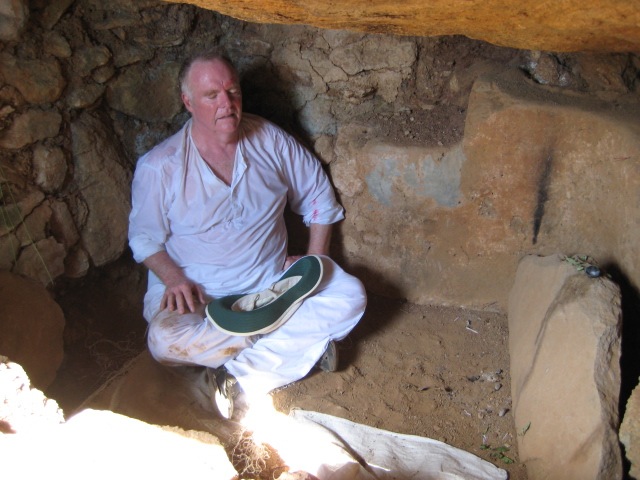
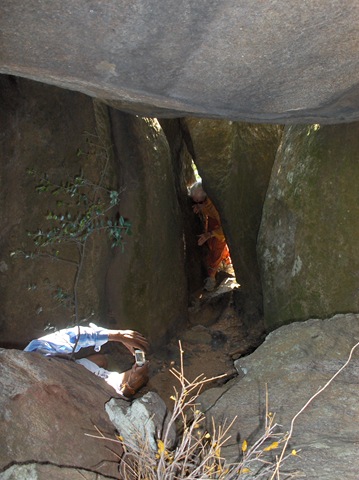
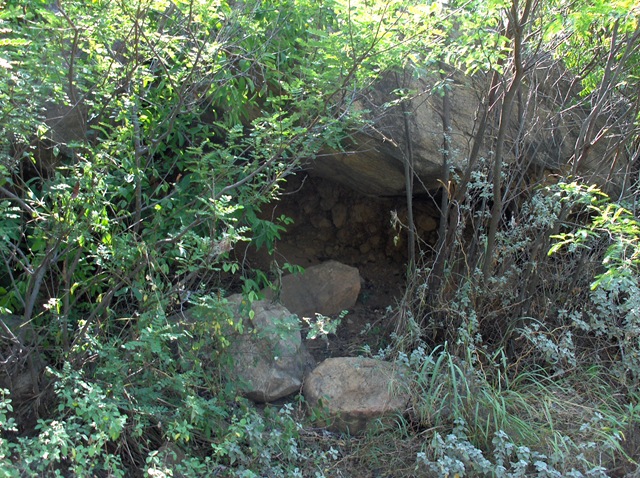
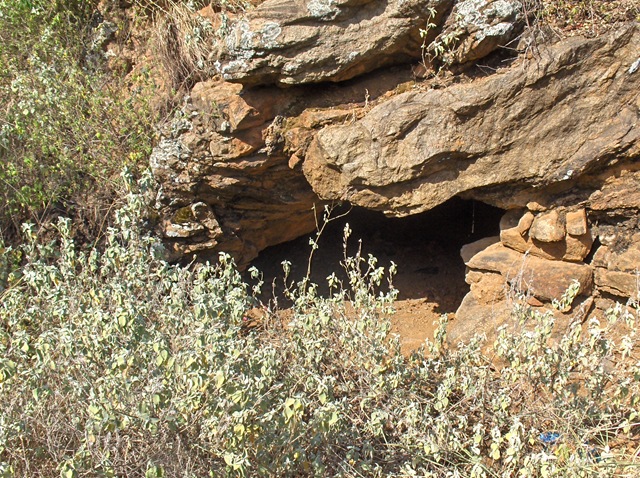
As we have been exploring Arunachala we keep finding ‘caves,’ some already widely known, and some not. A friend suggested that we put this onto the blog. This seems a good idea, and this is the first attempt in so doing. We can find nothing like this available now.

Our exploration of Arunachala is ongoing, and any more caves we find will be added to this. I will often refer to other postings where there may be more photos and information about specific caves.

I put quotes around the first instance of ‘caves’ since what are called caves here are often nothing more than a sheltered space under a big rock.

Is some cases the individual caves already have names in common use. Most do not, and for the purposes of this listing I am calling these by names that I made up. If other caves are known, or names of caves shows are  known, I ask that you let me know, and I will update this listing.

Caves Associated with Sri Ramana Maharshi

Virupaksha Cave

bhagvans_cave

Virupaksha is, for most, deeply associated with Sri Ramana Maharshi. Ramana lived where he lived for 17 years [1899-1916].

Below is a famous photo of the young Ramana at Virupaksha cave.

rest-9_1

The cave is named for a famous saint, Virupaksha, who lived in this cave in the 1500’s, around the same time as Guhai Nama Shivaya lived nearby (see below). At Virupaksha’s demise, called here ‘maha samadhi,’ it is said that his body was transformed into vibhuti (sacred ash). In the interior of this cave there is a mound in the shape of Arunachala. It is said to be made of this vibhuti.

Skandashram

More on Skandashram is in the post Walking up to Skandashram.

HPIM4373

Sri Ramana lived at Skandashram from 1916 to 1922. His mother joined him during this period, and for the first time cooking was done there. This is where the mother had her maha samadhi in 1922. Her room is now a shrine.

HPIM4367

Mango Tree Cave

Sri Ramana lived here during the summer during the Virupaksha days. I do not yet have a photo. This will be added soon.

Guhai Nama Sivaya

This is another cave in which Ramana lived in 1899. It is here that he wrote the notes which later because the pamphlet, Who am I?

A bit more on this cave is in the post New Access to Ramana Sites below Virupaksha.

HPIM4986

A short clip from Arunachala Grace Blog:

Guhai Namasivaya is known to have been born around the year AD 1548 in Karnataka to a pious Saiva couple. His spiritual nature became evident at an early age: he was virtuous in his conduct, adept at his studies and evinced no attachment to worldly matters.

He practised his system of yoga for many years and as a result of the dream guidance of Lord Mallikarjuna, the presiding deity of Sri Sailam, Guhai Namasivaya came to Arunachala and remained as a Guru, giving teachings to mature disciples who approached him.

Seven Springs Caves

The next four caves are shown in the Seven Springs posting. They are all located on the hill above Skandashram, one of the paths that goes to the top of the hill.

Godman’s Cave

This is a cave, said to be greatly improved by the work of David Godman in the 1980s. Maybe ten people can fit into this cave.

HPIM7886

Altar in the cave.

HPIM7891

Looking out the entrance. John, the archivist at Ramanasramam, stands outside  the entrance.

HPIM7897

Seven Springs 1

This is first of three caves found at Seven Springs. There is a stone entrance built, and a good altar in the cave. Maybe four people can fit in here.

Up the hill you can see stonework.

HPIM7933

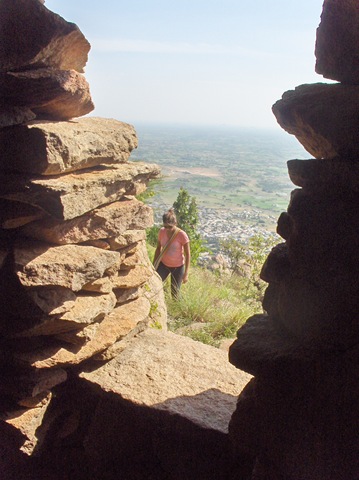
The entrance, from the inside.

HPIM7953

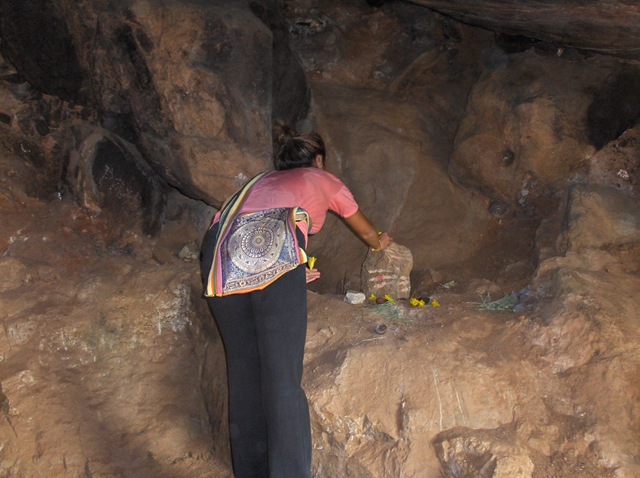
Richard, offering incense to the altar.

HPIM7939

Carol, exiting the cave.

IMG_1702

Seven Springs 2

This is a small cave, behind Seven Springs 1. Maybe two people fit inside. Many stone and concrete improvements have been made.

HPIM7958

Richard, meditating in the cave.

IMG_1714

Ramana’s resting cave

HPIM7988

I call it ‘Ramana’s Resting Cave’ since this is the cave that is documented in writing about Ramana where he was known to rest, while others made the climb up to the top of Arunachala.

It is in the shade all day with a nice breeze through it, and a view out through green trees.

The entrance is a bit tight, though.

HPIM7993

Caves below Virupaksha Cave

These caves are described in the post New Access to Ramana Sites below Virupaksha.

Below Virupaksha 1

This cave is big enough that one or two people can sit in it.

HPIM4991

Below Virupaksha 2

This cave is very small. One person can lie down in it.

HPIM4997

Below Virupaksha 3 – Associated with Ramana?

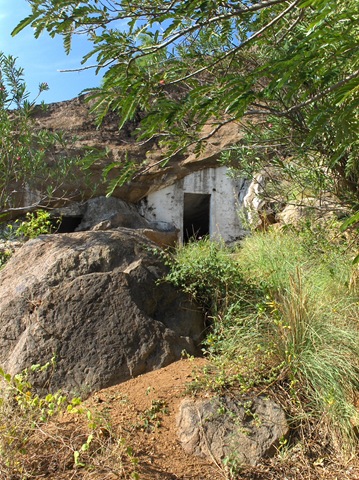
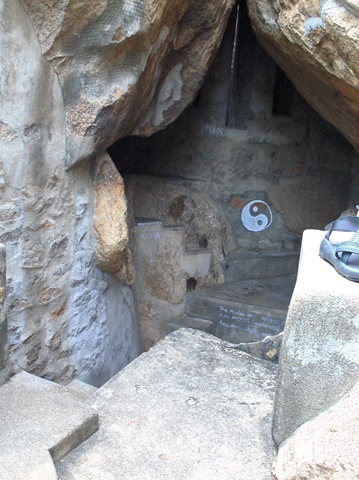
This cave is said by local villagers to be one used by Ramana in the early days. Recently, people have built walls and a door and an altar in it.

HPIM5004

The altar.

HPIM5010

Caves on Papaji’s Knoll

These caves are shown in the posts Papaji’s Cave and Aum Amma’s Cave.

Papaji’s Cave 1

The first ‘cave’ of Papaji’s is in the area where part of his ashes were scattered. This is a nice place to sit and meditate at the altar that has been set up there.

HPIM3940

HPIM3980

Papaji’s Cave 2

The next of the caves named for Papaji, and one that he is said to have lived in, is near the first cave, down the rock and a bit up the path.

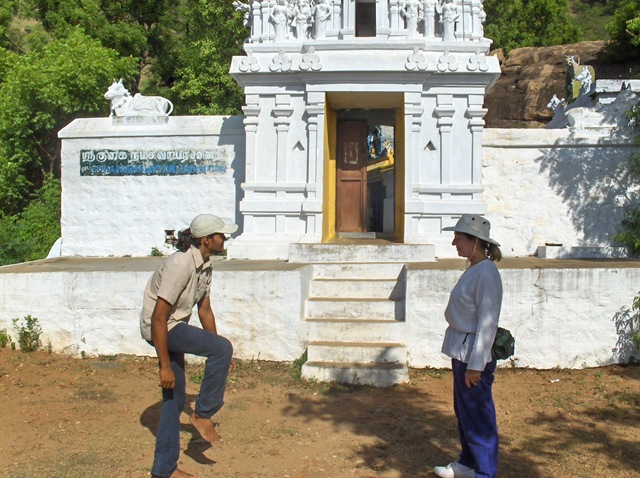
Carol enters the cave from the path.

HPIM5936

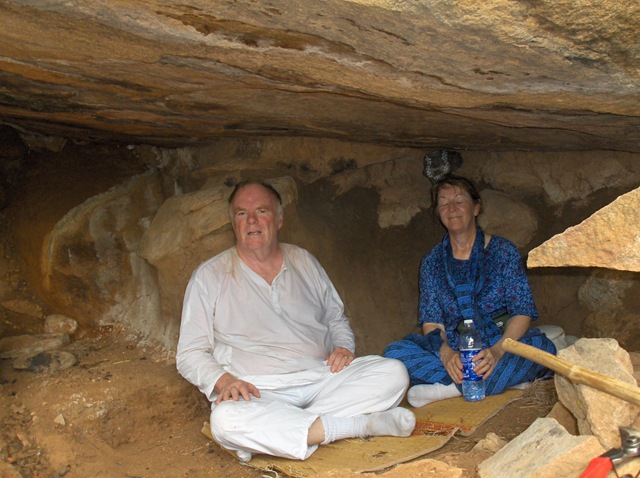
Richard and Carol, meditating in the cave.

HPIM5941

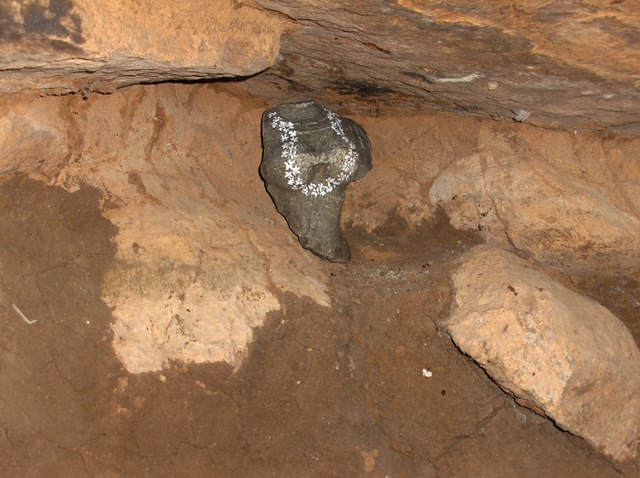
Below is part of a mother goddess statue, placed in this cave.

HPIM5944

Aum Amma’s Cave

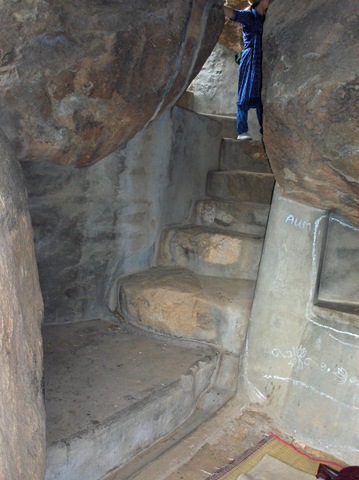
Aum Amma’s cave is the most developed of any cave we have found so far (except for those, like Virupaksha, which have had buildings constructed around them).

HPIM5873

Many bags of cement were carried up the hill to make these cave improvements. Aum Amma lived her for several years until just a few years ago.

HPIM5876

Stairs lead down into a main room.

HPIM5895

There is a good view out the “window” in the main room. It looks like sometimes that people sleep in this cave, though you are not supposed to, and if you stay too long, the Forestry Department people will chase you out.

HPIM5888

Caves in Kattu Siva area

Kattu Siva Cave

This cave is shown in the post Kattu Siva Cave.

There is a nice cleared area around the cave. this is good place to come during the heat of the day. There is plenty of shade.

HPIM8655

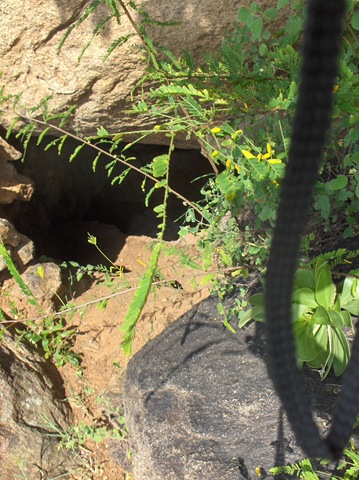
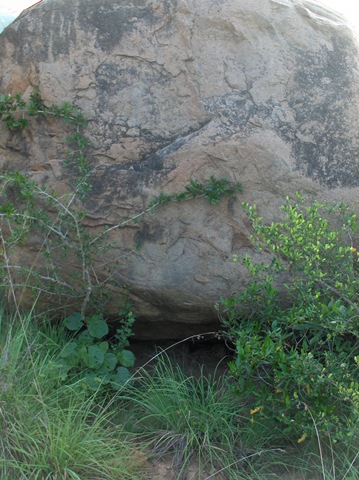
Climbing over the rocks at the end of the clearing, a hole in the rock appears.

HPIM8659

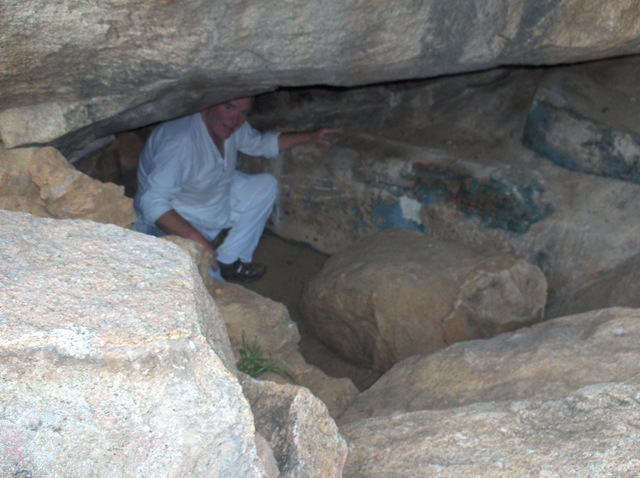
This is Kattu Siva’s cave. A big rock, in front of Richard, has fallen into the cave. Will someone be able to remove it?

HPIM8665

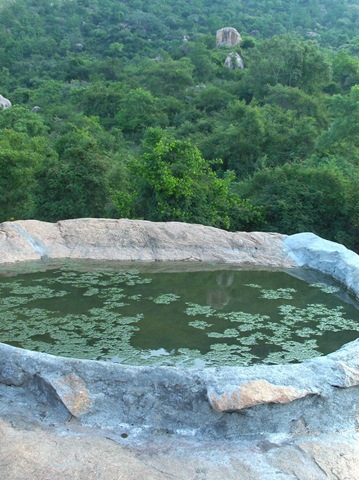
On the top of the rock over the cave, a cement water catching area was made. The photo below looks over this to the Arunachala hillside behind Kattu Siva’s cave.

HPIM8678

Cave Above Kattu Siva Meditation Perch

Related posts are: Kattu Siva Meditation Perch and Kattu Siva path Renewal – Part 1.

This is a small unused cave. Rocks need to be cleared from the floor to make a good sleeping area.

HPIM8743

Mankala Cave

This cave is shown in the post Kattu Siva path Renewal – Part 1. It is under a rock that looks like a natural lingam as you approach this cave.

HPIM8804

Cave next to Inner Path near Kannapar Temple

This cave is shown in the post Inner Path – Around Parvati Hill.

A path leads to it from the Inner Path.

HPIM9659

This cave was improved with a stone and cement wall in front.

HPIM9669

A nice cement floor has been put in the cave.

HPIM9665

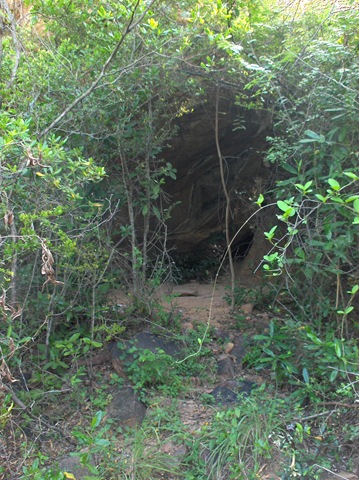
More caves to find, more of Arunachala to explore

I have heard of more caves. I have been told:

  • There are four caves on the hill above the Mountain of Medicine Arunachala reforestation facility.
  • There is another cave high above Papaji’s cave.
  • There are three caves on the north side.
  • There is a cave near Virupaksha occupied by a sadhu that does not like to be bothered.

What else is there? We have to explore to know more. If you know of any more caves that haven’t been listed, please let me know.