Harsha's avatar

HarshaSatsangh: The Sri Bhagavan Ramana Maharshi Group on Yahoo

Ramana Maharshi Devotees, please note that Harshasatsangh@yahoogroups.com is the largest Ramana Maharshi internet forum on yahoo with around 1500 members. It has been in existence since January 1999.  Lively discussions on Sri Ramana’s self-inquiry methodology as well as submissions of poetry, essays, and relevant postings by members keep Devotees in touch with Bhagavan Ramana’s teachings on a daily basis. The current moderator of the group is Sri Alan Jacobs, the President of the Ramana Maharshi Foundation UK. Ramana Maharshi Foundation UK website is given below.

http://www.ramana-maharshi.org.uk/

HarshaSatsangh is supported by luthar.com which is an e-magazine containing numerous important articles on Sri Ramana and his teaching of Self-Inquiry.  Luthar.com is one of the top Advaita-Vedanta sites on the Internet.  Sri Alan Jacobs and other authors have written a number of articles on Bhagavan’s teachings on luthar.com.

Articles are added to luthar.com on a monthly or a weekly basis by Bhagavan devotees and other authors writing on spirituality. The luthar.com site is Interfaith in its outlook, and people from many different religions and backgrounds write there.  Usually the themes of the topics center on God, Self-Realization, Enlightenment, and mysticism. Majority of the articles and essays focus on issues relevant to Yoga, Advaita, Inquiry, but there is flexibility to write on other topics as well such as lifestyles related to healthy living and vegetarianism. Articles on Buddhism, Christianity, Hinduism, Jainism, and Sufism can be found there as well. Scholar and sages from all spiritual traditions are welcome to write there.

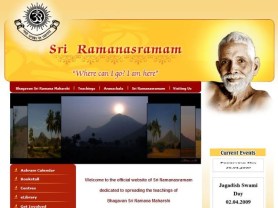
The snapshot of luthar.com is given below. Please scroll down to read the history and a detailed description of the HarshaSatsangh group.

History of HarshaSatsangh

In order to build a spiritual online community devoted to the ancient traditions of Advaita-Vedanta and Yoga, centered around the Sage of Arunachala, Sri Bhagavan Ramana Maharshi, I founded HarshaSatsangh in January 1999. The group’s two main pillars have been the philosophy of Ahimsa (nonviolence) and Sri Ramana’s teachings of Self-Inquiry and Self-Realization.

I received my first teachings of Ahimsa from Gurudev Sri Chitrabhanu, with whom I studied after I finished college. Chitrabhanu-ji had been a Jain monk for 29 years.  Ahimsa is the cardinal principle in the Jaina philosophy. Chitrabhanu-ji and his wife Pramoda-ji have dedicated their life to spreading the message of Ahimsa, specifically focusing on the welfare of underprivileged people in India as well to stop the inhumane and cruel treatment of animals.

All Self-Realized sages spontaneously develop the feeling of reverence for life and embrace all living being regardless of age, race, ethnicity, gender, as their own.

Sri Ramana used to say that “Ahimsa Param Dharmo”. It means that Nonviolence is the first principle of the spiritual life. Ahimsa is also the first principle in Yogic Psychology of Self-Realization. In the classic Yoga work, Patanjali’s Yoga Sutras, Maharishi Patanjali puts Ahimsa at the top of the list above all other virtues. All other virtues follow from the principle of nonviolence.

Self-Realization and Ahimsa go hand in hand. It is only when the feeling of Ahimsa, reverence for all life, and amity towards all beings permeates one’s being can the deepest possible relaxation and letting go is possible for the mind to surrender to the Heart.

Sri Ramana was known for his immense kindness to people, animals, birds, and even plants growing in his vicinity. It came naturally to him. No one had to teach Sri Ramana to be compassionate to others. Self-Realization changes a person from the center.  For a Self-Realized Being, the same life runs through all living beings. Same Truth. Same Self.

With that as the background and context, HarshsSatsangh came into existence in January of 1999. The following description is taken from the yahoo groups.

Description of HarshaSatsangh

Harshasatsangh@yahoogroups.com is the largest Sri Bhagavan Ramana Maharshi on yahoo groups. It has been in existence since January 1999. It is supported by https://luthar.com/. The current moderator for the group is Sri Alan Jacobs, the President of the Ramana Maharshi Foundation UK.

Ramana Maharshi Devotees world wide are invited to apply for free membership.

http://groups.yahoo.com/group/HarshaSatsangh

General Information on HarshaSatsangh

Ramana Maharshi devotees should know that this is Sri Ramana’s Sangha. It is dedicated To Teachings of Self-Inquiry as given by Sri Ramana Maharshi. This is the Largest Yahoo Group for Sri Ramana Devotees. It is blessed by Sri Bhagavan Ramana, the Sage of Arunachala. The group was Started in January 1999.

Ramana Maharshi is known as the Sage of Arunachala. Sri Ramana spontaneously realized the Self at 16. After that he moved to the holy mountain of Arunachala and remained there for the rest of his life. Sri Ramana taught the method of self-inquiry which through Grace leads to Realization of our Self.

Blessings of Bhagavan Sri Ramana Maharshi do not require that one be from a particular school of yoga, meditation, or a follower of a certain religion, philosophy, or some esoteric school of thought.

The highest teaching of Sri Ramana is that of Self-Inquiry. Self-inquiry can be performed by anyone who has the maturity of mind to ask the ultimate question, “Who Am I?” and focus attention with patience and vigilance on one’s self-nature. If one can understand it and become aware of the awareness within, it is Grace at work.

Aspirants practicing Raj Yoga, Tantra, Kundalini Yoga, Hatha Yoga, Nada, Mantras, and Japa and belonging to any religion all came to see Sri Ramana. Sri Ramana always pointed them to their own Self, their own Heart, from which the consciousness sprouts up and world becomes visible. Finally, it is in the Heart where the Shakti, the mind, and all the paths merge, and the Absolute shines forth in its own nature.

Sri Ramana often quoted the Bhagavad Gita and said that the Lord sits in our Heart as our own Heart; indeed as our very own Self  (“I am in the Heart of all O’ Gudakesa”). So, it is nice to be in the company of the devotees of the Lord of the Heart.

This list is dedicated to the Sage of Arunachala, Sri Ramana Maharshi, and the pure teachings of the Self as taught in Advaita Vedanta. Sri Ramana taught that all spiritual practices (prayers, meditation, pranayama, japa) ripen the mind and make it suitable for self-inquiry. Ultimately, the Grace of Bhagavan leads the mind into the Heart for Self-Realization.

HarshaSatsangh Group Information – March 2009

  • Members: 1206
  • Category: Yoga
  • Founded: Jan 2, 1999
  • Language: English

HarshaSatsangh Group

  • Membership requires approval
  • Messages from new members require approval
  • All members can post messages
  • Email attachments are distributed, not archived
  • Members cannot hide email address
  • Listed in the Yahoo directory
Harsha's avatar

The Bhagavan Sri Ramana Maharshi website

This is the official website of Sri Ramanasramam.  A number of books on the teachings of the sage of Arunachala can be freely downloaded here.

Harsha's avatar

What is God’s Name? By Dr. Harsh K. Luthar

Ramana Maharshi: “I am” is the name of God. Of all the definitions of God, none is indeed so well put as the Biblical statement “I am that I am” in Exodus (Chapter 3).

Words are used in various spiritual traditions to describe God or give God a name. Many people are convinced that their religion, their scriptures, and their way of worshipping God is the best way. Sometimes people argue and and fight over God as well. 

Our conception of God is to large extent a function of where we are born and in what religion. Our mental conditioning is often so strong that we are not able to see the diversity of perspectives in various spiritual traditions. Only the mystics in different religions, who have through self-reflections and meditation, gone beyond their mental conditioning offer a unified vision of God. 

Continue reading

Harsha's avatar

Ulladu Naarpadu (Reality in Forty Verses) :Verse #13

ULLADU NAARPADU
(Reality in Forty Verses)

The famous Vedantic poem in Tamil by Bhagavan Ramana Maharishi
(consisting of two preliminary verses called Mangalam,
40 verses which form the main text ,
and another 40 verses called the Appendix)
Detailed Commentary in Tamil by Lakshmana Sharma,
adapted into English by Profvk

(Continued from ULLADU NAARPADU – Verse No.12
See Post#48444 Of Harsha Satsangh

Lakshmana Sharma’s Introduction to Verse No.13

Now Bhagavan takes up the question of ‘What is Real?’ and ‘What is unreal?’. He answers the question about how the unreal appears to shine like real and establishes the advaita conclusions clearly. The Atman is the only Reality; taking that as its support (adhishhTAnam), the superposed universe appears as if it is real. – This is the advaita siddhAnta (Final Conclusive Verdict).

Verse No.13

jnAnam Am tAne mey; nAnA Am jnAnam ajnAnamAM;
poyyAm ajnanamume jnAnamAm tannai anRi inRu
aNikaL tAm palavum poy
meyyAm ponnai anRi uNDO ? puhal.

Translation (Lakshmana Sharma)

This Self, (here) declared to be Consciousness, is alone real, without a second; all knowledge which is manifold is only ignorance; this ignorance – which (being a negation) is non-existent – has no existence apart from the Self who is Consciousness. Say, do the unreal jewels exist apart from the gold which (alone) exists?

Translation (Prof. K. Swaminathan)

The Self that is Awareness, that alone is true. The knowledge which is various is ignorance. And even ignorance, which is false, cannot exist apart from the Self. False are the many jewels, for apart from gold, which alone is true, they cannot exist.

Translation (Osborne)

The Self, which is Knowledge, is the only Reality. Knowledge of multiplicity is false knowledge. This false knowledge, which is really ignorance, cannot exist apart from the Self, which is Knowledge-Reality. The variety of gold ornaments is unreal, since none of them can exist without the gold of which they are all made.

Word by Word

tAne : The Atman (the Self)
jnAnam Am : whose nature is Knowledge
mey: is the true Reality.
jnAnaM : the (worldly) knowledge
nAnA Am: which is multifold
ajnAnamAm: is only Ignorance.
ajnAnamume: And that Ignorance also,
poyyAm : which is non-existent
inRu : cannot be
tannai anRi :distinct from the Self
jnAnamAm: whose Nature is Consciousness.
aNikaDAm palavum : All the multi-formed ornaments
poy: are false
ponnai anRi: Apart from the gold
uNDO ? Is there anything?
puhal: Tell (me).

Commentary in Tamil by Lakshmana Sharma.

In the previous verse it was said “tAn aRivu Ahum” (The Self is Consciousness). This Self which is of the Nature of Consciousness is the only Reality – that was mentioned right in the beginning , namely, the Existent Reality (“uLLa poruL” – cf. Mangalam-1, 2nd line) , because it is One and remains unchanging. This is the meaning of “jnAnam Am tane mey”. In other words, the Self is Existence-Consciousness – sat-chit. therefore it is Brahman.

There is the question whether the multiple appearance of the world –the Individual, Ishvara and the universe – is true or not. The reply is given by the statement “nAnAvAM jnAnam ajnAnamAm”. The knowledge of multiplicity that is referred to here indicates only the manifoldness of the world’s appearance. For, other than knowledge – meaning, other than the thoughts created by the mind – there is no universe.

What is being said here is a definition of the discrimination between what is real and what is unreal. Being One is the characteristic of Reality. Appearing manifold is the characteristic of Unreality.

The purport of the statement that the world is Ignorance is to say that the world arose from Ignorance. And Ignorance is nothing but Ego. That is not something that is material; this is the truth that Bhagavan teaches as the fundamental truth in this work. Ignorance means the absence of Knowledge; and that again tells us that Ignorance is like Darkness. It is not a material substance. Darkness cannot be present in the presence of Light. So also Ignorance cannot persist in the face of the Light of the Self. How can such a destroyable Ignorance be the Existent Reality? This is what is meant by the words “poyyAm ajnAnamume”.

Ignorance is not a material substance – this is the conclusion of Vedanta. If it were so, then the universe and the bondage that arise from it would have an element of truth in them. An immature disciple is told as if there were an Ignorance that caused the bondage. In reality there is no such thing – this is the bottom line teaching. Therefore the question: “Wherefrom did I get this Ignorance?” is an absurd question. The question presumes there is a relationship between the Existence-Knowledge Brahman and the transmigratory cycle of samsAra. There is no such relationship. The Vedanta teaching is: “asango-hyayam purushah”, that is, the Atman that is Brahman is associationless and relationless. This is technically known as “ajAta-siddhAntaM”. It means that from the Absolute point of view there is no universe arising from Ignorance, no JIva, no bondage, no seeker, no mokshha. What is Real is an ever-pure, ever-knowing, ever-free Atman only (*nityashuddha, nityabuddha, nitya-mukta AtmA*). This is the experientially-confirmed Truth of the JnAnis who live in that experience. Bhagavan says that Sri Krishna in the Bhagavad Gita, right in the beginning of the second chapter, declared this truth to Arjuna but the latter was struggling to absorb it and that is why Krishna gave him several other teachings.

Though the relationship does not exist in reality, for the purpose of teaching, an imagined relationship has to be talked about. But this does not in any way affect the Reality that exists.

This universe – that is, the individual, the Ishvara and the universe – which is an expansion of Ignorance, appears as if it is real. The reason for this is that their adhishhTAnam (substratum, base) is that Existent Reality namely, the Atman. They have been superposed on the sat-chit Nature (svarUpa) of the Atman. From this it is clear that the universe has no existential reality of its own. Such an existential reality is there for the Atman; for, it shines in purity without the appearance of the universe, in the turIya that is Knowledge-experience (jnAna-anubhava). Therefore it is said that the Atman is real and the universe is mithyA.

‘The universe is mithyA’ means the differences of names and forms superposed on the substratum of the Atman are mithyA. After throwing off the differences what remains as the adhishhTAnam (support) is the real truth of the universe – this prompts us also to say that the universe is real. Thus the two statements ‘the universe is mithyA’ and ‘the universe is real’ are not contradictory. If one understands it this way without the contradiction, both the statements are true.

The analogy for this comes from the case of gold and golden ornaments. The golden ornaments are at all (three) times only gold; before they are made into ornaments, after they are made and are handled as ornaments, and when they are destroyed back into gold. In all three states of time the truth of the gold is unchanged. Further, gold is one whereas the ornaments are many. Therefore, as per the definitions indicated earlier, gold is more real than the ornaments; ornaments are unreal. In the two statements in the verse: namely, “aNigal tAm palavum poy” and “meyyAm ponnai anRi uNDO”, notice that the two words ‘poy’ (false) and ‘mey’ (true) are used in juxtaposition. When you look at it as gold, the ornaments don’t appear; therefore they are false. When you look at it as ornaments, their false names and forms hide the truth of the gold. The gold that is hidden is the truth. Worldly people say that both are the truth. If that were so, the analogy would not match the situation; so Bhagavan deliberately uses the two words here. The purport of this is: “The ornaments are many and (therefore) false, have as their adhishhTAnam the one, and (therefore) real, gold; so also, the knowledge, which is only Ignorance, that imparts an inherent nature of multiplicity, and (therefore) falsity, to the world, has as its adhishhTAnam the Atman, which is the One Reality-Consciousness and consequently appears as if it is real”.

If Bhagavan had not added the words ‘poy’ (false) and ‘mey’ (true) here, a wrong interpretation may be attributed to Bhagavan that in addition to the ornaments being dense with gold, their differences of forms and names are absolutely true; and this may be followed up by the analogous inference that in the same manner in addition to the world being dense with Brahman their differences of names and forms are also true in the absolute sense. In order to prevent such a wrong interpretation these two words appear here as said.

The same thought appears in Tirumoolar’s Tirumandiram in the verse:

Marattai maRaittadu mAmada yAnai,
Marattil maRaindadu mAmada yAnai;
Parattai maRaittadu pArmudal bhUtam,
Parattil maRaindadu pArmudal bhUtame.

Meaning,

The gigantic elephant hides the wood,
The gigantic elephant is (also) subsumed in the wood.
The earth and the elements hide the Absolute,
The earth and the elements are (also) subsumed in the Absolute.

In more explanatory words, in the wake of Ignorance, the Absolute is hidden by the five elements and appears as those elements and their ramifications. In the wake of Enlightenment, the elements do not appear, only the Absolute shines in all Glory.

Thus, what has been said is nothing but what the analogy of the rope and the superposed snake would have implied.

Thus the appearance of the world is false. This implies that even during the time of its appearance, it is not there. This meaning would become explicit in Verse No.37.

(To be continued in Verse No.14)

Harsha's avatar

Paradox Of The Mind: By Alan Jacobs

“Oh Mind, do not waste your life in roaming outside, pursuing wonders and wallowing in enjoyments. To know the Self through grace and to abide in this way firmly in the Heart is alone worthwhile.” [1]

This relevant quotation leads us to consider that what we term ‘mind’ can be conceived as a great paradox. From one standpoint it is a benevolent friend but from another it is a malicious enemy. Continue reading

Harsha's avatar

ULLADU NAARPADU (Reality in Forty Verses): Verse #4

ULLADU NAARPADU
(Reality in Forty Verses)

The famous Vedantic poem in Tamil by Bhagavan Ramana Maharishi
(consisting of two preliminary verses called Mangalam, 40 verses which form the main text , and another 40 verses called the Appendix)

Translation into English by Lakshmana Sharma
Detailed Commentary in Tamil by Lakshmana Sharma,
adapted into English by Profvk

(Continued from ULLADU NAARPADU – Verse No.3)

Introduction to Verse No.4

Besides the most eligible seekers (uttamAdhikAris), in order that for the other medium level seekers devotion to the Atma-svarUpa and dispassion for the material world may increase, — in other words, for them to get the detachment from the world, born out of conviction that the world is a myth and that it is impractical to expect happiness out of it –Bhagavan explains in the following verses how the world is only a mental construct and the mind also is unreal.

We have already said that the world is nothing but names and forms. This verse says those forms are not real, only mAyA.

Verse #4

uruvam tAn Ayin ulagu param aTru Am
uruvam tAn andREl uvatRin uruvattaik
kaNNuRudal yAvan? evan? kaN alAl kAtchi uNDO?
kaN adu tAN andam ilAk-kaN.

Translation (Lakshmana Sharma)

If the Self have form, then the world and God also would have form. But since the Self is formless, by whom and how are forms to be seen? Can what is seen be of a different nature from the seeing eye? The (real) Eye is just the Real Self, and that Eye is infinite, unconditioned worldless, without a second.

Translation (Prof. K. Swaminathan)

If Self has form, the world and God likewise have form. If Self is without form, by whom and how can form (of world and God) be seen? Without the eye, can there be sight or spectacle? The Self, the real Eye, is infinite.

Translation (Osborne)

If one has form oneself, the world and God also will appear to have form, but if one is formless, who is it that sees those forms, and how? Without the eye can any object be seen? The seeing Self is the Eye, and that Eye is the Eye of Infinity.

Word by word

uruvam : form
tAn : the Atman
Ayin : if it be
(uruvam tAn Ayin: if the Atman has form)
ulagu: the world
param: and the Supreme
atRu Am: will (also) be so.
uruvam : form
tAn : the Atman
andREl: if it be not
(uruvam tAn andRel : if the Atman is formless)
uvatRin : their
uruvattai : forms
kaNNurudal: the Seer
yAvan? : who is it?
evan? : how
kaN alAl : other than the eye (kaN = eye)
kAtchi : sight or spectacle
uNDO? : does there exist?
kaN adu: The (True) Eye
tAn : Atman
andam-ilA: without end; infinite
kaN: eye.

Commentary by Lakshmana Sharma

Whatever the quality of the eye so is that of the sight or spectacle. By this maxim, for those who are under the conviction that this body is the Self – that is, for the ajnAnis – the world will appear as distinct from them and as a conglomeration of forms. Not only that. They are prone to think that the Absolute also has a form and they would want to see it –which is but natural. But that does not anyhow prove that those forms are real. In Self-Realisation there are no forms.

For the words ‘kaN alAl kAtchi uNDO?’ of the text, besides the interpretation mentioned above, there is another. ‘Whatever is the nature of reality of the seer, that which is seen has no other distinct reality.’ Only when The JIva who is the seer appears does the seen world also appear. The substance of this is that in the Absolute state of experience there is only the Atman, no JIva, no world.

An ajnAni is one who lives with the conviction that he is this body. Here the ‘body’ includes both the physical and the subtle. The subtle body is the mind. He who lives with the conviction that he is ‘his’ mind is also an ajnAni. Both the bodies are only forms.

An ajnAni in addition to seeing himself as a form simultaneously sees also other forms; he integrates them all into one and calls it ‘the world’. With his physical eye that is only a part of his body he sees that body as well as all the other forms. That eye itself is a form. Bhagavan has said that of whatever nature is the eye so is what is seen. By that maxim, both the eye and all the spectacles are all forms.

This eye itself shines by another eye known as the mind. That is also a form, but subtle. Therefore whatever is seen by the mind-eye are also only subtle forms.

Mind is not self-effulgent. It shines because of the light of the Atman. This will be clear when we come to #22 (‘madikkoLi tandu’). Therefore it is the Atman that is the real Eye. It is an eye full of Knowledge (jnAnam). It has no form. Since the Atman-eye has no form whatever is ‘seen’ by it also has no form. Only forms create duality and differences. In the complete state of Self-Realisation that is formless there is no duality. The Atman is non-dual. In other words having vanquished the ego and the mind by the sAdhanAs that are to be mentioned hereafter, when we are in the Realised State of oneness with the Atman, the only thing that remains is the formless Atman. That Atman has been described as the Infinite Eye in this verse.

This tantamounts to saying that all the physical as well as subtle forms are only mental constructs, not real.

It is Brahman that is the pure Atman that we imagine as God. Brahman is the Absolute. We call God as the Absolute Person. And we think that this God is distinct from us. It is because of the ‘I am the body’ attitude that we consider Him as distinct and for the same reason we consider Him as having form. This form is a mental construct. Each one of us has our own imagination about Him and accordingly various forms of God are imagined. All of them are mental constructs and so not real. In truth, the Absolute Person is the same as Atman, not distinct. So long as we consider the Atman as having form, we have to consider Him also as having a form — as per the maxim already enunciated. In the state of Self Relisation the imagined form of the Absolute Person becomes unreal along with all the forms of the world and then what remains is only the Atman. That ‘Form’ (SvarUpa) of the Atman is the truth of the Absolute Person that is God. This has been emphatically reiterated by Bhagavan on several occasions.

This also explains why so long as the ‘I am the body’ conviction does not get eradicated, we ajnAni devotees cannot but think of the Absolute Person (God) except through a form. And Bhagavan says that will do only good; for then the devotees get to worship God.

Of course there are those who put forth the argument that in reality the Absolute God is formless and so it is wrong to worship Him with form. Here Bhagavan’s words ‘kaN alAl kAtchi uNDO?’ of the text should be noted. That they are only prattling without having understood the meaning of these words of the text, will be clear from the following conversation which Bhagavan had with a group from another religion, when they accosted him with the argument that when God is formless how anybody can worship Him in a particular imagined form.

Adherent of the Other Religion (AOR): Does God have a form?
Bhagavan (B): Who said He has?
AOR: In that case is it not wrong to worship Him in a form ?
B: Let that be. Do you have a form?
AOR: Certainly. See, here it shows.
B: Is this form which is of six feet, black colour and with a moustache and a beard, is this itself you?
AOR: Yes.
B: Even when you sleep, is this itself you?
AOR: Certainly. As soon as I wake up I notice that I am this only.
B: Even after the death of the body, is this itself you?
AOR. Yes.
B: In that case, when the relatives come and want to remove the body and take it out of the house for burial, will this body proclaim ‘Oh. This house is mine. I will stay here only. You should not take me out for burying me’?

That was the time when the adherent of the other religion realised where his argument was leading him. And so he claimed: “I am not at all this body. I am the life within.” And Bhagavan replied: “You see. So far you were holding on to the tenet that you are the body. This is the basic Ignorance. It is from this Ignorance (ajnAnam) all other ignorances spring forth. So long as this primal Ignorance is not vanquished, the other ignorances will continue to exist. But they are not so harmful. If this primal Ignorance is got rid of, the others will follow suit”.

Further the ‘I-am-the-body’ –minded person is mistaken if he thinks that he is meditating on the Impersonal Godhead. The Truth of God is He is the Atman; so He is not amenable to any meditation or thinking process. When one meditates, he has to imagine a subtle form and that is what he meditates on. Meditation on the Formless is an impossibility. But one should not under-estimate the value of meditation on the Form and should not therefore shirk from it. Some one asked Bhagavan: “Meditation on the Formless is not possible to accomplish. Meditation on the Form is of a lower value. So what should I do?” Bhagavan replied: “Who asked you to compare the two and distinguish them as higher and lower? By doing the meditation on the Form one can realise the Formless”.

The dialogue that Bhagavan had with the adherent of the other religion shows how from the innocuous question: ‘Does God have a form?’, one is led on to the more fundamental question: ‘Does the inquirer have a form?’. In the same manner whatever question arises, one will be led on to the question: ‘What is the truth of oneself?’. In fact it is that question which is at the bottom of all questions. This question is of the nature of Self-Enquiry, of the kind: ‘Who am I?’. That is what makes it possible to know the truth of oneself. He who does not experientially know this truth will not be able to know the truth of anything. Therefore every question that arises has the answer: ‘Find out who is asking this question’. If you pursue this both the questioner and the question will vanish.

To be continued in Verse #5.

Harsha's avatar

Wisdom and Action (No. 2) – by V. Ganesan

“Everything as they are, is perfectly all right” — Bhagavan Ramana.

“Accept things as they are” — Bhagavan Ramana.

“Have faith” — Bhagavan Ramana.

“Surrender the ‘me’ to the ‘I AM’ “ – Bhagavan Ramana.

God and Guru are one and the same. Guru is ‘God’ in human form. Guru knows what is best for you and what is to be given to you, including your emotional fulfillments. He anticipates as how best he could extend his help to you.

Read the following fascinating ‘story’ :–

In the far South India there is an area where the lady-inmates would never be permitted to go out of the house, at all. There, the usual joke was that no lady ever knew the shape of the front door of the house !

A teen-age girl came upon a book on Sri Ramakrishna Paramahamsa and was captivated by his life and teachings. She started reading books by Swami Vivekananda. Appreciating her deep interest in the lives of Saints, his uncle who had been to Arunachala, brought a book on the life and teachings of BHAGAVAN SRI RAMANA MAHARSHI, in Tamil [entitled: “Sri Ramana Vijayam”]. When she received the copy on her hands, she lost her body consciousness – the first time it was happening to her ! She kept the book in her Puja Room and whenever she wanted to open the book and read it, the very touch of it sent her into that state of ‘no body experience’. She understood that something great was contained in that book. At long last, she could succeed in opening the book. Lo ! The picture of the Maharshi in the frontispiece sent quivers of joy and ecstasy ! She then and there decided that Bhagavan Ramana was her Sadguru and that her place of residence was not that home but only at ARUNACHALA, at the Holy Feet of her Sadguru !

Her younger brother fully understood her spiritual aspirations and helped her to “run away” from home, without anyone’s knowledge. One dark night, he took her to the Railway station, bought her ticket to Tiruvannamalai and assured her that everything would be well. He had to stay back at home to tackle the terrible commotion that would be raised.

Safe did she reach Arunachala. But, her mind started haunting her with tremendous guilt of having ‘deserted’ her kith and kin and having run away from home like a ‘thief’ . She was crying all her way from station to the Ashram, uncontrollably. She suffered from great emotional trauma.

When she neared the Old Hall where her Sadguru Ramana was seated, she heard him talking loudly : “ I ran away from home, in the dark night, hiding myself behind trees and buildings. My brother had given me money to pay his school fees which I did not do, but ‘stole’ a portion of it. I was afraid all the way to the Railway Station lest any one should notice me, catch and hand me over to my uncle and brother. Inside the train compartment I hid myself till the train left the station. I was feeling terribly ‘guilty’ that I was deserting my kith and kin and was running away from home ‘like a thief’ ! But, no sooner the train left the station, there was total composure that ‘this was venturing only to fulfill a good cause’…….”

What a relief, what a blessing ! The pious girl’s ‘guilt’ took to flight ! She stepped into the Hall, prostrated to her Sadguru Ramana and when she looked up at Him, He was pouring His Blessings on her through His ‘Glance of Grace’ ! Was not the nod of His head total approval of her act ! To whom else she could totally surrender other than to her God, Guru Ramana ! Till she dropped her body at a ripe old age she lived at Arunachala, having a home in front of the Ashram – all her life, basking herself in His Glorious Presence ! Even after the Brahma Nirvana of Sri Bhagavan, she immersed herself in devotion to the teaching of her Sadguru.

Surrendering one’s “me” is the only ‘loss’ a seeker has to meet with. But, what a great gain it brings about : the Absolute Truth – “ I AM “ ! The Truth that is extolled in all scriptures and by all sages and saints !

Has not Jesus Christ proclaimed : “Only he who gives up his life [ ‘me’ ] will find it [ “I AM” ] ” ? Staying in the state of “I AM” brings about spontaneously the act of giving up the ‘me’. The ‘me’ is a never-existed state and “I AM” is the ever-existing state. Remember, Sri Bhagavan repeatedly said :”Affirm the Truth, the non-truth will drop off of itself” !

In this light, shift your attention from ‘work’ outside, to ‘Wisdom’ inside.

If you pay exclusive attention to ‘work’ , you will miss even tasting the ‘Wisdom’. Jesus Christ said: “Attain first the Kingdom of Heaven and all else shall be added to you”. Arthur Osborne, in one of his brilliant Editorials, wrote: “If one seeks to attain all else, the Kingdom of Heaven is not likely to be added !”

Bhagavan Ramana, on the very first day of his arrival at Arunachala, in 1896, declared before his Father – ARUNACHALA : “Thy Will be done”. The rest of his stay of 54 years, there was no ‘me’ for him to decide over ‘actions’ done, to say either ‘yes’ or ‘no’ . Actions happened in his presence – that’s all ! In a court case, when the Judge who came to the Ashram to examine him and asked him to sign the document, the Maharshi didn’t, as he had no name to sign, nor any form of identification as a ‘me’ to affix a signature as an individual ! All the time immersed, as he ever was in the Perfect State of “I AM”, where was any possibility of a ‘me’ to put out its hood !

One might say, ‘It is all right for the Great Maharshi. But how about me, an ordinary person ?’ For an answer to such a query, we have to turn once again only to the very same Great Maharshi’s life. Take up one cue from many of Maharshi’s utterances, say : “Everything stated in the ancient texts are word by word true.” Have complete ‘faith’ in those sacred words of the Great Master.

Look ! How and what happened in his life :–

__________________________________

During Bhagavan’s Virupaksha Cave days, many supernatural visions and experiences occurred. Generally, he disapproved of giving importance to visions and supernatural happenings. But where Arunachala was concerned he did not conceal anything – rather, he was ever jubilant in describing them.

When questioned about the Siddhas [ realised beings] residing on the Hill and inside the Hill, Bhagavan narrated the following scintillating experience of his : “I was wandering on the Hill and suddenly I found a big cave. When I entered the cave, I saw a number of waterfalls, beautiful gardens, tanks within those gardens, well-laid paths, fine lighting – everything there was most pleasing. As I went further and further I saw a Realised Person [ Siddha Purusha ] seated, like Lord Dakshinamurti under a tree on the bank of the tank. Around him, a number of saints [ munis ] were seated. They were asking questions and he was replying to them. That place appeared to me as a very familiar one. That is all. I opened my eyes ! Subsequently, when I saw “Arunachala Puranam” [ “Ancient History of Arunachala” ] in Sanskrit, I found two verses in this regard. That cave and that Siddha Purusha have been described in them and so I was surprised that what had appeared to me was to be found in “Arunachala Puranam”. So, I translated those two verses into Tamil :

O Arunachala ! Though you are in the Form of Fire, you have kept away the Fire and have taken the shape of a Hill mainly to shower your Blessings on people. You are always living here in the Form of a Siddha, in the interior of the cave. In you is Transcendental Glory, with all the enjoyments of the world, as well.”

Bhagavan continued : “Some time back, when the temple in Adi Annamalai was renovated, it has been reported that in the sanctum sanctorum of the temple, a large tunnel was found and when people tried to find out its extent they said that it was extending to the very centre of the Hill. I thought that which occurred to me and is in the Arunachala Purana appears to be true and that the tunnel was the way to the place I had seen. It is reported that the siddhas come from the cave inside to the temple through that tunnel !”

————————————————————

As a true seeker, one has to listen to the holy words of the Sadguru. Even a look, a gesture, a nod from the Guru is enough ! Look at how a wandering seeker “ Ramdas ” [ Swami Ramdas ] got enlightened in the presence of the Maharshi. And, listen to his words of spiritual advice to us, seekers :–

—————————————–

Ramdas went to Ramana Maharshi in a state of complete obliviousness of the world. He felt thrills of ecstasy in his presence. The Maharshi made the awakening permanent in Ramdas. How ?

Ramdas addressed Sri Bhagavan, thus : “ Maharaj ! Here stands before you a humble slave. Have pity on him. His only prayer to you is to give him

your Blessings.” The Maharshi turned his beautiful eyes towards Ramdas and looked intently for a few minutes into his eyes, as though he was pouring into Ramdas his Blessings through those orbs; then, shook his head to say he had blessed. A thrill of inexpressible joy coursed through the frame of Ramdas, his whole body quivering like a leaf in the breeze….

After many years, when Swami Ramdas was well-known, some people pleaded with Swami Ramdas : “You went to Ramana Maharshi and you got Illumination. Give us Illumination like that.” Swami Ramdas replied : “You must come to Ramdas in the same spirit and in the same state as he went to the Maharshi. Then, you will also get it. Where was his heart ? How intense was his longing ? What was world to him at that time ? If you come in that state, it is all right !”

—————————————-

We should conserve all our energies to help ourselves deeply spiritually

by again and again turning to the sacred words of the Maharshi. I quote here the words of guidance from another reputed mature soul, Swami Rajeswarananda :–

———————-

“ Sri Ramana Maharshi awakens in every one of us the dormant Divinity, the Potential Power, the Primary Principle, which is hidden behind the flow and flicker of our day-to-day, ordinary life. He sets before us, as the glory and goal of life, the Realisation of the Full Divine Consciousness of our own Self. The Self is not something to be created or attained, but which is fully aware of itself with an awareness that can neither begin nor end, as it is Eternal. He proclaimed the Absolute as the Self, the “I AM” in each individual life, ever being itself.”

—————————————————

In the last days of the Maharshi’s earthly life, the Ashram management sought his guidance as how they should conduct themselves in the future. They were intending to express as to what they should do after he dropped the body ! Bhagavan smiled at them and said : “ The same Higher Power which was running the Ashram till now, would also continue to take care of its further welfare.” The need for total surrender was the message !

How to give effect to total surrender in each one’s life ?

There is only one way and that is to put his direct teaching into effect. When a group of senior devotees, under the leadership of Muruganar, approached Bhagavan and prayed to give them his guidance, his crystal clear instruction was : “ Put my direct teaching into practice !”

Wisdom and Surrender are the two sides of the same coin. Without ‘Wisdon’, Surrender is impossible; and, without ‘Surrender’, Wisdom is incomplete !

In this regard, the following dialogue between Sri Bhagavan and a senior devotee, G.L.Narasimha Rao throws greater light :–

————————

Sri Bhagavan replied to G.L.Narasimha Rao, thus : “ You say that on final analysis all that I see or I think or I do is One. But, that really comprises two notions : the ‘all’ that is seen and the ‘I’ that does the seeing, thinking and doing, and says ‘I’. Which of these two is the more real, true and important ? Obviously, the ‘seer’, since the ‘seen’ is dependent on it. So, turn your attention to the ‘seer’ , who is the source of your ‘I’ and realize that.

This is the real task .

Up to now, you have been studying the ‘object’ , and not the ‘subject’ . Now, find out for what Reality this word ‘I’ stands. Find the entity which is the source of the expression of ‘I’ . That is the SELF — the SELF of all selves.

The simplicity of it made GLN burst out : “Then, Bhagavan ! ‘Self-Realisation’ is very easy, just as you say in your poem : ‘ Atma Vidhya [ ‘Song on Self-Knowledge’ ] ! “

Sri Bhagavan smiled and said : “Yes, yes ! It seems so at first, but there is difficulty too. You have to overcome your present false values and wrong identifications . Therefore, the quest requires concentrated effort and steadfast abidance in the Source when this is reached.”

While giving such a warning, Sri Bhagavan also added words of solace :

“But, don’t let that deter you. The rise of the urge to seek for the ‘I’ itself is an act of Divine Grace . Once this urge gets hold of you, you are in its clutches. The grip of Divine Grace never relaxes and finally devours you ,

just as the prey in a tiger’s jaws is never allowed to escape ! ”

Giving up of the ‘me’ is indicated when Sri Bhagavan said : “You have to overcome your present false values and wrong identifications”. The ‘me’ is nothing but a conglomeration of ‘false values’ and ‘wrong identifications’ !

Long for, pine for experiencing the “I AM” – that’s all that is needed ! Grace will flood one’s Heart that pines for “I AM” experience ! The Great Compassionate Guru Ramana assures our doubting minds, with these assertive words : “The rise of the urge to seek the ‘I’ itself is an act of Divine Grace” and adds : “The grip of Divine Grace never relaxes and finally devours you [ the ‘me’ ].”

All that is required of a seeker is to turn one’s attention within. Then, one can experience the splendour taking place within oneself – the ‘me’ dropping of its own accord and “I AM” spontaneously asserting itself !

The glorious words of Bhagavan Ramana : “Shift your attention from non-truth to Truth” , when adhered to, helps one to transcend the ‘me’ [drowned in one’s endless activities] and get established in “I AM” [the vibrant SELF] !

“Begin with the beginning”, commanded our Great Master. The beginning of the quest for Truth, can begin only in ‘you’; and, its ending also can take place only in ‘you’.

“There are no others”, is yet another powerful guidance from Sri Bhagavan.

How ?

One begins the quest only in oneself — with a ‘me’ — and ends up with the Truth – experience of “I AM” — also within oneself ! That is, one [ say, Ganesan ] begins the quest with a ‘me’ [body-mind] and ends it also in himself with the Illumination : “ I AM THAT I AM” ! The profound declaration made by GOD three thousand years ago !

The ‘me’ has a time and a history !

“I AM” is NOW !


************************************************

Related posts:

Satsang with Ganesan
Self nature, Faith and Attention
Wisdom and Action (No. 1)

V. Ganesan Bio

ganesan-1

Born in 1936, up to the age of 14 years old, Ganesan grew up in the presence and proximity of Bhagavan Sri Ramana Maharshi. His sacred memory of the Great Master is rich in its content; and, even at that tender age he could see Sri Ramana as the greatest compassionate human being.

On April 14, 1950 – the day the Great Master chose to leave the body – the adolescent Ganesan stood near the entrance to the room where Sri Ramana was lying and was fortunate to witness the brilliant flash of Light that later moved towards the top of the Holy Hill – Arunachala.

Ganesan obtained a Master’s Degree in Philosophy; and, then came to stay permanently at “Sri Ramanasramam, Tiruvannamalai” – the sacred abode of Sri Ramana Maharshi – taking care of the Old Devotees of Sri Ramana. He did it as his sole sadhana (spiritual practice). In that way, he collected the reminiscences of Sri Maharshi from those Old Devotees which have never before been recorded.

His close contacts with sages and saints, including Swami Ramdas, Mother Krishnabai, J. Krishnamurti, Nisargadatta Maharaj and Yogi Ramsuratkumar, he says, have deepened and widened his understanding of the ‘Direct Teaching’ of the Maharshi. However, he feels himself to be an insignificant ‘dust’ at the Holy Feet of Bhagavan Ramana.

He has traveled widely and spread the ‘Direct Teaching’ of Sri Ramana Maharshi, in its pristine purity, wherever he was invited to give talks.

He has authored a few books on the life and teaching of Bhagavan Ramana. Among others, “Purushothama Ramana”, “Be the Self”, “Moments Remembered”, “Direct Teaching of Bhagavan Ramana” and “Practising Self-Enquiry” , are very popular.

At the veranda of his cottage – “Ananda Ramana” – he meets earnest seekers, every Monday and Thursday, between 9.30 and 11 a.m., sharing with them the spiritual treasure entrusted with him by all these holy and sacred souls.


Harsha's avatar

Wisdom and Action (No. 1): By V. Ganesan

This is the first part of three ‘sharings’ from Ganesan, at his house in Tiruvannamalai.

Today is the Happy Christmas day – 25th December,2008 !

When I opened the computer, the glorious, serene and the saintly picture of JESUS CHRIST blossomed before me, with the following powerful words written beneath Him :

“ TRUST in the Lord, with your Heart; and,
Don’t lean on your own understanding.
In all things acknowledge Him, and
He shall direct your way. ”

—– PROVERBS 3:5. 6

I felt blessed !

The Great Master: JESUS CHRIST thus was “directing” me the way of what with and how I should commence the ‘Morning Sharing’ with fellow-seekers !

In our last session, we quoted FOUR varied sayings of the Great Master : BHAGAVAN RAMANA, on which the mode of sharing would be taking place for a few more sessions. They are :

(1) In 1936, Paul Brunton asked the Maharshi : “Can a man of the world [ viz., one who is involved in worldly activities ] practice this Jnana Marga – Wisdom Path ? “

Sri Bhagavan’s cryptic answer was : “There is no contradiction between Work and Wisdom.”

(2) On another occasion, Sri Bhagavan said : “ The only purpose of life is to realize the SELF. All other activities are waste of time.“

(3) Yet another affirmative statement of Sri Bhagavan is : “ If one identifies oneself with the body, ‘Karma ’ [ destiny ] is inevitable
and unavoidable [ which means, one is ever bound, one is ever in bondage ]. If one’s attention is turned inwards, one is always free. One is ever a Free Man.”

(4) When asked whether his teachings could be put in one word,

Sri Bhagavan answered : “ATTENTION” [ “Unar]

* * * * * * * * * * * *

For clarity in spiritual striving, Sages and Saints of yore had conveniently classified the approach to spiritual attainment into four branches : ‘Jnana’ , ‘Bhakti’, ‘Yoga’ and ‘Karma . The “Bhagavad Gitadeals elaborately on all the four methods. Sri Bhagavan also refers to these four paths in his original composition : “Upadesa Sara . However, Sri Bhagavan’s ‘Direct Teaching ’ is “ To turn the outgoing mind inwards and merge it in the Inner Reality .” Any theory which gave emphasis on the ‘mind’ to move out or go outwards, Sri Bhagavan warned the seeker to be vigilant. He said : “ Constant vigilance is the price a seeker has to pay. ”

In that light, it is interesting to observe that Bhagavan gave greater importance only to TWO of the four methods : ‘JNANA’ and ‘KARMA’ . He further elucidated the reason for doing so. He said that ‘Bhakti’ and ‘Yoga’ are included, imbued into ‘Jnana’ and ‘Karma’.

Attention turned outwards is “KARMA” which is body-based and mind-based [ ‘Destiny’ ] .

Attention turned inwards is “JNANA” which is “Attention paying attention to Attention” [ “Ulladu Unar ” ] .

When one identifies with the body, one is bound by rules, regulations, do’s and don’t’s – that is ‘Karma’ . They are unavoidable if one is the body only. Sri Bhagavan raises the question : “Are you only the body ?”

Body is perceptible in the waking; and, vaguely and differently in the dreaming; and, totally absent in the deep sleep state. But, the inward awareness of “ I AM ” is continuous and uninterrupted.

Body is there, temporarily. Awareness is ever there !

Am I the body only ? The mind only ? Or, am I the awareness ? WHO AM I ? Vichara [ Enquiry ] results. Vichara takes one to the inner depths of Truth – to the threshold of TRUTH itself. All other methods are mind based. Vichara transcends mind. When Paul Brunton reported thus to Sri Bhagavan : “ I have been acquainting myself with the various teachings in India before coming to you.

Every one of them preaches the same truth. You also say the same. So, how is your teaching different from the others ?” Sri Bhagavan replied : “All other teachings are based on the ‘mind’ . Mine does not. It transcends the mind.”

Every spiritual practice is based on body & mind and thus only secondary — including meditation. Vichara alone transcends all borders of conditionings.

Listen to Bhagavan Ramana :

“ Devotee: Will Vichara alone do even in the absence of meditation ?

Sri Bhagavan : Vichara is the practice and the Goal also. “ I AM “ is the Goal and the final Reality. To hold to It with effort is ‘Vichara’ [practice] . When spontaneous and natural It is Realization [Goal] . “

— “TALKS” , No.390

The two paths that Sri Bhagavan emphasized are JNANA and KARMA. He classified them in unmistakable terms as well, which can be grasped from the following dialogue with a devotee :

“ Devotee : What is Aham Sphurana (shining) ?

Sri Bhagavan : Aham, Aham = “I AM” , “I AM” is the SELF. Aham Idam = ‘I am this’ or ‘I am that’ is the ego. Shining [ ‘I AM’ ] is there always. The ego [ body-mind ] is transitory. When the “I AM” is kept up as “I AM” alone it is SELF.

When it flies out at a tangent and says ‘this’ or ‘that’, it is the ego. “

— “TALKS” , No.363

* * * * * * * * * * * * * * * *

Now, let us go back to the last session, in a brief way :

In verses 26 & 27 of the Supplement to the Forty Verses [ Ulladu Narpadu ] Bhagavan translated the instruction given to Sri Rama by his preceptor, Sage Vasishta. The theme is the right relations between awareness and heroic action. In 1944 when the proofs of the third edition of Ulladu Narpadu was being corrected in Bhagavan’s presence, some of the English Professors who had accompanied Prof.K. Swaminathan, found fault with the introductory note by the author, Lakshmana Sarma [ “Who” ] :

“To the question how the sadhaka [aspirant] is to behave in the world till he succeeds in attaining Wisdom, the answer is given in the two following verses, taken from the Yoga Vasishta. “

* * * * * * * * * * * * * *

Verse 26 : Supplement to the Forty Verses on Reality :

“ Having understood, i.e., by consciously experiencing the various states – like, the waking, dreaming and the deep sleep – and yet always holding firmly at Heart to the Supreme State of Inner Silence, play your part, O Hero, ever in the world. Having thus realized the Inner Silence of the Heart as the underlying Truth behind all forms of appearances, never swerve from it. Thus, play your allotted part in the world, O Hero, acting as though attached to them all ! “

Verse 27 :

“ Outwardly pretending to have enthusiasm and delight, excitement and aversion, initiative, effort and perseverance, yet without any inner attachment at all, play, O Hero, in the world. Thus, releasing oneself from all forms of bondage [attachment ] and having equanimity of mind, act outwardly, in all situations, in accordance with the part one is endowed with, play your part as ordained, O Hero, in the world. “

* * * * * * * * * * * * * *

Now, the Professors pointed out to Sri Bhagavan the obvious absurdity of Sarma’s suggestion that Sri Rama – Incarnation of Lord Vishnu – a Self-Realized great soul — needed this teaching.

“Who has these doubts ?” enquired Sri Bhagavan. “Prof. K. Swaminathan !” said some one. The cool bright beam of the Maharshi’s glance of grace pierced through the entire being of Prof. K. Swaminathan. Sri Bhagavan said smiling : “ Look ! It is for you” [ Paar, Unakkuttaan ! ]

The “you” refers not only to Prof.Swaminathan, but so vibrantly to every one of us ! Remember, some time back, we shared how one of the Saints that I had met, had asked me to read “The Bhagavad Gita ” and actively guided me by saying : “To truly understand the import of this great spiritual masterpiece, one should read it assuming oneself to be Lord Krishna and never by identifying oneself with Arjuna !”

Likewise, one should read these two verses from the standpoint of Jnana [ Wisdom ] and never from the viewpoint of Karma. Notice how the verse begins : “ Having understood……and always holding constantly, firmly in the Heart to the Supreme State of Inner Silence, the “I AM ” ” . As a trapeze act in a circus, one is advised to keep a perfect balance between the outward and inward in one’s activities — a coherent unison — which can successfully be effected by one turning within and not having attachments to actions done.

How to do it ? Allow things to happen as it is. Do not “react” , just “act”. The Higher Power will make things happen “through” you and not “by” you. Give up the attitude of “by me”, at all times and under all circumstances ! The Vedas declare : “ Be a channel for the ‘White Light’ [ Higher Power ] to pass through.”

Look at the lives of Great Masters like the Buddha, Jesus Christ and Ramana Maharshi. How did they live ? Were they lazy ? Were they not more active than any one of us ? Was there not perfect correlation between what they taught and how they lived that very teaching themselves ? On the very first day of his arrival at Arunachala, the sixteen year old youth Ramana, declared : “THY WILL BE DONE”. Never after that there was there any ‘action’ done by himself ! “The same Higher Power which brought me from Madurai to here, has brought me from Skandashram to Sri Ramanasramam,” was Sri Bhagavan’s reply to a query: “Is it not ‘you’ who decided to climb down from Skandashram to here in 1922 ?”

In our own lifetime, we saw how Yogi Ramsuratkumar lived; very actively, yet, totally resigned to the Higher Power, which he chose to address as “Father” . Quite often he used to repeat : “This beggar died at the holy feet of his Guru in 1952.” “Yogi Ramsuratkumar is not this beggar’s name – it is Father’s Holy Name. Chant three times : ‘Yogi Ramsuratkumar’ ; my Father will rush to you and help you.” When Yogiji performed remarkable ‘miracles’

for me, as he had done to his innumerable devotees, and I attributed them to him, his invariable response, every time, was : “This dirty beggar knows nothing, does nothing Ganesha. It is Father ! Out of His abundant Grace and Compassion, He responds forthwith whenever His holy name is thus called.” After a few moments of silence, he would add : “Father alone exists here, there and everywhere. Nothing else. Nobody else. It is Father, Father,

Father alone ! ” “ ‘Yogi Ramsuratkumar’ is not this beggar’s name, Ganesha ! It is Father’s Sacred Name ! You know there is the “1008 Names of Lord Vishnu” which all Hindus chant – like that, this Name is also only Father’s Name !”

Plunge within and recognize the Higher Power guiding you and operating ‘through’ you. Giving up the falsehood of “by me” and holding firmly to the truth of Higher Power working “through me”, is to be “newly reborn”. The purport and significance of our celebrating the birthdays of Sages and Saints – like, our celebrating today the Birthday of the Great Master JESUS CHRIST, as “Christmas” – is to remind to ourselves that one has to be reborn to the truth : “God’s living in me and is operating through me” and to dying to the falsehood : “actions are done by a ‘me’ .” Jesus Christ said : “By dying one lives” . Die to the past and the future and live in the NOW !

Be reborn anew by dying to the age-old attachments to Karma [destiny]. Sri Bhagavan said : “ If you say that there is Karma [ prarabdha karma ] , there is Karma. If you say that there is no Prarabdha Karma, take it for certain, there is no Prarabdha Karma. ”

One is ever the SELF ; never either the body nor the mind ! Be a “Hero ” by diving within and being the SELF !

************************************************

Related posts:

Satsang with Ganesan
Self nature, Faith and Attention

V. Ganesan Bio

ganesan-1

Born in 1936, up to the age of 14 years old, Ganesan grew up in the presence and proximity of Bhagavan Sri Ramana Maharshi. His sacred memory of the Great Master is rich in its content; and, even at that tender age he could see Sri Ramana as the greatest compassionate human being.

On April 14, 1950 – the day the Great Master chose to leave the body – the adolescent Ganesan stood near the entrance to the room where Sri Ramana was lying and was fortunate to witness the brilliant flash of Light that later moved towards the top of the Holy Hill – Arunachala.

Ganesan obtained a Master’s Degree in Philosophy; and, then came to stay permanently at “Sri Ramanasramam, Tiruvannamalai” – the sacred abode of Sri Ramana Maharshi – taking care of the Old Devotees of Sri Ramana. He did it as his sole sadhana (spiritual practice). In that way, he collected the reminiscences of Sri Maharshi from those Old Devotees which have never before been recorded.

His close contacts with sages and saints, including Swami Ramdas, Mother Krishnabai, J. Krishnamurti, Nisargadatta Maharaj and Yogi Ramsuratkumar, he says, have deepened and widened his understanding of the ‘Direct Teaching’ of the Maharshi. However, he feels himself to be an insignificant ‘dust’ at the Holy Feet of Bhagavan Ramana.

He has traveled widely and spread the ‘Direct Teaching’ of Sri Ramana Maharshi, in its pristine purity, wherever he was invited to give talks.

He has authored a few books on the life and teaching of Bhagavan Ramana. Among others, “Purushothama Ramana”, “Be the Self”, “Moments Remembered”, “Direct Teaching of Bhagavan Ramana” and “Practising Self-Enquiry” , are very popular.

At the veranda of his cottage – “Ananda Ramana” – he meets earnest seekers, every Monday and Thursday, between 9.30 and 11 a.m., sharing with them the spiritual treasure entrusted with him by all these holy and sacred souls.
Harsha's avatar

ULLADU NAARPADU (also spelt as Ulladu Narpadu): Comments By Professor V. Krishnamurthy

ULLADU NAARPADU

The famous Vedantic poem in Tamil by Bhagavan Ramana Maharishi

(consisting of two preliminary verses called Mangalam, 40 verses which form the main text , and another 40 verses called the Appendix)

Translation into English by Lakshmana Sharma

Detailed Commentary in Tamil by Lakshmana Sharma,

adapted into English by Profvk


Mangalam – 1

Text in Tamil:

uLLadu aladu uLLa uNarvu uLado?

uLLa poruL uLLal aRa uLLatte uLLadAl

uLLal enum uLLa poruL uLLal evan?

uLLatte uLLapaDi uLLade uLLal uNar.


Translation (Lakshmana Sharma)


Can there be a sense of existence without something that is? Is Real Consciousness  a thing other than That? Since that (Reality) dwells, thought free, in the Heart, how can It – Itself named the Heart – be meditated on?

And who is there, distinct from It, to meditate on It, the Self whose nature is Reality Consciousness?

Know that to meditate on It is just to be at one with It within the Heart.


Incidentally the Mangalam-1 Verse has been translated by Prof. K. Swaminathan as follows:

“Unless Reality exists, can thought of it arise? Since, devoid of thought, Reality exists within as Heart, how to know the Reality we term the Heart? To know That is merely to be That in the Heart.

The first sentence may also be rendered thus: Can there be Knowledge of Reality other than existing as Reality?”


I am giving the original Tamil for us all to see the majesty of Ramana’s classical Tamil (even if one does not understand Tamil!).


Commentary on the first line


There are two meanings for this line. Both are valid. These are the first two sentences of the translation.


On the first meaning of first line


Can there be a sense of Existence without something that is? Here the conclusion is there exists something that always is. The jIva-Ishvara-jagat (soul-God-universe) which appears as real is not real, but there is a substratum (*adhishTAnam* of Reality underneath. This is the truth declared by the Upanishads, which call this Reality ‘Brahman’. Bhagavan himself explains this as follows:


“Every one sees himself and the universe around him. He thinks both are real. If they are real they should always appear, not off and on. But they appear and also disappear. They appear in the waking and dream state but not in the deep sleep state. In other words they appear only when the mind is there. They do not appear when the mind is not there. Therefore the seer JIva and the seen universe are only thought-forms of the mind and not real. Where these thoughts arise from, where they merge, that is the only shining Reality”. This same content is going to be given by Verse beginning with ‘ulagaRivum onRAy’ (Verse #7) later.


So what appears only off and on is unreal and what appears always uninterruptedly is Real. Recall B.G. *nAsato vidyate bhAvo …*. Which gives the distinction between sat and asat. ‘What does not exist before and after, is only non-existent even in the present but only appears to exist’ says Gaudapada in his Karika. Those who accept this maxim of Reality are advaitins. Others are dvaitins.


The standard example for this unreal appearance of the universe and the Reality of the AdhishTAnam is the snake-rope example. Brahman is the adhishhTAnam (sub-stratum, base) ; jIva-Ishvara-jagat is Aropitam (Superposed entities).


The snake which is imagined hides the rope which exists. So also the imagined jIvaIshvara-jagat hides the existent Brahman. So long as Brahman is seen only as the universe (By the way ‘Universe’ here will include jIva and Ishvara also because if the universe is not there, the JIva and Ishvara also are not there), Brahman will not be seen or known as brahman. When by Atman-Realisation, Wisdom arises, the universe will not be seen as universe but as Brahman, the only Reality. This appearance and disappearance form the characteristic of mAyA. Really mAyA is not real. But that will be known only on Self-Realisation. Before that, that is, so long as the universe is taken to be real, one has to say mAyA exists. This mAyA is also called avidyA or ajnAna.


When the rope appears as snake, the appearance is due to the confusion in the mind of the seer. Now the jIva-Ishvara-jagat appearance is due to what? Is there a consciousness other than Brahman and is it that which shows the universe to us? Is Brahman inert or conscious? Is consciousness Brahman or is consciousness a quality of Brahman? The replies to these are given by the second meaning of the first line of the verse. It is actually the second sentence that appears in the translation.


On the second meaning of first line.


Is Real Consciousness a thing other than That?


What exists – false or real – what sense makes it explicit? This consciousness is not different from what absolutely exists. That itself is a bundle of consciousness – of the form of Knowledge (jnAna-svarUpa). In order for this to express itself there is no cognizing source other than itself. That which exists expresses itself by its own luminiscence of consciousness. It is self-effulgent. This is the substance of the 2nd meaning.


At the time of Ignorance Brahman appears as the universe. At the state 

of jnAna that itself expresses as the sat-cid-Atman (and nothing else). For both expressions it is the knowledge-factor of brahman that is the shining Light.


 [ Footnote: For the universe to appear it is again the Light of Brahman that shines. The Light of Brahman is not totally hidden by the universe. The akhaNDa-brahma-chaitanyam itself sparks as the speck of ego and that shows up the universe] .


There is one more implication in this sentence. Since we said there is no other consciousness distinct from Brahman, the universe that appears to be different must be only a false sensation. And he who sees this universe as a real show, is also having only a false sensation. Bhagavan says the seer or jIva who sees this universe is also part and parcel of this show of universe. This same idea comes again in the verse beginning with ‘nAmulagam’ (Verse #1).


In the Appendix (anubandham) to this text Bhagavan calls this ‘false soul’ or ‘false jIva’. Vedanta books call this ‘cidAbhAsa’ (also false consciousness). Ignorant people think of this jIva as AtmA; they call this jIvAtmA and call God as paramAtmA, as if there are two AtmAs. This text-line tells us that other than this ever-existent Brahman there is no one to be called jIva. Therefore we, that is, the AtmA is Brahman and not something else. This is the brahmAtmaikya conclusion of all Upanishads. This is also the considered conclusion of Adi Shankara. This is the Absolute pAramArthika truth that will be clear by the experience of jnAna. We think in our Ignorance, that the false jIva is AtmA and other things are different from it.


All this means: Brahman is what exists. It is the only Reality. It is also the Consciousness that expresses itself. Therefore Brahman is AtmA. There is nothing different from it either sentient or not. It has no differences like the seer and the seen. This is the conclusion of advaita.


Note that this text-line does not tell you that brahman HAS consciousness. Brahman IS consciousness – that is the teaching. If something has consciousness it means it has consciousness as a quality or qualification. In that case it will be callled buddhi. Actually this is not different from the mind. For mind, to be conscious is not its nature. It is its quality or qualification. Therefore consciousness of the mind is not permanent or stable. In sleep the mind’s consciousness vanishes. The consciousness that is the nature of brahman is not of this kind. It is eternal and unchanging. It is unaffected by time and space. Even when all the universe disappears, even in that primordial state, it exists.


That Brahman is jnAna-svarUpa is to be known by the teaching that we receive. But it can also be inferred by logic. Such a logic appears in the first meaning of this text line. We saw therein that it is Brahman that is the origin as well as destination of all thoughts of the mind. So Brahman is the source of this sentient mind; so this brahman has either sentience or is itself sentience. If it HAS sentience it is like the mind and so not a reality. Thus it is neither insentient nor an entity which has sentience. Then what is it? It IS sentience, consciousness (chit or chaitanyam). This is the conclusion of all Vedanta. Therefore it is called sat-chit.


Alternatively we can also argue as follows:


It is not correct to say that Brahman HAS sentience. Therefore it has to be either insentient or Caitanyam (Sentience, Consciousness) itself. If you accept it is insentient then it means it is not self-effulgent; for all insentient things show up only by an external intelligence. Then the question arises: how is brahman effulgent, by what intelligence? The opponent would say it is effulgent by an intelligence outside of it. Now the question is: That caitanyam – is it *sat* (existent) or *asat* (non-existent)? Certainly not non-existent; for a non-existent thing never lights up anything. If you say it is *sat* then it becomes *sat* and *cit* . Thus we have accepted that the same entity can be both *sat* and *cit*. In that case, the earlier mentioned brahman which exists, can as well be also *cit*. This is the easy way out. Thus it turns out that the existent Brahman which is the adhishhTAnam for the universe is self-effulgent, in other words, in order to show it there is no other intelligence necessary. On the other hand, if we say that this existent thing is not self-effulgent, then in order to show it there must be another cit (intelligence). That also cannot be said to be self-effulgent, by the above logic. Thus another intelligence has to be postulated. So we have to go on postulating non-self-effulgent intelligences, — a series of them. This is then an infinite regress (anavasthA-doshha). Thus the conclusion is the Brahman which is the Reality is self-effulgent.


Thus it is clear that Brahman is by nature Existence as well as Intelligence. That is why it is called *sat-cit*. But this does not exhaust the svarUpa of Brahman. Its svarUpa can be understood only by experience not by any other means.


So the mind which appears to have sentience is really not so. It is also insentient (jaDa) like the universe.


In fact this Brahman is our AtmA. But then why does it not show up like that for us? Why are we thinking that we are finite beings who suffer all the unhappiness and revolve in this samsAra? The answer comes in the next portion of the Mangalam first verse.

The next sentence in the Mangalam – 1 Verse


uLLa-poruL uLLal-aRa uLLatte uLLadAl

uLLamenum uLLa-poruL uLLal evan?


Translation

Since that (Reality) dwells, thought- free, in the Heart, how can It – Itself named the Heart – be meditated on? And who is there, distinct from It, to meditate on It, the Self whose nature is Reality Consciousness?


[Note by VK: Bhagavan Ramana’s masterly handling of classical poetic Tamil can be appreciated even by non-Tamil people, when I tell you that he uses the words

uLLam = mind;

uLLadu = that which exists; (uL = interior, content);

uLLal = thinking, thought, meditation (comes from the verb form)

uLLam = heart (Bhagavan Ramana’s usage, when the context permits),

in all possible combinations so that the verse manifests as a lilting poetry!]


Commentary


Here the Tamil word ‘evan’ must be taken in two meanings, namely, ‘who?’ and ‘how?’, according to Bhagavan’s own words. [That is why, in Lakshmana Sharma’s translation above, there are two sentences in English for this one sentence of Tamil].


In sum, this sentence says: The svarUpa of brahman is without mind [Note: thought-free = uLLal-aRa] and full of peace; it is in the heart (uLLam). This Reality (the existing thing = *uLLa-poruL*) will show up only in the heart, that is devoid of the mind (uLLal-aRa = mind-without). When the mind is active and poised outside It will not show up ‘as is’ (=*uLLapaDi*). What does it mean to say it will not show up as is. It means it will show up as jIva-Ishvara-jagat. By this very reason Brahman cannot be thought of (=*uLLal*) by the mind.


Why cannot Brahman be thought of by the mind? There are several reasons for this. One of them will be understood when we come to the verse *madikkoLi tandu* (Verse #22). But here there are two reasons given. 1. Mind by nature imagines differences in Brahman of pure non-duality, and treats them as real; 2. There is no intelligence, sentience (*cit*) other than Brahman to meditate on it or think of it.


We shall consider the first reason. First mind imagines a duality of inside and outside (the mind) and thinks that there are universes, other jIvas, God – all of these are outside. This is mind’s nature. We have already seen that all this imagined world etc. have an adhishhTAna (substratum) reality of Brahman and they are all Aropitam (superposed) on that Brahman. By the logic that the superposed thing hides the show-up of the existence of the substratum, the superposed universe hides the existence of the substratum of Brahman. So long as mind is focussed outside (=*bahir-mukham*) brahman, instead of showing up as is, shows up as jIva-Ishvara-jagat. Once the mind is focussed inside (*antar-mukham*) it joins up with its original location, the heart, and there mind loses its ‘mind’-nature and ‘vanishes’. So the three kinds of shows, namely jIva, Ishvara and jagat also do not show up and Brahman shows up as the AtmA, without any obstacle. Of course mind does not see it, nor does it know!


Here we have talked as if there is something called heart or *uLLam* which is the ‘location’ for Brahman but in reality it is not different from brahman; so neither it is the location nor does brahman is ‘located’ in a place. The seeker who is after Self-Realisation needs to change from his look-outside to a look-inside and for this purpose the heart was spoken of as a sAdhana (means) and there is nothing more meant. The heart (spiritual interior) itself is Brahman. Look at the 2nd line in the above text: *uLLamenum uLLa poruL*:

uLLam = heart,

*enum* = named

*uLLa poruL* = that which exists.

This means: Brahman itself is what is called the heart, because uLLa-poruL is brahman only.


Since brahman is in this (inner) heart, it shows up as is when the mind has vanished. When the mind is otherwise engaged outside, It will not show up. We already observed that that is when all the imaginations about the three things happen and they hide brahman. Thus it is clear that those whose minds are turned outside will not realise brahman.


Now we shall go to the second reason: namely, to think of Brahman, there is no other sentient entity (cetana). The jIva that thinks of itself as knowing another entity is a false jIva. When the mind is turned outside, such a false jIva appears to be real. When mind turns inside, that is, merges in the uLLam (heart) , that false jIva vanishes. The false jIva is only an imagination; so there is no one to meditate on Brahman. The conclusion is: brahman is not amenable to the mind’s thinking.


Then how do we ever ‘think’ of or meditate on, the Brahman which is the Atman? This question is answered by the fourth line of Mangalam-1 verse.


Fourth Line of the Verse


uLLatte uLLapaDi uLLade uLLal uNar.


“Know that to meditate on It is just to be at one with It within the Heart.”


*uNar* = know(that)

*uLLal* = meditation

*uLLade* =(is) just only being, abiding in, (Tamil: *iruttal*)

*uLLatte* = in the heart

*uLLapaDi* = as (It) is.


Commentary


This line describes Atma-jnAna-anubhavam (Self-Realisation-Experience). Mind to be seated in the heart, and abiding in brahman that is nothing but that heart, and to lose its mind-status, so that brahman, unmoving and peaceful, is ‘seen/known’ as Atman: this is known as dhyAnam.


But mark it. Though we have said this is dhyAnam it is not the meditation by the mind. Meditation caused by the mind has three facets in it, namely, the meditator, the meditated object and the meditation. But this dhyAnam above is devoid of these three components. Since other than this everything else is not considered to be dhyAnam, this is said to be dhyAnam in the text. Bhagavan Ramana says this is pUjA, this is bhakti, this is darshan, this is Knowledge. All benefits supposed to be accrued by these are only accrued by this; not otherwise. What is called mukti or mokshha is this. This is also known as the Fourth (turIya) state. To get to this state the sAdhanA is described later in the verse beginning with ‘ezhumbum-aganthai’ (Verse #28).


 Continued in ULLADU NAARPADU – Mangalam 2

********************************************************************


Harsha's avatar

Self-Nature, Faith, and Attention: By V. Ganesan

This posting is from a series of ‘sharings’ done by V. Ganesan in Tiruvannamalai in 2009.

Bhagavan Ramana emphasized that nothing is more productive of the highest spiritual results than concentration of the mind on one’s True Nature, which is the Absolute Reality, God and Inner Guru.

To adhere to this injunction of Sri Bhagavan, even the physical form of the Guru should not be an obstacle for a true seeker. Listen to the story of Uddhava in “Srimad Bhagavatham” :–

When Lord Krishna ended His mission on earth and was prepared to return to his eternal abode in Heaven, Uddhava, who was greatly attached to His person, appealed to Him with tears in his eyes to take him along with Him, saying :   “I have strong forebodings, O Supreme Lord, that after destroying the Yadu race you will leave the earth altogether.  I cannot bear to be away from your holy feet even for a moment.  Grant that I may be taken with You to Your Divine Abode in Heaven.  How can I now be separated from you ?”

Lord Krishna answered that it would be in Uddhava’s own interest not to cling to His body but to stay on after Him and practice the Inner Yoga in the Himalayas, after shaking off all attachments to his family and kinsfolk, keeping his mind fixed wholly on Him, within his Heart.

Sri Krishna added : “You must always remember, dear friend Uddhava, that whatever is thought by the mind, perceived by the eyes and ears and spoken by the tongue is the creation of the mind and therefore illusory. By controlling your mind and senses, you will see the world as only the projection of your own Self and that your Self is in ME, the Supreme Lord.  Possessed of this Wisdom, be immersed in the Supreme Peace of Self-Realisation. Then, you will experience no obstruction in regaining ME, in your Heart.”

There was a pious lady, who once prayed to Sri Bhagavan to bless her by selecting a few important verses from his written works, so as to help her progress in her spiritual emancipation.  Sri Bhagavan gave her a glance of compassion.  It seemed to endorse Jesus Christ’s statement : “Ask, it shall be given”.  Instantly, he quoted two verses from “Sri Bhagavad Gita ”. He had already selected 42 verses from out of the 700 and odd total verses of the ‘Gita ’ and had translated them into Tamil verses.  They are :

“The faith of everyone is according to his nature.  Man is
essentially endowed with faith.  What his faith is, that
indeed is he.”  —  [xvii (3) ]

“One who has faith and one-pointed attention and has
subdued his senses, attains Wisdom.  Having gained
Wisdom, he speedily attains Supreme Peace.” – [ iv (39) ]

These two are Verses 17 and 18  of  “The Song Celestial ”- the 42 verses that Sri Bhagavan had selected from the ancient classical, spiritual treatise : ‘The Bhagavad Gita’ .

The first verse [ No.17 ]  affirms the traditionally upheld ‘Law of Karma’, which dictates that one’s present life is due to the past actions and that one’s nature is thus ever controlled. The second verse [ No.18 ], however, postulates the certain possibility of one’s turning one’s attention within and thus getting rooted in Wisdom, resulting in the attainment of Supreme Peace.

Whatever is one’s sadhana-mode – as referred to in verse 17 – one is always free to make a concerted effort to turn one’s attention inwards and thus supersede the law of karma and be established in the SELF . The choice is all the time available to each seeker in the solid form of  “ NOW”.

Ignore one should the ‘prarabdha’  and pay full attention [ within ] to ATTENTION !   The very effort of one to plunge within is due to Grace, affirms Bhagavan Ramana !

Attention is “NOW”, which swallows one’s ‘faith’ and one’s  ‘nature’, thus establishing one in the Supreme Truth of Existence, the  “ I AM ” .

All ‘karmas’ project a ‘past’ and  then a ‘future’ – the two non-existents. Bhagavan Ramana’s commandment is :

“ Shift your attention from non-truth to Truth.”

Let us remove our attention from the ‘past’ and ‘future’ and one-pointedly plunge our full attention within – on NOW – and be supremely happy !

************************************************

Related post: Satsang with Ganesan

V. Ganesan Bio

ganesan-1

Born in 1936, up to the age of 14 years old, Ganesan grew up in the presence and proximity of Bhagavan Sri Ramana Maharshi. His sacred memory of the Great Master is rich in its content; and, even at that tender age he could see Sri Ramana as the greatest compassionate human being.

On April 14, 1950 – the day the Great Master chose to leave the body – the adolescent Ganesan stood near the entrance to the room where Sri Ramana was lying and was fortunate to witness the brilliant flash of Light that later moved towards the top of the Holy Hill – Arunachala.

Ganesan obtained a Master’s Degree in Philosophy; and, then came to stay permanently at “Sri Ramanasramam, Tiruvannamalai” – the sacred abode of Sri Ramana Maharshi – taking care of the Old Devotees of Sri Ramana. He did it as his sole sadhana (spiritual practice). In that way, he collected the reminiscences of Sri Maharshi from those Old Devotees which have never before been recorded.

His close contacts with sages and saints, including Swami Ramdas, Mother Krishnabai, J. Krishnamurti, Nisargadatta Maharaj and Yogi Ramsuratkumar, he says, have deepened and widened his understanding of the ‘Direct Teaching’ of the Maharshi. However, he feels himself to be an insignificant ‘dust’ at the Holy Feet of Bhagavan Ramana.

He has traveled widely and spread the ‘Direct Teaching’ of Sri Ramana Maharshi, in its pristine purity, wherever he was invited to give talks.

He has authored a few books on the life and teaching of Bhagavan Ramana. Among others, “Purushothama Ramana”, “Be the Self”, “Moments Remembered”, “Direct Teaching of Bhagavan Ramana” and “Practising Self-Enquiry” , are very popular.

At the veranda of his cottage – “Ananda Ramana” – he meets earnest seekers, every Monday and Thursday, between 9.30 and 11 a.m., sharing with them the spiritual treasure entrusted with him by all these holy and sacred souls.