Harsha's avatar

Inner Path to Pachaiamman Koil

This concludes the series that shows details of Arunachala’s Inner Path used by devotees of Sri Bhagavan Ramana Maharshi for the sacred walk around this holy hill. This walking is called pradakshina, or in Tamil, girivalam.

This series shows the Inner Path in some detail all the way from Sri Ramanasramam, around Arunachala, and onto the streets on the Eastern side of  Arunachala.

Part One shows the path from Ramanasramam. Part Two shows the walk around the southwest side of the hill.  Part Three details the section of the path around Parvati Hill, at the west end of Arunachala. Part Four shows the path on the north side, under the Elephant. Part Five follows the path through the trees. This is part six, the final  section of the Inner Path.

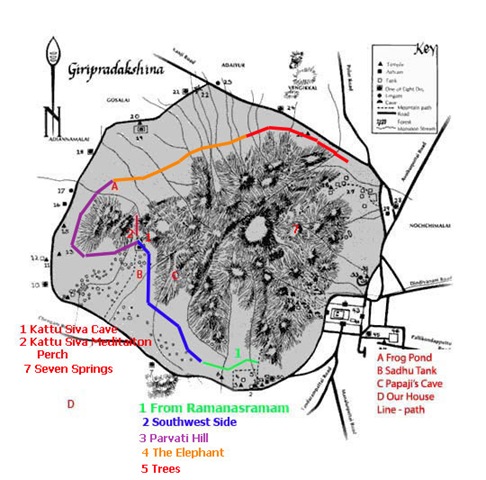
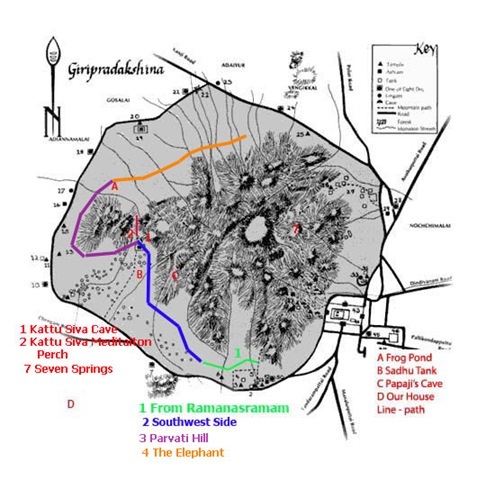
Below is a map of the entire Inner Path, that shows the six sections as well as some other landmarks along the way. The final section is in yellow.

Arunachala Inner Path Pachaiamman Koil

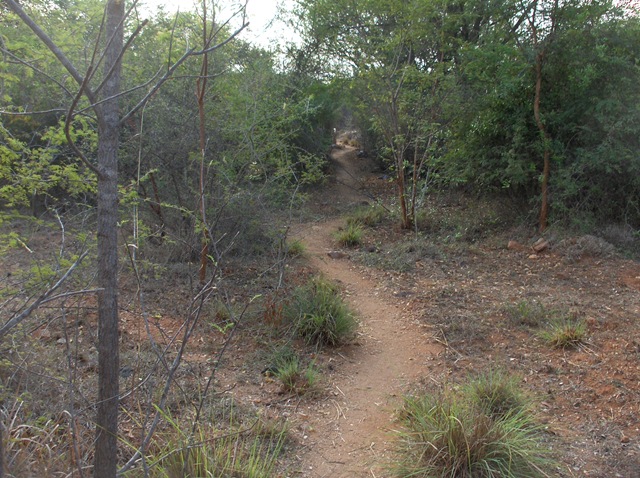
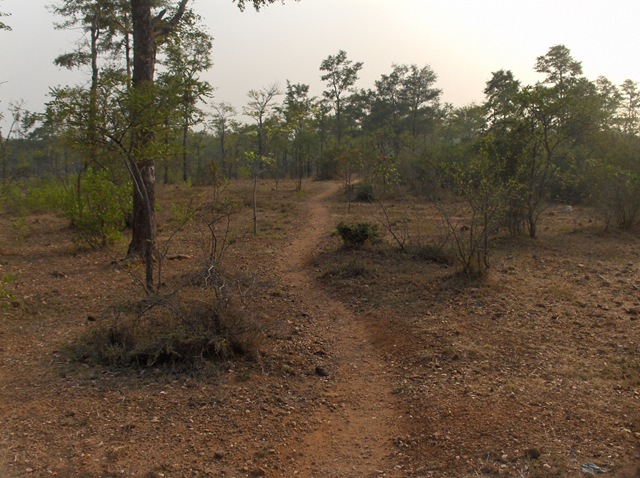
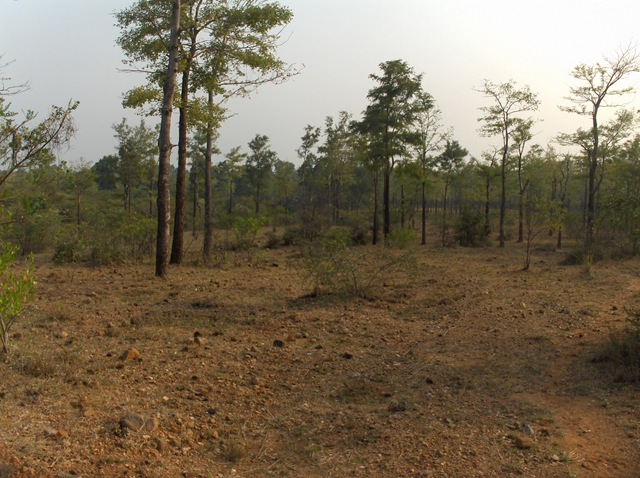
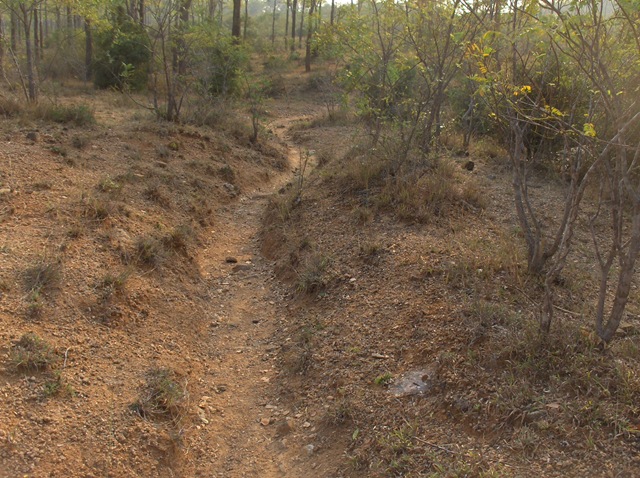
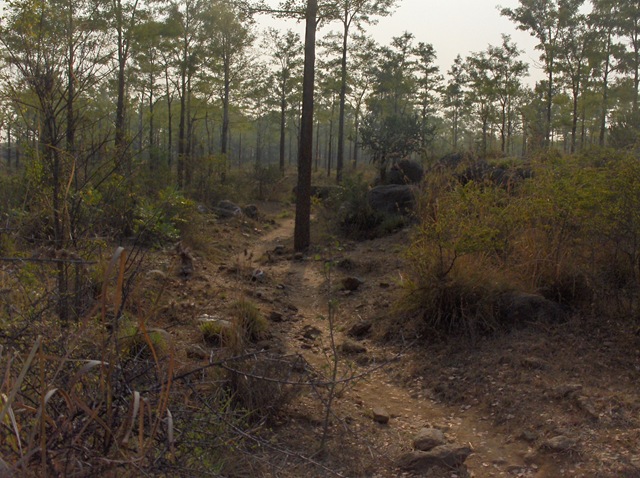
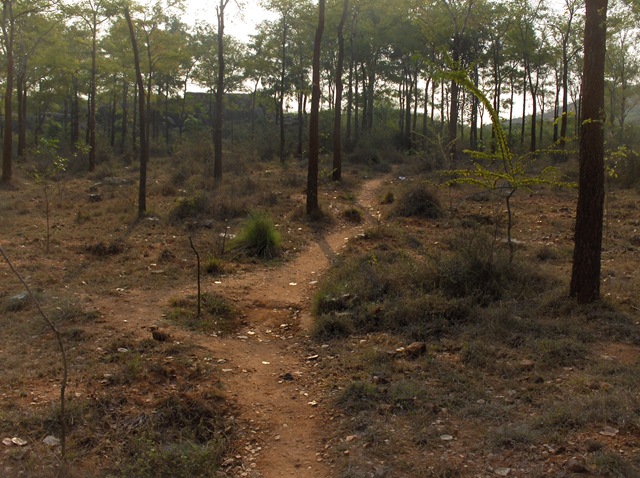
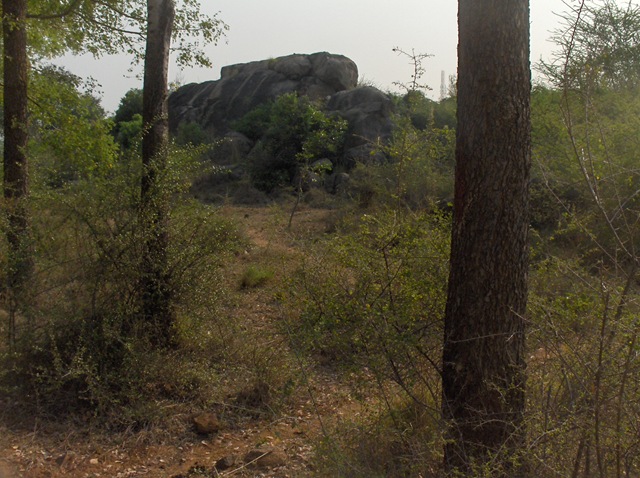
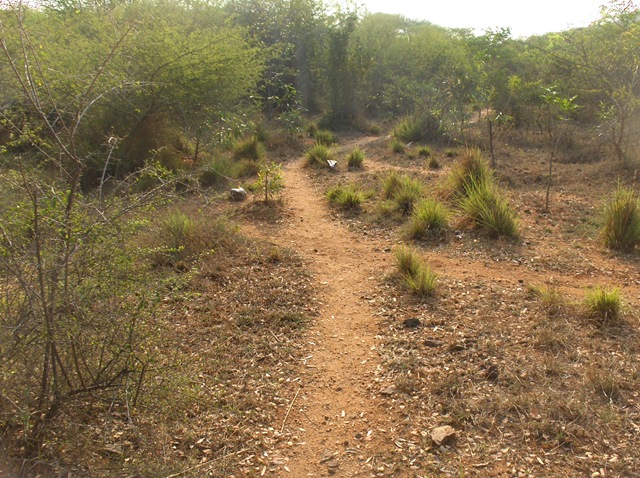
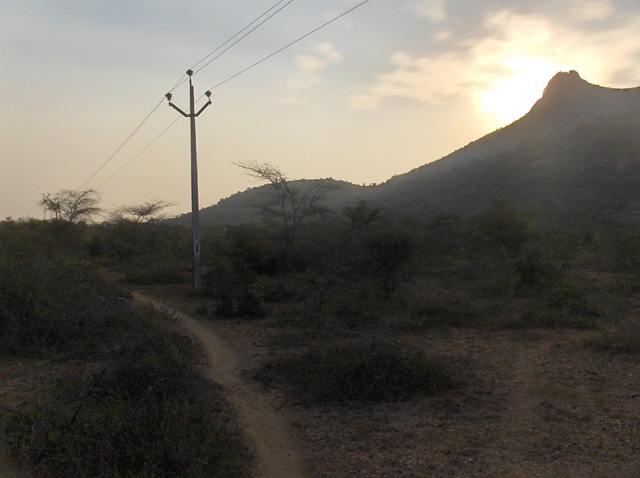
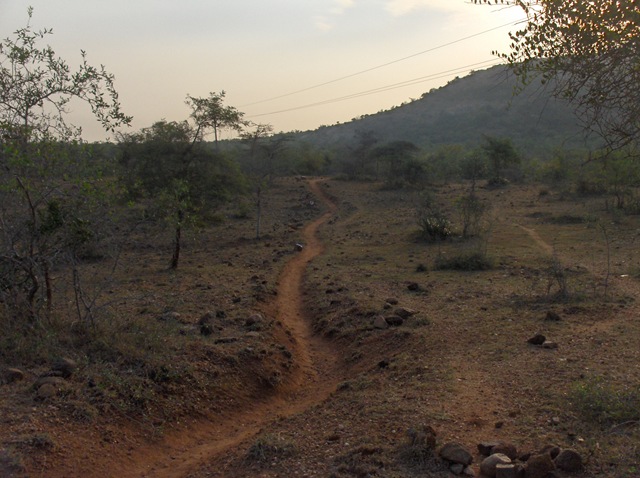
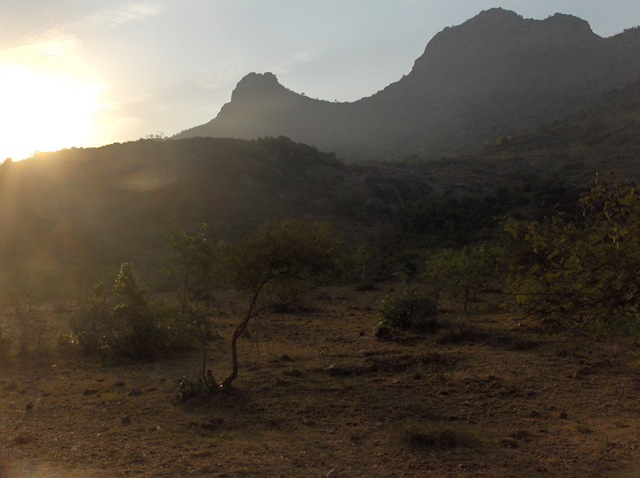
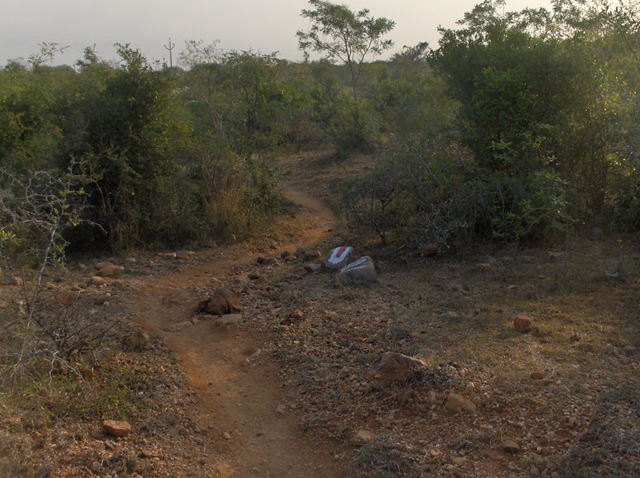
The final section of the Path goes for a bit through trees and brush, near to (but not visible from) Pradakshina Road. It then goes behind a few houses of local villagers, then up a small hill to Pachaiamman Koil, then down the hill back to the road. And the way we walk, finally to Ramakrishna Hotel for breakfast of Indian coffee, vadas and dosas.

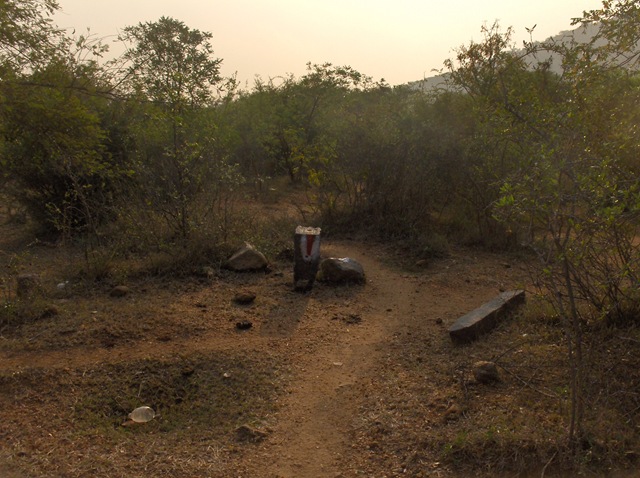
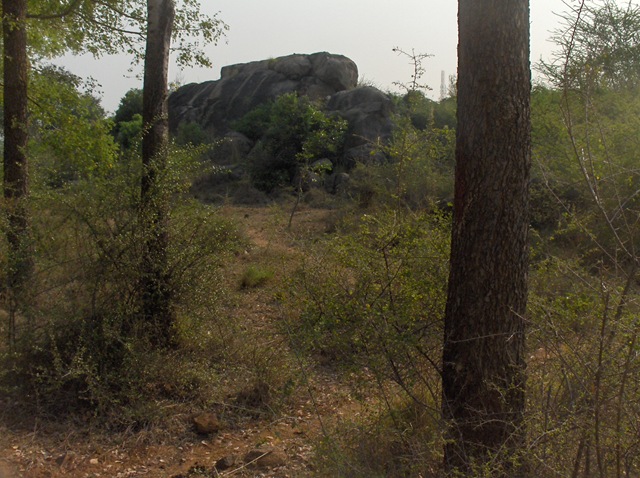
Starting from the Big Rock
HPIM2197

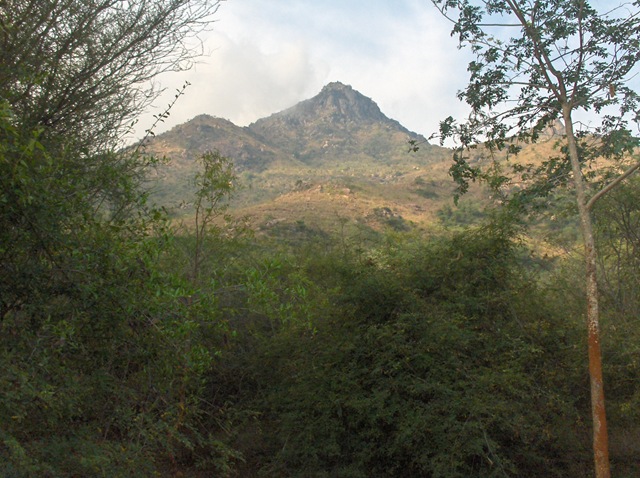
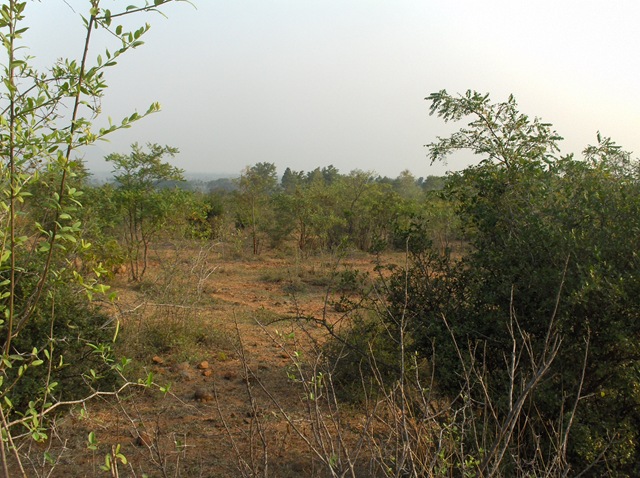
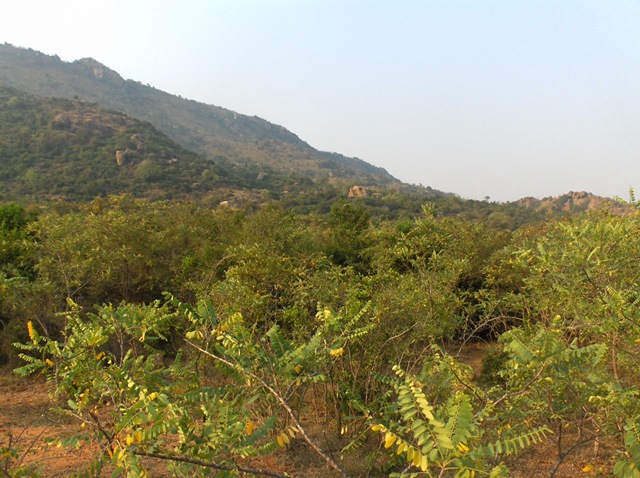
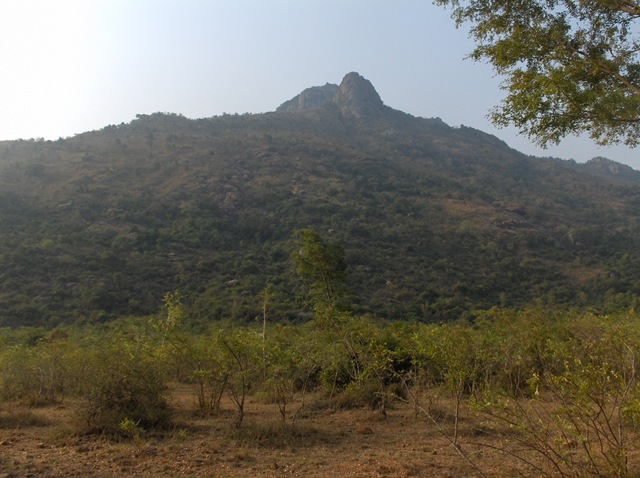
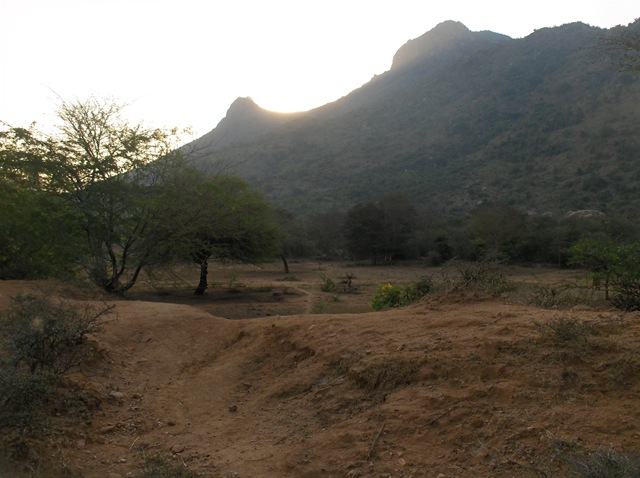
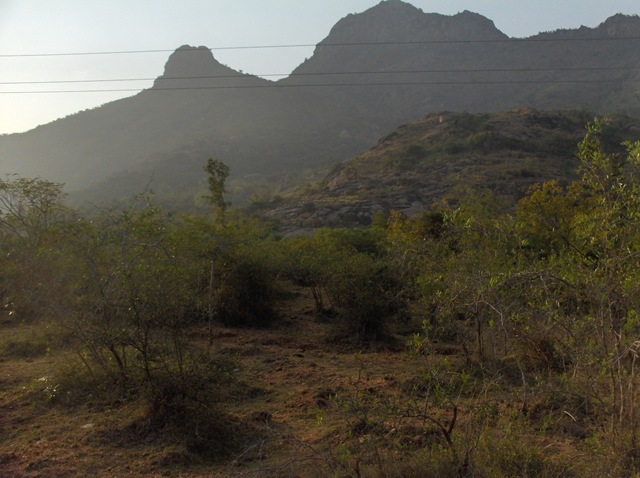
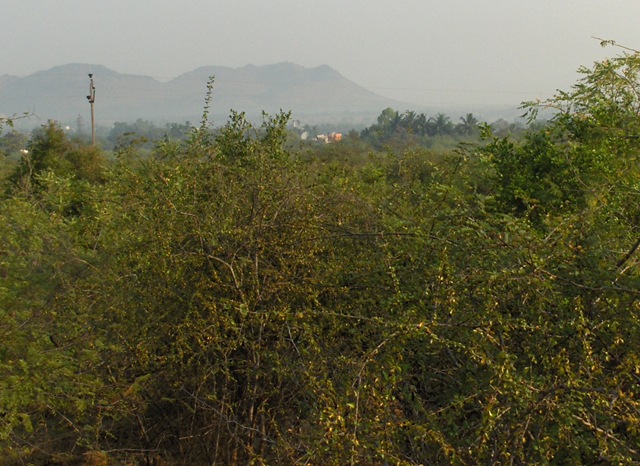
Looking towards Arunachala, the peak rises behind the trees.
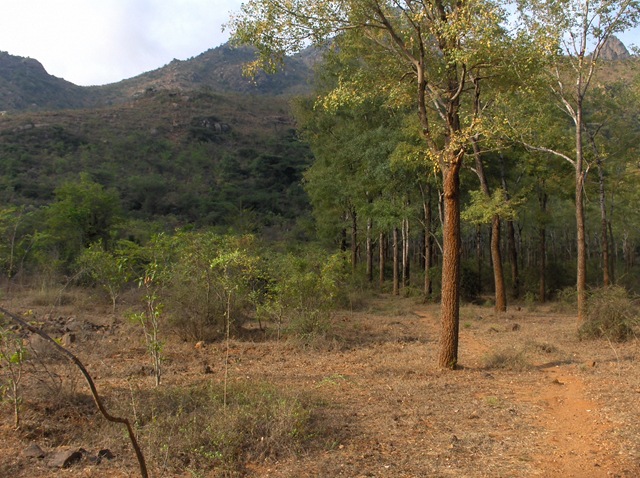
HPIM2309

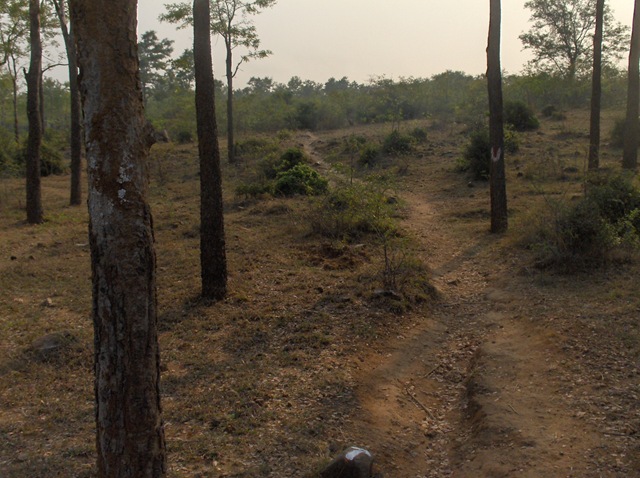
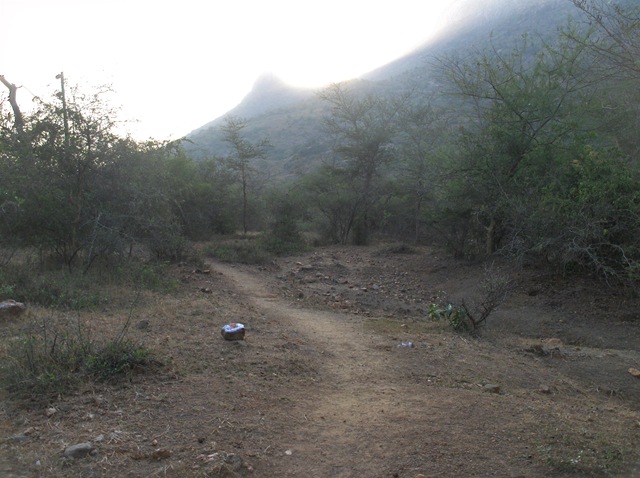
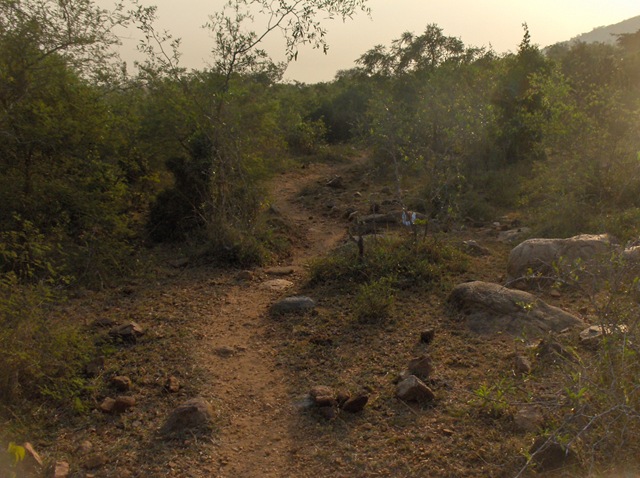
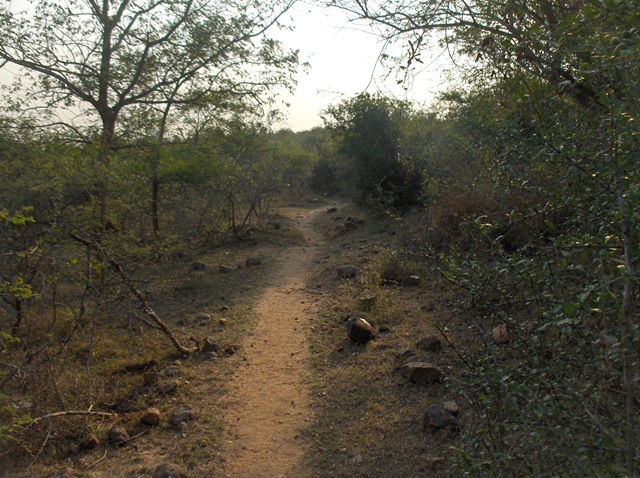
The Path continues straight ahead.

HPIM2311

HPIM2315

HPIM2320

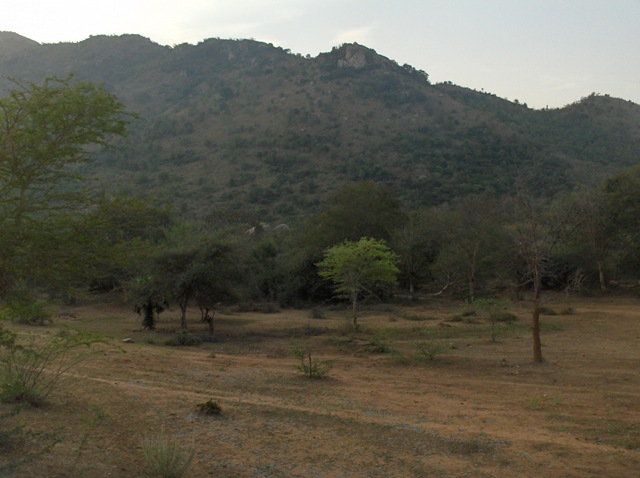
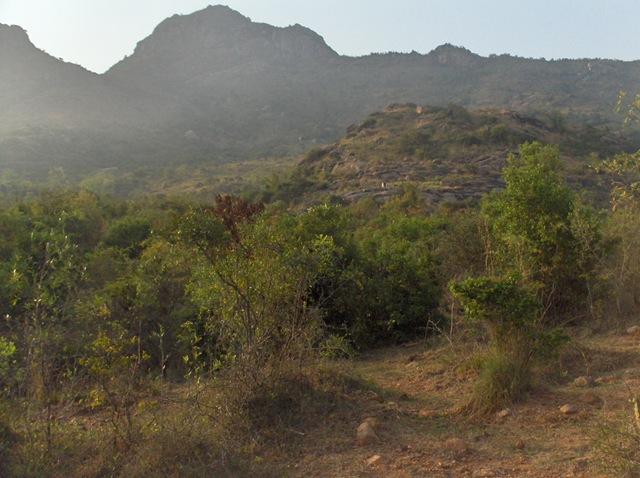
Arunachala through the trees.

HPIM2321

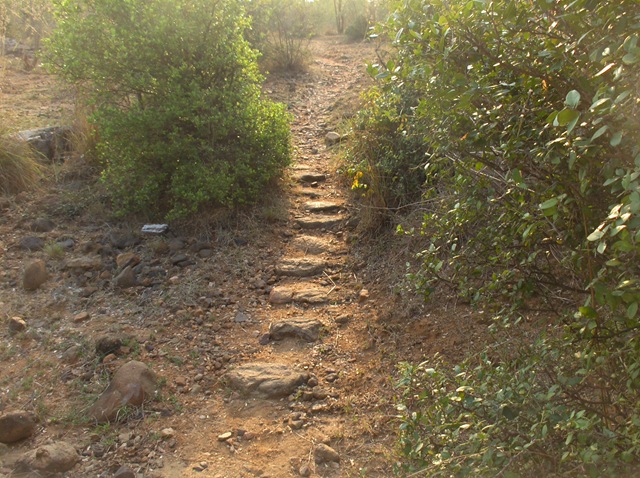
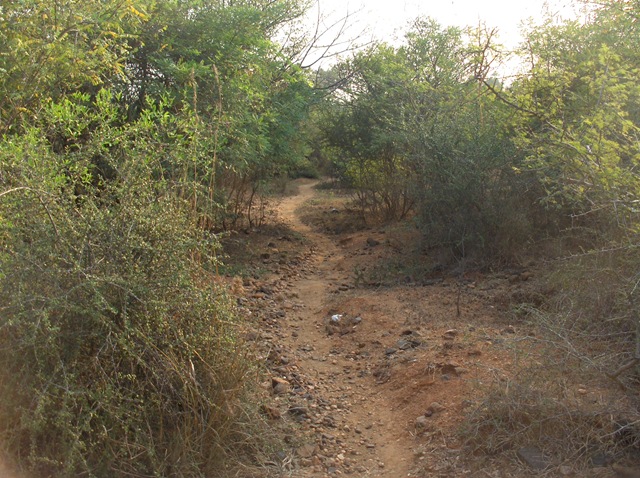
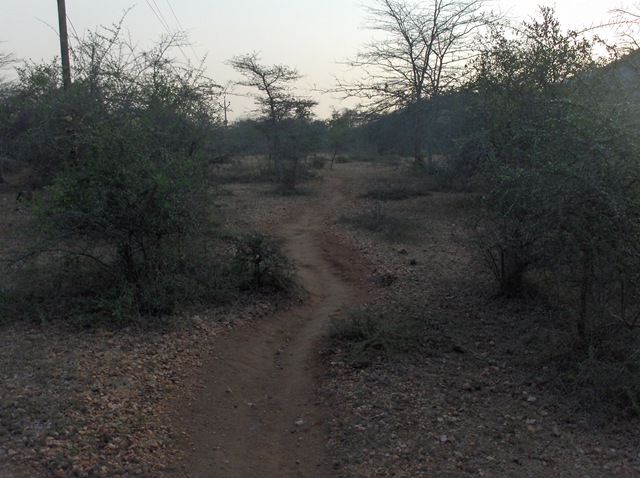
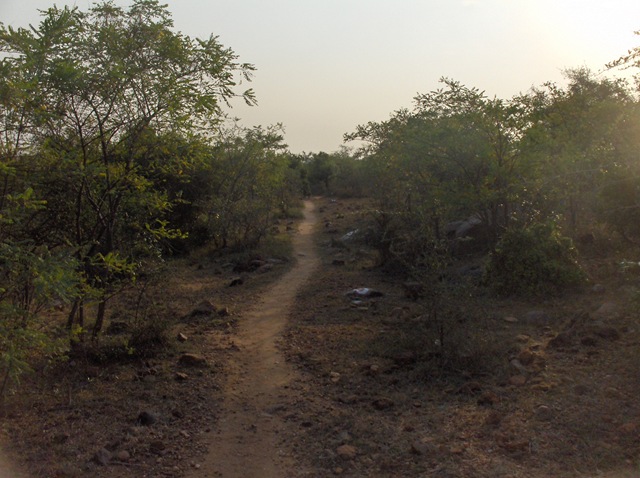
Continue through the brush and small trees.

HPIM2322

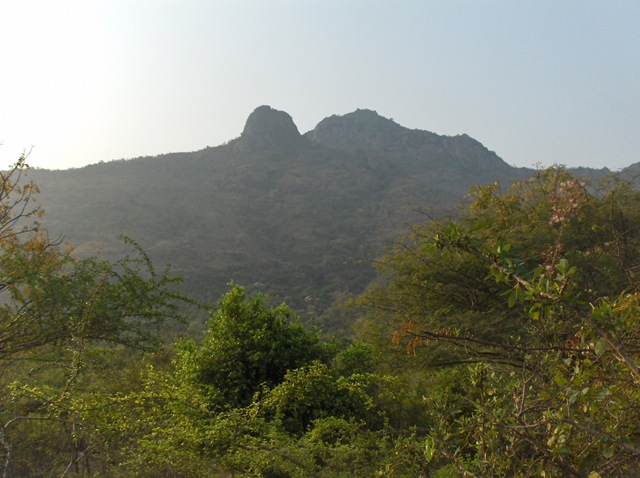
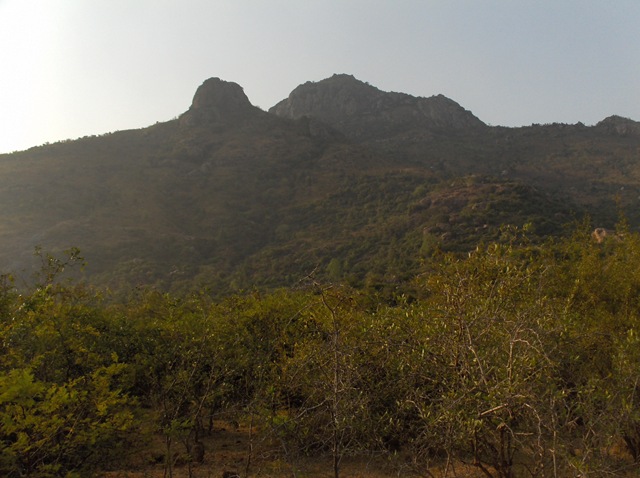
Here is a clearer view of the Arunachala peak. The trunk element of The Elephant rises on the right of the peak.
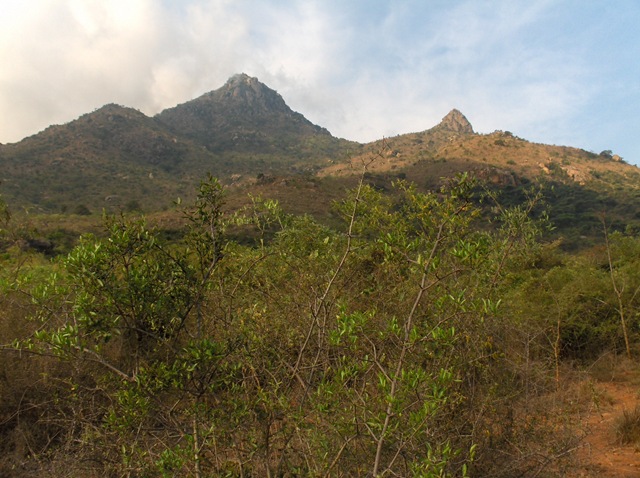
HPIM2323

Continuing down the Path. This is a shortcut where Carol cleared the brush and now is the main part of the trail. Before only cows could get through here, and everybody else took a jog to the left.
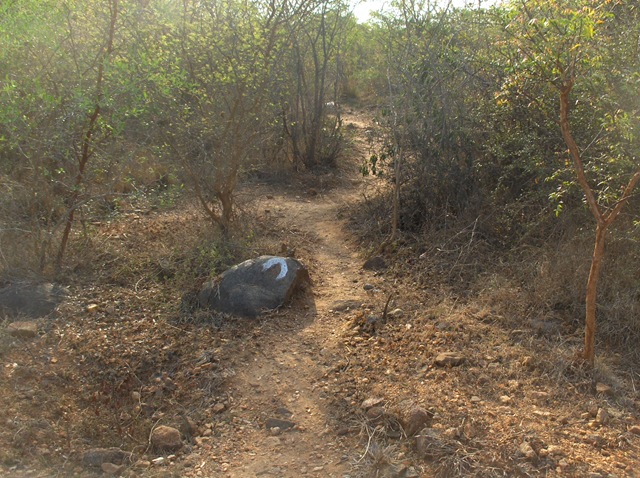
HPIM2326

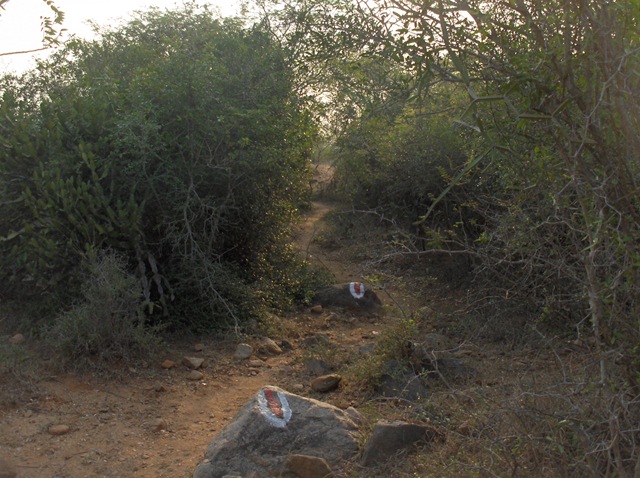
We turn a bit right and there is a nice red and white Om painted on a rock. By now there is quite a bit of road noise, but the road  is not yet visible.
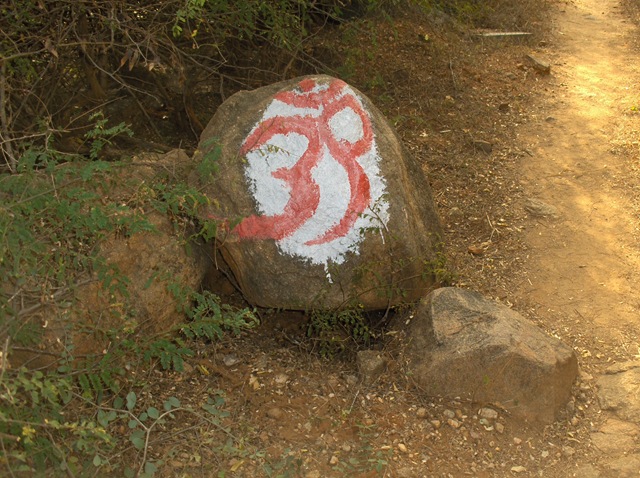
HPIM2331

A village woman walks ahead, with a container of dry branches on her head. This is fuel for the day’s cooking fire. So much of this brush is gathered that it does not have a chance to compost back into topsoil. This is a long standing issue in India, where much of the soil has been depleted by the last 2000 years of continual use.

HPIM2335

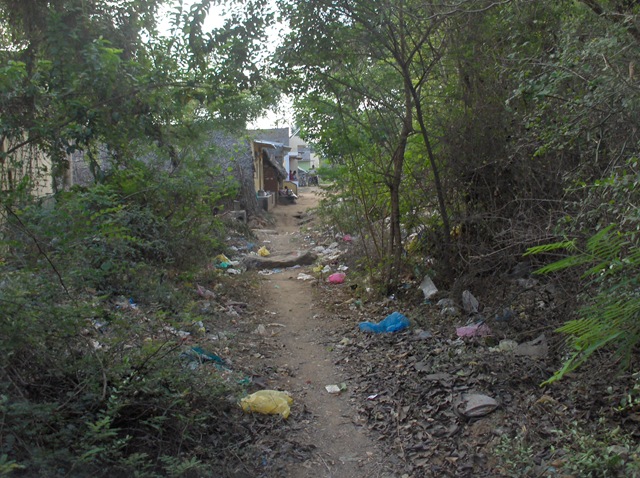
Trash heaps line the path. And sometime piles of human waste, since the typical houses here have no toilets, and the people are used to going outside their houses to do their business. Watch where you step!

HPIM2340

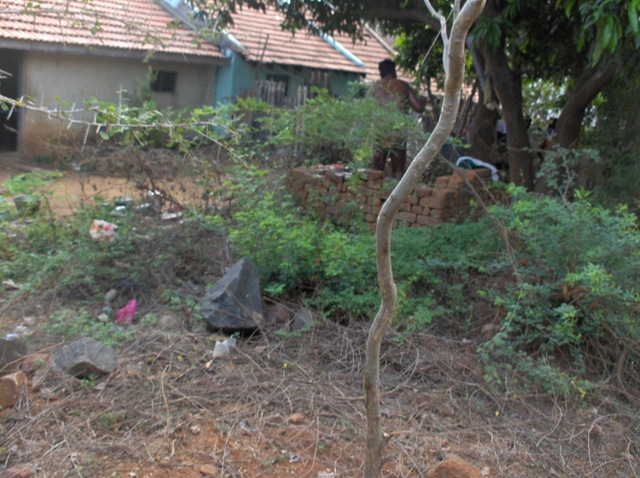
Behind these houses, you can see into their back yards. Here a man is standing in his undershorts in a brick-lined bathing area taking his morning bath.
HPIM2342

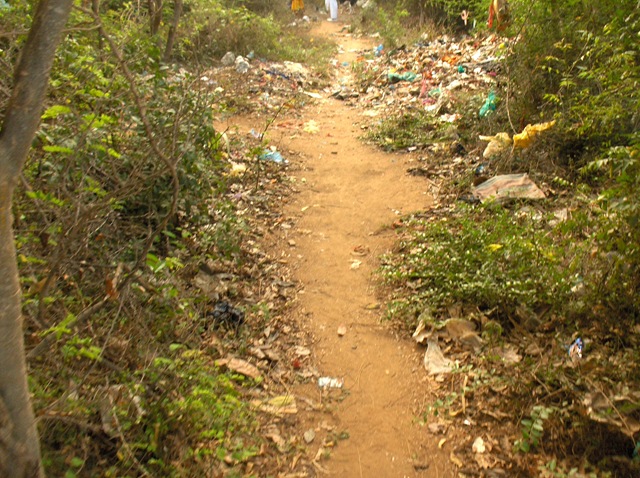
The Path continues through more refuse. Paper products are burned, but the ubiquitous plastics have nowhere to go. Some towns are beginning to address this serious problem by banning plastic bags. The real problem is to educate and sensitize the people to “littering.”
HPIM2345

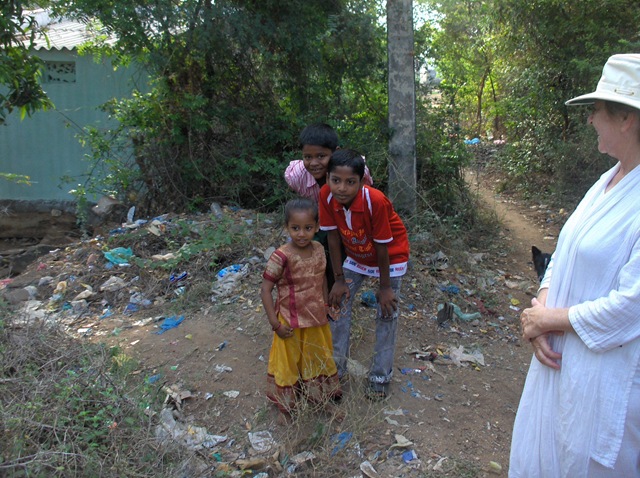
Village children start to greet us. We go through here often and are known by many of them. It seems that children always want their  picture taken. They will come and ask ‘photo’ or ‘camera.’ The children will often ask us for pens. Their schools don’t supply them, so there is no way to practice their writing skills. Amazingly, the little girl in the foreground here actually offered to give US two pens. What beautiful children, physically and spiritually.
HPIM2346

More path through more trash.

HPIM2348

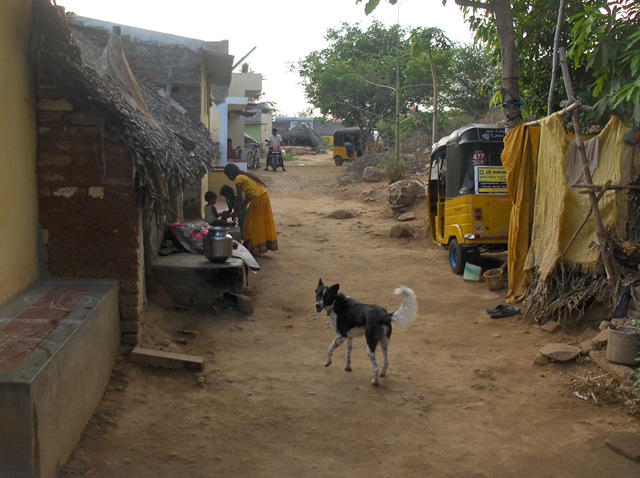
Now we walk directly behind a few houses. Be respectful to the people here. This is their home. A silent smile is usually enough.
HPIM2350

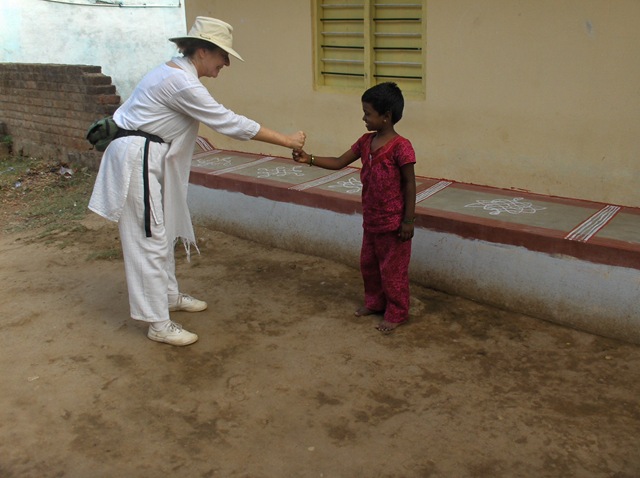
At this house Carol has been greeting the two kids with a ‘fist bump.’ She started doing this as a way to  divert the children’s request for a pen, etc. It really seems that what they want is just some kind  of contact, and the fist bumps provide an easy way. She calls them ‘Obama bumps’ after the photo of Obama and his wife taken during the election.
HPIM2354

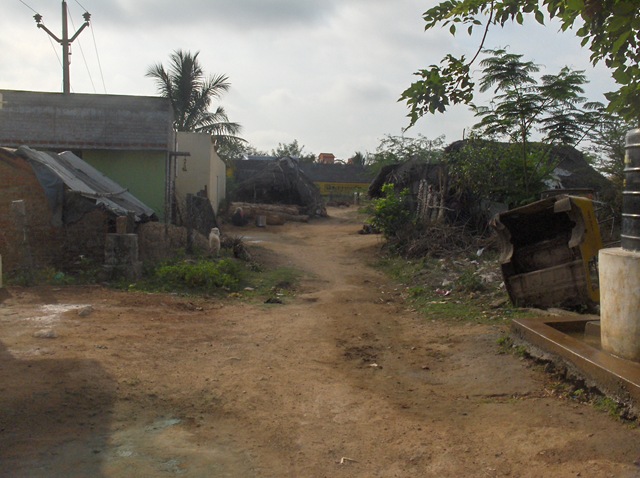
Proceeding  through the village.

HPIM2364

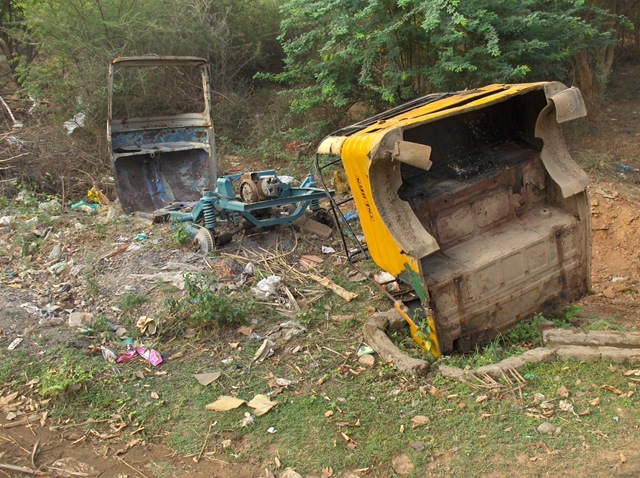
The skeleton of a dead  rickshaw sits  by the path.
HPIM2366

This is a small thatched hut, some family’s home.

HPIM2369

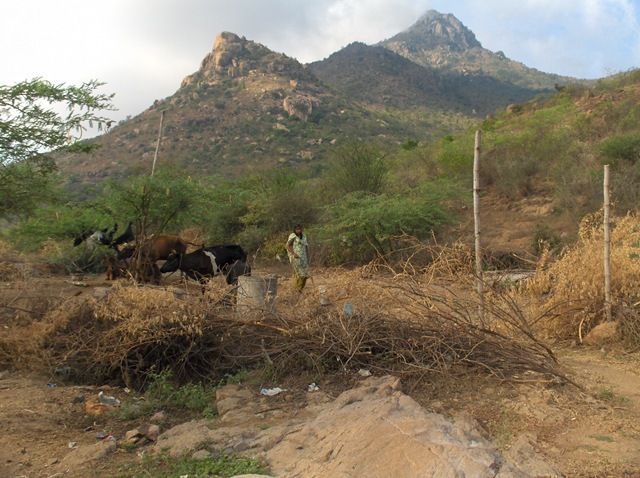
There are a number of cows here. Arunachala is in the background.
HPIM2372

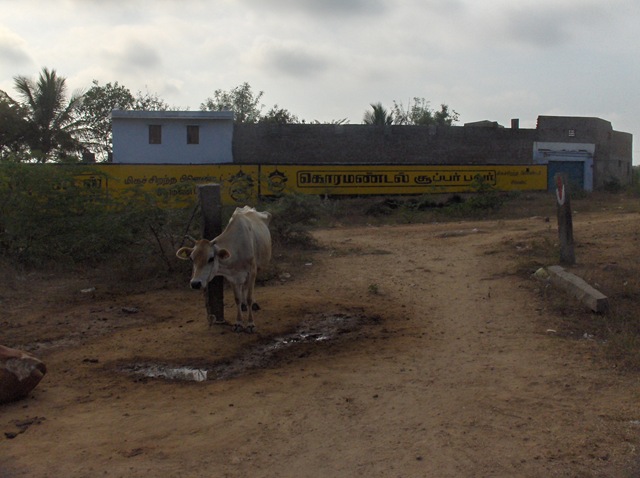
This long yellow sign is a predictable landmark. The Path turns to the right.
HPIM2376

Here is Arunachala again. Clouds are forming around the peak.

HPIM2377

The Path goes up and to the right.

HPIM2378

HPIM2383

Now Arunachala is shrouded in clouds. It is said that there are five faces of Siva that are visible in these eastern hillside rocks. This how you can be sure that it is Siva, since he, apparently, really has five faces.

HPIM2389

Near the Path are newly built homes, with bright paint jobs. Much care was taken with these houses. The bright colors conform to the principles of Vaastu, the Indian equivalent of Feng Shui.

HPIM2390 closeup

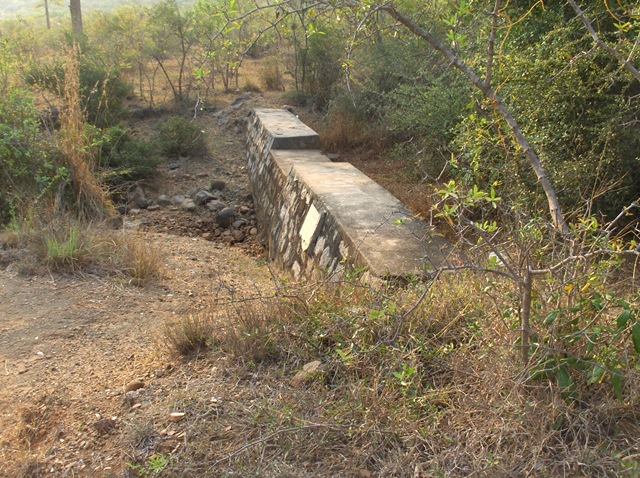
Now the Path goes over two concrete bridges.
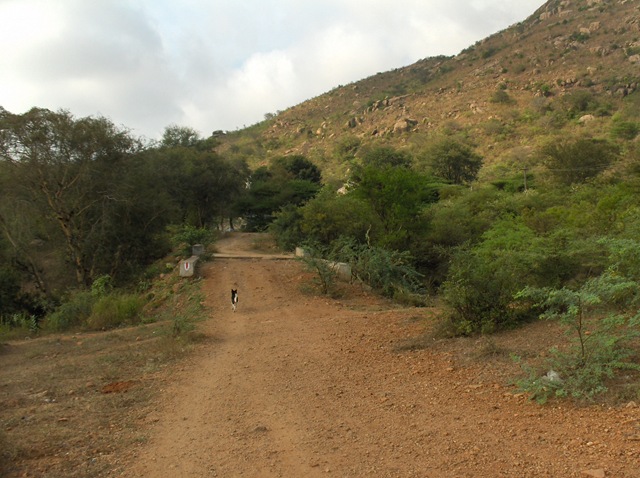
HPIM2395

Arunachala is nearly hidden by the hill in the foreground.
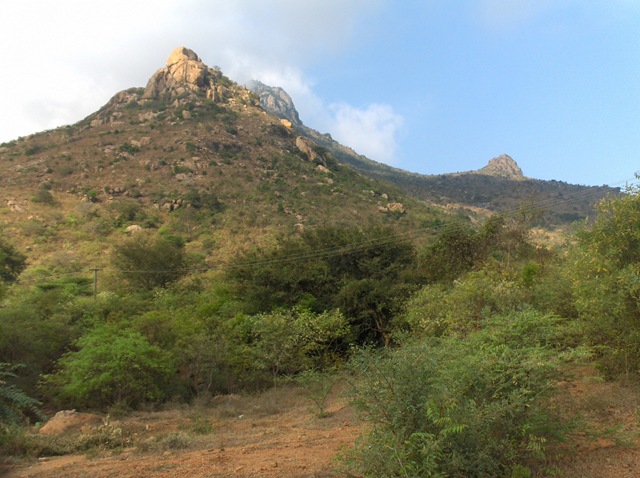
HPIM2396

Below is the first glimpse of Panchiamman Koil, rising out of the trees.
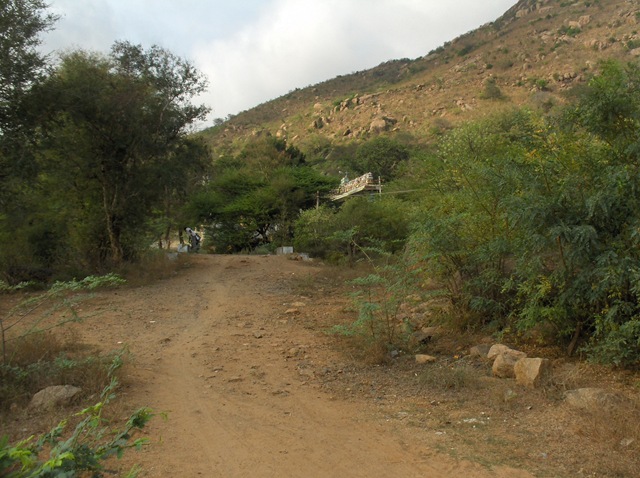
HPIM2399

Patties of cow manure mixed with straw are drying here. They are used a fuel for cooking fires.
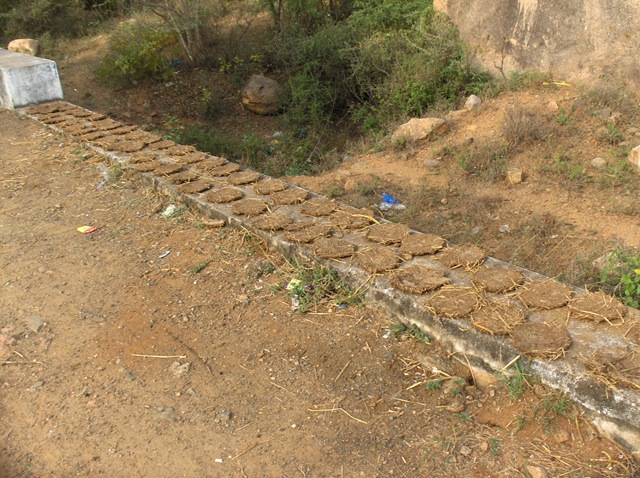
HPIM2400

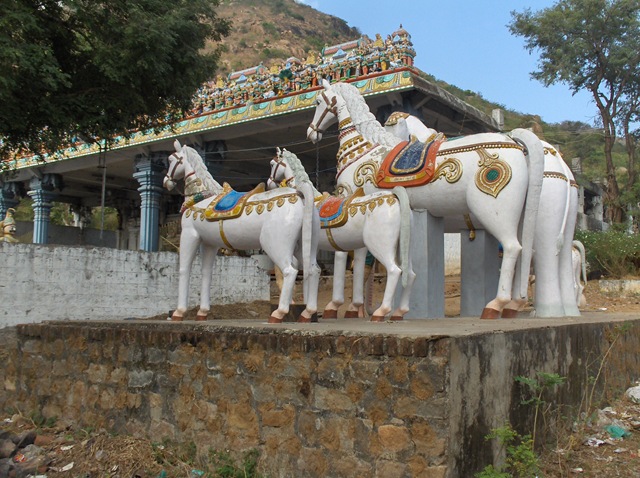
More Vediyappan mounts and guardians.
HPIM2404

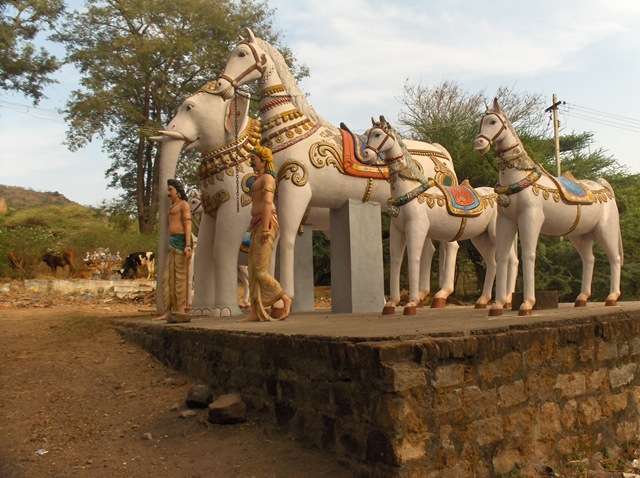
This group also has an elephant as a mount.
HPIM2406

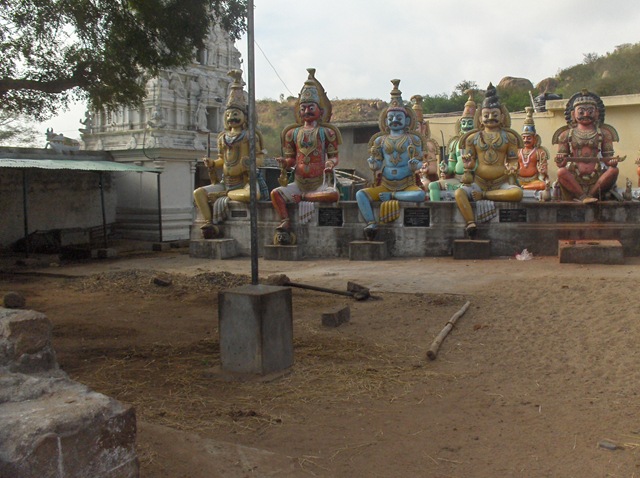
In front of Panchaiamman Koil are two rows of Guardians. If you look closely, the two on the left are resting their feet on heads.
HPIM2409

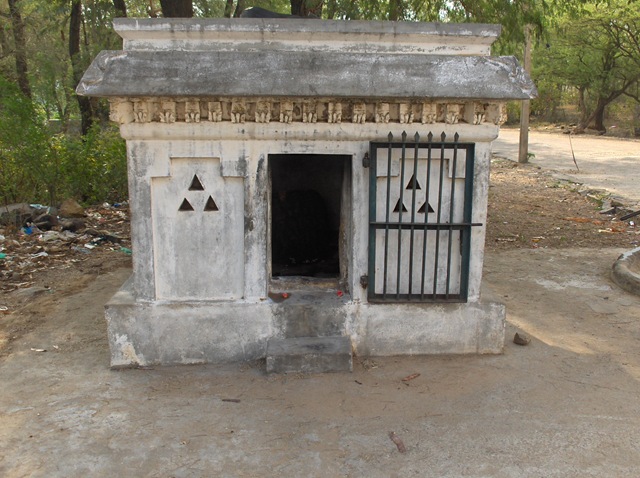
Outside Panchaiamman Koil is a small shrine.
HPIM2415

Inside is an ancient figure of a male and female. Siva and Parvati, maybe?

HPIM2414

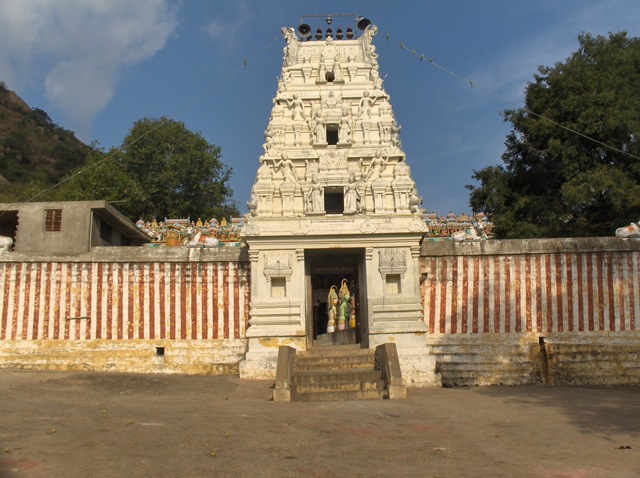
Here is the front of Panchaiamman Koil. The vertical red and white stripe indicate that it is is temple. You will see these many times in South India, marking temples.
HPIM2417

The Arunachala peak is  entirely hidden here.

HPIM2421

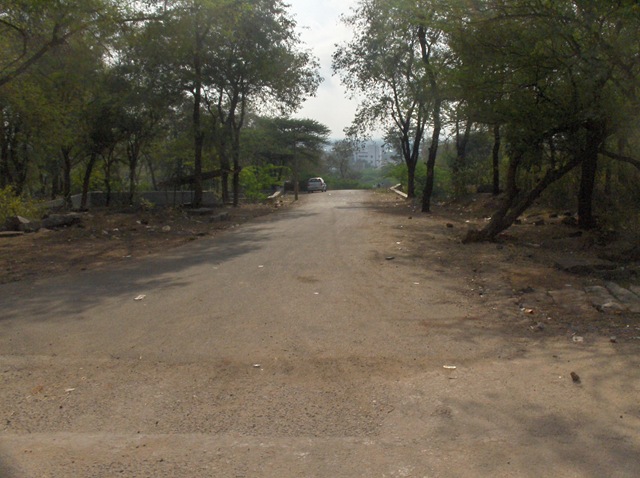
The road down the hill to the main street.
HPIM2419

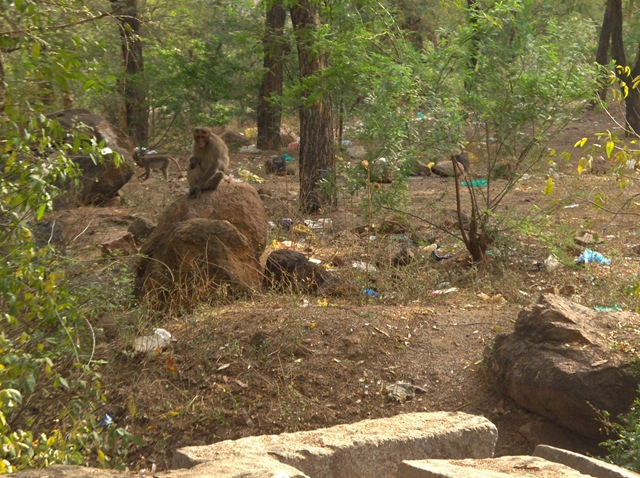
There are monkeys here today. This  one is sitting on a rock. I wonder if monkeys meditate.
HPIM2425

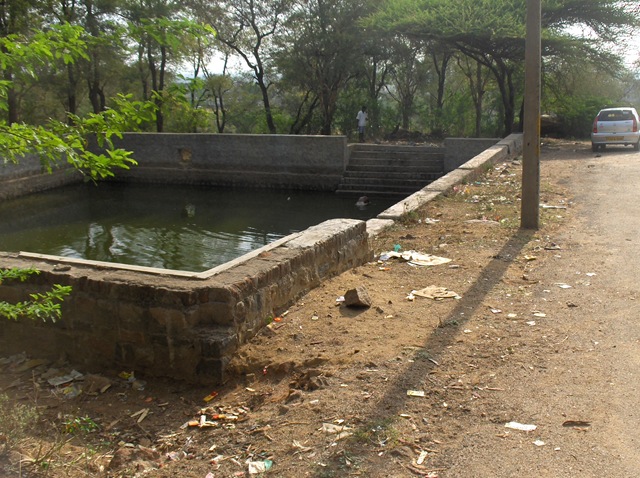
There is a tank down the hill from the temple. Usually in the morning there are men bathing in the tank.
HPIM2427

On the other  side of the road through the trees is another temple. There is a path here that goes a bit further around the mountain. After a rough bit and a scramble up a rock face, you come out to a small village built on the face of a very large hillside.

HPIM2429

Down the road.

HPIM2430

Often you will see this billy goat along the road  here. He seems like the king of this hill.

HPIM2200

We turn right at the first street. You could keep going straight down this hill. We think  of this as the ‘scenic route.’

HPIM2432

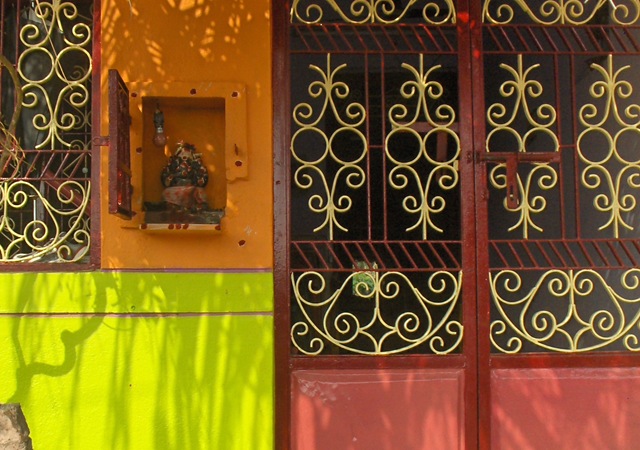
A nice Ganesh shrine in the doorway of this house insures that things go well within the house.
HPIM2434 closeup

In the mornings, many women with water jugs are gathered around this tank, getting their day’s supply of water. This is a hard job. Naturally it  is  mainly done by the women.

HPIM2437

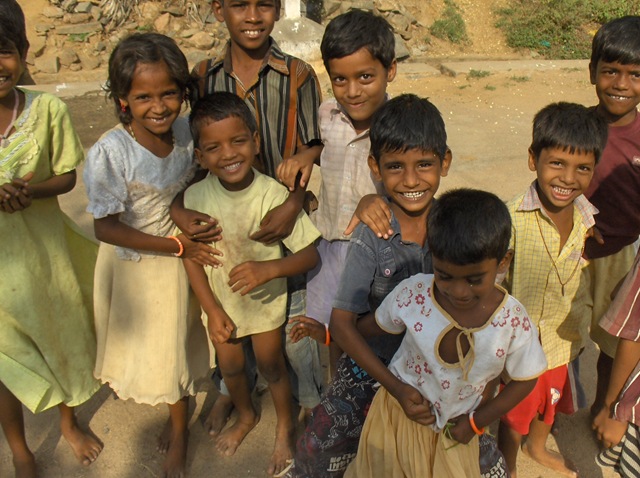
Kids gather, asking, ‘photo, photo, photo.’
HPIM2443

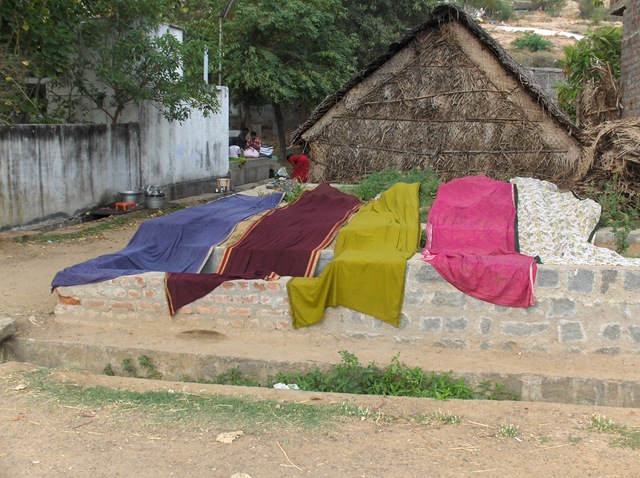
Sarees are spread out to dry.

HPIM2445

They were probably just washed in this community clothes washing area.

HPIM2446

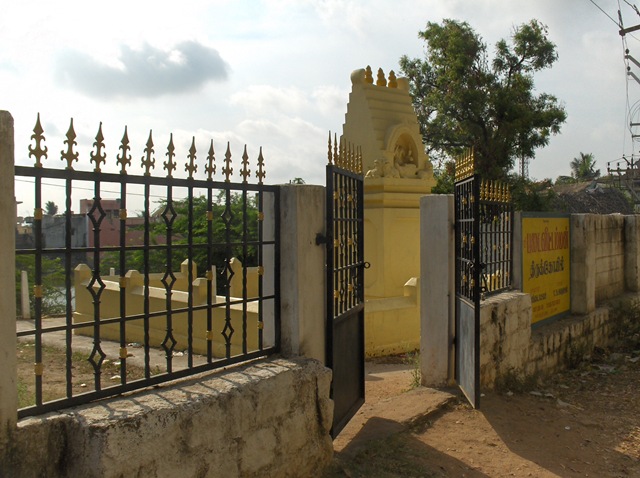
Across the road  is a sweet little shrine.
HPIM2450

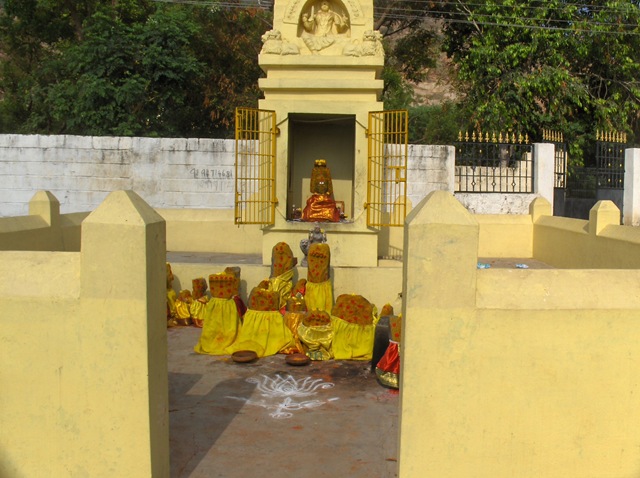
Many primitive Nagas (Snake Gods) are set out in front of the central shrine. All are dressed in their dhotis. This shrine is very well taken care of.
HPIM2452

The road continues on.

HPIM2453

We take the first left turn, down the hill.
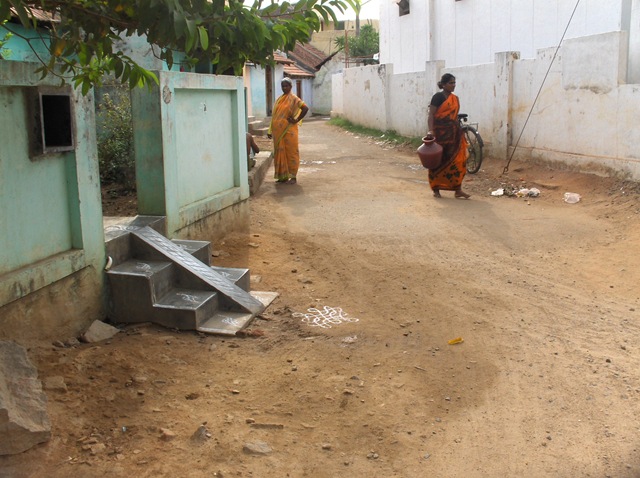
HPIM2454

This is a nice clean street to walk down.

HPIM2459

It passes by a large tank. This has water year round.
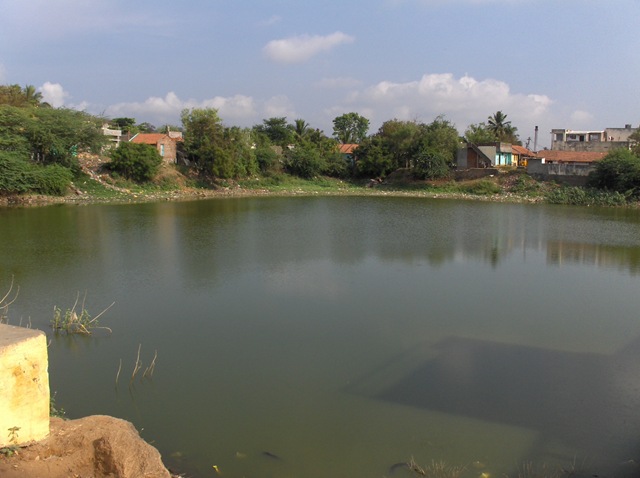
HPIM2462

A Ganesh shrine is next to the road. It was  recently repainted, and is brightly colored.

HPIM2463

Down the hill we go.

HPIM2464

Now we come to the main street. Hotel Ramakrishna rises ahead.

HPIM2465

Arunachala is obscured by the main buildings and phone/electricity lines.
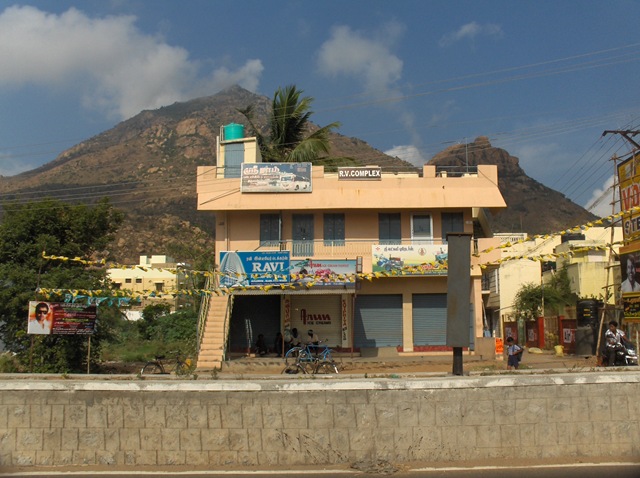
HPIM2467

Almost to the hotel. We can’t wait to eat breakfast!
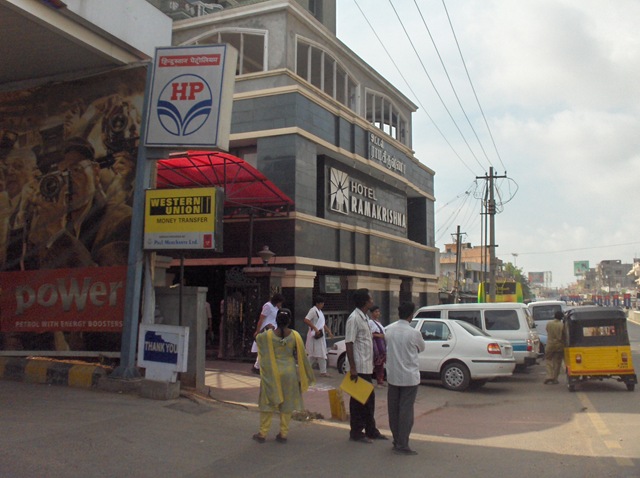
HPIM2471

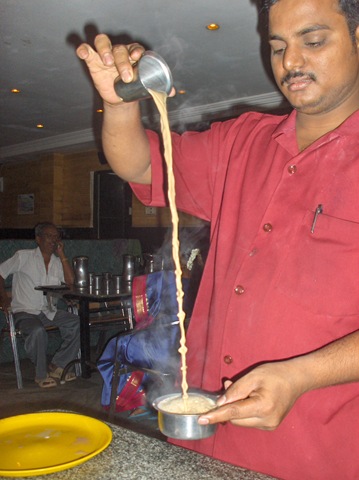
First is coffee. We have coffee before the meal. Indians have it after. The staff here know us, and  know to bring the coffee to begin with.

It is served in a metal cup and small pan. The waiter, Raja, pours it from one to the other to cool the coffee. If I tried it from this height, the coffee would be all over the table.
HPIM7318

Then the dosas and vadas are served. Since the staff knows that we LOVE the chutneys, they bring us big bowls of it.

HPIM2473

This concludes the inner path portion of Arunachala Pradakshina.

From here you can complete it by walking through town on the main street, or on back streets closer to the mountain. We usually have our rickshaw driver, Rajan, pick up us after breakfast and ride through town.

The Inner Path Pradakshina is something that gives many people a deep sense of the holy maintain, and its peace and tranquility. The walk can be made year round. In the summer months start as early as you can (6 am?) and take lots of water. Take your time. Be willing to explore. Near the path are many places of wonder, beauty and  peace. Savor it all, if you can.

Related Posts

Inner Path – Southwest Side
I
nner Path – South Side from Ramanasramam
Inner Path – Around Parvati Hill
Inner Path – The Elephant
Inner Path – Through the Trees
Harsha's avatar

What is God’s Name? By Dr. Harsh K. Luthar

Ramana Maharshi: “I am” is the name of God. Of all the definitions of God, none is indeed so well put as the Biblical statement “I am that I am” in Exodus (Chapter 3).

Words are used in various spiritual traditions to describe God or give God a name. Many people are convinced that their religion, their scriptures, and their way of worshipping God is the best way. Sometimes people argue and and fight over God as well. 

Our conception of God is to large extent a function of where we are born and in what religion. Our mental conditioning is often so strong that we are not able to see the diversity of perspectives in various spiritual traditions. Only the mystics in different religions, who have through self-reflections and meditation, gone beyond their mental conditioning offer a unified vision of God. 

Continue reading

Harsha's avatar

Ulladu Naarpadu (Reality in Forty Verses) :Verse #13

ULLADU NAARPADU
(Reality in Forty Verses)

The famous Vedantic poem in Tamil by Bhagavan Ramana Maharishi
(consisting of two preliminary verses called Mangalam,
40 verses which form the main text ,
and another 40 verses called the Appendix)
Detailed Commentary in Tamil by Lakshmana Sharma,
adapted into English by Profvk

(Continued from ULLADU NAARPADU – Verse No.12
See Post#48444 Of Harsha Satsangh

Lakshmana Sharma’s Introduction to Verse No.13

Now Bhagavan takes up the question of ‘What is Real?’ and ‘What is unreal?’. He answers the question about how the unreal appears to shine like real and establishes the advaita conclusions clearly. The Atman is the only Reality; taking that as its support (adhishhTAnam), the superposed universe appears as if it is real. – This is the advaita siddhAnta (Final Conclusive Verdict).

Verse No.13

jnAnam Am tAne mey; nAnA Am jnAnam ajnAnamAM;
poyyAm ajnanamume jnAnamAm tannai anRi inRu
aNikaL tAm palavum poy
meyyAm ponnai anRi uNDO ? puhal.

Translation (Lakshmana Sharma)

This Self, (here) declared to be Consciousness, is alone real, without a second; all knowledge which is manifold is only ignorance; this ignorance – which (being a negation) is non-existent – has no existence apart from the Self who is Consciousness. Say, do the unreal jewels exist apart from the gold which (alone) exists?

Translation (Prof. K. Swaminathan)

The Self that is Awareness, that alone is true. The knowledge which is various is ignorance. And even ignorance, which is false, cannot exist apart from the Self. False are the many jewels, for apart from gold, which alone is true, they cannot exist.

Translation (Osborne)

The Self, which is Knowledge, is the only Reality. Knowledge of multiplicity is false knowledge. This false knowledge, which is really ignorance, cannot exist apart from the Self, which is Knowledge-Reality. The variety of gold ornaments is unreal, since none of them can exist without the gold of which they are all made.

Word by Word

tAne : The Atman (the Self)
jnAnam Am : whose nature is Knowledge
mey: is the true Reality.
jnAnaM : the (worldly) knowledge
nAnA Am: which is multifold
ajnAnamAm: is only Ignorance.
ajnAnamume: And that Ignorance also,
poyyAm : which is non-existent
inRu : cannot be
tannai anRi :distinct from the Self
jnAnamAm: whose Nature is Consciousness.
aNikaDAm palavum : All the multi-formed ornaments
poy: are false
ponnai anRi: Apart from the gold
uNDO ? Is there anything?
puhal: Tell (me).

Commentary in Tamil by Lakshmana Sharma.

In the previous verse it was said “tAn aRivu Ahum” (The Self is Consciousness). This Self which is of the Nature of Consciousness is the only Reality – that was mentioned right in the beginning , namely, the Existent Reality (“uLLa poruL” – cf. Mangalam-1, 2nd line) , because it is One and remains unchanging. This is the meaning of “jnAnam Am tane mey”. In other words, the Self is Existence-Consciousness – sat-chit. therefore it is Brahman.

There is the question whether the multiple appearance of the world –the Individual, Ishvara and the universe – is true or not. The reply is given by the statement “nAnAvAM jnAnam ajnAnamAm”. The knowledge of multiplicity that is referred to here indicates only the manifoldness of the world’s appearance. For, other than knowledge – meaning, other than the thoughts created by the mind – there is no universe.

What is being said here is a definition of the discrimination between what is real and what is unreal. Being One is the characteristic of Reality. Appearing manifold is the characteristic of Unreality.

The purport of the statement that the world is Ignorance is to say that the world arose from Ignorance. And Ignorance is nothing but Ego. That is not something that is material; this is the truth that Bhagavan teaches as the fundamental truth in this work. Ignorance means the absence of Knowledge; and that again tells us that Ignorance is like Darkness. It is not a material substance. Darkness cannot be present in the presence of Light. So also Ignorance cannot persist in the face of the Light of the Self. How can such a destroyable Ignorance be the Existent Reality? This is what is meant by the words “poyyAm ajnAnamume”.

Ignorance is not a material substance – this is the conclusion of Vedanta. If it were so, then the universe and the bondage that arise from it would have an element of truth in them. An immature disciple is told as if there were an Ignorance that caused the bondage. In reality there is no such thing – this is the bottom line teaching. Therefore the question: “Wherefrom did I get this Ignorance?” is an absurd question. The question presumes there is a relationship between the Existence-Knowledge Brahman and the transmigratory cycle of samsAra. There is no such relationship. The Vedanta teaching is: “asango-hyayam purushah”, that is, the Atman that is Brahman is associationless and relationless. This is technically known as “ajAta-siddhAntaM”. It means that from the Absolute point of view there is no universe arising from Ignorance, no JIva, no bondage, no seeker, no mokshha. What is Real is an ever-pure, ever-knowing, ever-free Atman only (*nityashuddha, nityabuddha, nitya-mukta AtmA*). This is the experientially-confirmed Truth of the JnAnis who live in that experience. Bhagavan says that Sri Krishna in the Bhagavad Gita, right in the beginning of the second chapter, declared this truth to Arjuna but the latter was struggling to absorb it and that is why Krishna gave him several other teachings.

Though the relationship does not exist in reality, for the purpose of teaching, an imagined relationship has to be talked about. But this does not in any way affect the Reality that exists.

This universe – that is, the individual, the Ishvara and the universe – which is an expansion of Ignorance, appears as if it is real. The reason for this is that their adhishhTAnam (substratum, base) is that Existent Reality namely, the Atman. They have been superposed on the sat-chit Nature (svarUpa) of the Atman. From this it is clear that the universe has no existential reality of its own. Such an existential reality is there for the Atman; for, it shines in purity without the appearance of the universe, in the turIya that is Knowledge-experience (jnAna-anubhava). Therefore it is said that the Atman is real and the universe is mithyA.

‘The universe is mithyA’ means the differences of names and forms superposed on the substratum of the Atman are mithyA. After throwing off the differences what remains as the adhishhTAnam (support) is the real truth of the universe – this prompts us also to say that the universe is real. Thus the two statements ‘the universe is mithyA’ and ‘the universe is real’ are not contradictory. If one understands it this way without the contradiction, both the statements are true.

The analogy for this comes from the case of gold and golden ornaments. The golden ornaments are at all (three) times only gold; before they are made into ornaments, after they are made and are handled as ornaments, and when they are destroyed back into gold. In all three states of time the truth of the gold is unchanged. Further, gold is one whereas the ornaments are many. Therefore, as per the definitions indicated earlier, gold is more real than the ornaments; ornaments are unreal. In the two statements in the verse: namely, “aNigal tAm palavum poy” and “meyyAm ponnai anRi uNDO”, notice that the two words ‘poy’ (false) and ‘mey’ (true) are used in juxtaposition. When you look at it as gold, the ornaments don’t appear; therefore they are false. When you look at it as ornaments, their false names and forms hide the truth of the gold. The gold that is hidden is the truth. Worldly people say that both are the truth. If that were so, the analogy would not match the situation; so Bhagavan deliberately uses the two words here. The purport of this is: “The ornaments are many and (therefore) false, have as their adhishhTAnam the one, and (therefore) real, gold; so also, the knowledge, which is only Ignorance, that imparts an inherent nature of multiplicity, and (therefore) falsity, to the world, has as its adhishhTAnam the Atman, which is the One Reality-Consciousness and consequently appears as if it is real”.

If Bhagavan had not added the words ‘poy’ (false) and ‘mey’ (true) here, a wrong interpretation may be attributed to Bhagavan that in addition to the ornaments being dense with gold, their differences of forms and names are absolutely true; and this may be followed up by the analogous inference that in the same manner in addition to the world being dense with Brahman their differences of names and forms are also true in the absolute sense. In order to prevent such a wrong interpretation these two words appear here as said.

The same thought appears in Tirumoolar’s Tirumandiram in the verse:

Marattai maRaittadu mAmada yAnai,
Marattil maRaindadu mAmada yAnai;
Parattai maRaittadu pArmudal bhUtam,
Parattil maRaindadu pArmudal bhUtame.

Meaning,

The gigantic elephant hides the wood,
The gigantic elephant is (also) subsumed in the wood.
The earth and the elements hide the Absolute,
The earth and the elements are (also) subsumed in the Absolute.

In more explanatory words, in the wake of Ignorance, the Absolute is hidden by the five elements and appears as those elements and their ramifications. In the wake of Enlightenment, the elements do not appear, only the Absolute shines in all Glory.

Thus, what has been said is nothing but what the analogy of the rope and the superposed snake would have implied.

Thus the appearance of the world is false. This implies that even during the time of its appearance, it is not there. This meaning would become explicit in Verse No.37.

(To be continued in Verse No.14)

Harsha's avatar

Inner Path – “Trees”

This post continues the series that show Arunachala’s Inner Path, used by devotees of Sri Bhagavan Ramana Maharshi for the sacred walk around this holy hill. This walking is called pradakshina, or in Tamil, girivalam.

Part One shows the path from Ramanasramam. Part Two shows the walk around the southwest side of the hill.  Part Three details the section of the path around Parvati Hill, at the west end of Arunachala. Part Four shows the path on the north side, under the Elephant. This is Part Five.

A map is below. The Trees section of the Inner Path is shown in red.
Arunachala Inner Path Trees
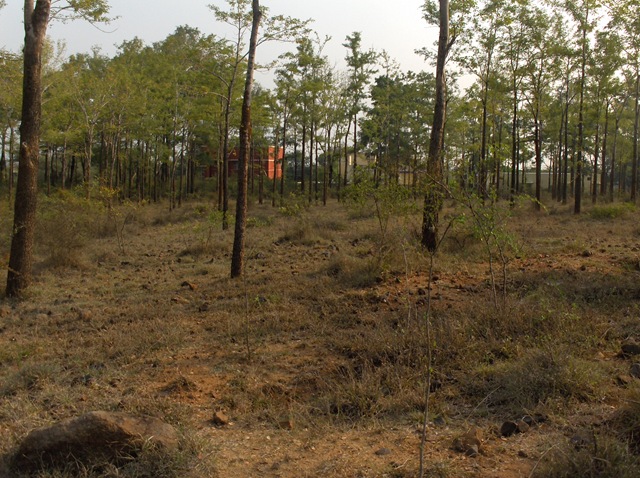
In this section of the Path, tall trees, planted about 20 years ago, are a main feature, first away from the Path, near the road, then next to the Path, then the Path goes through these trees. Also the Path gets closer to the road, and is  less quiet. 

Starting from the Stone Post

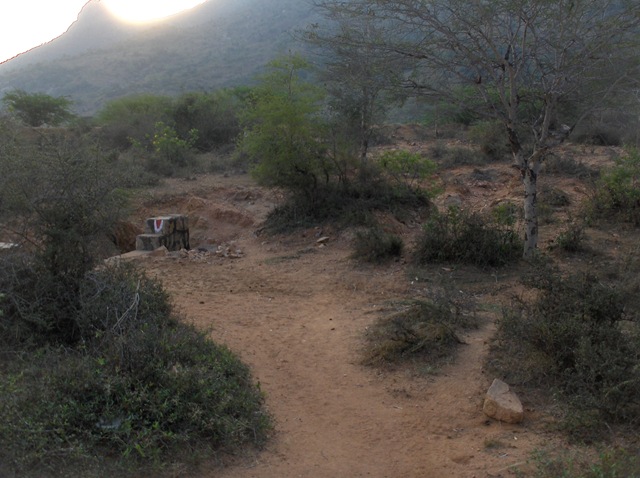
It is about 7:30 in the morning when we start from here. There is sunlight on the trail already. It is late March, and moving towards summer, so the plants are drying out. 

At this spot there are paths leading both towards and away from the mountain. Go straight: the Path is marked here.

Sometimes you will see camphor burning in a pit in this marker. If you brought camphor, you might want to light a piece of it here.

HPIM2056

Looking  away from Arunachala, you can see trees rising far away.

HPIM2057

The Elephant ‘compass’ is now pointed almost directly at us.

HPIM2058

Ahead, there is a ridge that slants down towards the Inner Path. This is a landmark on this part of the path. When this ridge comes down to the Path, there is a nice place to sit, rest and have a drink of water. There is also a little-known feature of Arunachala at this spot, called by some the ‘Ringing Rock.’ 

HPIM2059

The path is well marked. Sometimes it goes through thickets.    

HPIM2062

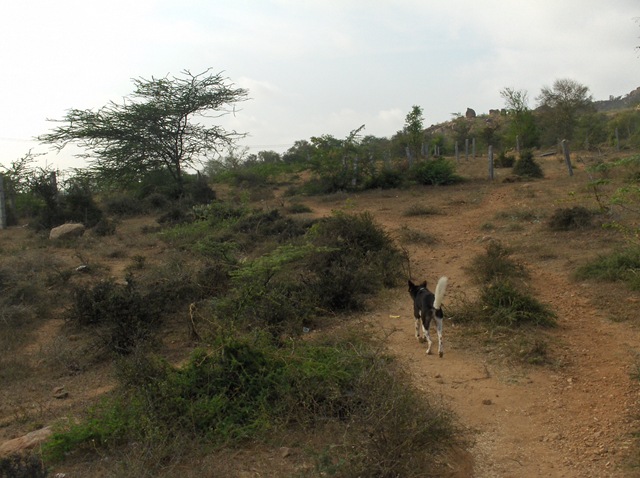
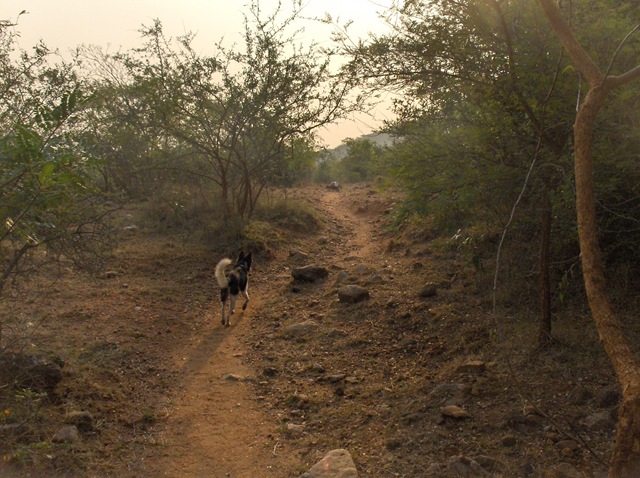
Sometimes through open scrub brush. There is a black and white dog walking with me today. He sometimes joins us on the walk. I bring doggie biscuits for him (and two other dogs that are friends).

HPIM2063

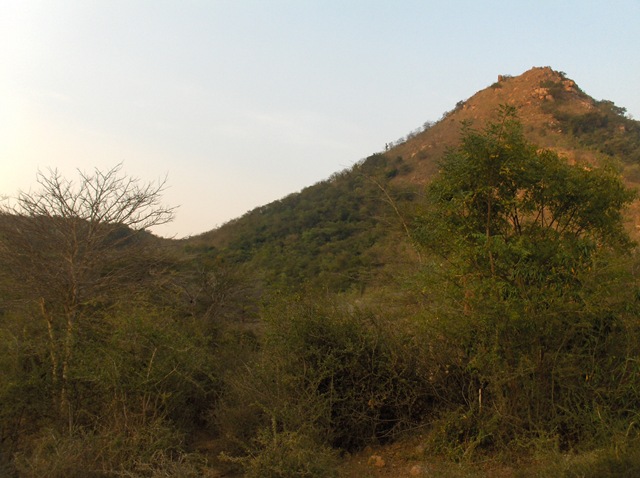
Looking back towards the mountain, the ridge seen when walking The Elephant rises to the right. In the center here you can see a low hill, where it will be worth exploration trips in the future.

HPIM2068

Ahead on the Path we see the ridge angling down to the Path.

HPIM2071

HPIM2075

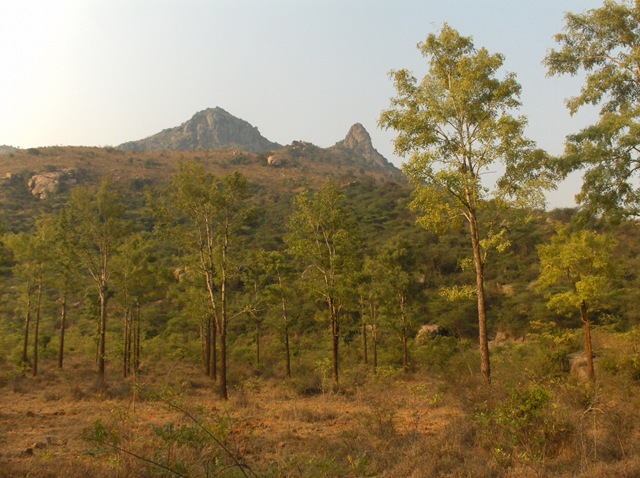
Trees are now closer to the Path.
HPIM2077

The Path continues through open brush.

HPIM2081

We pass a stone retaining wall intended to reduce erosion during the rainy season.

HPIM2082

Now  it looks  like we are heading into the trees.

HPIM2086

They are closer to the Path here.

HPIM2095

We wind down a small hill.

HPIM2097

And come to a well-made rock-and-cement structure that is part of the system to slow down water running off the Holy Hill.

HPIM2098

Below, we have crossed to the other side of the Elephant ‘compass’.

HPIM2103

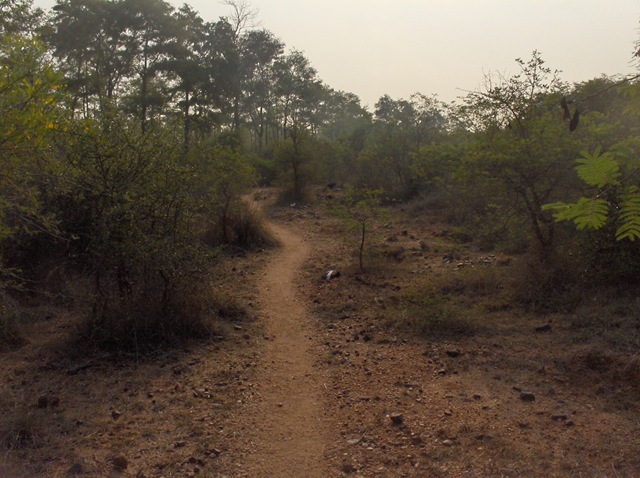
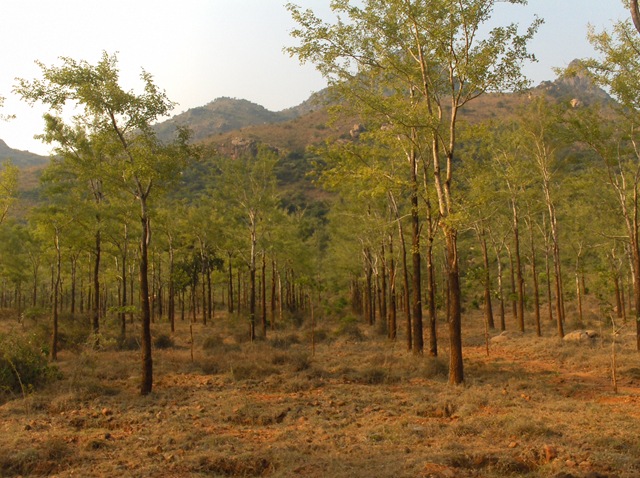
The path goes through trees for a short bit, then back into the brush.
HPIM2107

Here is a short set of stone stairs. Again and again we see work that has been done by someone who loves Arunachala, and provided some service to the mountain by working on the Inner Path. 

HPIM2110

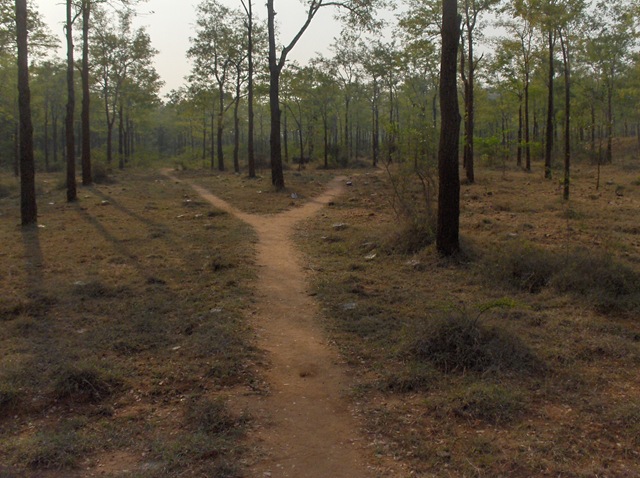
Winding through the low trees and brush.
HPIM2116

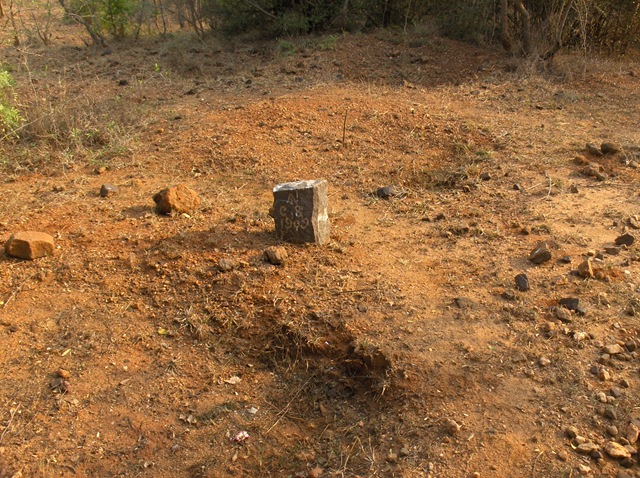
Here is a survey marker. The date is 1909.

HPIM2117

Now the Path is next to the trees.

HPIM2123

The Elephant ‘compass’ shows we are on the north east side of Arunachala.

HPIM2125

We see many trees to the right of the Path.
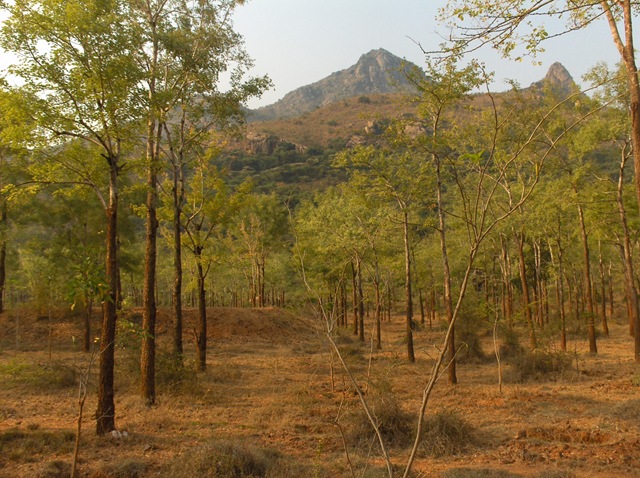
HPIM2132

In the foreground, notice the green ridge coming down towards the path.
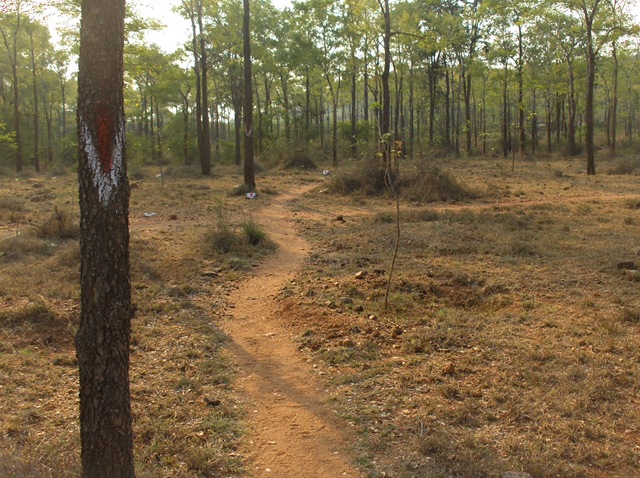
HPIM2137

This two-rock marker also shows where we are. We are near a group of rocks were we can sit and rest.

HPIM2140

To the right, through the trees, we can see a spot of yellow color. This is from a house by the Girivalam Road. You can hear traffic  on the road now.

HPIM2141 crop

Here are the rocks. We usually sit here for a bit, and have a drink of water.

HPIM2153

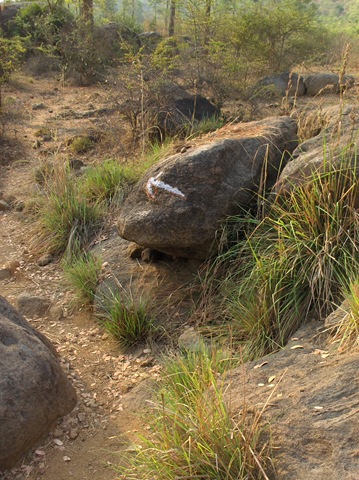
Off the right side of the Path is a rock with an arrow painted  on it. (In the photo above, it’s the rock to the right in the middle ground.) If you look closely, you will see that it is scuffed (above and to the right of the arrow). Grab a hand-sized stone and strike it in the scuffed area.

Listen and know why it is called ‘The ringing rock.’  Have you ever heard anything like this before?

HPIM2157

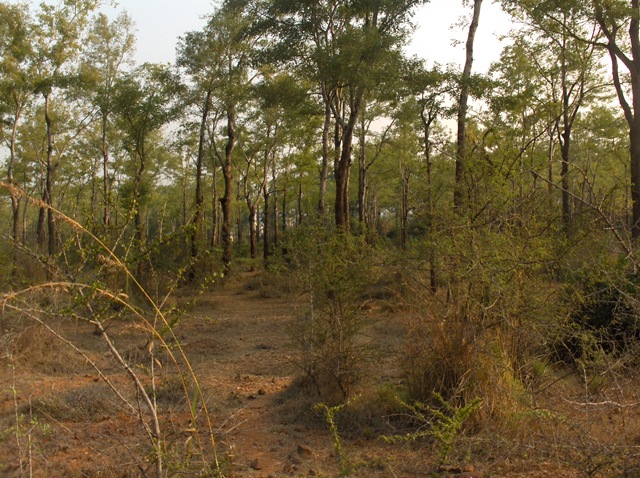
Now the Path continues through the trees.

HPIM2160

More houses and commercial buildings are visible to the right of the Path.

HPIM2164

The peak of Arunachala is behind us. We see The Elephant from the other side now.

HPIM2165

These trees are planted  in rows.

HPIM2175

Take the right fork of the Path.

HPIM2176

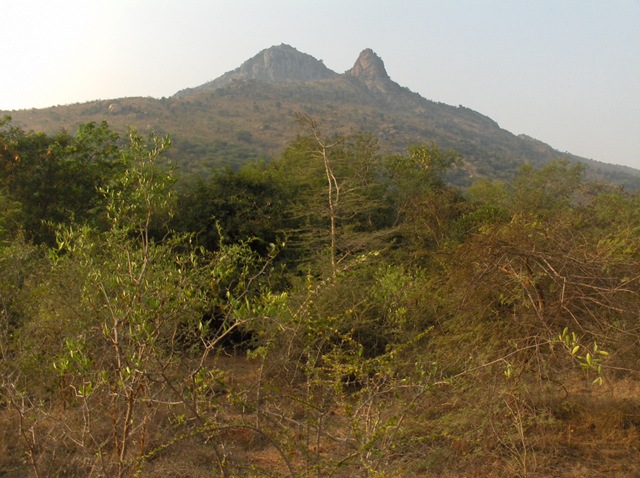
Below is the peak through the trees.

HPIM2180

We cross a couple of paths.  The Inner Path is well marked. Go straight.

HPIM2183

Now a rock formation rises to the left of the Path.

HPIM2192

It is maybe 20 feet high. Recentlyl we saw a photographer here, having gone ahead of his group to get a shot from a great angle.

HPIM2197

We cross the path that goes by this rock. This  is the end  of this section of the Inner Path. 

HPIM2196

We will post the next and last section of the Inner Path soon.

Related Posts   

Inner Path – Southwest Side
I
nner Path – South Side from Ramanasramam
Inner Path – Around Parvati Hill
Inner Path – The Elephant

Harsha's avatar

ULLADU NAARPADU (Reality in Forty Verses): Verse #12.

ULLADU NAARPADU
(Reality in Forty Verses)

The famous Vedantic poem in Tamil by Bhagavan Ramana Maharishi
(consisting of two preliminary verses called Mangalam,
40 verses which form the main text ,
and another 40 verses called the Appendix)
Detailed Commentary in Tamil by Lakshmana Sharma,
adapted into English by Profvk

(Continued from ULLADU NAARPADU – Verse No.10 &11
See Post#48287 Of Harsha Satsangh
For the first post in this series see #47923)

Lakshmana Sharma’s Introduction to Verse No.12

If both Ignorance and Knowledge are gone, then what remains must be a void. Is it so? – is the question that arises. What so remains is not a void. The Consciousness that is the Nature of the Atman is what remains. This is the content of this verse. The Self-Realisation where there is neither knowledge nor ignorance is what is known as the (ultimate) Knowledge Supreme. It is the nature of the Atman; it is not a quality or attribute of Atman – so says this verse.

Verse No.12

aRivu aRiyAmaiyum aRRathu aRivAme;
aRiyum athu uNmai aRivu AhAthu.
aRithaRku aRivittaRku anniyam inRAy avirvathAl,
tAn aRivu Ahum; paazh anRu, aRi.

Translation (Lakshmana Sharma)

Know that that alone is true knowledge, in which there is neither knowledge nor ignorance; the (so-called) knowledge of objects, understand, is not at all true knowledge. The Real Self shines always alone, with neither things for Him to know, nor persons to know Him; therefore He is only Consciousness; do not think He is non-being.

Translation (Prof. K. Swaminathan)

True Knowledge is being devoid of knowledge as well as ignorance of objects. Knowledge of objects is not true knowledge. Since the Self shines self-luminous, with nothing else for It to know, with nothing else to know It, the Self is Knowledge. Nescience It is not.

Translation (Osborne)

That alone is true Knowledge which is neither knowledge nor ignorance. What is known is not true Knowledge. Since the Self shines with nothing else to know or to make known, It alone is Knowledge. It is not a void.

Word by Word

aRivAme: (True) Knowledge
aRRathu : (is) devoid of
aRivu: Knowledge
aRiyAmaiyum : and Ignorance.
aRiyum athu : What knows
AhAthu: will not be
uNmai aRivu: True Knowledge.
avirvathAL : Because it shines
inRAy: without (the necessity of the presence of)
anniyam: a distinct object
aRithaRku: for (either) to know
aRivittaRku: (or) to be known,
tAN : the Real Self
Ahum: is
aRivu: Consciousness (True Knowledge)
pAzh anRu: (It) is not a non-being or void.
aRi: Know (this).

Commentary (in Tamil) by Lakshmana Sharma.

‘Self Realisation is the only True Knowledge; all else is just Ignorance’ –this thought has already been said in Verse No. 10. The same thing is being reconfirmed here for emphasis. Knowledge and Ignorance subsist only when the Ego has its sway on samsAra. In the turIya there is only Pure Knowledge that is unmixed with Ignorance and which has no relationship with Ignorance. Therein there is no duality of knowledge and ignorance, nor there is the triad of knower, knowledge and the known.So there is no concept of ‘difference’ there. But the common knowledge-triad is full of concepts of difference and so is in relationship with Ignorance. Therefore it is nothing but Ignorance, says the second line of this verse.

One might ask: Why do Knowledge and Ignorance both get destroyed in turIya? Why not Ignorance alone meet with destruction and Knowledge survive? The knowledge that is being spoken of in this question is itself nothing but Ignorance – we have mentioned this already. The reason that both Knowledge and Ignorance do get destroyed in turIya is that the latter is the state of mokshha; there is no second thing there. This is what has been said in the third and fourth line of this verse. There is nothing distinct from the Supreme and so there is no question of the Supreme ‘knowing’ anything. So the knowledge that is spoken of in the knowledge-triad is not there in the Atman. Again in order that It, the Atman, may be shown to exist as the ‘known’ (an object of knowledge), there has to be a distinct intelligence other than the Atman. There is no such. Actually this truth was what was already meant through the second meaning of the very first line of Mangalam – 1: ‘What sense distinct from It makes explicit what exists as Real Consciousness? The Atman does not shine by an ‘outside’ something, but shines by its own self-effulgence, which is its natural state of Pure Knowledge. So it is not inert and by that very fact thre is no Ignorance there. It is the Complete totality which has neither ignorance nor the opposite of it.

By this very fact of Self-effulgence, it follows that the Atman’s very nature is the shine of True Knowledge. This is the conclusion of all Vedanta and this is stated here by the words “tAn aRivu Ahum” (The Real Self is Consciousness).

There are those who do not understand that what exists as Absolute reality is the Knowledge-Supreme and that whatever appears in the world is the mithyA that has as its support (adhishhTAnam) this Knowledge-Supreme. These are the ones who complain that the Atman is equivalent to a void. To guard against this pitfall of delusion, Bhagavan says “Understand that this is not a void”. What makes all this world exist, by what shine all this shines, that cannot be a void.

Those who believe that the Atman is a void, would consider the experience of the material bliss of the heavenly world as most desirable. They do not know the true nature of happiness. The heavenly bliss of happiness in the other world has many faults, and further, it has an end. So it cannot be permanent Bliss. On the other hand the Bliss that comes from Self Realisation has none of these faults and it is infinite.

Now we can understand what it means to say ‘Self-Knowledge’. It may mean two things: ‘Knowledge of Self’ and ‘Knowledge that is Self’. The first meaning implies the knowledge that knows the Self. But this will make the Self an object that is known or is to be known. In other words the Self becomes an object of knowledge and the knowledge that knows it as distinct from it. But the Self is non-dual and we already mentioned that it does not afford the triad of knower-knowledge-known. Thus the first meaning is to be discarded. The second meaning which says the Self itself is Knowledge indicates that the Self is of the nature of Knowledge. This is what Bhagavan says by the words ‘tAn aRivu Ahum’. Thus it follows that it is wrong to say either that we do not now know the Self or that we will one day know the Self. ‘Knowing the Self’ can only mean ‘Being the Self’. In fact this meaning will be made explicit in Verse No. 33.

(To be continued in Verse No. 13)

PraNAms to all advaitins.
PraNAms to Bhagavan Ramana Maharishi.
profvk

Harsha's avatar

What Is The Ultimate Truth? By Dr. Harsh K. Luthar

In discussions, we are often asked the question about the “Ultimate Truth”. It comes in different variations.

1. What is the ultimate Truth of Life

2. What is the ultimate Truth of Love?

3. What is the ultimate Truth of God?

4. What is the ultimate Truth of Bliss?

5. What is the ultimate Truth of Existence?

6. What is the ultimate Truth of the Universe?

I am sure there are other ways of framing similar questions.

Albert Einstein once suggested that sometimes a difficult problem or a question cannot be  answered at the  level that it is postulated. Indeed, there is a lot of support for that thought in mathematics and physics.

For example, to solve Fermat’s last theorem in geometry (for which  Fermat in 1637 claimed to have a simple proof) took over 350 years.  Many prominent mathematicians worked on it in their life times over several hundred years with no success.

Fermat’s Last Theorem

My own father worked on the Fermat’s theorem (off and on) most of his life and sent in his proof to various Math Journals. The referees found subtle flaws of logic in his papers.

In 1995, Andrew Wiles (Sir Andrew John Wiles), a British Mathematician and a Professor at Princeton released a lengthy and complex proof of Fermat’s theorem which withstood the analysis of the world’s best mathematicians.

Sir Andrew John Wiles

My father was very happy when finally the Fermat’s theorem was laid to rest.  He told me that he could not have solved it as the proof involved fields of mathematics with which he was not even familiar.

Andrew Wiles solution used very complex branches of mathematics that did not even exist when Fermat was alive and were developed hundreds of years after Fermat had passed away.  In a very real sense, the answer to Fermat’s theorem was discovered at a different level than it was proposed.

So can we answer the question about Truth at the level that it is raised? Indeed, if we investigate carefully, we are forced to instead examine assumptions implicit behind such a question. In order to answer the question of  “What is Truth?”, one has to inquire about the reality of the  level at which the question is raised.

We ask questions about the Ultimate Truth because our present condition is that of suffering. At some level, in every life, suffering is going on. There is suffering of the body, the suffering of the mind, suffering in emotions. Then there is the ultimate suffering of our not knowing where we come from, who we are, and where we are going. We are left only with the reality of our present moment to come to terms with. Running from this present moment is a futile attempt. The present moment follows us like our shadow because it is essentially our very existence.

My friends, Albert Einstein pointed out that sometimes the solution to a problem must take place at a different level than where the problem originated. Similarly, the problem of our suffering must be resolved at a different level than where the suffering originates.

We can all identify with the grief people feel and describe at the loss of their loved ones. Joy, grief, pleasure, pain, etc., are of the nature of  the body and hence unavoidable. If we meditate deeply on the nature of the Self, we can easily see that the conventional idea of Vairagya  (detachment or dispassion) has limitations.

Indeed, attempting to practice detachment from the world in a contrived way is highly problematic. Such efforts to be detached from everyday life can serve as resistance to that what is natural, and thus take our attention away from this, the present moment. Self is only found where you already are, in this very moment.

Suffering, if we can meet it without resistance, in a natural way, will have its effect but lose its power. One should be perfectly natural in self-awareness. That is the true meaning of Vairagya. Self as described in Advaita is by its very nature whole and complete and thus has nothing to attach to or detach from.

The body, on the other hand, has to go through its sorrows and joys and various experiences of pain and pleasure. One need not  judge oneself because of it. Too much judgment and self-criticism only adds another layer of suffering on top of everything else.

The state of the Self is referred to as  Sahaj or natural. Easy and natural. So if we are searching for the  truth, we are searching for that which is easy and natural.

Sri Ramana said to Paul Brunton that Sahaj Samadhi should be practiced from the very beginning by the aspirant. It means one should act and remain natural in self-awareness. All the virtues are hidden in self-awareness. The more we remain in the present moment with awareness, the separation between the perceiver and the perceived becomes thin. When Ahimsa (nonviolence) starts to dominate one’s being, the meaning of surrender to the Lord of the Heart becomes clear.

The fruit of Ahimsa with awareness is Self-Realization. It is actually only Self-Recognition. There is no new state to be realized or achieved. If Self is clearly recognized in the Heart as our own Being, we see that it is ever-new, ever full, perfect and clear stillness whose very nature is awareness that has nothing as its object.

In our natural state of wholeness, no questions or answers can arise. Hence the question of “What is Ultimate Truth?” becomes moot.

Harsha's avatar

Fait Accompli

052904 002

Fait Accompli

As the dawn blooms into the light of day
And the petals of flowers open to pray
So open your heart

As the day surrenders to the cloak of the night
In the eternal cycle of change
So too must you

As each breath you take fills you with the energy of life
Sustaining the body in which you are clothed
So you must be inhaled

As the sun shines effulgent dissolving the ethers
And the fire consumes the veils
So die to the fires

As the moon glows luminous
Softly bathing the naked earth
So stand before her

As the rain falls upon the earth
Nourishment to the soil, boon to the harvest
So drink of the nectar

As the path you walk seems laden with strife
Lessons to be learned in life
So embrace your sorrow

As the wind carries the fallen leaves
to wherever it wills
So offer no resistance

Just keep walking into the light
Sivuda:gjna le:nide: chi:maina: kuttadu
For without Ishwara’s will, Even an ant will not bite.

052904 008

“You say you offer your body,
soul and all possessions to God.
Were they yours that you could offer them?
At best, you can only say, ‘I falsely imagined
till now that all these which are yours were mine.
Now I realize they are yours. I shall no more act as if they are mine.’
This knowledge that there is nothing but God or Self,
that I or mine don’t exist and that only the Self exists, is jnana.
Thus there is no difference between bhakti and jnana.
Bhakti
is jnana mata or the mother of jnani).”

~ Ramana Maharshi~

Harsha's avatar

Inner Path – The Elephant

This post continues the series that show Arunachala’s Inner Path, used by devotees of Sri Bhagavan Ramana Maharshi for the sacred walk around this holy hill. This walking is called pradakshina, or in Tamil, girivalam.

Part One shows the path from Ramanasramam. Part Two shows the walk around the southwest side of the hill.  Part Three details the section of the path around Parvati Hill, at the west end of Arunachala. This post is Part Four of the series.

A map is below. The Elephant section of the Inner Path is shown in orange.

Arunachala Inner Path The Elephant

Note from the map that this section of the Path has many small streams that cross it. The terrain here features small ‘hills’ as you enter into and out of the creek bed. These creeks are all pretty small, and only have water when it rains.

It is in one of these that Sri Ramana found the banyan leaf, and followed the stream upstream, only to be stung by hornets, and then abandoned his search for the banyan tree.

Starting from the Frog Pond

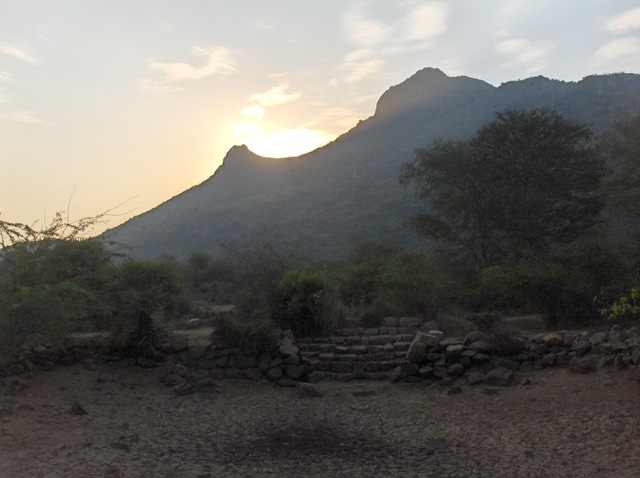
The Frog Pond is dry by mid March when these pictures were taken. The season is getting hot, so  we started early and were here by 7 AM, before the sun rises over Arunachala. The bright sun can be seen behind the ‘trunk’  of The Elephant. We will have sunlight in a few minutes.

HPIM1934

The Path starts off across an area pretty dry and flat.

HPIM1935

Looking to the right side, first you see the gap between Arunachala and a small hill. There is a path over this gap that is shown in A Path Across Arunachala.

HPIM1936

Looking behind is Parvati Hill, and the pass at the other end of the hill. This is where the original Path was. This is shown in the postings: Kattu Siva Path Renewal – Part 1 and Kattu Siva Path Renewal – Part 2 .

HPIM1937

Next the Path crosses the first of many creek beds …

HPIM1938

Then rises up to the Northside Catchment Basin. Notice that there is a path across the basin that is usable much of the year. Some people take this path here.

HPIM1940

The main route of the Path goes to the left, and follows along the dirt berm that makes up the retaining wall for the catchment basin.

HPIM1941

Walking across this berm, farmers’ fields come right up to the path. This is the only place where this occurs.

HPIM1945

In the photo below, looking over the basin, a big rock can just barely be seen rising through the trees. On the other side of the basin here is a trail nexus where a number of paths go towards and along the mountain side. This is shown better in Under the loving gaze of The Elephant.

There is an old small trail next to the mountain in this area that we call ‘The Inner-Inner Path.’ This will be detailed in subsequent postings. Easy exploration can be done here.

HPIM1948

Between the Path and the fields, the farmer has made ‘fences’ of dry thorny branches. This keeps cattle from entering the fields. 

HPIM1950

At the end  of the basin the Path crosses another dry stream bed …

HPIM1952

Then goes off across the gentle hills. 

HPIM1953

In this section a power line crosses the Path. This is the only place where this happens.

HPIM1957

Now the sun is starting to  rise above the Holy Hill, and there is better light for photography.

HPIM1961

The Path lights up …

HPIM1960

And crosses yet another creek bed. We walk down and up the little hill.

HPIM1963

Looking to the left, the gopuram of Adi Annamalai Temple rises through the trees.

HPIM1967 closeup

Often this man will be seen, asking for coins. Sometimes it looks like he is working, clearing rocks off the Path and doing other work to improve the Path. 

HPIM1968 closeup

Looking to the left of the Path, not a house can be seen. More mountains rise up on the horizon. There is no motor noise here; all we hear are bird songs.  

HPIM1974

The Path proceeds across the hillside.

HPIM1976

Looking towards Arunachala, a rocky hill can be seen in the foreground, rising from below. More places to explore. I have seen a group here, up on one of the rocks. It seems they were with a teacher and meditating.

HPIM1979

Past another creek bed. This on has a stone wall to prevent erosion. These are seen in other places as well. This is all a part of the task of protecting the hillside and bringing as much water into the water table as possible.

HPIM1987

The Elephant is in the background. A face of the hill rises in the foreground. Water can be seen flowing down rock faces during the rainy season.

HPIM1990

The Path winds on.

HPIM1992

And on.

HPIM2000

We are getting close to the face of the hill that rises here.

HPIM2007

Reminding us of the desert-like environment, here is another cactus, well protected from the heat that is soon to come.

HPIM2010 closeup

Just barely visible here on the hill face is a small white box. This once housed an idol. This idol has been taken by vandals. You can walk up to this spot and get a great overlook of the surrounding area.

HPIM2014

On the other side is a steeper area of the rock face. Back towards this hill it is greener, a sign of better water. There is a trail that leads into this greener area. Sometimes village women can be seen carrying bundles  of dried grasses down this trail.  The local people know the plants that can be used here, and make good use  of everything.

HPIM2020

Now the angle between the trunk and head of The Elephant has  become more acute. This means we are nearing the end this section of the Inner Path. I think of this as the ‘Elephant Compass’ and use the angle as a way to know where I am on the Path.

HPIM2021

The Path continues to wind through the countryside.

HPIM2023

HPIM2034

The ‘Elephant Compass’ gets yet more acute. Getting closer to the end the of the section. 

HPIM2035

Now, through the trees, houses can be seen far away. Road  noise is also sometimes heard.

HPIM2037 closeup

The Path continues through the dry brush. 

HPIM2039

Look at the ‘Elephant Compass’ now. Where are we? We’re reaching the end of this section.

HPIM2045

Looking back, we can see the hill face rising behind us. There is a  big area on this side of the hill that needs to be explored. This will be done in other posting, later.

HPIM2046

Down a bit more of the Path.

HPIM2048

A stone post with a painted Inner Path marker defines the end of The Elephant section of the path. Sometimes camphor will be seen burning in a pit on the top of this post. Notice that there are paths that lead both to the right and the left here. One set goes  towards the road, the other towards the mountain. The Inner Path goes straight, past the post.

HPIM2050 closeup

The next section of the path, we call ‘Trees.’ We will post this soon.                          

Related Posts   

Inner Path – Southwest Side
I
nner Path – South Side from Ramanasramam
Inner Path – Around Parvati Hill 
Under the loving gaze of The Elephant
Adi Anamalai Temple

Harsha's avatar

Body And The Universe: By Madathil Rajendran Nair

Close your eyes and still,
Feel your body
Part by part.

And, as you begin to drown
In slumber’s sweet hold,
Mountains pop up,
As do vales, waterfalls
Green trees, vast landscapes,
Stars and the Milky Way.

The body is all that,
Part by part!
The body is the Universe,
You are the body
And you are all!

A magnificent pulsation
Without parts and
Without a beyond!
Be just aware
And remain
Your own ecstatic self.

[Inspired by the poem “We Encountered The House Of Realization”  by Yunus Emre (1238 – 1320)]

Harsha's avatar

ULLADU NAARPADU (Reality in Forty Verses) – #s10 & 11.

ULLADU NAARPADU
(Reality in Forty Verses)

The famous Vedantic poem in Tamil by Bhagavan Ramana Maharishi
(consisting of two preliminary verses called Mangalam,
40 verses which form the main text ,
and another 40 verses called the Appendix)
Detailed Commentary in Tamil by Lakshmana Sharma,
adapted into English by Profvk

(Continued from ULLADU NAARPADU – Verse No.9
See Post #48214 Of Harsha Satsangh.
For the first post in this series see #47923)

Lakshmana Sharma’s Introduction to Verse Nos.10 & 11.

We have just said that duads and triads are all unreal. The most important duad is the pair ‘jnAnam-ajnAnam’. Among the triads the important one is: ‘knower, known and knowing’. These also are unreal. In addition to explaining that in the state of Self-Realisation these don’t survive, the main topic of this work is called ‘Self-Knowledge’ (Atma-jnAnam). Therefore the meaning of the word ‘jnAnam’ is taken up for explanation in the four stanzas 10 to 13.

Of these four, the first one below explains how all the knowledge that is accrued by an ajnAni is nothing but ajnAnam (ignorance), and not jnAnam (true knowledge). ‘Knowledge of the Self is the only Knowledge’ says Verse #10. So we get the meaning that any knowledge of non-Self is only ignorance. That except for the Self-Knowledge all other things are only ajnAnam is further clarified in verse #11.

Verses #10 & #11

aRiyAmai viTTu aRivu inRu Am;
aRivu viTTu avvaRiyAmai inRu Agum;
‘anda aRivum aRiyAmaiyum Arkku’ enRu
ammudalAm tannai aRiyum aRivE aRivu.

aRivu uRum tannai aRiyAdu;
ayalai aRivadu aRiyAmai anRi, aRivO?
aRivu ayaRku AdhArat-tannai aRiya
aRivu aRiyAmai aRum.

Translation (Lakshmana Sharma)

#10. Knowledge is never and nowhere in the world separate from ignorance, neither is ignorance at any time and for any one separate from knowledge. True knowledge is the awareness of the original Self, which becomes manifest by the Quest ‘Who is this I in the form of Ego to whom belong both of these’, nothing else.

#11. How can the knowledge of objects arising in relative existence, to one that knows not the truth of (himself) the knower, be true knowledge? If one rightly knows (the truth of) him in whom both knowledge and its opposite subsist, then along with ignorance (relative) knowledge also will cease once for all.

Translation (Prof. K. Swaminathan)

#10. There is no knowledge without ignorance; and without knowledge ignorance cannot be. To ask, `Whose is this knowledge? Whose this ignorance?’ and thus to know the primal Self, this alone is Knowledge.

#11. Without knowing the Self that knows, to know all objects is not knowledge; it is only ignorance. Self, the ground of knowledge and the non-Self, being known, both knowledge and ignorance fall away.

Translation (Osborne)

#10. Ordinary knowledge is always accompanied by ignorance, and ignorance by knowledge; the only true Knowledge is that by which one knows the Self through enquiring whose is the knowledge and ignorance.

#11. Is it not, rather, ignorance to know all else without knowing oneself, the knower? As soon as one knows the Self, which is the substratum of knowledge and ignorance, knowledge and ignorance perish.

#10. Word by Word

aRiyAmai viTTu : Separated from ignorance
aRivu : knowledge
inRu Am.:can never be
aRivu viTTu: Separated from knowledge
aRiyAmai: ignorance
inRu Agum. there never is.
Arkku: Whose (or, to whom)
anda aRivum: (belong) that knowledge
aRiyAmaiyum: (and) ignorance ?
enRu : (By questioning) thus,
aRivE :that knowledge alone
aRiyum : that knows
ammudalAmtannai: the ‘I’ in the form of Ego which is the source of everything
aRivu: is the (true) Knowledge.

#11. Word by Word

aRiyAdu: Without knowing
aRivu uRum tannai :the truth of the self who knows (tan, tAn: one’s own; self)
aRivadu: to know
ayalai : all else (foreign to Self; non-self)
aRivO? : Is it Knowledge
aRiyAmai anRi : other than Ignorance ?
aRiya : (Once we ) know
AdhArattannai : the root-source
aRivu ayaRku : For both knowledge and the non-self (the known thing)
aRivu aRiyAmai : (the duad of) knowledge and ignorance
aRum: will perish.

#10. Tamil Commentary by Lakshmana Sharma

The two words ‘knowledge’ and ‘ignorance’ refer to the knowledge and ignorance of worldly matters and things. These two arise from the Ego as pointed out in the last verse. They appear to be true so long as the Ego is live. But the Ego vanishes in the state of Self-Realisation; so knowledge and ignorance are unreal.

The worldly knowledge is not jnAnam, as we usually think. It is only ajnAnam (Ignorance). One reason for this is stated here; namely, knowledge and ignorance form a duad – one cannot be isolated from the other. Things that form a duad have this property of non-separability. In the same manner worldly knowledge and ignorance are inseparable. When we have knowledge of one thing there is ignorance of another thing. What is knowledge for one may be ignorance for another. In other words the concepts of knowledge and ignorance are impermanent. All such knowledge belong to the Ego which is the root of all Ignorance. So all these are only ajnAnam.

Two more reasons will come out in the next stanza. ‘I know, I don’t know’ –these are statements of the JIva; but they arise only in the state of non-realisation of the True state of the JIva which is the Atman. When the Atman is realised, the knowing and non-knowing disappear. Therefore they are both ajnAnam.

Further ajnAnam itself is a non-existing entity. It is our delusion that creates it. This will be explained in Verse #13.

Since now we have said that whatever we think as jnAnam (knowledge) is actually ajnAnam (ignorance), the question arises: What exactly then is jnAnam? Whose are these two kinds of ajnAnam? The reply to this will come as: “It is for me”. “Who is this I?” is the next question which is the basic question for the Self-Quest. If one makes his mind one-pointed in that quest, the result will be the destruction of the ego-centric I. This is jnAnam. The words ‘mudalAm tan’ of the verse mean this Ego. This is the one which is the source of all the body, mind and intellect. When this ego is destroyed, the ever effulgent pure experience of the Atman will manifest without any obstacle. This is the true state of jnAnam. It is by the destruction of the Ego that this state becomes one’s own: — this is explained in Verse #27.

‘Separated from Ignorance there is no Knowledge’ — In these words of the verse the word Ignorance may also mean the ‘I-am-the-body’ feeling that constitutes the Moola-ajnAnam (Root-Ignorance). From this one can interpret that worldly knowledge occurs only to those who have no knowledge of the Atman and that those who have the Self-Knowledge would not have the worldly knowledge.

#11. Tamil Commentary of Lakshmana Sharma

The ‘I’ that says “I know the things of the world” is the chid-AbhAsa, (relected Consciousness) the false feeling of ‘I’. It is like the snake seen on the rope, or the son of a barren woman. It is totally unreal – we saw this earlier itself. It will be again explained later. It is none other than the Ego. To quest in search of the source of this Ego is the means of attaining jnAna, that is mukti. He who does not know himself by this means is not the knower of the real Self. He thinks that this chid-AbhAsa is the Atman. This is the root-ignorance (moola-ajnAnam). Those who are subject to this do not know the world as it truly is; therefore whatever he knows as knowledge was said to be ignorance only.

A devotee asked Bhagavan: “How can we say the world that we see directly is unreal?”. Bhagavan replied to him: “The world laughs at you because it says ‘How can you, you who do not know yourself, know the truth of me?’”. The way the jnAni knows the world and the way the ajnAni knows the world are totally different – this will be known by the verse #18. The ajnAni ignores the groundbase-Brahman (adhishTAna-brahman) and cognizes the superposed (Aropitam) names and forms and their differences and takes them as real, thereby imprisoning himself in bondage. For the jnAni however, only the base-brahman manifests. So the jnAni does not incur any bondage.

Thus there are two kinds of ajnAnams in ajnAnis. One is the ignorance known as ‘Ignorance’. The other is the ignorance known as ‘knowledge’. Both these have to be eradicated. It is ignorance to think that one of them should go and the other should remain.

There is another reason for contending that both these are ajnAnam. Both are destroyed at the onset of Self-Realisation. This is the content of the last two lines of this verse.

In other words in the state of Self-Realisation, both these don’t exist.

In the text, the word ‘ayal’ which means ‘foreign’ has two interpretations. Ignorance is the opposite of Knowledge, is one. The other meaning is: ‘It is the known that is thought of as distinct from the knower’. The mind which takes the place of knower and the known worldly matter which is manifested by it — the source for both is the Ego. And its Truth goes back to the Atman.

(To be continued in Verse No.12)