

Meeting Nisargadatta Maharaj: By Dr. Lakshyan Schanzer

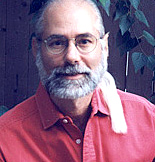
My name is Lakshyan Schanzer. I have been practicing and teaching yoga and meditation since 1971. I am also a psychologist and practice a meditative approach to psychotherapy. This is my first writing about my experiences with Nisargadatta Maharaj.

By 1978 I had been practicing and teaching for about 7 years (primarily Integral Yoga) and had reached a ‘wall’ in my practice. I was having wonderful experiences/results on a daily basis. Yet, for me, these experiences were just that; only experiences. Yes, they were important and healing ones, bringing revelations and insights into my history, release of deep feelings, or guidance about the coming day or accurate premonitions about the future.
However, as I became accustomed to ‘pushing the buttons’ that generated these experiences, I began to ask myself: “Was there any value beyond these temporary conditioning effects of regular practice? That is, if we experience ourselves as the product of conditioning, and if practice is just to create a ‘sattvic’ body-mind condition, does cultivating one condition over another give any real freedom?
In spite of my pessimistic reasoning, of course I continued my practice. Obviously it is better to condition yourself to have positive life experiences rather than to have negative ones. Yet, because of my sense of truth or maybe because of a scientific bent, I really wasn’t satisfied in thinking that the result of practice was just a kind of conditioning.

I focused heavily on these kinds of thoughts: Was I just ‘luckier’ than someone who didn’t practice? What if my conditions changed so that I couldn’t keep up this sadhana practice (i.e. if my health or means of survival changed)? How would my sattvic state really be any different than anyone else’s non-sattvic suffering? I began to ask my teachers these questions, inquiring if something was lacking in my practice. Most really didn’t understand my problem. At best, the answer was: “Just practice more.”

I believe it was this kind of self-examination that led me to Maharaj.
I had already begun a career in integrating meditative practice with the world of mental health and health psychology. Interested in continuing my studies (especially regarding the integration of yoga into health care settings) and hoping to take these questions to some known or unknown guru, I planned a trip to India for December 1978.
I arranged to visit various centers, ashrams, even hospitals, and of course, gurus. I did not know that Nisargadatta even existed, let alone that I would be directed to see him. Yet, within two days of my arrival in Bombay one of the head monks (I think his name was Pierre) in Swami Muktananada’s ashram said: “Since my guru isn’t here right now, you really should meet a fully enlightened master. Here is his address”.
What follows are some of my first impressions of my first meeting with Maharaj that I kept as notes during the trip:
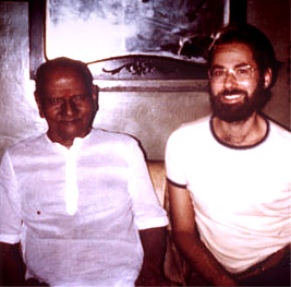
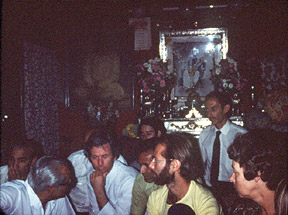
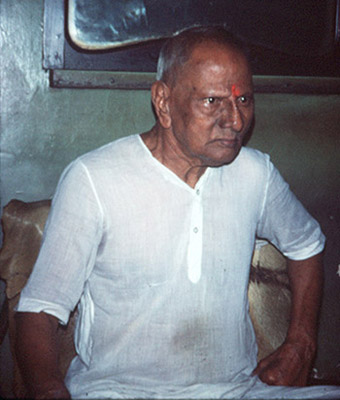
The taxi driver was having trouble locating the address. Maharaj’s apartment was located at Ketwadi Street, a humble residential area, not far from the prostitute district. Neighbors could not tell where to find this Jnani Yogi, even though he had been residing and teaching there for many years. Finally after finding it, one of Maharaj’s devotees spotted the taxi and was directing people upstairs to a tiny (maybe 12 x 12 ft) room. There were about ten people already sitting with a wiry little old man. Maharaj inspected each person as they ascended the loft where he gave satsangh.




 Luthar.com
Pingback: Sri Bhagavan Ramana Maharshi « HarshaSatsangh
This is one of the best reads Dr. Lakshyan. Thank you so much for posting.
Never seen so many photographs of Maharaj.
But tell me the secret of “…. having found something that was never lost. ”
How, how how???
I feel I have been a beginner for so long, I have forgotten what it is to be a seeker on the way!! 😦
Thank you for the marvelous post anyway!!!
LikeLiked by 1 person
These days, when the ever growing number of naive spiritual seekers are on a hunt for their spiritual guru, Sri Nisargadatta Maharaj needs to be brought to the forefront of spirituality. Thank you, Dr. Lakshyan for bringing Maharaj even closer to my heart!
Peace,
Stan
LikeLiked by 1 person
Reblogged this on Luthar.com and commented:
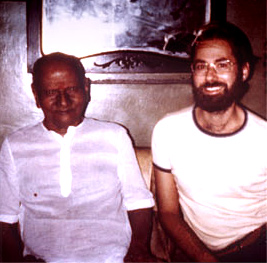
A classic and original article about meeting Nisargadatta Maharaj in 1978 by Dr. Lakshyan Schanzer. All the pictures of Nisargatta Maharaj were taken by Dr. Schanzer. At the end, the author is shown sitting with Maharaj.
LikeLike
Just Beautiful
LikeLiked by 1 person
❤
LikeLike
Nisargadatta..is my constant guide…..thank you Dr. Schanzer for sharing your experiences…Brian
LikeLiked by 1 person
“I observed Maharaj decorating his altar preparing for meditation and chatting with his wife…”
Thank you for mentioning that. I was under the impression that his wife had died in the 1940’s and that he never remarried. That changes my impression of him very little, but I nonetheless appreciate having a small detail of his life corrected.
LikeLiked by 1 person
The author of the article probably took another member of Nisargadatta Maharaj’s family to be Maharaj’s wife. Maharaja’s wife died when Maharaja was in his forties. For other biographical information see the following link to David Godman’s site. David Godman spent time with Maharaja and knew him well.
http://www.davidgodman.org/interviews/nis1.shtml
LikeLike
Thank you
LikeLiked by 1 person
Very nice post!
Good to know what you are in Providence, RI. Wish I could have met you there.
I went to grad school studied in the city.
LikeLiked by 1 person
Wonderful!
LikeLiked by 1 person
Thank you so much for this charing. Many years back i went through the same doubts about my sadhana . It is interesting to see that they are many ways to deal with it.
LikeLiked by 1 person
I too have similar experience with similar enlightened personality Bhagat Shri Raghuveer ji way back 1981- 87 even after till to date after his samadhi ,Bhagatji all visible discribed attributes of Nisagadatta maharaj , difference was I was not ayoga practitioner but an ordinary person . I will assemble my days days in satsang with Bhagatji maharaj,as we usually called him ,as I have not kept any records and will share with you. Under the caption my days in Chandigarh.
LikeLike