Harsha's avatar

What is God’s Name? By Dr. Harsh K. Luthar

What is God’s name?

Harsha's avatarLuthar.com

Ramana Maharshi: “I am” is the name of God. Of all the definitions of God, none is indeed so well put as the Biblical statement “I am that I am” in Exodus (Chapter 3).

Words are used in various spiritual traditions to describe God or give God a name. Many people are convinced that their religion, their scriptures, and their way of worshipping God is the best way. Sometimes people argue and and fight over God as well. 

Our conception of God is to large extent a function of where we are born and in what religion. Our mental conditioning is often so strong that we are not able to see the diversity of perspectives in various spiritual traditions. Only the mystics in different religions, who have through self-reflections and meditation, gone beyond their mental conditioning offer a unified vision of God. 

The ultimate reality of God and Existence is…

View original post 691 more words
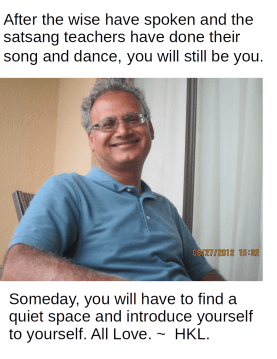
Harsha's avatar

The Heart of God:The Nature of Self-Realization. By Dr. Harsh K. Luthar

The nature of Self-Realization

Harsha's avatarLuthar.com

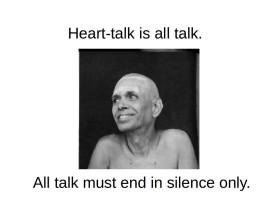
Heart Talk is All Talk

The difficulty in many of our conversations about spiritual insight is that the true understanding is not intellectual or conceptual, but absolutely direct. It is clear and direct without the medium of the mind.

Truth has never been a monopoly of a particular religion or spiritual tradition. How can it be? Some may disagree, but in my view, God does not play favorites.

We cannot make Truth our personal property but only allow the quality of Truth to overtake us and shine in us. We cannot possess God but only surrender to the Divine Will and let God take over our life.

View original post 1,261 more words

Harsha's avatar

How to Begin Self-Inquiry: By Dr. Harsh K. Luthar

The play of concepts is endless. Concepts about the body, the mind, spirit, etc. It is the quicksand which entangles one more and more. It is the stuff of religion, philosophy, spirituality, great writers, great thinkers, great teachers, great leaders, etc.

The presumption to teach and help others to improve themselves reveals the unrelenting grip of the ego. Sri Ramana used to say that our first duty is to realize our true nature.

The wise say, that, “I am the doer” notion is bondage (See the Bhagavad Gita). This is a very deep philosophy and requires a subtle understanding of how to remain balanced in life. 

Continue reading

Harsha's avatar

NAGARJUNA’S KILLER TIME GAP

From Mira Prabhu at Arunachala.

Mira Prabhu's avatarmira prabhu

1ce24b49ef2c97c59535c8ba9b69f382I am no scholar and frankly admit that my long years of immersion in Eastern Philosophy were driven solely by an obsession to destroy my own darkness. In my teens, I dived into esoteric teachings in an attempt to understand my angst, and while much I learned took me a little further down the road to peace, it was a Buddhist Geshe I met in Manhattan many years ago who finally helped me sort out the confusion I felt about the nature of reality; it was through him that I came upon the luminous Indian scholar Nāgārjuna, considered second only to Gautama Siddhartha in the context of his critical contributions to eastern thought.
Nagarjuna’s life is a bit of a mystery to us moderns since surviving accounts of his life were written, in Chinese and Tibetan, centuries after his death. Most likely he was born into a Brahmin family in South India…

View original post 778 more words

Harsha's avatar

Rest in Beauty: By Dr. Harsh K. Luthar

Rest in beauty awaken in love. Myself, yourself we rise like waves. Splash and play on the banks of life. Sign our names on this lovely sand and then back again. Ocean calls. This embrace has no be…

Source: Rest in Beauty: By Dr. Harsh K. Luthar

Harsha's avatar

Self, Shakti, Heart, and Enlightenment in Advaita: By Dr. Harsh K. Luthar

As Sri Ramana has said, — that which is real is ever present—. We have to see what is present right now in this very moment. If we become quiet, we are able to feel our ordinary awareness, the sense of “I Am” as being present in this moment. That is the seed. If we water it and give it food, it grows and the Reality reveals it Self from within.

Harsha's avatarLuthar.com

Often on the spiritual path, the topics of best postures, best techniques of meditation, best behaviors conducive to spiritual growth, best gurus, etc., come up. All of these questions are appropriate to their time and circumstances.  Such questions were frequently put to Bhagavan Ramana.

Underlying all such questions is the fundamental theme or inquiry as to what constitutes superior spiritual practice that will lead to improvement in one’s mental and physical conditions and finally to Self-Realization or Enlightenment. From this perspective, Self-Realization is viewed as an attainment. It is something that is achieved by an individual by making the right effort. This approach in its methodology is not too different than that of a talented world class athlete, who after having trained rigorously, wins a gold medal at the Olympics.

This point of view emphasizes the need to focus the mind in order for it to expand and evolve to…

View original post 1,246 more words

Harsha's avatar

The Path to Enlightenment: By Dr. Harsh K. Luthar

In this essay, I suggest that the philosophies and perspectives of the gradual or the direct path are not inherently meaningful. Their truth lies only in being teaching tools. Words and concepts such as the “direct path” and the “gradual path” are meant to point at the truth but they are not themselves the truth. The Truth must reveal itself to us in our own Heart.

Harsha's avatarLuthar.com

docimage138

A Popular Dichotomy

A popular dichotomy has emerged about Enlightenment in the West since the 1970s between the schools of “gradual enlightenment” and “instant enlightenment”. Some of this can probably be traced back to Poonja ji’s and Nisargadatta Maharaj’s disciples returning to the west in the 1970s and 1980s from India and bringing their understanding of Advaita Vedanta with them as given to them by their teachers. However, because many of these students deviate from traditional Advaita as taught in the classic lineage of Adi Shankracharya, they are referred to as neo-advaitins.

Given this thesis and antithesis between the gradual path and the direct path, I address the following question:

It is said that there are two approaches to the Truth of Being or Reality which some call Enlightenment or Self-Realization. A gradual path and a direct path. What is the truth of it? Are their really two paths? If…

View original post 2,125 more words

Harsha's avatar

Self-Realization According to Ramana: By Dr. Harsh K. Luthar

Summary of Bhagavan Sri Ramana Maharshi’s teaching on the Self.

Harsha's avatarLuthar.com

The following is a summary of Bhagavan Sri Ramana Maharshi’s teaching on the Self.

Self-Realization cannot be described because Self can never be an object of perception.  The Self  is always the subject. The Ultimate Subject.  When the mind is temporarily absorbed in the Heart, the Self is known with immediacy as the eternal presence. That is called Kevala Nirvikalpa Samadhi.

However, even after having attained Nirvikalpa Samadhi, the mind has the tendency to sprout up again with its conditioned habits due to the force of karma (previous tendencies). Hence the need for awareness and practice of reflective inquiry continues.

When the mind is completely resolved in the Heart, the Self naturally and spontaneously dominates in all states of consciousness (waking, sleeping, super-conscious). That is known as Sahaj Samadhi or the natural state. In this state, the karma that has started to bear fruition will continue until the end of…

View original post 89 more words

Harsha's avatar

Nirvikalpa Samadhi – Two Different Perspectives: By Dr. Harsh K. Luthar

The state of Nirvikalpa Samadhi that Sri Ramakrishna refers to and Kevala Nirvikalpa Samadhi that Ramana Maharshi refers to are two different things.Two different Samadhis.

Source: Nirvikalpa Samadhi – Two Different Perspectives: By Dr. Harsh K. Luthar

Harsha's avatar

The Magic of Being Alone

From Mira Prabhu, the yogini, mystic, and insightful writer currently residing at Arunachala.

Mira Prabhu's avatarmira prabhu

GRAPHIC OF WOMAN1992 for me was a time of great personal darkness—sparkly on the outside, rotten on the inside. Stuck in a difficult marriage, I asked a friend at work if I could unload my troubles on her.

Karen was an opera singer at the start of her career; like me, she supported herself by freelancing in Manhattan law firms and on Wall Street. I admired her creativity, courage and higher values. Often  after work we’d walk across Manhattan to my apartment and chat while I cooked us dinner.

“Let’s go to Central Park tomorrow,” she suggested. “We can talk freely there.” So next day we strolled through that gorgeous park and I told her, tears streaming down my face, that the husband I once believed I’d love and respect to my dying day had turned into a materialistic stranger.

“Why are you so scared to leave him then?” she asked in her direct fashion. “Sounds…

View original post 787 more words