Harsha's avatar

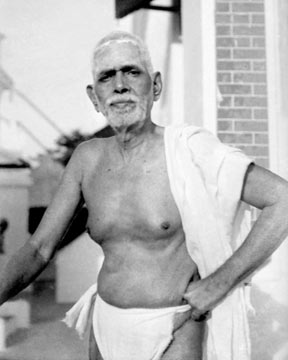
Ramana Maharshi: The Master of Silent Teaching: By Gabriele Ebert

Editor’s note: Because Gabriele Ebert’s native tongue is German, I had to edit the article. If there are any mistakes in the article, I accept complete responsibility. Please bring any such errors to my attention and these will be corrected right away.

Master and Disciple

The characteristics of a spiritual master is that he leads his disciple toward experience of the eternal truth by way of teaching. In Hinduism this is called upadesa (spiritual teaching, spiritual instruction). But master and disciple have to harmonize with each other, i.e. the master must be able to transmit his teaching whereas the disciple must be ready to grasp it and put it into practice. Otherwise, the relationship of master and disciple will bring no fruit.

In giving instructions to the student, medium of speech normally plays an important role. However, in spiritual instruction and transmission to the prepared student, according to Sri Ramana, speech is not the most potent means. Indeed, the sage of Arunachala is known as the great master of silent teaching.

A visitor said: “Bhagavan says, ‘The influence of the Jnani (Self-Realized one)steals into the devotee in silence.’ Bhagavan also says ‘Contact with great men, exalted souls, is one efficacious means of realising one’s true being.”

Ramana responded: “Contact with them is good. They will work through silence. By speaking, their power is reduced. Silence is most powerful. Speech is always less powerful than silence. So mental contact is the best.”

And on another occasion Ramana pointed out the potency of such teachings outside the verbal medium: “Such mouna [silence] is not inertness but great activity. It is the most powerful speech.”

Silent Teachings – Heart to Heart Instructions

The silence (mouna) Ramana talks about is not just absence of speech. It is when the mind/ego becomes silent, free from thought, and comes to rest in the Self.

If the ego/mind is fully absorbed in the Self, it will not appear anymore and assert itself as a separate identity. Such a one in whom the ego has been fully vanquished is called a Jnani. He will stay in the Self and will no more return to an ego-centered state. The ‘I’ working through him/herself is no more the little ego-I, but the Self of God. In his booklet “Who am I?” Ramana says: “It is this state, where there is not the slightest trace of the ‘I’-thought, that is the true Being of oneself. And that is called Quiescence or Mouna (Silence).”

Only who rests permanently in this silence can also transmit his teaching in silence. The disciple is not yet in this state, but he yearns for it above all. Through the silence of his teacher he is guided into his own heart, the source of the ego, to that ‘place’ from where this impermanent ego-I arises and submerges again.

In the beginning, the disciple will become silent, and enter for a short in the same state in which his master permanently rests. In this state, he finally experiences his own true nature. In this silence he starts to understand the truth. This is the Heart to Heart instruction.

This is a different path than the one of eloquent speeches and lectures of popular swamis and gurus.  This is the direct path of experience. This is the pathless path, and only suitable for mature seekers. Ramana states that for most seekers verbal instruction is needed.

“Silence is the best Upadesa (spiritual teachings), but it is suited only for advanced students. Others are unable to draw full inspiration from it, therefore they need words to explain the Truth. But Truth is beyond words. It does not admit of explanations. Lectures may entertain individuals for a few hours without having an effect upon them, whereas the result of silence is permanent and benefits all. Even though it is not understood, that does not matter. Oral lectures are not so eloquent as silence. It is unceasing eloquence. The primal master Dakshinamurti is the ideal and he taught in silence.”

Ramana and Dakshinamurti

Ramana was often identified with Dakshinamurti, who is the youthful Siva and represents his ascetic aspect. He is considered as the Guru of all Gurus, sitting under a Banyan-tree in silence. The four disciples, who seek his guidance, are “old”, i.e. they are ripe and Dakshinamurti teaches them in silence alone.

Ramana writes in his two verses on Dakshinamurti:

“Who is the youthful guru beneath the banyan tree?

Very old are the pupils who seek him.

The handsome teacher’s speech is silence.

Cleared are all the pupils’ doubts.

Under the wonderful banyan tree shines the youthful

guru. Aged pupils come to him. Silence is this teacher’s

speech. Gone are the doubts in the pupils’ minds.”

The following episode from Sundaresa Iyer’s reminiscences illustrates Ramana’s way of silent teaching:

“It was a Sivaratri Day. The evening worship at the Mother’s shrine was over. The devotees had their dinner with Sri Bhagavan, who was now on His seat, the devotees at His feet sitting around Him.

At 8 p.m. one of the Sadhus stood up, did pranam (offered obeisance), and with folded hands prayed: ‘Today is Sivaratri Day; we should be highly blessed by Sri Bhagavan expounding to us the meaning of the Hymn to Dakshinamurti (stotra).’ Says Bhagavan: ‘Yes, sit down.’

The Sadhu sat, and all eagerly looked at Sri Bhagavan and Sri Bhagavan looked at them. Sri Bhagavan sat and sat in His usual pose, no, poise. No words, no movement, and all was stillness! He sat still, and all sat still, waiting. The clock went on striking, nine, ten, eleven, twelve, one, two and three. Sri Bhagavan sat and they sat. Stillness, calmness, motionlessness – not conscious of the body, of space or time.

Thus eight hours were passed in Peace, in Silence, in Being, as It is. Thus was the Divine Reality taught through the speech of Silence by Bhagavan Sri Ramana-Dakshinamurthi.

At the stroke of 4 a.m. Sri Bhagavan quietly said: ‘And now have you known the essence of Dakshinamurti Hymn?’”

Ramana’s own Spiritual Experience

Ramana’s way of teaching in silence arose from his own spiritual experience. At the age of 16 he suddenly had a kind of death-experience, through which he spontaneously realized the Self.

One day, when he was all alone at home, unexpectedly and without reason an unmistakable fear of death caught hold of Ramana. But instead of seeking help from outside he turned within and asked, who was it, that is going to die and if death of the body means also death of himself. Suddenly the shell of the ego dropped off forever. From then on, he was certain, that in truth he was the Self (Atman, God, the Absolute, or whatever name one might like to give it). His attitude towards the world changed completely. Ramana had become silent in the deepest sense of the word.

Soon after he left his home in Madurai and went to the holy hill Arunachala, which he venerated since childhood. He settled down and stayed there until his death.

In the first few years at Arunachala Ramana was silent and completely absorbed in this truth, which was his inner most and real Being. Withdrawn from the world, Ramana remained in perpetual samadhi while the insects fed on his body. His body was kept alive by a few people who by the grace of God happened to be around and noticed this teenager doing what they believed was intense tapas (spiritual practice).

Ramana did not start teaching of his own accord. If people would not have noticed him and sought his company or advice, he perhaps never would have become known. But the spiritual seekers who came within his orbit felt instintcively that he was a great sage, a rishi, a Maharishi, the One, who was a great seer and who lived the truth and was completely authentic.

Sincere people started to come to Ramana with their questions. The silent Sage answered them, at first only by writing down his answers. But slowly in response to the aspirations of those around, Ramana returned gradually to speech, and using words to teach.

Ramana always emphasized that the highest teaching is transmitted in silence. Ramana never called himself a guru or Maharishi. In His view there were no master and disciples. However, the students who gathered around him were overwhelmed by the brillaint luster and the peaceful radiance of the great sage of Arunachala. Ganapati Muni, one of most powerful intellect and spiritual personalities of the time was the first to call Ramana a Maharishi (Great Seer).

As Ramana adapted to his surroundings, he  gradually became more and more open to talks.  In the Hall, where he could be met days and nights, philosophical topics were vividly discussed. Pundits came with their questions. His followers like Ganapati Muni, were superb adepts of the holy Hindu-scriptures – and the answers which Ramana gave fill many volumes. At times the Hall was also a workshop of artful peotry. Politics and themes of everyday life were discussed as well.

Though Sri Ramana was a master of silent teaching and silence (mouna) is seen as an important means in Hinduism, he dissuaded his devotees from taking a vow of silence. Nevertheless Major Chadwick, one of the Western devotees of Ramana made plans to do so.

This amusing story is found in Major Chadwick’s reminiscences: “During the war I decided that I would like to do so, chiefly to protect myself from the jibes of others. I went and asked Bhagavan’s permission. He was not enthusiastic and told me that it was useless to keep the tongue still but to continue to write messages on bits of paper which so many so-called Maunis (silent ones) continue to do. In this way only the tongue had a rest but the mind continued just as before. I said that I had no intention of doing this but would throw my pencil and paper away. I felt that I had obtained a reluctant consent as Bhagavan agreed that people were worrying me. So I made the necessary arrangements, installed a bell from my room to the kitchen so I should not have to call my servant, and fixed a lucky day to begin.

The night before I was to start, a friend of mine brought up the subject in the Hall after the evening meal when only a few of us were present. Bhagavan immediately showed his disapproval and said it was unnecessary and in fact not a good thing at all. I did not talk much anyhow. It was better to speak only when it was necessary, that it actually did no good to observe silence, that if one did so for twelve years one became dumb and might obtain some thaumaturgic powers, but who wanted them? Speech acted as a safety valve. Naturally after this talk I gave up the idea.”

The Power Of Silent Look (Darshan)

Many people came to be in Ramana’s silent presence, without asking him questions or talk to him. His look was extraordinary intense and penetrating directly into the hearts. The cook Shantamma reports the following example:

“One morning a European came in a horse carriage to the Ashram and went straight to Bhagavan. He wrote something on a piece of paper and showed it to Bhagavan. Bhagavan did not answer; instead he gazed at the stranger with unwinking eyes. The stranger was staring back at him. Then Bhagavan closed his eyes and the stranger also closed his. They stayed without moving. At mealtime the meals were served but Bhagavan would not open his eyes. Madhavaswami, the attendant, got Bhagavan’s water pot and stood ready to lead Bhagavan out of the Hall. Bhagavan would not stir. We felt afraid to go near, such was the intensity around him. His face was glowing with a strange light. The guests in the dining hall were waiting and the food before them was getting cold. Chinnaswami was talking loudly to attract Bhagavan’s attention. Even vessels were banged about, but all in vain. When the clock was striking twelve Bhagavan opened his eyes. They were glowing very brightly. Madhavaswami took up the water jug; the European got into the carriage and went away. It was the last we saw of him. We did not even get his name.”

Silence is the Eternal Stream of Speech

In “Talks” many quotes of the Maharshi can be found, which make clear, that silence is the actual, direct and eternal speech, which flows heart to heart.

“Silence is ever-speaking; it is a perennial flow of language; it is interrupted by speaking. These words obstruct that mute language. There is electricity flowing in a wire. With resistance to its passage, it glows as a lamp or revolves as a fan. In the wire it remains as electric energy. Similarly also, silence is the eternal flow of language, obstructed by words. What one fails to know by conversation extending to several years can be known in a trice in Silence, or in front of Silence – e.g., Dakshinamurti, and his four disciples.

That is the highest and most effective language.”

Elsewhere it is stated: “Silence is never-ending speech. Vocal speech obstructs the other speech of silence. In silence one is in intimate contact with the surroundings. The silence of Dakshinamurti removed the doubts of the four sages. Mouna vyakhya prakatita tatvam (Truth expounded by silence). Silence is said to be exposition. Silence is so potent.

For vocal speech, organs of speech are necessary and they precede speech. But the other speech lies even beyond thought. It is in short transcendent speech or unspoken word, para vak.”

On 20th July 1936 Ramana had the following talk:

A visitor asked: “What is mouna (silence)?”

M.: “Mouna is not closing the mouth. It is eternal speech.”

D.: “I do not understand.”

M.: “That state wich transcends speech and thought is mouna.”

D.: “How to achieve it?”

M.: “Hold some concept firmly and trace it back. By such concentration silence results. When practice becomes natural it will end in silence. Meditation without mental activity is silence. Subjugation of the mind is meditation. Deep meditation is eternal speech.”

D.: “How will worldly transaction go on if one observes silence?”

M.: “When women walk with water pots on their heads and chat with their companions they remain very careful, their thoughts concentrated on the loads of their heads. Similarly when a sage engages in activities, these do not distrub him because his mind abides in Brahman.”

Major Chadwick reports the following episode: “A gentleman from Kashmir came to the Ashram with his servant who could not speak a word of any other language except his native Kashmiri. One night when the Hall was almost dark except for the pale glimmer of a single hurricane lantern, the servant came into the Hall and stood before Bhagavan in a respectful manner jabbering something rapidly in his own language. Bhagavan said nothing, but lay quietly gazing at him. After a while the servant saluted and left the Hall. Next morning his master came to Bhagavan and complained, ‘Bhagavan, you never told me you could speak Kashmiri, was it fair?’

‘Why, what do you mean?’ asked Bhagavan. ‘I know not a single word of your language.’

Bhagavan aksed the gentleman how he had got hold of this absurd idea and the latter explained: ‘Last night my servant came to you and asked you several questions in his language. He tells me that you answered him in the same language and cleared his doubts.’

‘But I never opened my mouth,’ Bhagavan replied.”

Another story: “When Bhagavan Sri Ramana was staying in the Virupaksha Cave, a District Collector and a Deputy Collector went there for his darshan. After prostrations to Sri Bhagavan, the Collector began to speak, narrating at length all that he had read and done by way of sadhana [spiritual practice], and at the end confessed that in spite of all that, peace was as far from him as ever before. No sooner had he finished than the Deputy Collector started to tell his story and stopped only after saying all that he had to say. These two conversations took quite a long time, but Sri Bhagavan did not interrupt them even once, observing strict silence all throughout.

Seeing that neither of them got any reply from Sri Ramana, the Collector once again delivered a long harangue and stopped only when he was at the end of his resources. Yet not a word passed from the mouth of Sri Ramana. The Collector was a little put out at this, and drawled out: ‘We have been speaking to you since long, but you don’t open your lips at all! Will you please tell us something at least?”

Then, Sri Bhagavan spoke: ‘All the while I have been speaking in my own language. What can I do when you won’t listen to it?’

The Collector was intelligent and he caught the meaning of Sri Ramana’s cryptical reply. He was overpowered with devotion and fell down at the feet of Sri Bhagavan, chanting the following (Sanskrit) verse: ‘Strange (sight) under the banyan tree! The disciples are all old and the Guru is youthful; he expounds (the Truth) in Silence and the disciples are freed from doubts!’

Then both of them sat before Sri Bhagavan in silent meditation. They got the peace they were in search of and departed fully satisfied at the outcome of their visit.”

Silence and Inspiration

This silence of the Heart is no dead silence, but also the source of all inspiration. Sri Ramana inspired Ganapati Muni in his writing of the last part of his major poem ‘Uma Sahasram’ just by silently sitting with him. Sundaresa Iyer reports the story in detail:

“Sri Kavyakanta [Ganapati Muni] had composed 700 stanzas of Uma in some thirty different meters, and had announced to his devotees in various parts of the country that this poem would be dedicated on a certain Friday in the Shrine of Sri Uma in the great Temple of Sri Arunachaleswara. Over a hundered persons gathered at the Pachaiamman Temple so as to be present on the occasion. … At about 8 p.m. on the evening before the dedication day, after supper, Sri Maharshi asked Sri Kavyakanta whether the dedication would have to be postponed to some other Friday, as 300 verses were still to be composed to complete the thousand. But Sri Kavyakanta assured Bhagavan that he would complete the poem immediately.

The scene that followed can hardly be believed by one who did not actually witness it. Sri Maharshi sat silent and in deep meditation like the silent Lord Dakshinamurty. The eager disciples watched in tense admiration the sweet flow of divine music in Sanskrit verse as it came from the lips of the great and magnetic personality of Sri Kavyakanta. He stood there delivering the verses in an unbroken stream while disciples eagerly gathered the words and wrote them down. … The ‘Sahasram’ was finished in several meters. … For a while the disciples present enjoyed the deep ecstasy of the silence pervading the atmosphere, as Sri Kavyakanta concluded with the normal type of colophon. Then Sri Bhagavan opened His eyes and asked, ‘Nayana, has all that I said been taken down?’ From Sri Ganapati Muni came the ready and grateful response ‘Bhagavan, all that Bhagavan inspired in me has been taken down!’

Silence and Self-Inquiry (Atma Vichara)

Sri Ramana taught self-inquiry (atma vichara) as the most effective spiritual practice. For the spiritual practitioner both – atma vichara and silence – belong inseparably together. Atma vichara is the active spiritual practice, which leads – together with the influence of the guru, to this silence. Ideally both complement each other (practice and influence of the guru) – as is the case with devotees of Sri Ramana Maharshi.

Ramana has described the method of atma vichara in his booklet “Nan Yar?” (“Who am I?”). The I in the question relates to the original I-feeling of the human being. Ramana says, that this I is the first thought, on which all other thoughts and feelings are based.

But this I-feeling is no continuous entity, as there are also times, when it is absent, so for example in deep-sleep. Ramana explains, that the mind, i.e. this I-feeling arises from the Heart and submerges therein again. With the question “Who am i?” the mind turns to its own origin. But no answer, which the intellect might give can be accepted. Ramana assures us, that with continuous practice the ego will dissolve in the Self – though this is no more in the hands of the practitioner. One day the ego will be rooted out and just drop away. Ramana has repeatedly pointed out this path as the most effective among all.

Teaching in Silence is not bound to Time and Space

One might ask, if with the bodily death of the Maharshi his silent teaching of the Heart to Heart transmission as well came to an end. Does this kind of contact with Him continue or have we to go on search for another master?

Before his death Ramana said: “I am not going away, I am here!” Again and again he assured his devotees, that the body is not the guru and that it does not matter for the jnani, if he is in the body or not. So his bodily death did not end his spiritual guidance.

When in 1950 Sri Ramana died of cancer, his devotees scattered to the four winds. The Ashram was deserted, so that even in daylight thieves could break in and loot. Only slowly the truth of Ramana’s words dawned on the devotees. The power of the Silent Truth and transmission again brought the devotees together to Ramanashram.

This continues today. People are still drawn towards Ramana Maharshi and open themselves to his silent guidance and to self-inquiry as taught by him.

Sources

This article is the translation of: Ebert, Gabriele: Ramana Maharshi: Der Meister der schweigenden Belehrung, in: Wege der Stille, Hamburg 2008)

Iyer, T.K. Sundaresa: At the Feet of Bhagavan. – Tiruvannamalai, 1980

Mudaliar, A Devaraja: Day by Day with Bhagavan. – 3rd repint. – Tiruvannamalai, 1989

Ramana Maharshi: Collected Works. – 9th ed. – Tiruvannamalai, 2004

Ramana Maharshi: Words of Grace (Who am I?, Self-Enquiry, Spiritual Instruction) . – 3rd ed. – Tiruvannamalai, 1996

Ramana Smrti Souvenir: Ramana Maharshi Birth Centenary Offering 1980. – 1.ed. – Tiruvannamalai, 1980

Sadhu Arunachala (A.W. Chadwick): A Sadhus Raminiscences of Ramana Maharshi. – 4th ed. – Tiruvannamalai, 1994

Talks with Sri Ramana Maharshi. – 9th ed. – Tiruvannamalai, 1994


Mudaliar: Day by Day, 9.3.1946

dto., 29.4.1946

Words of Grace, p. 4

Sadhu Arunachala: A Sadhu’s Reminiscences of Ramana Maharshi, pp. 63f

Miracle of Dakshinamurit, in: Collected Works, p. 148

the „night of Siva“, high Siva-feast

Iyer: At the Feet of Bhagavan, pp. 29f

Sadhu Arunachala: A Sadhu’s Reminiscences, pp. 91f

Shantamma: Eternal Bhagavan in: Ramana Smrti, 1.ed., Ramanasram [p. 83]

from Talk 246

from Talk 68

Talk 231

Sadhu Arunachala: A Sadhu’s Reminiscences, p. 65

Silent Speech in: The Mountain path, 1995, p. 37

Recent Books by Gabriele Ebert are:

Ramana Maharshi: Sein Leben, Stuttgart, 2003

Sadhu Arunachala: Erinnerungen eines Sadhus, Berlin, 2004 (German transl.)

Both books are available at amazon.de and can be ordered from each German book-shop.

Gabriele Ebert is a well known  Ramana devotee. Gabriele is a German librarian, scholar, and a painter. Please go to the following link to see her beautiful article on icon paintings full of inspiring pictures.

https://luthar.com/icon-painting-as-a-spiritual-path-by-gabriele-ebert

Gabriele is a long term member of HarshaSatsangh (Harshasatsangh@yahoogroups.com) which is the largest Ramana Maharshi Internet Group on the web. Gabriele has been active in Sri Ramana groups for many years. She has served as an inspiration and a role model for all of us with her dedication to the interfaith approach to spirituality.

Harsha's avatar

In His Grace

721guruvayurappan

Pahi Pahi Gopa Baala

ragam: anandabhairavi    thaalam: Aadi
Composer:  Shri  Sundara Narayana

Pahi Pahi gopa baala vaasudevaa Krishnaa
Krishnaa protect me protect me, cowherd boy son of Vasudeva

Dehi maam Kaarunyam Guruvayoorappa
Guruvayoorappa, Give me your blessing and be kind to me.

ahivara shayana viswapaala devaa Krishnaa
Krishna, who sleeps on the great snake,( Anantha )
and who takes care of the whole world,

vihara mama hrudi wisvaroopa Devaa
Reside in my heart oh Deva, the lord of the world.

mahithabaahu phalguna saarathi devaa Krishnaa
Krishna who is the charioteer of the great Arjuna,

vihasitha saarasamukha Deva devaa
Lord of Devas,who is always smiling and has a beautiful face like a lotus

suhsitha sundaraanana vaasudevaa krishnaa
Smiling baeutiful faced son of Vasudeva Krishnaa

mohansareera pahi neeradanga
Please protect me, Krishnaa who is smiling and beautiful
and who has blue coloured body like the cloud.

Paahi divya vaarijaksha vaasudevaa krishnaaa
Protect me, holy one, lotus eyed son of Vasudeva, Krishnaa

Dehi sharanam nityam bandhuraanga
Oh one who has a shining body,please give me protection always.

aadyantha rahitha sarva jeeva paala Krishnaa
Oh , Krishna, one who has no beginning or end,who is the protector of all lives,

Veda swaroopa paahi tham namaami
One who is the embodiment of Vedas, protect me. I bow to you.

Vaathagehey viraajitha vaasudevaa thava
Son of Vasudeva, who resides in Guruvayoor

paadamooley dehi mama anthimaalayam
Please give me my final abode under your feet.

Sa Ri Ga Ma Pa Da Ni Sa
“Pahi Pahi Gopa Baala,” our teacher sang. We followed the words as we learned the bhajan, “Pahi Pahi Gopa Baala”…  “Vasudeva Krishna”…. “Vasudeva  Krishna.”   She continues leading us as the class progresses and she sings all of the two verses which are on the page of this new bhajan in my new class, carnatic singing class.  We will go through the bhajan phrase by phrase, kind of like kirtan.  At the end of class, she always graciously sings it through  so I can record it, as much for the pronunciation as for the melody and rhythm. Ever since I began attending temple at the Chinamaya Mission, I have always been drawn to the music.  Music has always been in my heart and I studied classical  piano and violin for most  of my youth and young adulthood.  I even spent a good portion of my college years majoring in music education until I did a turnabout in my senior year, and switched to psychology. How I ended up in law school is another story.  But music never left me, bound together as we were. (In my adulthood, I also played electronic keyboards in a rock band playing music written by my ex-husband, a far cry from where I am now, but a learning experience in playing without the music written note by note for me! )   So, I was thrilled to be starting this new class, where I could learn devotional singing.

I look around me…there is one catch. I am the only adult in the class, surrounded by young girls and boys just beginning their study as well. Sa Ri Ga Ma Pa Da Ni Sa,  the syllabic equivalent to the western scale, Do Re Mi Fa Sol La Ti Do.   But this will not be the first or the last time I am the child with children, so I might as well get used to it.  After a bit, I stop feeling uncomfortable and the class becomes more comfortable with me.  After all, I do stand out a bit to them with my blond hair and blue eyes.  But the Lord knows no limits on His love and the Self  has no form, so here I am,  just where He wants me. And as we move on and the groups merge, there are a few adults in the new batch.

When I stopped taking classes to focus on kirtan I slowly began to pull out some of the bhajans I had learned in class.  I did not want to lose all of what I had studied so hard to learn and I decided that now since I did not have to study new bhajans, I would pull out the old ones I had learned and also learn to accompany myself on the harmonium. I could also slow down and really study them one by one, learning the raga and memorizing the words more fully.  Pahi Pahi was always one of my favorites. But something was missing…I had the words (sahityam) and the melody to the song (swara) , but no translation.  I have this thing about translation of the words I sing…I like to know what I am singing. I had looked online and elsewhere, seeking a translation of the words I had and had come up with a rough idea of the first two verses which I had, but did not get much further and wanted to be sure it was correct.

So, when I was invited to join a Krishna bhakta  devotee group early this year, specifically a group dedicated to Guruvayurappa, I decided to ask to see if anyone had any idea who wrote the bhajan, since it referenced Guruvayurappa, one of the manifestations of Lord Krishna.  That was all I knew about Him in this form.  Swamiji at the Mission had told me that the man who wrote Pahi Pahi was from South India, and had written many bhajans, and had suffered a stroke and was paralyzed.  So, I wrote to the list looking for both the name of the  composer and help with the translation to the words which I posted.  I don’t ask for much, do I?

In His Grace
Well,  The Lord does have His way of granting wishes, or does He have His way of implementing His wishes?   He wanted me to be in that group,  and my wish was granted, even more so than I could have imagined when I made my request…I have reproduced below a small excerpt from what I wrote to the list looking for the words and the composer…this was on January 6th…

“It is really a beautiful bhajan and I would like to have the translation. First and foremost, for myself, so I know what I am singing to Him:-), and for anyone who happens to be there, so they can read along and know what I am singing to Him. I understand that it was written by a gentlemen in South India who also wrote a number of other bhajans and then succumbed to a stroke which paralyzed him. If this is so, considering the beauty of the song, I can only believe that in his paralysis, he is in His Grace. If anyone knows his name, I would like to add it to the lyrics…and if anyone can help me translate some more of the words, I would be so very GRATEFUL… Jai Shri Krishna!!!

The very next day, January 7, not only did I get the name of the composer, I got the composer himself!  As it happened, his wife, Dr. Sreedeviji Menon, is a member of the group and read my email, and wrote to me on the list that it was her husband who had written the bhajan. She also shared that he suffered a stroke in 2003, as well as a major heart attack in 2006 and had to undergo triple bypass heart surgery in 2007. Says Shrideviji…

“At one point he was very critical for one week, ironically because of the indecision of the doctors on what to do. But he prayed to Guruvayurappan that he will write more songs in praise of HIM and then the doctors gave the right medicine and he improved!!  He is almost back to his usual self now and he wrote about 15songs since then. We completely surrender to HIM for whatever it is in store for us.  Though he was initially completely paralysed, with God’s Grace he is able to walk with a cane and is selfsufficient and able to travel with little help. “

And furthermore, there were more verses, which they were kind enough to later sent me along with a translation of all of the verses (the bhajan is in Sanskrit).  It is common to sing only parts of a bhajan and you will see this online in youtube videos quite frequently in carnatic and other devotional music.  I must say I was really touched by this wonderful synchronicity and I am 100% certain was a gift from the Lord so that this  music could be heard by more people, beautiful as it is. I must admit I cried quite a bit that day in gratitude.

The story of Shri Menon is another wonderful example of His Grace and how He operates in unexpected ways,  in this case through Shri Menon for all of us who are graced to hear His music as expressed through the blessed composer through whom He speaks… another excerpt from his Sreedeviji Menon is below…

My husband, Narayanankutty Menon had no knowledge of classical carnatic music,no special education in malayaam, and only high school education in sanskrit. He had never written a poem till the age of 60. He never used to go for any classical concert.  As everybody else from our native place he used to go to Guruvayur whenever possible. We used to hear carnatic songs while travelling in the car. He had a very good sense of thaalam [rhythm or time signature] which he found out when our daughter was learning bharatnatyam.  A few days after he was 60 years old, one night, he had a dream that he was singing classical music in the kizhakke nada [Eastern entrance]  of Guruvayur temple.  He told me about it the next day..I told him that is just a dream because I knew he could not sing one line even in sruthi!!  The next day, the dream repeated. He said that Guruvayurappan told him to write classical carnatic music about HIM in simple language so that ordinary people can understand. HE wanted these songs to be propagated among the devotees. The dream repeated a few times. So he asked our friend, a music teacher. She said jestingly to write Hari OM Narayana and let us see. He did it and in a few days, he was listening to a song, in raga, reethigowla, when he suddenly got one song in his mind and he wrote it down immediately. He asked the musician who is our friend to look into it. One line in anupallavi [a section of the bhajan form]  did not come out right , she said.  Anyway, he wrote 6 songs within two weeks. He wanted to get guidance from the Lord whether he should continue writing.  So he submitted this to melsanthi of Guruvayur temple through one of our friends in Guruvayur. The priest gave the papers back with prasadam inside. To his dismay, the line which was thought to be wrong had disappeared from the paper because of the prasadam!!  Suddenly he was able to correct it and our friend approved of it!

Hearing his story, Dr. Omanakutty, a great devotee of Guruvayurappan kindly consented to sing these songs in Melpattur auditorium and make CDs. Now he has written more than 200 songs and a dance drama Manjulacharitham, which was performed in Melpattur auditorium by Noopura dance school in Calicut. Many of the listeners of these songs tell us they get mental peace and joy ,which gives us gratification. He still wonders if he is writing these songs!!  Guruvayurappan’s leelas are unfathomable !”

This is Sri Sundaranaraya’s website…he goes by this name, partly taken from his childhood nickname, Sundaran    www.gananjali.net

Go to this website and click on Krishna Bhajans section on the navigation bar on the left hand side for a traditional carnatic rendering of the bhajan with all of the lyrics above.   http://www.guruvayoor.com

You can also watch a video of my rendition of the first two verses during live kirtan.  Special thanks to Nancy on drums and Veo singing response vocals.

Click on the link  to watch the video…  http://www.youtube.com/watch?v=zhphgUKxLlY

pahi-pahi-1-082

OM NAMO NARAYANAYA!!!

In His Grace by Joyce Sweinberg


Harsha's avatar

ULLADU NAARPADU (Reality in Forty Verses) – Verse #9.

ULLADU NAARPADU
(Reality in Forty Verses)

The famous Vedantic poem in Tamil by Bhagavan Ramana Maharishi
(consisting of two preliminary verses called Mangalam,
40 verses which form the main text ,
and another 40 verses called the Appendix)

Detailed Commentary in Tamil by Lakshmana Sharma,
adapted into English by Profvk

(Continued from ULLADU NAARPADU – Verse No.8
See Post #48178 Of Harsha Satsangh)

Lakshmana Sharma’s Introduction to Verse No.9

The Ishvara and JIva spoken of here constitute a dual pair. They consist of two opposites, like light and darkness. Ishvara is all-knowledgeable while JIva has only a scanty intelligence; they differ in many other respects. So they form a pair. Knowledge and ignorance, good and evil, happiness and misery, inside and outside, are each a pair (Sanskrit: dvandva). Such pairs or dualities are numerous. The world is full of differences because of these dualities. Further, when we visualise an Ishvara, there are three different things, namely, the seer, the seen and the sight. These three constitute a triad (Sanskrit: tripuTi) or trinity. Triads also are innumerable. And they too create differences in the world. We have to enquire whether these differences are real or unreal. If they are unreal, it will confirm that the world is unreal. This is conveyed by Bhagavan in this verse.

Verse #9

iraTTaigaL, muppuDigaL, enRum onRu paRRi iruppavAm;
avvonRu Ethu enRu karuttinuL kaNDAl
kazhalum avai; kaNDavare uNmai kaNDAr,
kalangArE, kAN
.

Translation (Lakshmana Sharma)

The triads all arise depending on the ego-sense; so too arise the pairs. If one enters the heart by the Quest of ‘Who is the I?’ and sees the truth of it (the Real Self) all of them vanish utterly; such a one is the Sage; he is not deluded (by them).

Translation (Prof. K. Swaminathan)

`Twos’ and `Threes’ depend upon one thing, the ego. If one asks in one’s Heart, `What is this ego?’ and finds it, they slip away. Only those who have found this know the Truth, and they will never be perplexed.

Translation (Osborne)

The duality of subject and object and trinity of seer, sight, and seen can exist only if supported by the One. If one turns inward in search of that One Reality they fall away. Those who see this are those who see Wisdom. They are never in doubt.

Word by Word

iraTTaigaL: Pairs (like knowledge & ignorance, pleasure & pain)
muppuDigaL:Triads (like knowledge, knower & the known)
enRum : always
iruppavAm: hold alive, exist
onRu paRRi: supported by (some) one (namely, the ego )
Edu: Whence (is)
avvonRu: that one
enRu: thus
karuttinil : in the bottom of the heart
kaNDAl : if one finds out
avai ; they (the dualities and trinities)
kazhalum: slip away
kaNDavarE: Only those who thus see (the truth)
kaNDAr: have realised
uNmai : the Absolute Truth
kalangArE : they are not deluded (by the dualities and trinities)
kAN : Know this (to be the truth).

Commentary (by Lakshmana Sharma)

Pairs and triads all arise in the mind. In every pair, when one rises, the other (of the pair) also arises simultaneously. In the same manner, in every triad, when one rises, the other two of the triad also rise alongside. And similarly, when they die they die together – the two of the pair together and the three of the triad together. In sleep where the mind is absent, there are no duads or triads. Therefore they are all constructs of the mind. And at the bottom of all thoughts in the mind there is the thought of ‘I’. Always this thought arises only in respect of a form or body (see verse #25). This is what is called the Ego (‘ahamkAram’ or ‘ahamtA’ in Sanskrit and ‘akanthai’ in Tamil). It will be explained in the sequel. Thus, pairs and triads, all have their roots in the Ego. In the words ‘onRu paRRi iruppavAm’ in the first line of the verse the word ‘onRu’ (meaning ‘one’ in general, but here in the context meaning ‘some one thing’) stands for this.

In a later verse (#26), it will be shown that this Ego is the original source for all world-appearances.

All the differences of the world that hide the Atman, the Existent Reality, have their seed in this Ego. If this is destroyed, everything vanishes and the Real Nature of the Atman shines. This is the content of this entire work.

What is the means by which this Ego may be destroyed? The means is the quest for the source of the Ego. This comes up in verse #27 and succeeding verses.

That source is what is mentioned in the second line of this verse by Bhagavan. In order to know the truth of this Ego one delves inside; the mind dives into the heart and merges into it. Then one realises the Self. The ‘finding out’ in the bottom of the heart (‘karuttinil kaNDAl’) is nothing but this experience. ‘The dualities and trinities slip away’ says the verse; this shows that in theturIya of Self Realisation these do not survive. In other words in absolute truth (pAramArthika reality) they are not real. Only so long as the feeling or attitude of ‘I am the body’ is there they appear to be real – just as for the dreamer the dream is a reality while dreaming.

Those who see thus realise the absolute truth. This shows that such a seer is a jnAni. Not only that. Because he sees no differences – he does not see them – he is not perplexed by this mAyA of the world. The delusion caused by these differences is only when Ego is alive.

Thus all the differences have their root-source in our Ego; in Self-Realisation the Ego has vanished; therefore the mental constructs of dualities and trinities all vanish. And the only thing that remains is the Atman. All this go to confirm that the world is unreal.

(To be continued in Verse #10)

Harsha's avatar

Paradox Of The Mind: By Alan Jacobs

“Oh Mind, do not waste your life in roaming outside, pursuing wonders and wallowing in enjoyments. To know the Self through grace and to abide in this way firmly in the Heart is alone worthwhile.” [1]

This relevant quotation leads us to consider that what we term ‘mind’ can be conceived as a great paradox. From one standpoint it is a benevolent friend but from another it is a malicious enemy. Continue reading

Harsha's avatar

No-mind and the cinema screen analogy. By Mourad Rashad

All Zen masters and Zen sutras insist that enlightenment is having “No-mind.”  The late D T Suzuki composed a book with the title “The Zen Doctorine of No-mind”.

What does “No-mind” mean?

Does it mean that I am transformed to an idiot or a moron?

No, we can see clearly that all Zen Masters are neither idiots nor morons; then what does “No-mind” signify?

To answer this question; one has first to understand deeply what does it mean to have a mind – to have a mind to depend on- then we can glimpse no-mind. This mind that I depend on is ambitious and intelligent and has a library of accumulated and stored up knowledge. The ambition of the mind uses its intelligence and the stored up knowledge to derive out of this two things:

First, I derive the ability to hope for more, the desire for more and the greed for more. Secondly, the sense of being clever and intelligent, a sense from which I derive pride, I derive excellence, I derive uniqueness, I derive superiority, arrogance and conceit.

As a natural result of enjoying what I derive from my mind I get more and more glued and attached to it to the extent that I become absolutely identified with mind and think that I am the mind. This mind is me, it represents me. Without this mind I am lost. This mind is my identity; I become identified with the mind.

I encounter life with this inner structure of mind, with this identification with mind. Every new encounter with life, with its successful rewards affirms this mind of ambition/pride cocktail. It affirms “me”. This sweet affirmation of “me” creates the need for more excellence and more uniqueness. I become addicted to affirming “me”, my identity, myself. From now on, all the activities of man have one sole aim, which is affirming the ambition/pride cocktail of “me”. Now I am the mind, “me” is the mind. Vice versa, every failure, every pain, and every calamity that results from encountering life can not but be swallowed bitterly, I can not dodge, because of being identified with mind, glued to the mind.

If I can rid myself, just from the ambition/pride cocktail derived from this mind. The whole panorama will change, how? And to what?

Now a crucial question, if I rid myself from this ambition/pride cocktail; I will be at risk, I will be threatened, I might even starve and die. My answer to you will be: have you seen the birds of the sky, the fish in the see, they live and function beautifully and are never burdened by the fears of living. We humans carry this burden, while the whole existence does not.

Do we still think that man is intelligent? However, man does not want to live like a fish or a sparrow, man wants more.

Any way, if this mind rids itself from the ambition/pride cocktail, this mind will stop running in the channels that feed it, and you will stop depending on it for anything. Your identification and attachment to that mind will thus be severed and you will stand with “No-mind” of your own. Now this new mind which is no longer yours or any one’s will function as it should be, not as you wanted it to function. It will only reflect WHAT IS, not your ambition/pride cocktail. This new “mind”, this no-mind, is the cinema screen. To stand un-identified with mind is no-mind. This no-mind is the cinema screen of Sri Ramana Maharshi; the famous analogy in advita. This no-mind is what Lao Tzu calls the spirit of the valley. Verse no.6 of the Tao te Ching says:

The spirit of the valley never dies. It is called the subtle and profound female.

The gate of the subtle and profound female,Is the root of Heaven and Earth,

It is continuous and seems to be always existing.Use it and you will never wear it out.

Why is it called the spirit of the valley? It is non-material and  non-physical. In the same time it is able to recieve, it never transmitts, just like the valley that receives the rain.   This subtle and profound female, this no-mind, this unidentified, this cinema screen; it always receives, the cinema screen does not transmit anything. Just like the female, always receptive, always passive and never positive. This cinema screen, this no-mind  only reflects what Is and It was never separated from the Divine or what Is at any moment of time. Nevertheless, this subtle and profound female, this cinema screen was obscured by the ambition/pride cocktail. To stand as the cinema screen, to remain as no-mind is to be in perpetual contact with the Divine and opens the doors to the infinite secrets of the universe. To be always a no-mind, a cinema screen, means that you have known the eternal, that never changes nor disappears.

Harsha's avatar

ULLADU NAARPADU (Reality in forty Verses), Verse #8

ULLADU NAARPADU
(Reality in Forty Verses)

The famous Vedantic poem in Tamil by Bhagavan Ramana Maharishi
(consisting of two preliminary verses called Mangalam, 40 verses which form the main text , and another 40 verses called the Appendix)

Detailed Commentary in Tamil by Lakshmana Sharma,
adapted into English by Profvk

(Continued from ULLADU NAARPADU – Verse No.7
See Post #48160
Of Harsha Satsangh)

Introduction to Verse No.8

That existent Reality does not have names and forms. However, allotting names and forms to That Absolute, taking it to be God and worshipping it will pave the way for Self-Realisation. In spite of all these it is the actual experience that shows it truthfully. There is no alternate means of realising it. This is the content of this eighth verse of Bhagavan.

Verse No.8

Eppeyar iTTu, evvuruvil Ettinum,
Ar, pEr, uru, il apporuLaikkAN vazhi adu. Ayinum,
am-meypporuLin uNmaiyil tan uNmaiyinai Orndu oDungi
onDrudalE uNmaiyil kANal, uNar
.

Translation (Lakshmana Sharma)

Even though to worship Him in any form and by any name is a means towards the right vision of Him, who (really) is without name and form, true vision of Him consists in being at one with Him, by merging in Him the Transcendental Being, through the realisation of the identity of the Real Self with His real essence.

Translation (Prof. K. Swaminathan)

Under whatever name or form we worship It, It leads us on to knowledge of the nameless, formless Absolute. Yet, to see one’s true Self in the Absolute, to subside into It and be one with It, this is the true Knowledge of the Truth.

Translation (Osborne)

Under whatever name and form one may worship the Absolute Reality, it is only a means for realizing It without name and form. That alone is true realization, wherein one knows oneself in relation to that Reality, attains peace and realizes one’s identity with it.

Word by Word

eppeyar-iTTu : Whatever name you assign
evvuru-vil: (and) in whatever form
Ettinum : (you) propitiate it
adu. : that is
kANvazhi : the means of realizing
Ar apporuLai: that full and complete Reality
il : (which is) without
pEr: name
uru: (and) form.
Ayinum: However,
kANal: the Vision
uNmaiyil : in truth (is)
onDrudalE: only in becoming one
oDungi : (after) subsiding, sublating (oneself)
Orndu: (and) cognizing
tan uNmaiyinai: one’s own reality
uNmaiyil: in the Truth
ammeyp-poruLin : of that Reality.
uNar: Know (this)

Commentary (Lakshmana Sharma)

The JIva, Ishvara and the Universe are all mental constructs. In sleep where there is no mind, they don’t exist; the only Reality therefore is the Atman which is sat-cit-svarUpa. But man, trapped in the mAyA of the mind, thinks, out of Ignorance, he is a separate JIva and thus revolves in the vortex of samsAra; as such he cannot but think of a God as the maker of all Jivas and Universes. So long as he thinks of his Jivahood as real, God also has to be real for him. That God is in fact the unique sat-cit- svarUpa Reality. Because of Ignorance, the Atman which is the ever-existent Reality becomes foreign to him and is termed by him as God or Ishvara. That Reality is assigned names and forms by the ignorant devotee and he thinks of Him as distinct from him, as the Overlord of the Universe and as the Most Compassionate One. We already said that this is but natural. Our Bhagavan says this Bhakti type of worship will lead to a purification of the mind and a discriminating intellect and finally will take him to Self-Realisation. The second line of the present verse means exactly this. To get out of the bondage caused by names and forms, one can thus adopt the means of worshipping the Absolute Reality as God by assigning it names and forms.

The first line of the verse says that Brahman can be given any name and form associated with Shiva or Vishnu and one can worship it according to one’s taste. It is quite fitting to say that, since the Brahman that is worshipped as God is nameless and formless, whatever names and forms are imagined by a devotee those names and forms are accepted by God. This is Equanimity. It is only nonsense to fight with one another using notions of ‘My God’ and ‘Your God’.

The form for worship may be just a construct by the mind; or one might take any form in the outside world and worship the Absolute to be in that form. Thus the Sun, the Firmament, Fire, Mountain, River – any such natural form might be imagined as the form of the Absolute and worshipped. The highest among all such forms is that of the Guru who is an Atma-JnAni (One who has realised the Self). For, a JnAni does not think of himself as something different from the Absolute, nor as a body. That is why Krishna says in the Gita (VII: 18): ‘JnAni is Myself’. The Guru who is himself a JnAni, whatever way he thinks of himself, in the same way we should consider him. It is wrong to think of him as something different from Brahman. That seeker who thinks like that and works for Self-Realisation will not attain it.

The devotee who worships in this manner, without understanding that Self-Realisation is the ultimate objective, would want God to present before him in the form which he has imagined for Him. By the strength of his devotion he may even get a vision of that kind. But the vision that appears would not be a permanent one. It will be mentioned later that since in actuality God is not distinct from the Atman, the vision that shows up to him is again a mental construct, not real.

Though the devotee may not want Self-Realisation, he will ultimately attain it. It has to be said that is only due to God’s Grace. And that Grace is nothing but Brahman, that is God, being the Atman in the heart.

It is this Self-Realisation that gives permanent satisfaction. The latter half of the present verse indicates only this Self-Realisation. The last few verses of this chapter give the same meaning.

Bhagavan used to say that the above truth is also the lesson that we learn from the story of Prahlada occurring in JnAna-VashishhTam (different froim the one that occurs in the Bhagavatam and other Puranas). Prahlada’s father Hiranya-Kashipu conquered the three worlds and was comfortable in the thought of his being matchless. So his son Prahlada was living without any fear. But the father was vanquished and killed by Lord Vishnu. Prahlada thought that the same Vishnu could kill him also and this generated the fear of death in him. In order to overcome this fear, he surrendered to Vishnu Himself. To obtain His Grace, he observed devotion to Him by means of pUja, japa and dhyAna. Vishnu appeared before him in person and said: “For you to obtain immortality, this vision of mine is not enough. You have to realise the Vishnu in your Atman inside.”. And he was also taught what to practise. Accordingly Prahlada attained Self-Realisation and Immortality with the attendant Fearlessness.

Thus it is confirmed in this verse that the existent Reality, Brahman, is nothing but the Atman.

[To be continued in Verse #9].

PraNAms to all seekers of Truth.
PraNAms to Bhagavan Ramana Maharishi.
profvk

Harsha's avatar

Surrender: By Mourad Rashad

SURRENDER. What are you going to  surrender? What are you going to let go of? What is in your grip that you are going to drop?

I remember Rinzai (Lin Chai) said “Just rid your mind of the principle from which action springs”.

The Principle of Action, your own inner conviction that you can act and do something to change anything or to reach anything. I do not mean action, in the material and physical sense, NO; action is Intention, action is having a Purpose, what is your Intention? What is your Purpose? That is why the Prophet Mohamed said “Actions are based on intentions, and each man will reap what he intends”. Intention, manifests as planning, scheming, devising, calculating and controlling, all these are expressions of intention. What makes you see the world as world, not as a Divine Manifestation, a Divine Existence, God’s Face, and the Kingdom of Heaven or the Garden of Eden?  It is to have a purpose, to have an object in mind.  Without your intention, without your purpose, you are THERE. Without intention the Kingdom of God is at hand.

Surrender your intention to Him, to the Lord, to God. Have no intention, simply be as a child. A child does not know. Intention means that you know what to do and you imagine that this is for your own good. The question is how am I going to live and function without this planning, scheming, controlling…etc.? Start with simple things; say to yourself, I am not going to plan -about any simple item in your life. Then observe carefully how this item will turn out. You experiment with life; you experiment with your world. It will be seen, that what you had left without any planning, scheming, controlling, turns up beautiful, better than what you have hoped for, if you planned it yourself. It cannot be better. That is how you start, cultivating your faith; from small things, going up to larger things, more important issues in life and so forth. Faith – in not having an intention, in not having a purpose, faith in abstinence from planning – will increase, till one day; you will say to yourself “What a burden to plan and scheme”. The Lord plans for me, devises for me and schemes for me. All I have to do is to stop planning and be attentive; Guidance will come, doors will open and opportunities will offer themselves to you.

Lao Tzu said:

As to the roaming of the sages,
They move in utter emptiness,
Let their minds meander in the great nothingness;
They run beyond convention
And go through where there is no gateway.
They listen to the soundless
And look at the formless,
They are not constrained by society
And not bound to its customs.

The sages roam; they have no self generated purposeful activities. Purpose for their actions is imposed on them from without, from the Kingdom of Heaven. Their rein is not in their own hands.

There is a great Sufi Master called Ibn Atta Allah the Alexanderian. This Sufi master composed a book called ” Become Enlightened; Just Stop Planning”. Another great Sufi Master called Ahmed Al Refaaie said:” When I was in Mecca during pilgrimage, I took an oath that I will have no purpose again as long as I live”

Planning for man constitutes his whole life, his whole existence; without planning, there is no man. Without a purpose, you do not exist.  You become egoless. You drop your ego. You drop any purpose. Planning is what makes you an ego, an individual and a mortal. Stop planning, stop having a purpose and re-discover what you used to call your life, re-examine your world without  planning.  Secrets will become no secrets; the world will be transformed into the Kingdom of Heaven, into the Garden of Eden.

Harsha's avatar

ULLADU NAARPADU (Reality in Forty Verses) – Verse #7

ULLADU NAARPADU
(Reality in Forty Verses)

The famous Vedantic poem in Tamil by Bhagavan Ramana Maharishi
(consisting of two preliminary verses called Mangalam, 40 verses which form the main text , and another 40 verses called the Appendix)

Detailed Commentary in Tamil by Lakshmana Sharma,
adapted into English by Profvk

(Continued from ULLADU NAARPADU – Verse No.6
See Post #48121 Of Harsha Satsangh)

Introduction to Verse No.7

So the world is a mental construct. But that raises the question: Is the Mind real? If the mind is real, then the world that appears to it may be argued as real. Of course if mind is not shown to be real, then the unreality of the world is a certain conclusion. This is what is taken up in this verse.

Verse No.7

ulagu aRivum ondRAy udittu oDungumEnum
ulagu aRivu tannAl oLirum.
ulagu aRivu tOnDri maRaidarku iDanAy
tOnDri maRaiyAdu oLirum pUnDRamAm akdE poruL.

Translation (Lakshmana Sharma)

The two, the universe and the mind, arise and set as one; yet this inert universe is lighted up by the mind alone; know that that infinite Being whose nature is Pure Consciousness and in which the two (the universe and the mind) arise and set, but which itself neither rises nor sets, is alone Real.

Translation (Prof. K. Swaminathan)

Though the world and mind rise and fade together, the world shines by the light of the mind. The ground whence the world and mind arise, and wherein they set, that Perfection rises not nor sets but ever shines. That is Reality.

Translation (Osborne)

Although the world and knowledge thereof rise and set together it is by knowledge alone that the world is made apparent. That Perfection wherein the world and knowledge thereof rise and set, and which shines without rising and setting, is alone the Reality.

Word by word

ulagu aRivum: The universe and the mind (intellect)
ondRay: simultaneously
udittoDungumEnum: rise and set (fade)
ulagu: The universe
oLirum: shines, is lighted
aRivu tannAl: by the mind (intellect).
pUnDramAm : The Infinite Fullness
oLirum: (which) shines
tOnDri maRaiyAdu: without rising or setting
iDanAy : (but is) the base
tOnDri maRaidaRku for the rising and setting (of)
ulagaRivu : the universe and the mind
akde poruL: that (Fullness) is alone the Reality.

Commentary (Lakshmana Sharma)

The universe is a construct of the mind said the previous verse; in other words, the universe is contained in the mind. This is recalled by this verse in its second line. So ‘ulagu oLirum aRivu tannAl’. After this comes ‘ulagaRivu’. The meaning of this is not just ‘the universe and the mind’. In the context after the second line, this could be taken as ‘the knowledge that expands itself into the universe’ (Note: uru = personification). Since the universe is not distinct from the mind (knowledge), the locus of the rising and setting of the intellect that causes it is also the locus of the rising and setting of the univese.

Thus #s6 and & 7 together say that except for the Reality that is the Atman, the mind as well as its construct, namely the universe are unreal. Earlier what was said by Bhagavan in his explanation of ‘uLLadaladu uLLavuNarvu uLLadO?’ (cf. Mangalam – 1) as the definition of Reality, is again reiterated here. The substratum which forms the base for the rising and setting of the universe and the mind shines always, without rising or setting. Since that is shown here to be the Reality, it follows that the universe and the mind which have the property of rising and setting are unreal.

In addition, it also follows that since the universe and the mind rise and set together as one, in actuality they are one. The mind (intellect, knowledge) does not have the purity of non-appearance of the universe. Similarly the universe does not appear without the presence of the mind (intellect, knowledge). Therefore these two are each an expansion of something else. That is the Ego, whose characterisitic will be explained later.

The Reality which is the base for everything is nothing but the only existing reality that is Brahman. It is self-luminous. Not like the universe which requires to be lighted by something else. Also it is not associated with the world-appearance like the mind. It is pure. To explain that there is nothing else which is real, it is said to be the Complete Fullness (pUrNam).

(To be continued in Verse #8)
[See also: https://luthar.com/wisdom-and-action-no-3-by-v-ganesan ]

Harsha's avatar

Illusion and Reality! Fooled by my own mind. By Mourad Rashad

Illusion and to become disillusioned. What the mystics mean by the term “The world is an illusion”?  We have a proverb -where I live- it says “The one you think is Moses turned out to be Pharaoh”. The one you think is Moses is the illusion. You think that this man is as virtuous as Moses; you were under the impression that he is kind and you were bewitched by this impression, you were blinded by  the spell of this  illusion. The man turned out to be Pharaoh instead of Moses. The man was revealed to you as wicked as Pharaoh. You were freed from the spell of illusion and you were disillusioned. You had been living all your life thinking, imagining and hallucinating that this man is virtuous. Then circumstances proved to you that he is not virtuous.

If you are asked, what is your experience now? You would answer, “The world”. I am experiencing the world. I am in the world. You think that the phenomenal appearances -animals, humans, mountains, rivers and skies- constitute the world which you reside in and experience. This is the illusion. It is the way of viewing and reacting to these phenomena that constitute the world. This means it is my own thoughts about, and what I feel towards, and how I react to these phenomenal appearances, which gives me the impression that I am living in a world. If it is my own thoughts, feeling and reactions that are responsible for my experience of a world in which I reside. It follows that I am living in a world fabricated by my own mind. A world, fabricated by my own thoughts, feelings and reactions. This entails that I live in my own mind and in my own concepts. I come to believe that this world constitutes the sole reality. My only reason to believe that is UNANIMITY. The conventional way of seeing and experiencing these phenomenal appearances agreed upon by mortal humans, not by the Sages or Prophets. For the Sages and Prophets speak differently. For example, Lao Tzu said:   

As to the roaming of the sages,
They move in utter emptiness,
Let their minds meander in the great nothingness;
They run beyond convention
And go through where there is no gateway.
They listen to the soundless
And look at the formless,
They are not constrained by society
And not bound to its customs.

 Have you ever investigated  your experience of these phenomenal appearances without how you thought about them and how you felt towards them. Just like Jiddu Krishnamurti (JK) used to say “Have you ever listened or saw anything without your screens”. How I think about and how I feel towards these phenomenal appearances are my screens. The impression that I am living in a world is due to how I thought about and how I felt towards these phenomenal appearances.

Is there another Reality? Am I going to discover a more solid and truer Reality to this phenomenal experience without my screens?

The human mystical legacy insists that only God Exists and only Truth Exists, there is only One Reality in the whole Experience. Man is carrying out all his activities through this One Reality. Nevertheless, we are oblivious to this Reality, although every mystical writing states that you are living in this One Reality, this Divine Existence. Definitely this reality is not my mind’s world and my fabricated concepts about the phenomenal appearances. If my mind has fabricated my impression of living in a world, based only on UNANIMITY,  then Reality is masked and covered by what humans agreed on,  masked by convention  and this is my  screen. Convention is my screen. This one Reality is obscured and tarnished by my impression due to my screen. A screen that keeps on telling me  that I am living in a world. The Reality of man’s experience here and now is masked by these screens. This is man’s illusion. An illusion that there is a man living in a world with other men, amid other phenomenal appearances, all tied together by CONVENTION. My mind is the CONVENTION.

To become disillusioned, this is a horse of another color. First you must see that you have been fooled by your own mind. Then we can find a way to become disillusioned.

Harsha's avatar

ULLADU NAARPADU (Reality in Forty Verses) -#6

ULLADU NAARPADU

(Reality in Forty Verses)

The famous Vedantic poem in Tamil by Bhagavan Ramana Maharishi

(consisting of two preliminary verses called Mangalam, 40 verses which form the main text , and another 40 verses called the Appendix)

Detailed Commentary in Tamil by Lakshmana Sharma,

adapted into English by Profvk

(Continued from ULLADU NAARPADU – Verse No.5

See also Post #48090 of Harsha Satsangh)

Introduction to Verse No.6

The verses #s 6 and 7 elaborate the first meaning (Can there be a sense of Existence without something that is?) of the very first line of Mangalam -1: `ULLadaladu uLLa-vuNarvu uLadO‘. (See #47923 of Harshasatsangh. Also see https://luthar.com/ulladu-naarpadu). In this verse #6 Bhagavan explains that what we see as the universe is a mental construct.

Verse # 6

ulagu aimpulankaL uru, vERu andRu;

av aimpulan aimpoRikkup pulan Am.

ulagai manam ondRu aimpoRivAyAl OrndiDudalAl

Manattai andRi ulagu uNDO?

Translation (Lakshmana Sharma)

The world has no form apart from the objects of sense, namely sounds and the rest; thus the whole universe is just sensations of the five sense-organs; through these five sense-organs the one mind knows the world. That being so, say, is the world other than the mind?

Translation (Prof. K. Swaminathan)

The world is made up of the five kinds of sense perceptions and nothing else. And those perceptions are felt as objects by the five senses. Since through the senses the mind alone perceives the world, is the world other than the mind?

Translation (Osborne)

The world is nothing more than an embodiment of the objects perceived by the five sense-organs. Since, through these five sense-organs, a single mind perceives the world, the world is nothing but the mind. Apart from the mind can there be a world?

Word by Word

ulagu: The universe

Aim pulankaL : by the five sense-objects

uru : embodiment, form

vERu anDRu : nothing else

av aimpulan : those five sense-objects (aindu = five)

aimpoRikku : for the five sense-organs (poRi = sense-organ)

pulan AM : are perceptions

manam onDru: one mind

OrndiDudalAl : because (it) perceives

ulagai: the universe

aimpoRiyAl : by the five sense-organs

manattai anDRi : other than the mind

ulagu :the world

uNDO : does (it) exist?

Commentary (by Lakshmana Sharma)

He who says `I see the world’ thinks he is seeing the world which is outside his body; but he is actually seeing it, through and as, his mind, that is sitting in the body, sees it.

[Note by VK: One cannot but quote the 4th verse of

dakshinAmUrti ashhTakam by Adi Sankaracharya here.

The explanations below should be read in parallel with

the commentary on that verse. For an elementary exposition, see

http://www.geocities.com/profvk/gohitvip/63page8.html

For an exhaustive & substantial presentation of this verse,

see V. Subrahmanian’s posts #s30396 and 30466 of the `advaitin’ list.]

Bhagavan explains what the actuality is here. The JIva that is the seer has identified itself with the mind. The five sense-perceptions of sound, touch, form, taste, and smell actually arise in the mind. They are the sensations of the sense-objects. The mind `sees’ them. Other than these five types of sensations there is nothing else in the world.

Man thinks: These five sensations are having the objects outside as their source and their existence is realised by the mind through the five sense-organs such as the ear and the eye. This is only a mental inference, not the actuality. All enquirers agree that it is wrong to think that the objects of the world are visible and perceptible. Therefore those who conceive the world as a reality have the obligation to prove that these source-objects are `real’. Again, since they are `outside’ they have to prove that there is an `outside’.

Don’t say that you are seeing the worldly things by your own eyes and so what other confirmation does anybody want? The eye that sees is part of the body. That body itself is seen by the same eye. Since the body is part of the universe, the eye is also not distinct from that universe. So the eye cannot be a confirmatory witness to the truth of the universe. `uDalanDRi uNDO ulagam (Apart from the body does the world exist?) says Verse #5. So the universe and the body are one and the same. So what is confirming what?

Also Bhagavan has already said that something which is real cannot appear and disappear. In the next verse (#7) also he reiterates this. By these two verses the conclusion is obtained that the universe is unreal.

Further it is those who contend that the universe is real who have the responsibility to prove it. Those who disagree with that contention don’t have that responsibility. Now therefore let us look at the arguments of those who say that the world is real.

This verse only says that the world is just mind-construct, that is, an imagination by the mind. It appears when the mind is active and disappears when the mind has vanished; so what else can be the world if not a mental construct, says Bhagavan. If it were not a mental construct it must appear even in sleep (where there is no mind) and in turIya also. But this is not so.

You may reply that the world does not appear in sleep because the sense organs are not live there, and that actually the world does not cease to exist. This is not right. In sleep the Atman does not cease to exist. It is the Atman that is Knowledge itself which is `the eye of the eyes and eye of the mind’s eye’. In other words the Atman is that Knowledge by which the eye becomes capable of its function. The Knowledge of the Atman is its very Nature, therefore it is eternal. That is why the Upanishads say that the Atman doesn’t require any eyes to see. If you ask `Then, why does the world not appear in sleep, or in the state of Knowledge of the turIya?’, the answer could only be that it (the world) is an imagination of the mind which is itself unreal. That the Atman is self-luminous will be taken up in Verse #7.

Some people do argue that the world does illuminate itself (= show its existence) all the time and so it must be taken to be real. A person asked the Bhagavan the following question: “How can I assert that the world does not exist when I sleep. Those people who were awake at the time have undoubtedly seen the world then. And they tell me about it. So should I not conclude that the world continues to exist even when I sleep?”. And Bhagavan answered: “You did not see them, right when you were sleeping”.

The meaning of this is: The doubt, that the world may be a mental construct because it does not appear when one is sleeping, cannot be resolved by a person who belongs to the world that appears only after you wake up from sleep. They and their words and everything connected with them are part of the world which is under contention here. So the question arises whether they are real or mental constructs. So long as you cannot answer this question, how can they be witnesses to clear my doubt?

Just as the world does not appear in sleep it also does not appear in turIya, that is in Self-Realisation. This comes out in many places in this text. Whatever remains in turIya that is the only Reality, all else is unreal. This is the conclusion.

Thus it is clear that there is no sufficient evidence that the world exists outside of our mind. The truth about the world is this: It is the mind that constructs the world and then confounds itself in the belief that the world is real. By thoughts does the world arise in the mind, and by the erasure of those thoughts is the world destroyed. Thus the mind has the power of creation and destruction; but the mind is not aware of this power. It creates and destroys, but not consciously. And then it confounds itself.

That the mind itself can create and can also confound itself is clear from the phenomena of dreams and daydreams. This power also exhibits itself in well-concocted fictitious stories and plays. This coordinates well with the teachings of the jnAnis who say that this waking-state world is also a mental construct.

Here there could be an objection. The dream-world is shown to be unreal as soon as we wake up. But, in the same manner, the waking-state world does never show to be unreal. The reply to this is found in all Vedanta texts and also in Bhagavan’s ArunaachalaashhTakam. Just as dreams occur on the bed (`AdhAra‘) of what is called `sleep’, the dream of the waking-state has a bed (= base) called Ignorance (ajnAnam). It is itself a long sleep. It is in that long sleep does the dream of the waking-state occur. When this sleep of Ignorance vanishes by Self-Realisation, this waking-state dream also would be known to be unreal. This is the reply to the objection. This agrees well with all of Bhagavan’s teachings. Thus the waking-state world is as much a dream-world as the world of the dream.

[Note by VK: Those who want to delve more into this subject of similarity

of the waking-state to the dream-state, may go to

Chapter II called `Vaitathya-prakaraNa‘ of Mandukya-Karika

by Gaudapadacharya and the commentary by Adi Sankara.]

The succeeding verses will establish that the `outside’-`inside’ difference, as well as the difference defined by Time and Space, which are both the framework under which we perceive the world and all such differences are also not real

That all differences that are held to be real by unknowing people are in fact unreal is illustrated by a story in Vishnu Purana, where the jnAni by name Ribhu instructs his disciple Nidhagha about the theory of the Atman. Here is the story.

Nidhagha had upadesha from Sage Ribhu several times; still the vAsanA of `difference’ and attachment to Karma had not left the disciple. So Ribhu decided to go to Nidhagha’s place and enact a drama. Nidhagha after his bath in the river was returning home. There was a crowd of people on the way; so he stood aside for some time on the roadside. That is when Ribhu appeared before him. The latter did not recognise his Guru; he thought it was one from the crowd. A conversation ensued:

Ribhu: Why are you standing on the side?

Nidhagha: The King of this place is going in a procession; that is why this crowd. I am standing aside until the procession passes.

Ribhu: Who is the King here?

Nidhagha: The one who is sitting on the elephant.

Ribhu: Which is the elephant and which is the king?

Nidhagha: The one who is above is the King; the one who is below is the elephant.

Ribhu: I don’t understand; please explain this to me.

Nidhagha (jumping immediately onto the shoulders of Ribhu): See here. Just as I am above you, the King is above. Just as you are below me, the elephant is below.

Ribhu: Please explain who is the `I” and who is the `you’ in what was said.

Nidhaga was shocked. Suddenly he realised that it was his Guru who was talking like this. He jumped to the ground and fell at the feet of his Guru and said: “Who else can explain advaita in such a dramatic and simple way other than my Guru himself?”.

The moral of the story is: It is the Ignorance, which allocates the concept of `I’ to a single body, that is the root cause of all kinds of differences.

The complete truth of `the world’ will be taken up at the end of this chapter.

(To be continued in Verse #7).