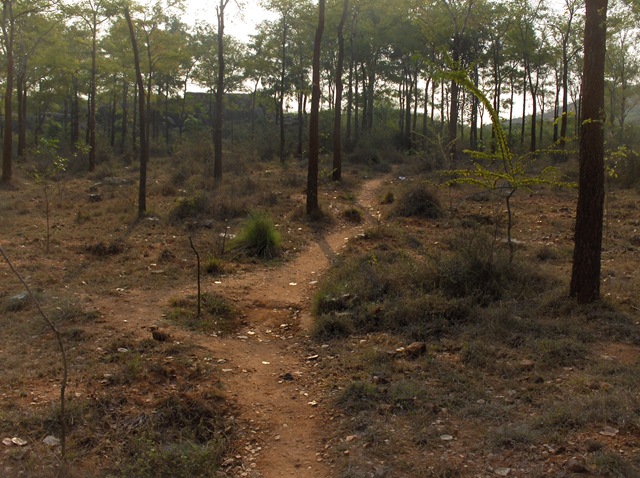
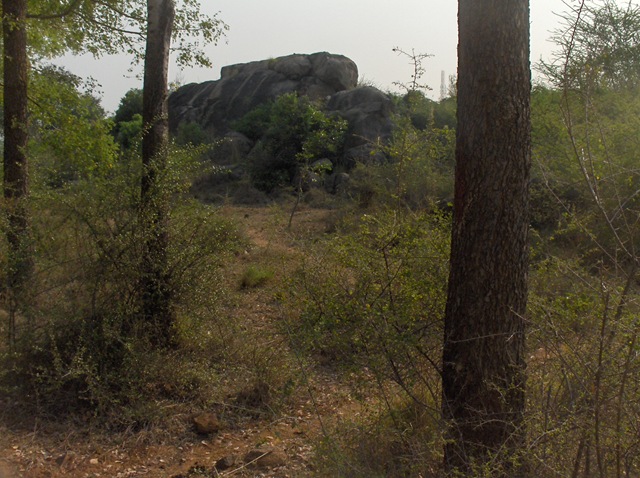
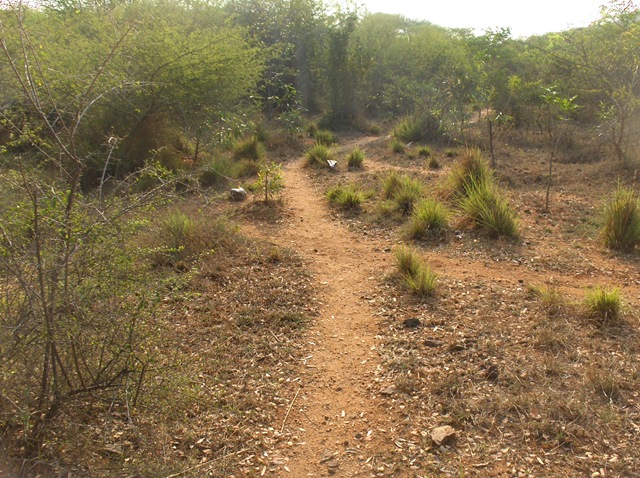
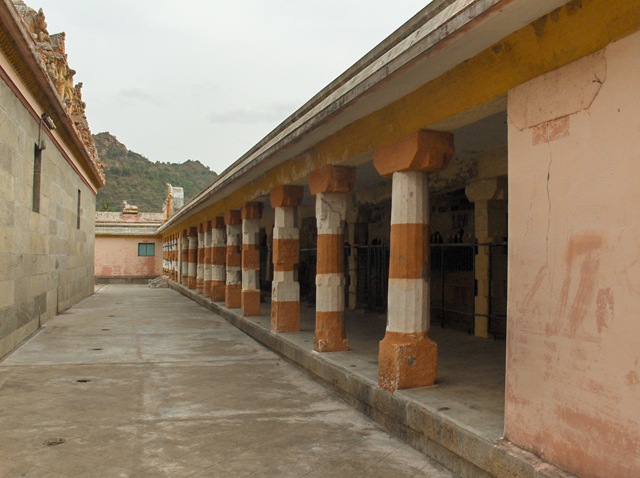
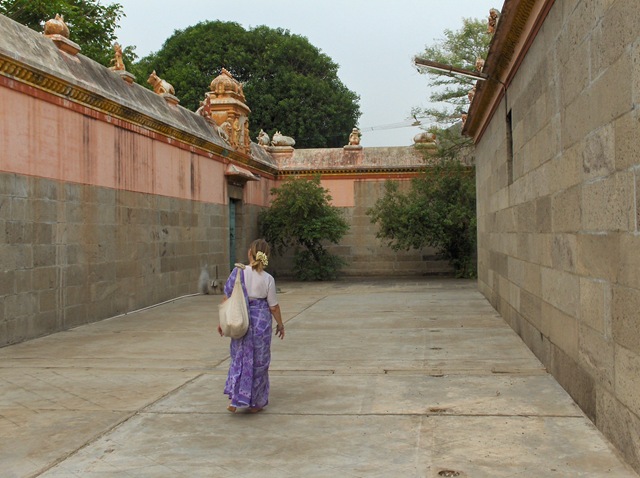
Harsha's avatar

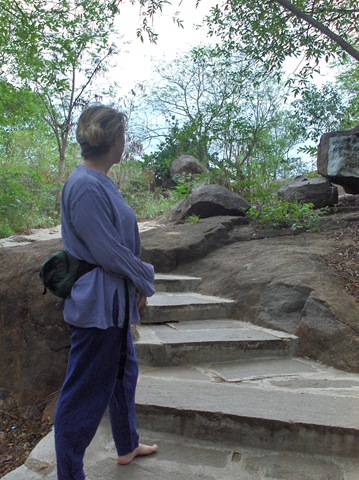
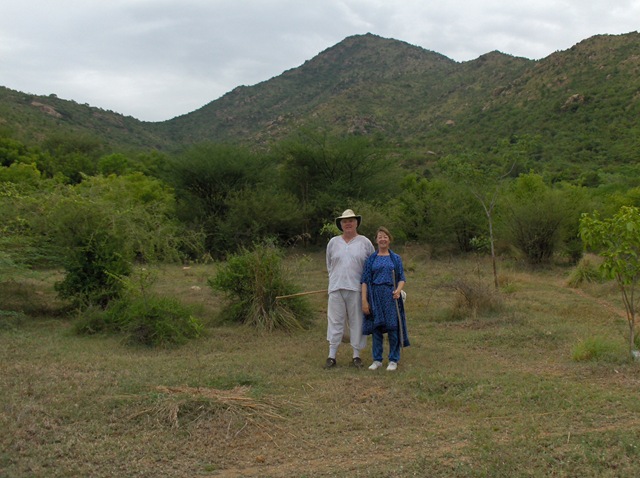
Richard Clarke and Carol at Arunachala

The exploration of Arunachala by Richard Clarke and his wife Carol and gracing us with their gift of writing from India are being celebrated by lovers of the holy mountain of Arunachala. Our brother and friend Richard has been writing on luthar.com off and on for several years now. He also has his own blog “Living in the Embrace of Arunachala” at richardarunachala.wordpress.com.

We wish Richard and Carol continued happiness at achieving their goal of being at Arunachala where Sri Ramana spent over 50 years. We all also express our gratitude to them for their generous and wonderful sharing of pictures and stories from Arunachala and letting us have a glimpse of their joyful living.

Harsha's avatar

Inner Path to Pachaiamman Koil

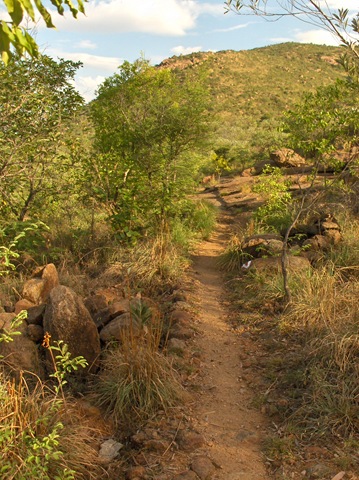
This concludes the series that shows details of Arunachala’s Inner Path used by devotees of Sri Bhagavan Ramana Maharshi for the sacred walk around this holy hill. This walking is called pradakshina, or in Tamil, girivalam.

This series shows the Inner Path in some detail all the way from Sri Ramanasramam, around Arunachala, and onto the streets on the Eastern side of  Arunachala.

Part One shows the path from Ramanasramam. Part Two shows the walk around the southwest side of the hill.  Part Three details the section of the path around Parvati Hill, at the west end of Arunachala. Part Four shows the path on the north side, under the Elephant. Part Five follows the path through the trees. This is part six, the final  section of the Inner Path.

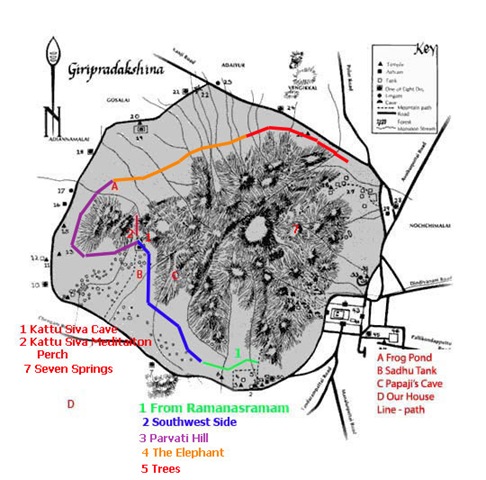
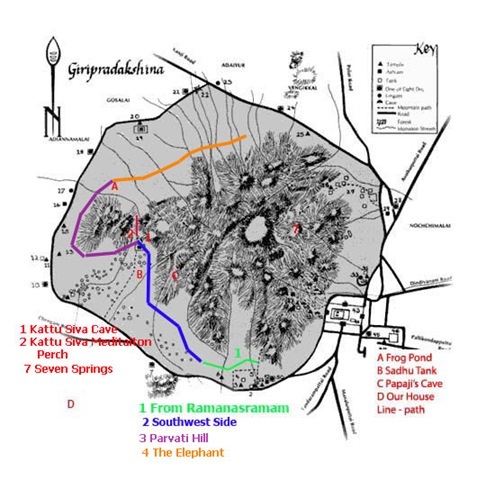
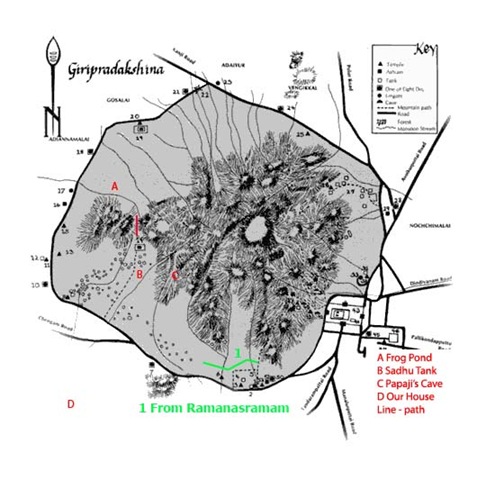
Below is a map of the entire Inner Path, that shows the six sections as well as some other landmarks along the way. The final section is in yellow.

Arunachala Inner Path Pachaiamman Koil

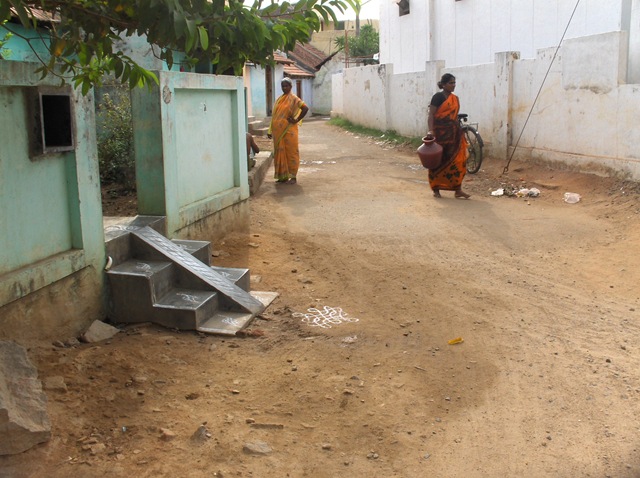
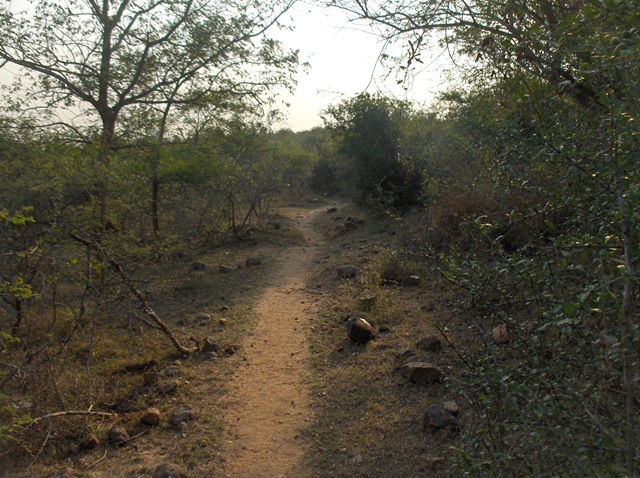
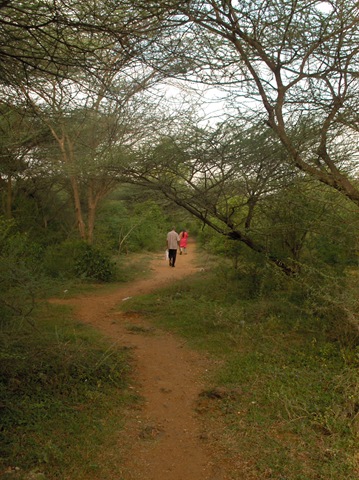
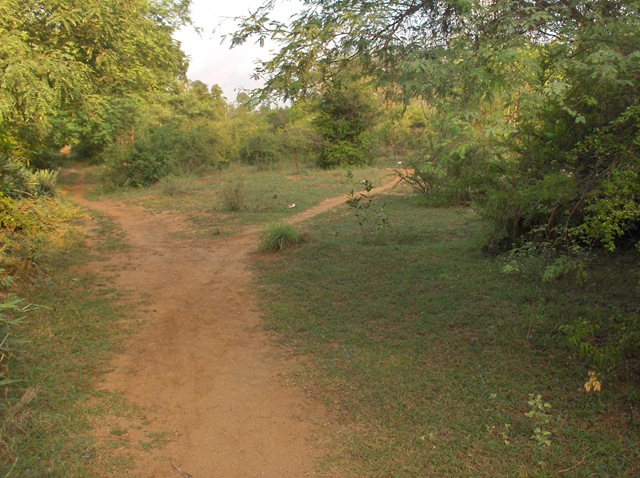
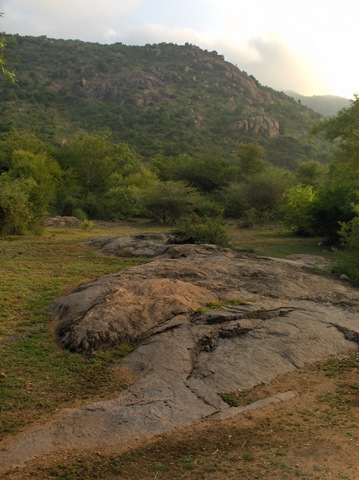
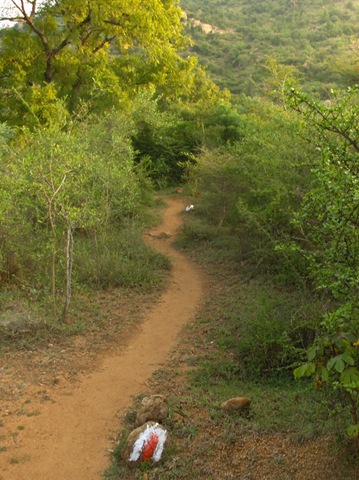
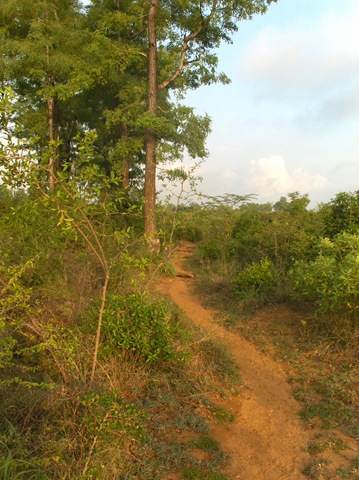
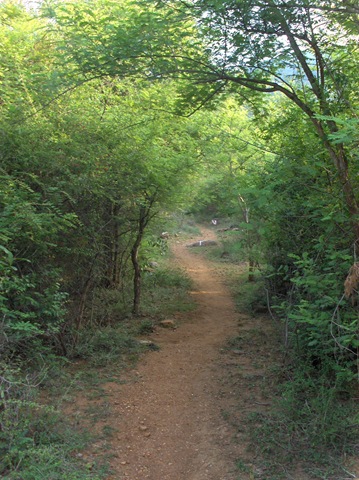
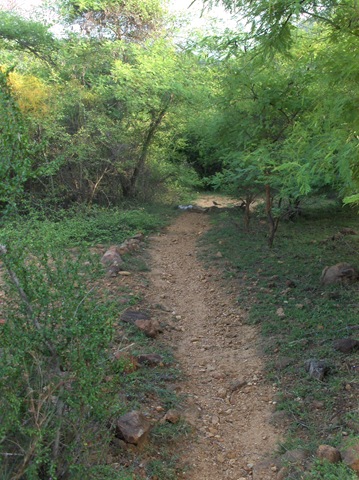
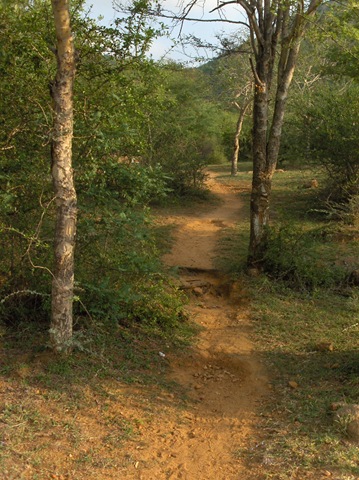
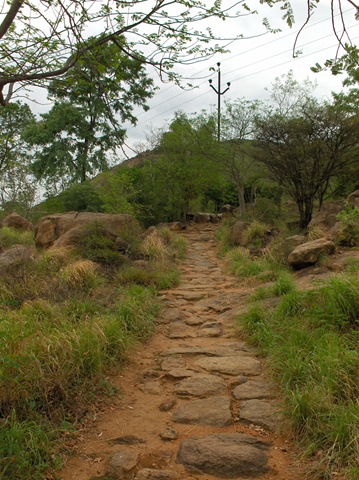
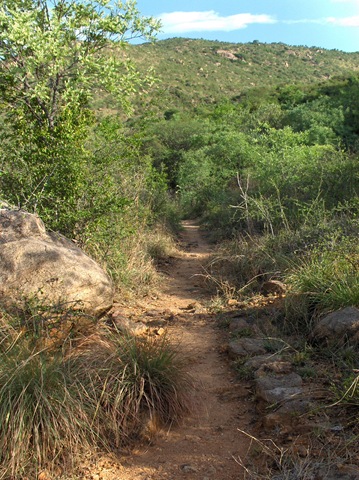
The final section of the Path goes for a bit through trees and brush, near to (but not visible from) Pradakshina Road. It then goes behind a few houses of local villagers, then up a small hill to Pachaiamman Koil, then down the hill back to the road. And the way we walk, finally to Ramakrishna Hotel for breakfast of Indian coffee, vadas and dosas.

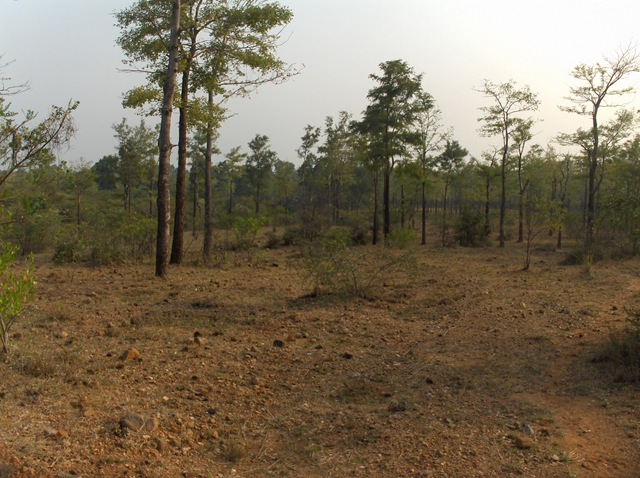
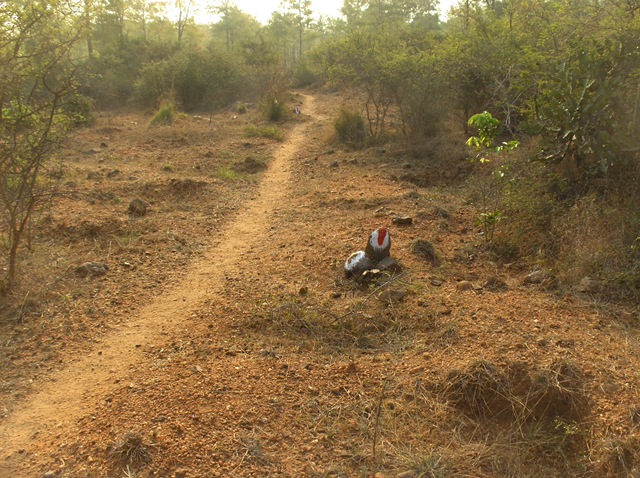
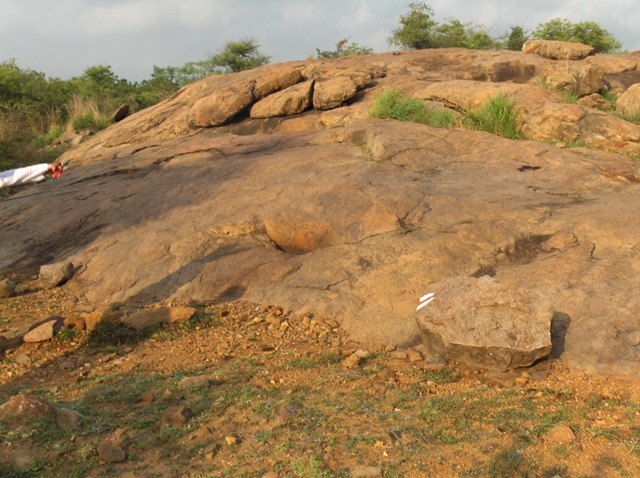
Starting from the Big Rock

HPIM2197

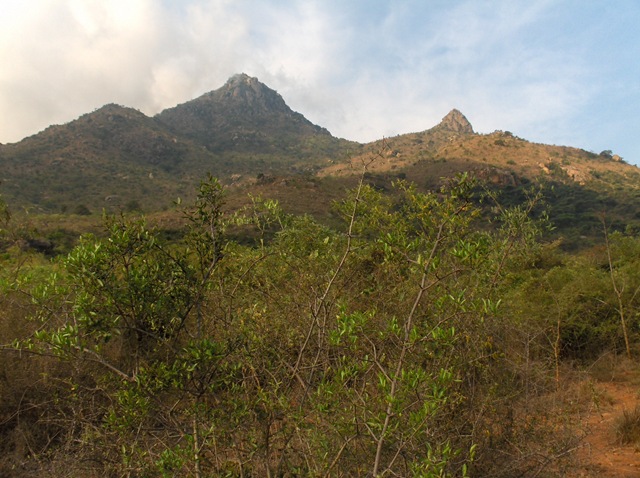
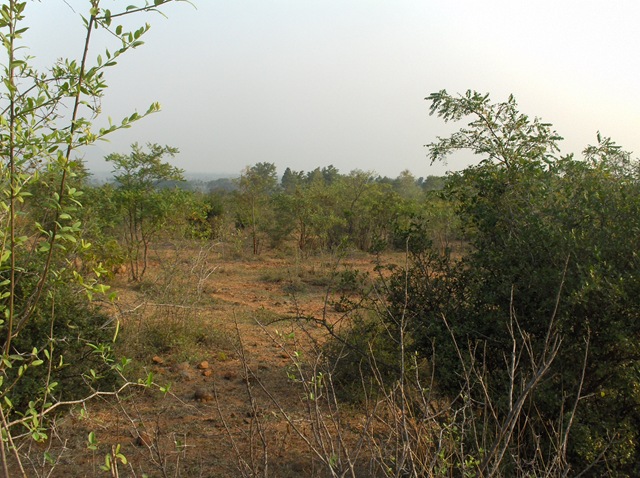
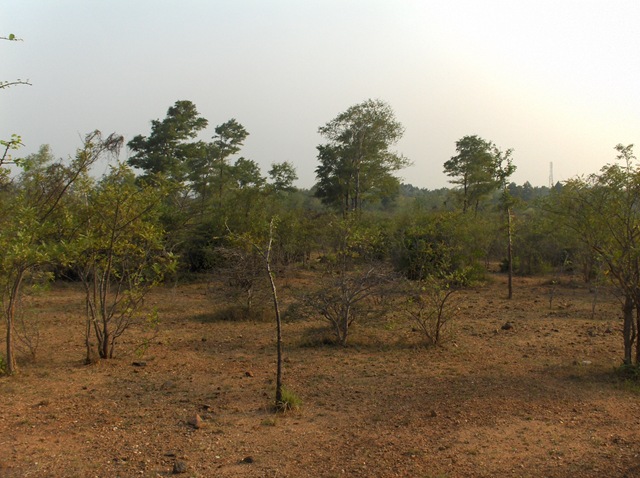
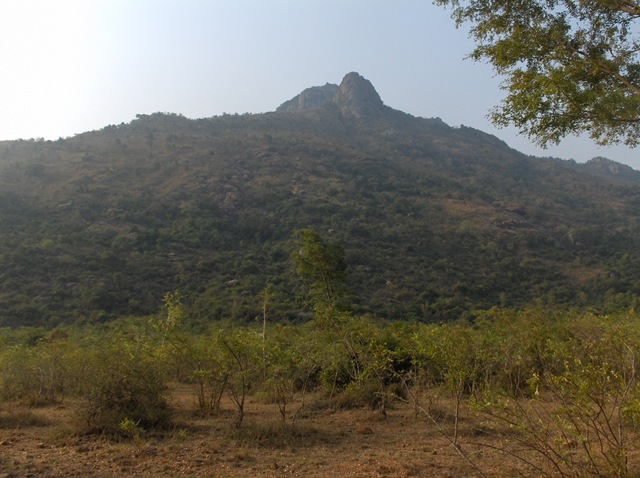
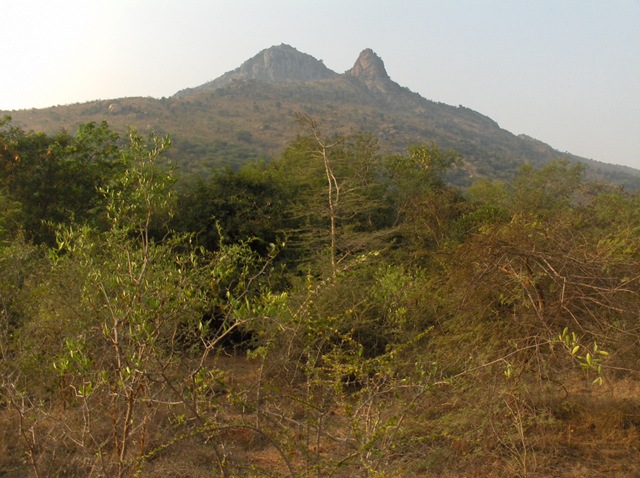
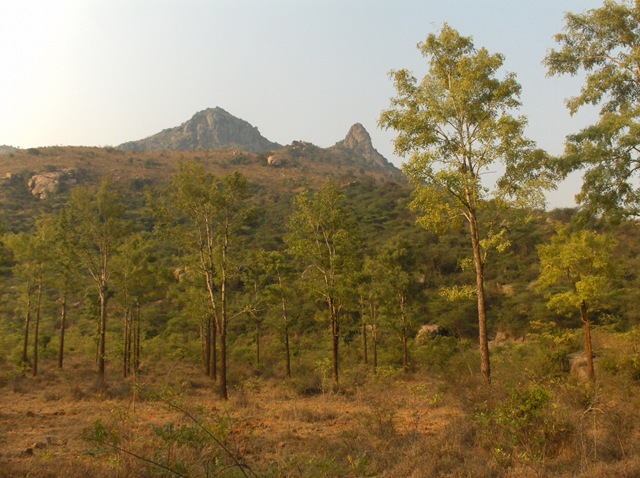
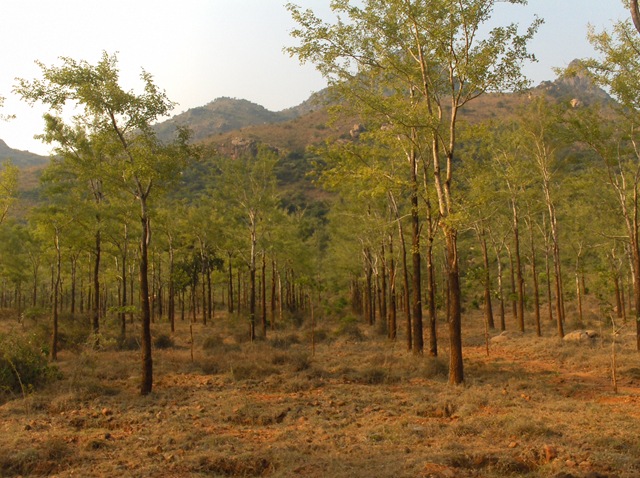
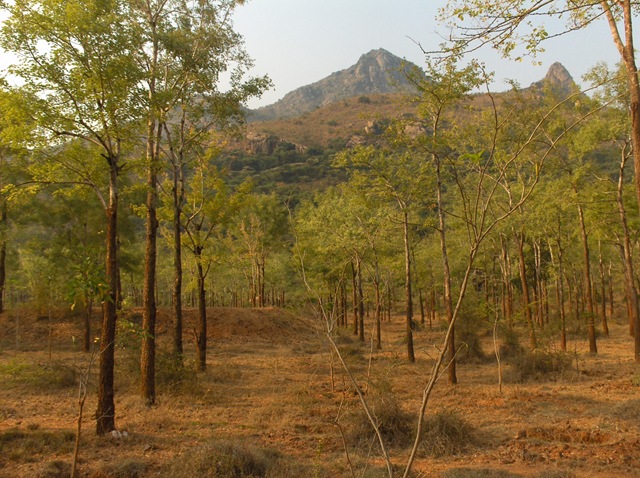
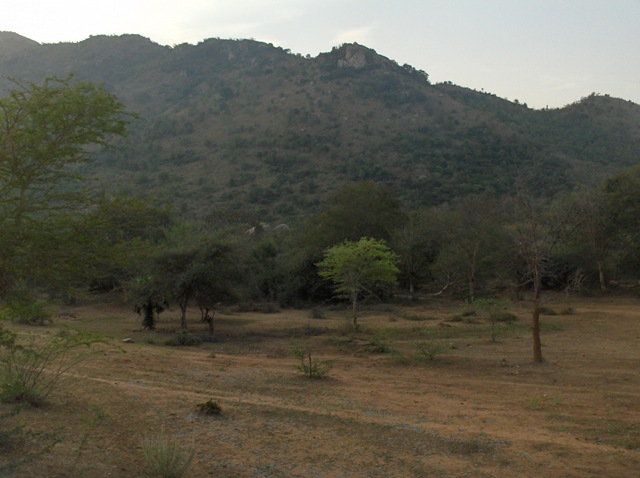
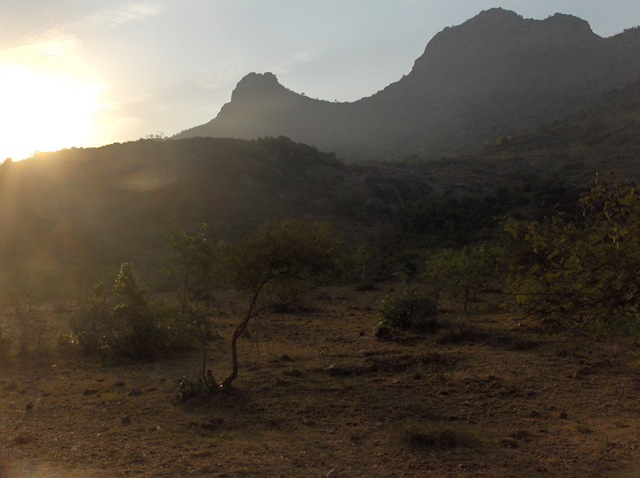
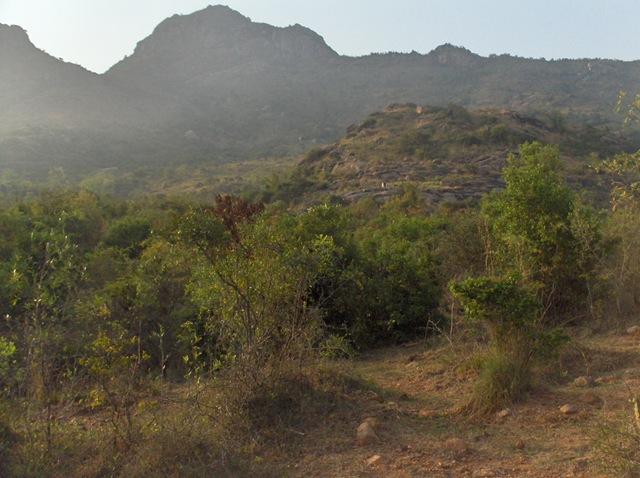
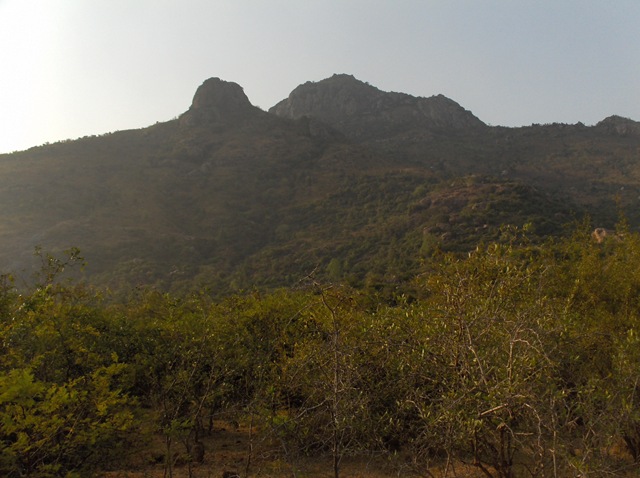
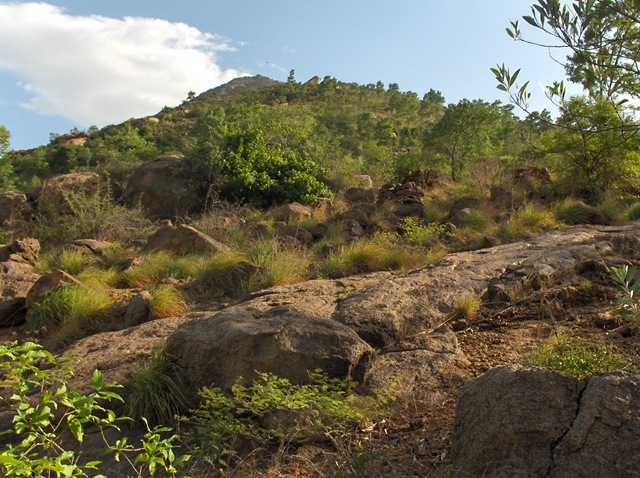
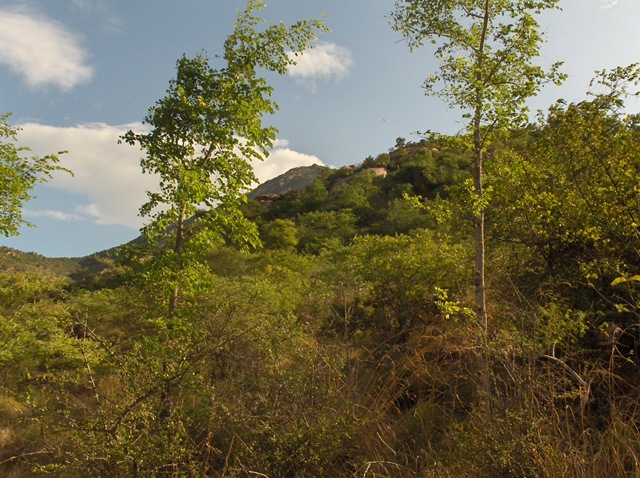
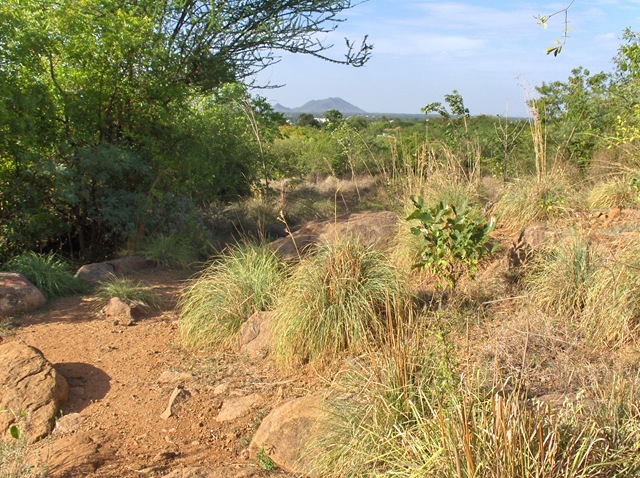
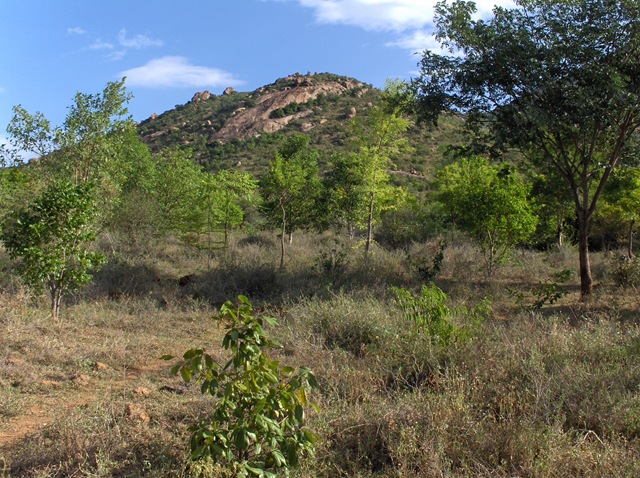
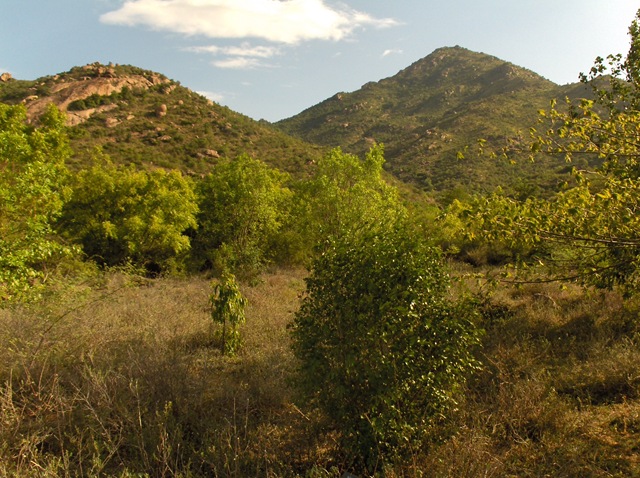
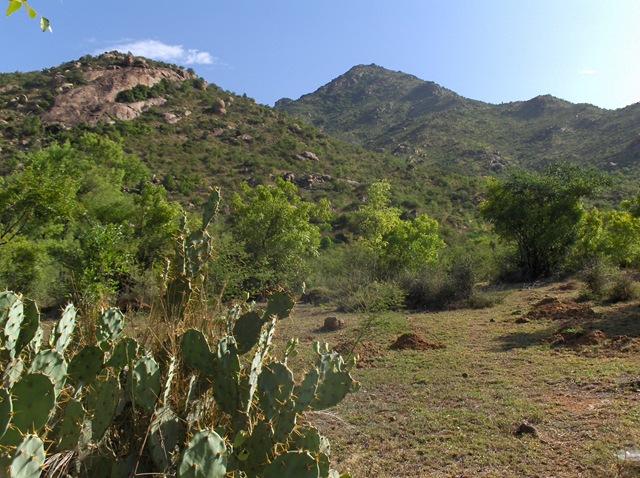
Looking towards Arunachala, the peak rises behind the trees.

HPIM2309

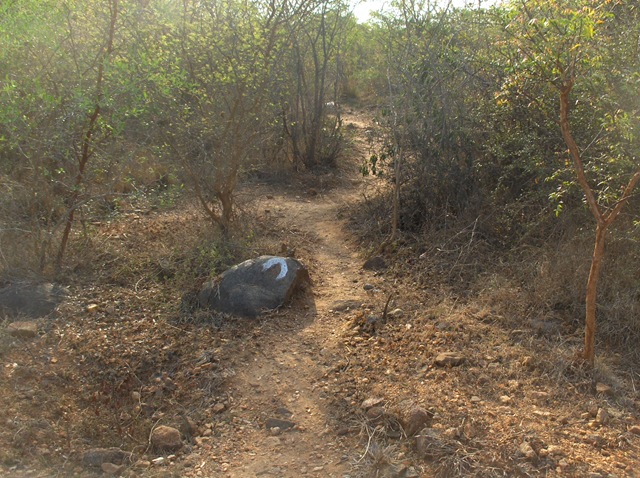
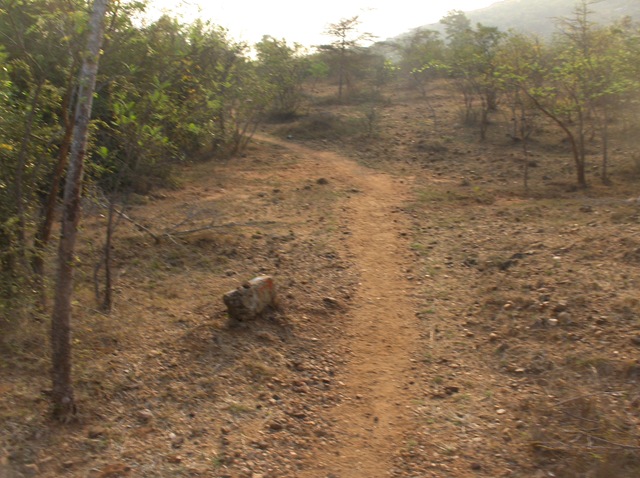
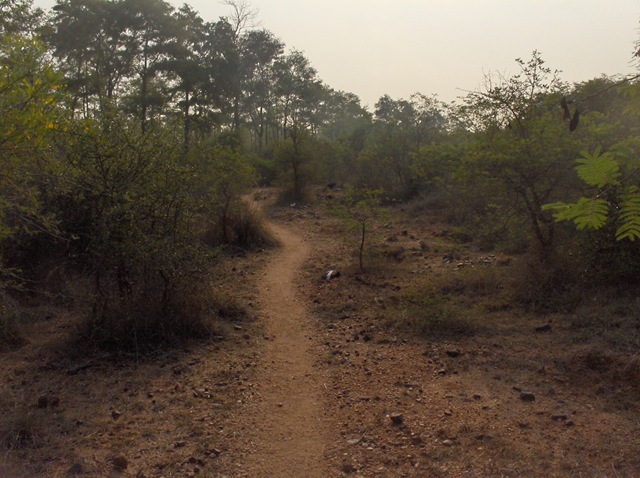
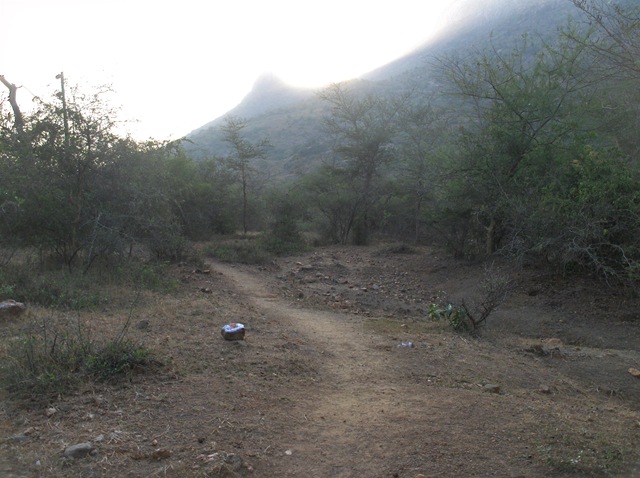
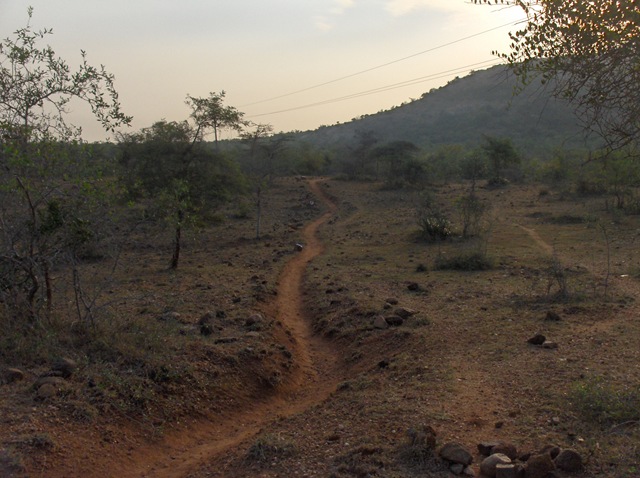
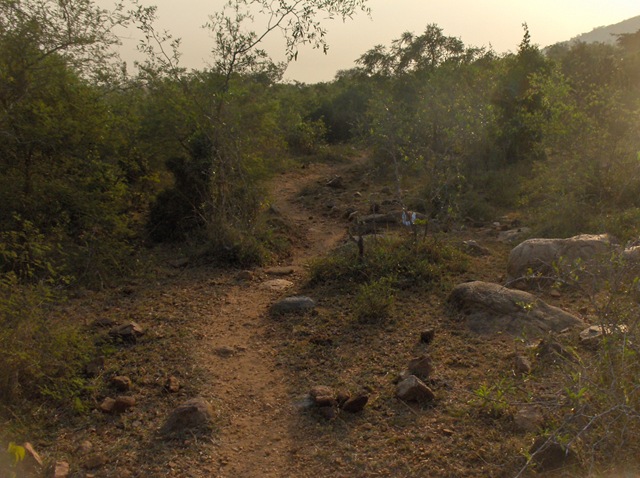
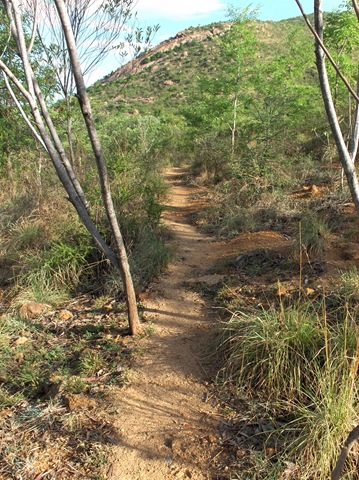
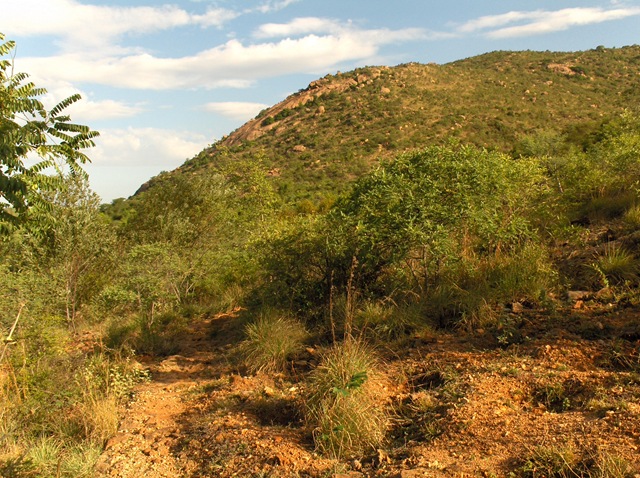
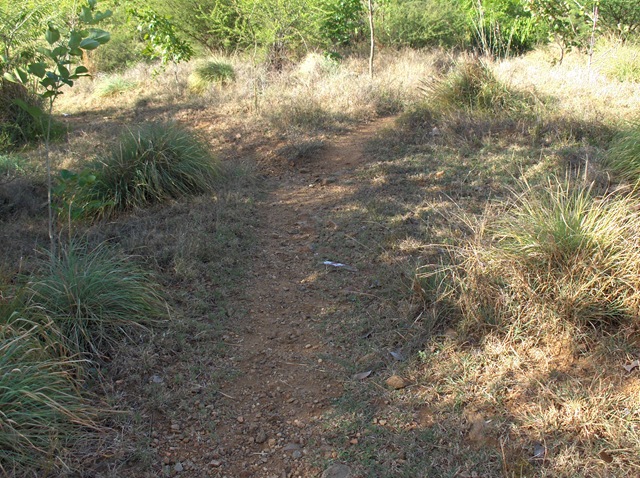
The Path continues straight ahead.

HPIM2311

HPIM2315

HPIM2320

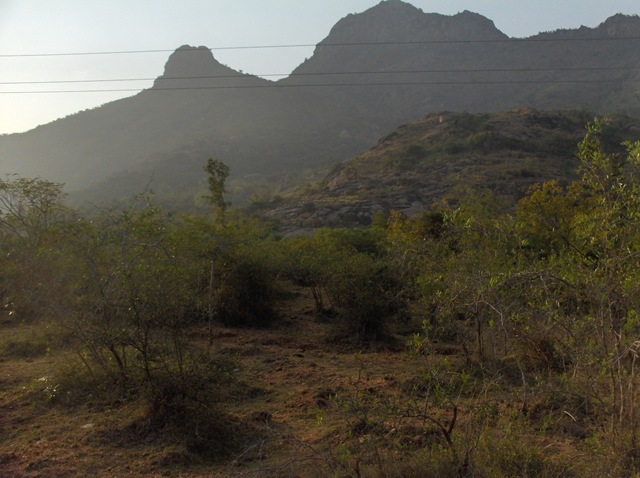
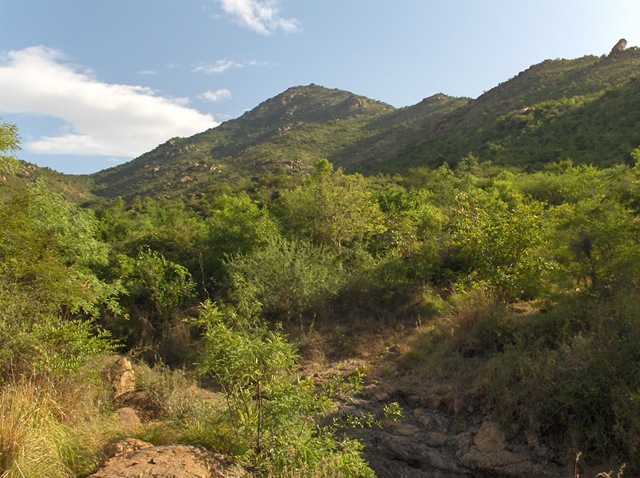
Arunachala through the trees.

HPIM2321

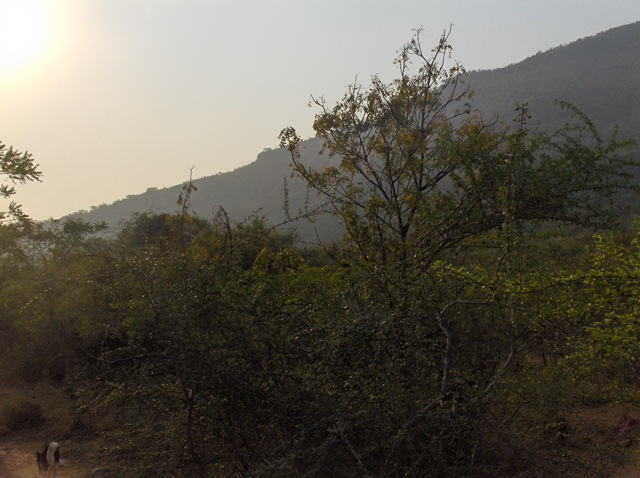
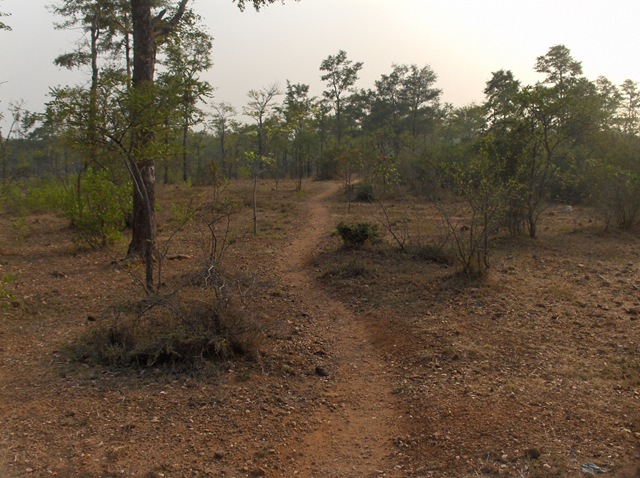
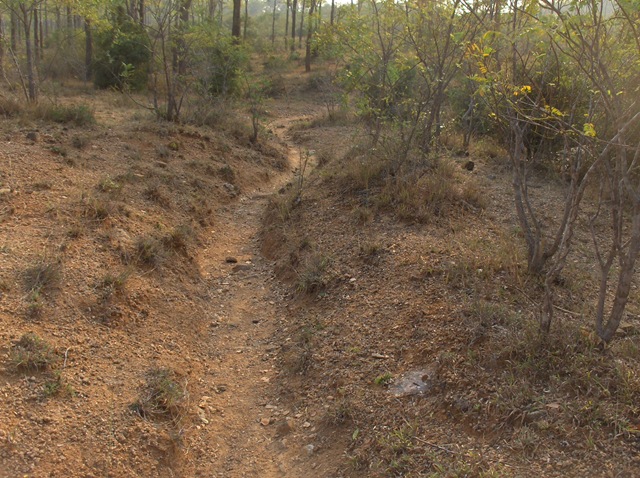
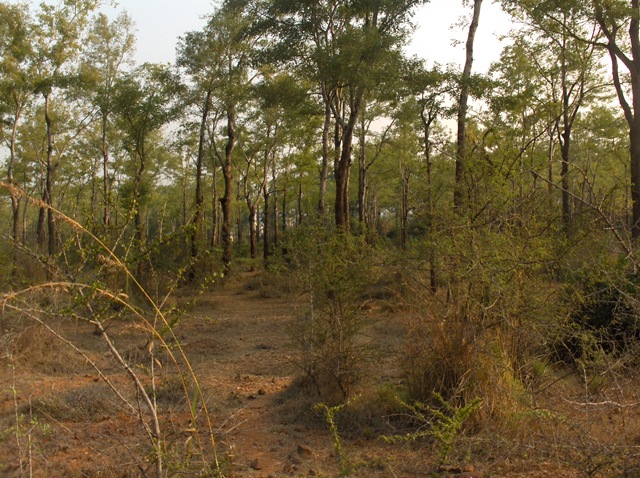
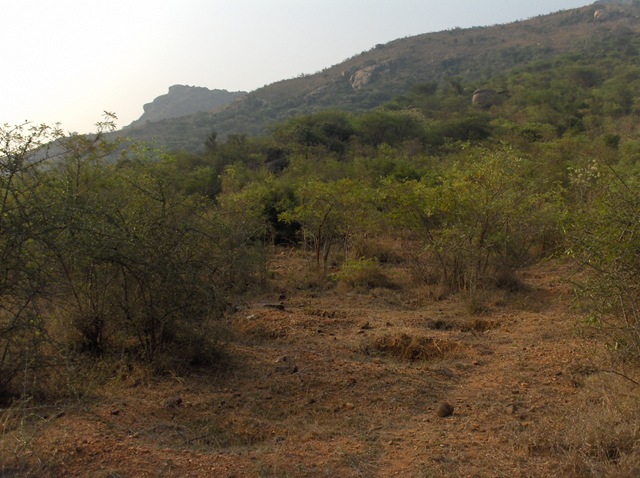
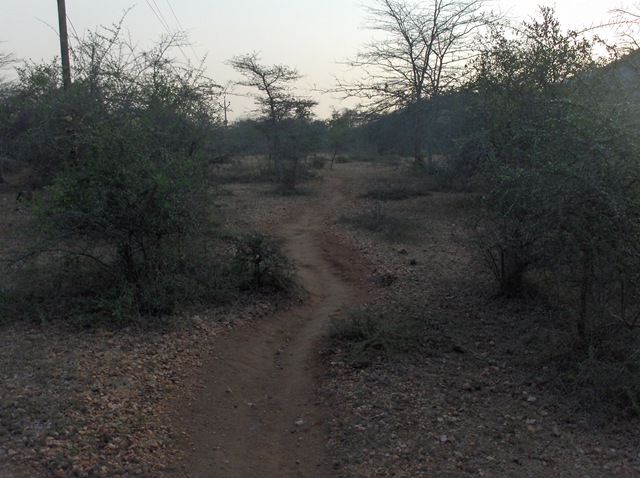
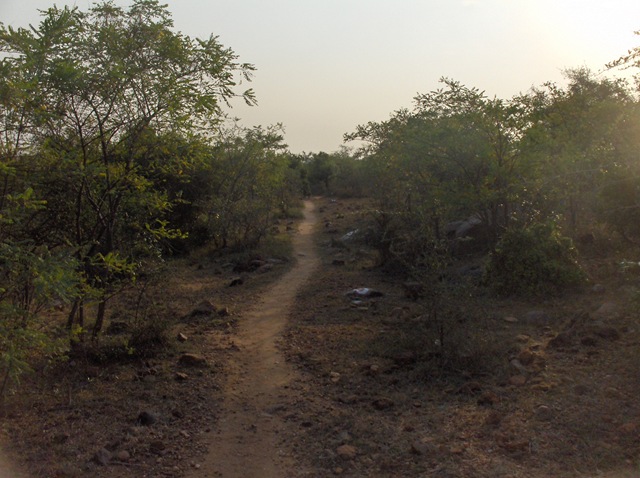
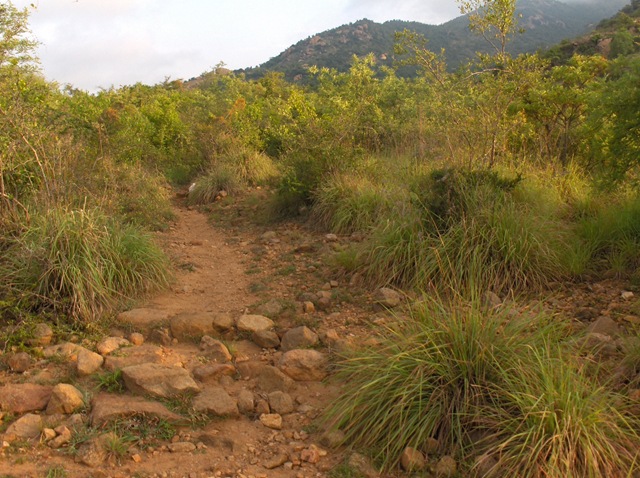
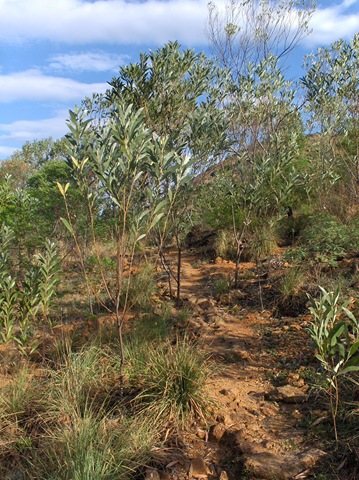
Continue through the brush and small trees.

HPIM2322

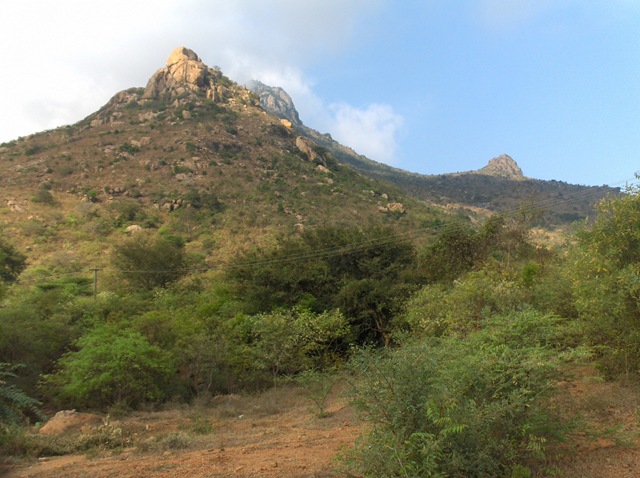
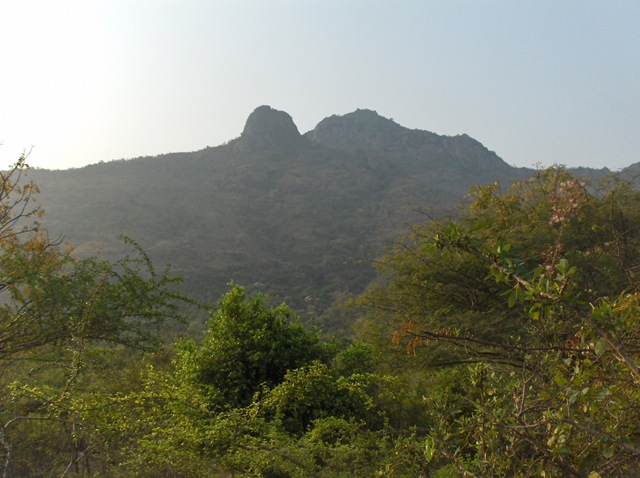
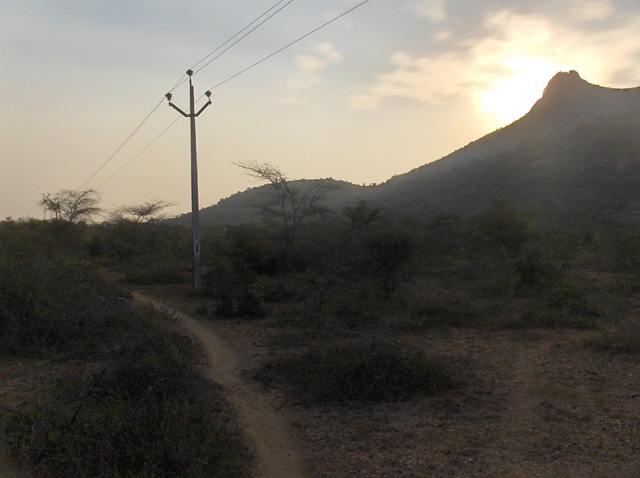
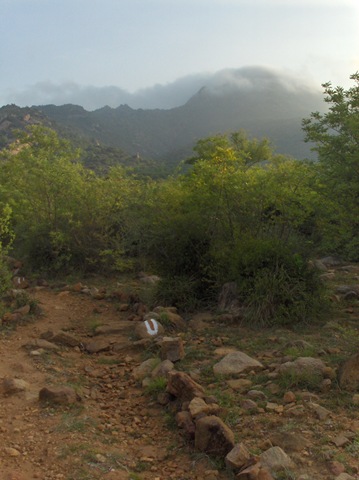
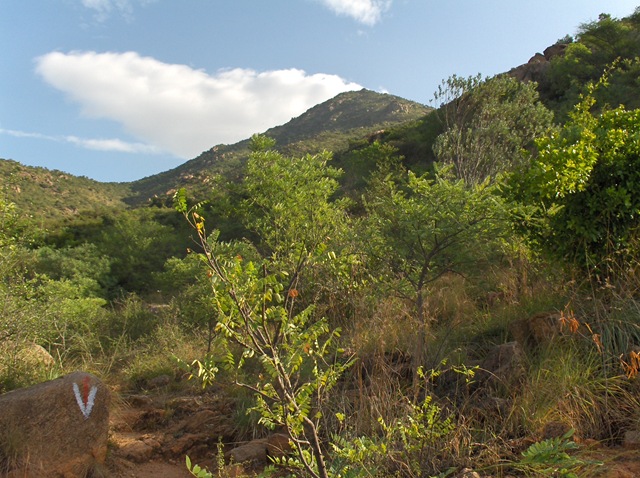
Here is a clearer view of the Arunachala peak. The trunk element of The Elephant rises on the right of the peak.

HPIM2323

Continuing down the Path. This is a shortcut where Carol cleared the brush and now is the main part of the trail. Before only cows could get through here, and everybody else took a jog to the left.

HPIM2326

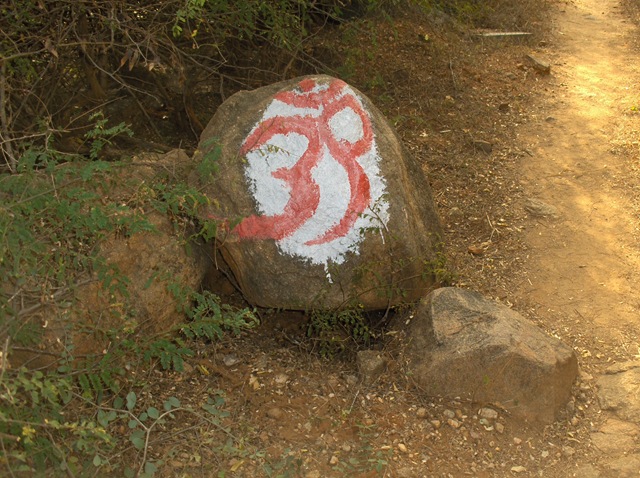
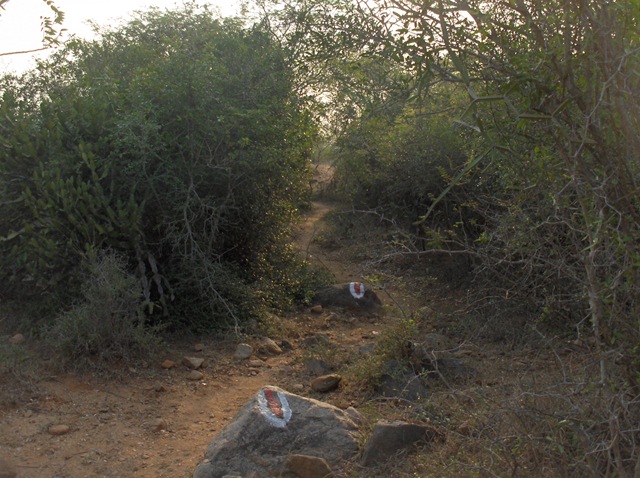
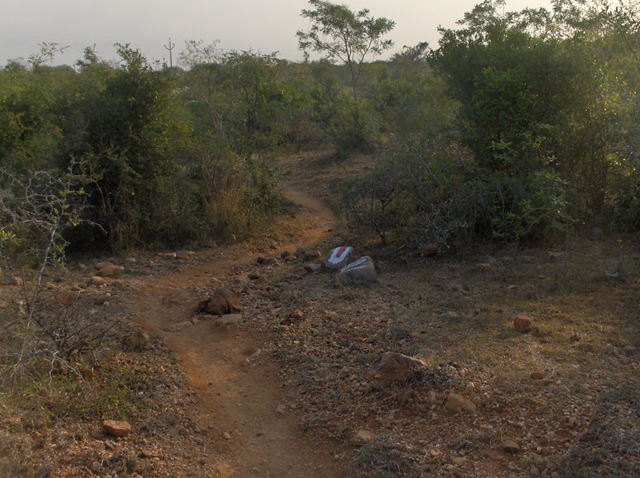
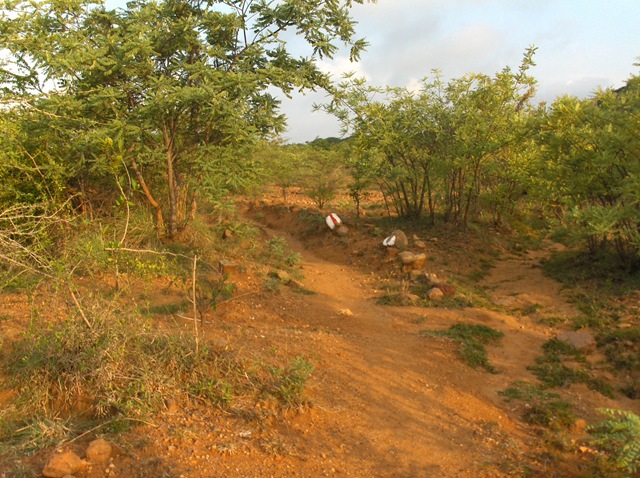
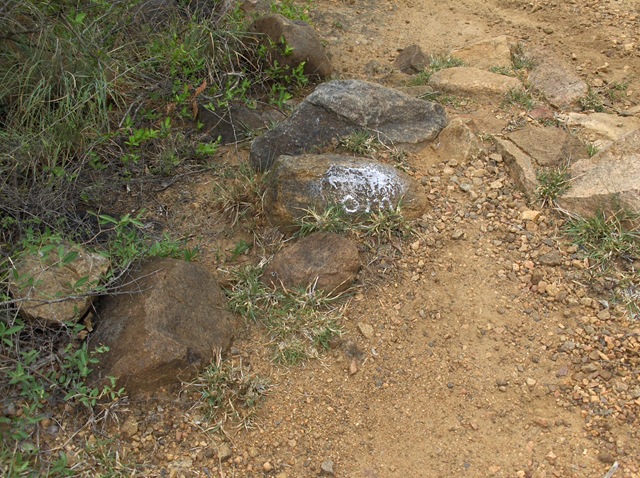
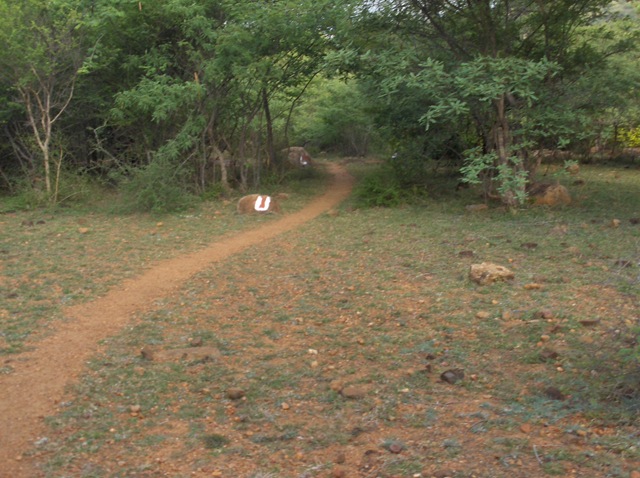
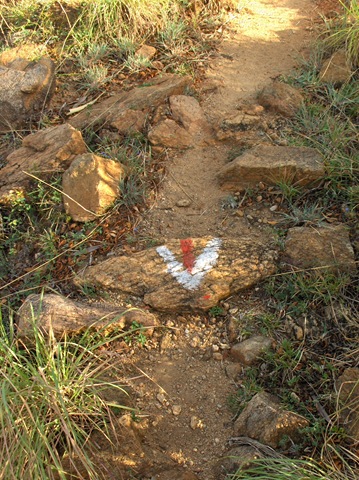
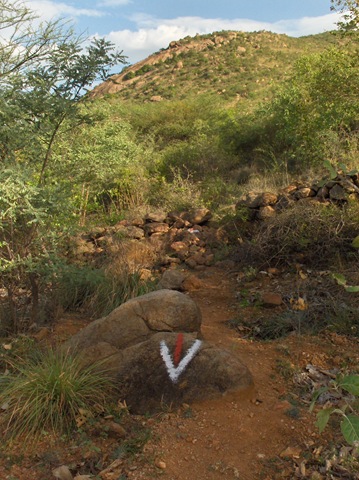
We turn a bit right and there is a nice red and white Om painted on a rock. By now there is quite a bit of road noise, but the road  is not yet visible.

HPIM2331

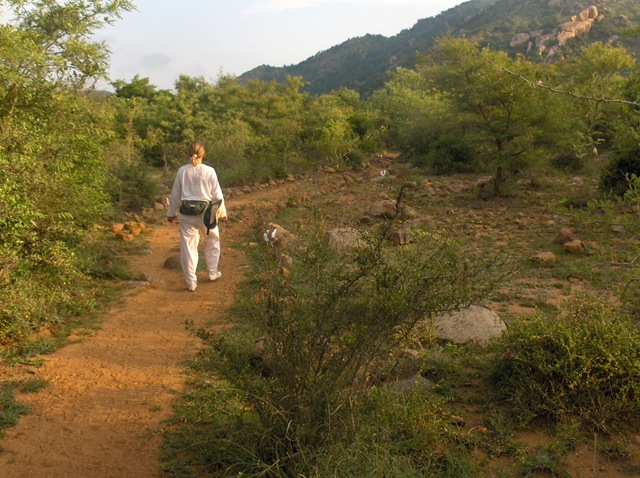
A village woman walks ahead, with a container of dry branches on her head. This is fuel for the day’s cooking fire. So much of this brush is gathered that it does not have a chance to compost back into topsoil. This is a long standing issue in India, where much of the soil has been depleted by the last 2000 years of continual use.

HPIM2335

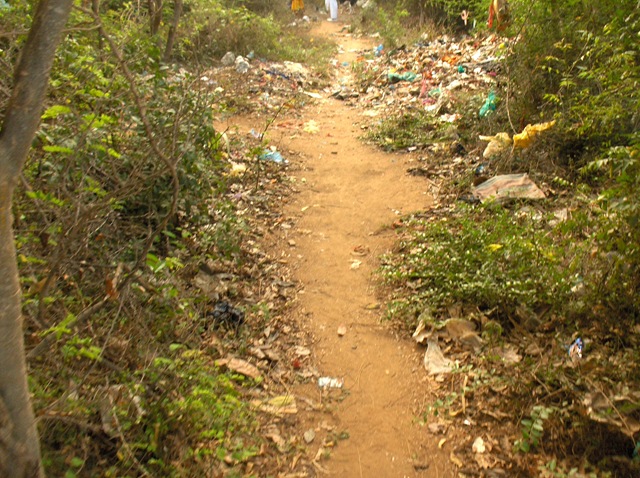
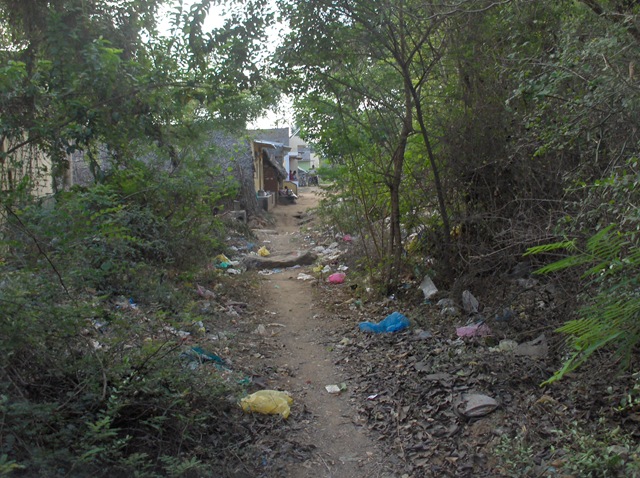
Trash heaps line the path. And sometime piles of human waste, since the typical houses here have no toilets, and the people are used to going outside their houses to do their business. Watch where you step!

HPIM2340

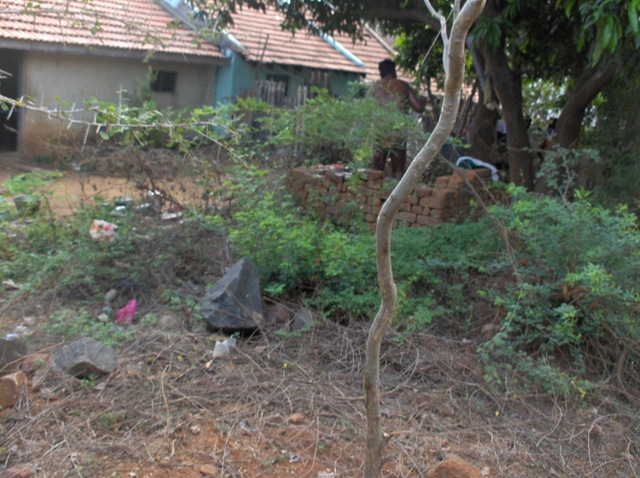
Behind these houses, you can see into their back yards. Here a man is standing in his undershorts in a brick-lined bathing area taking his morning bath.

HPIM2342

The Path continues through more refuse. Paper products are burned, but the ubiquitous plastics have nowhere to go. Some towns are beginning to address this serious problem by banning plastic bags. The real problem is to educate and sensitize the people to “littering.”

HPIM2345

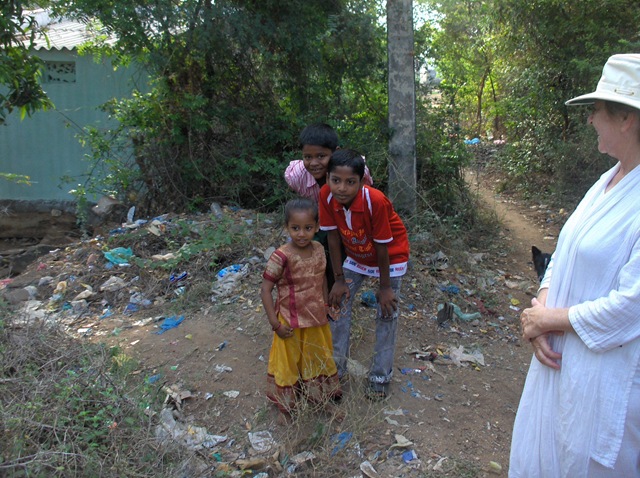
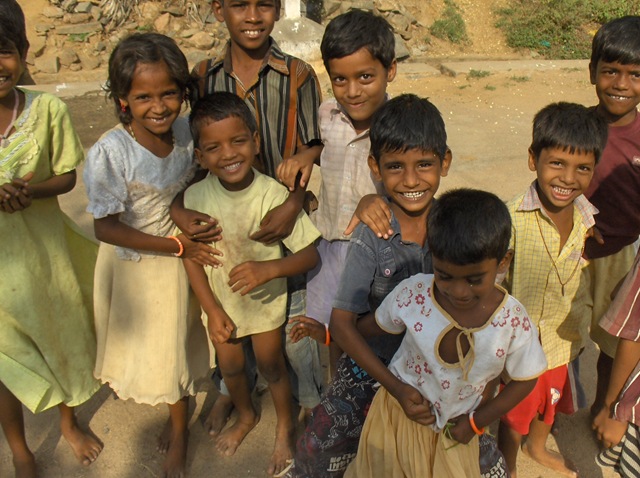
Village children start to greet us. We go through here often and are known by many of them. It seems that children always want their  picture taken. They will come and ask ‘photo’ or ‘camera.’ The children will often ask us for pens. Their schools don’t supply them, so there is no way to practice their writing skills. Amazingly, the little girl in the foreground here actually offered to give US two pens. What beautiful children, physically and spiritually.

HPIM2346

More path through more trash.

HPIM2348

Now we walk directly behind a few houses. Be respectful to the people here. This is their home. A silent smile is usually enough.

HPIM2350

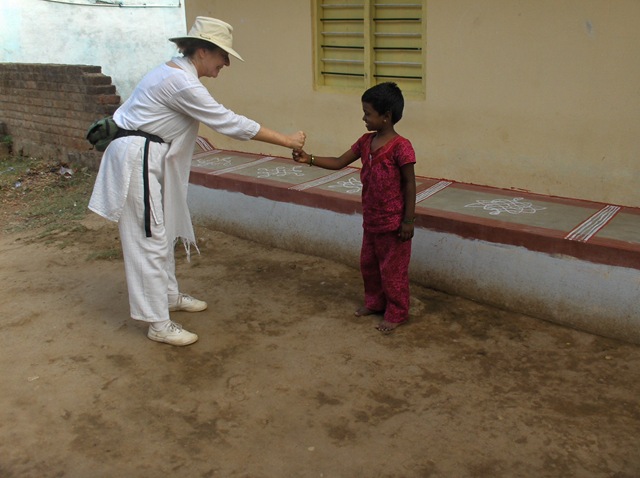
At this house Carol has been greeting the two kids with a ‘fist bump.’ She started doing this as a way to  divert the children’s request for a pen, etc. It really seems that what they want is just some kind  of contact, and the fist bumps provide an easy way. She calls them ‘Obama bumps’ after the photo of Obama and his wife taken during the election.

HPIM2354

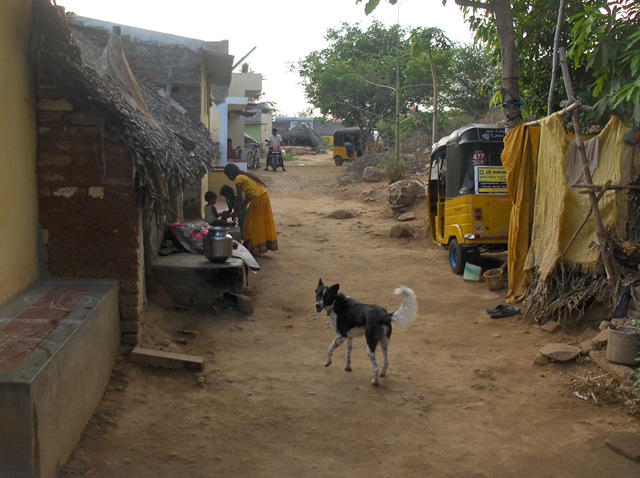
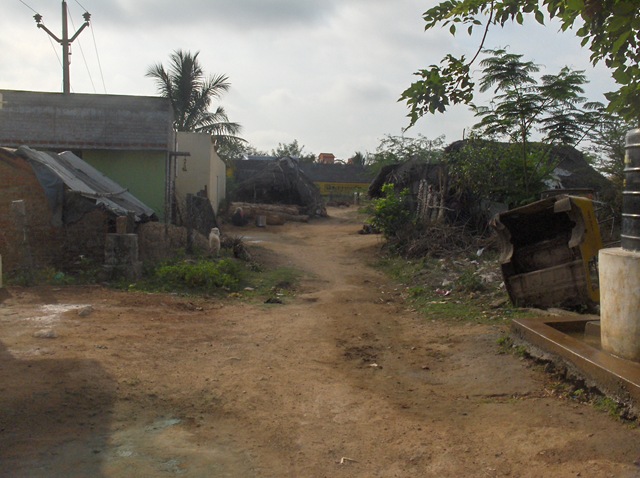
Proceeding  through the village.

HPIM2364

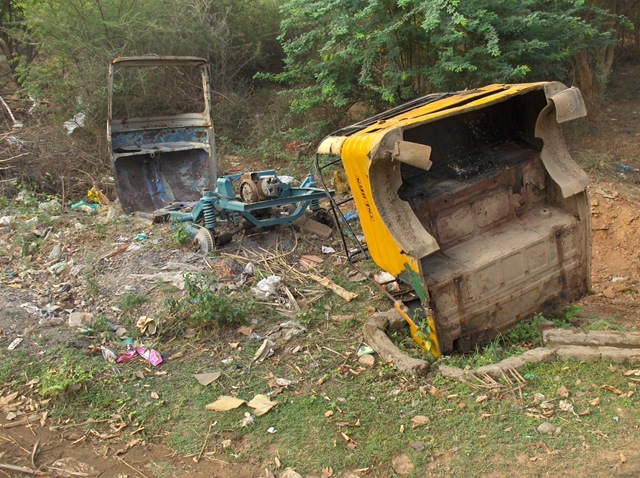
The skeleton of a dead  rickshaw sits  by the path.

HPIM2366

This is a small thatched hut, some family’s home.

HPIM2369

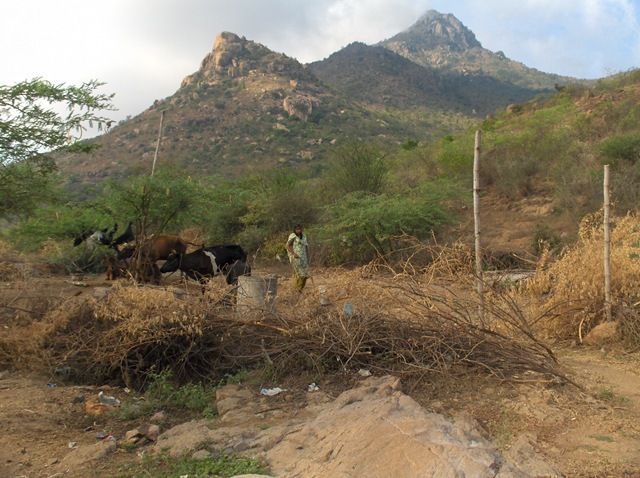
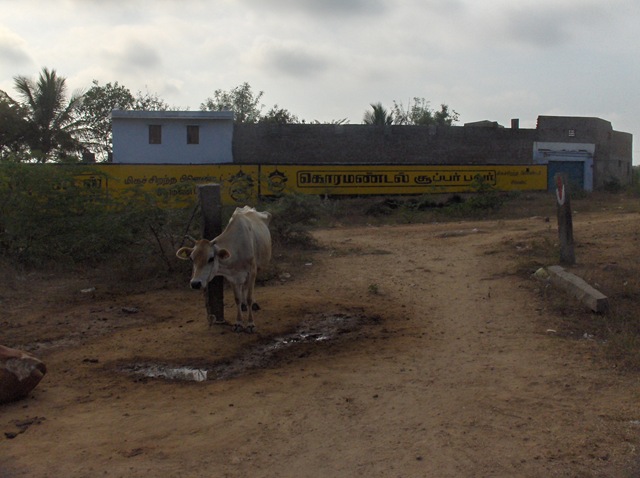
There are a number of cows here. Arunachala is in the background.

HPIM2372

This long yellow sign is a predictable landmark. The Path turns to the right.

HPIM2376

Here is Arunachala again. Clouds are forming around the peak.

HPIM2377

The Path goes up and to the right.

HPIM2378

HPIM2383

Now Arunachala is shrouded in clouds. It is said that there are five faces of Siva that are visible in these eastern hillside rocks. This how you can be sure that it is Siva, since he, apparently, really has five faces.

HPIM2389

Near the Path are newly built homes, with bright paint jobs. Much care was taken with these houses. The bright colors conform to the principles of Vaastu, the Indian equivalent of Feng Shui.

HPIM2390 closeup

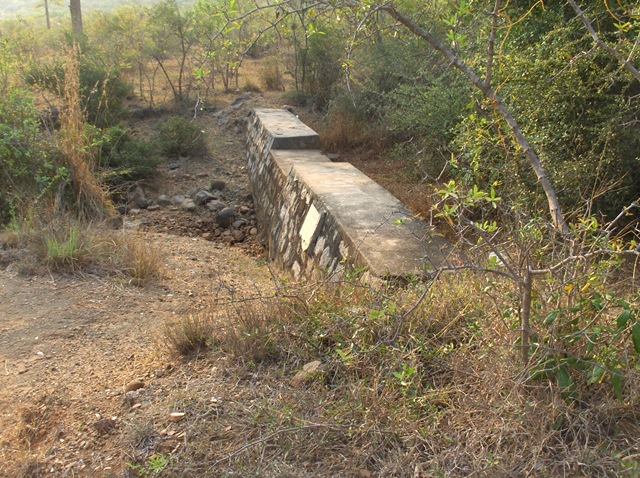
Now the Path goes over two concrete bridges.

HPIM2395

Arunachala is nearly hidden by the hill in the foreground.

HPIM2396

Below is the first glimpse of Panchiamman Koil, rising out of the trees.

HPIM2399

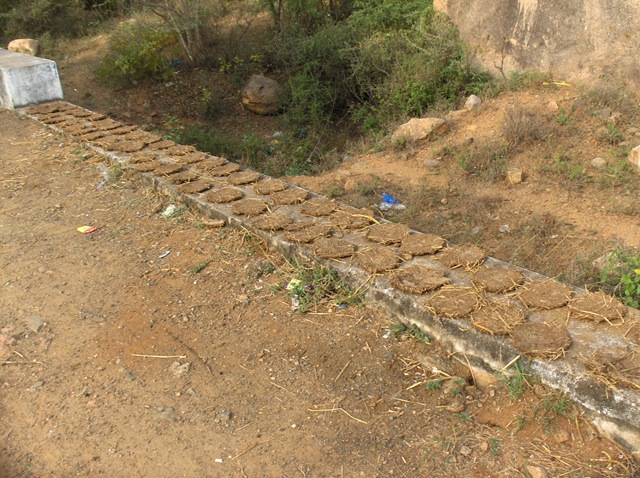
Patties of cow manure mixed with straw are drying here. They are used a fuel for cooking fires.

HPIM2400

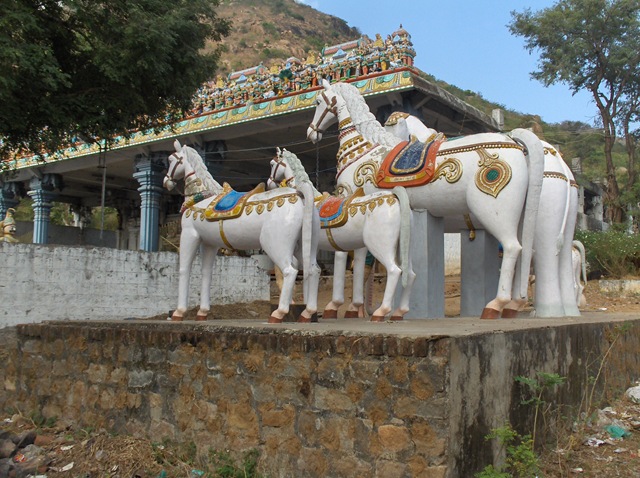
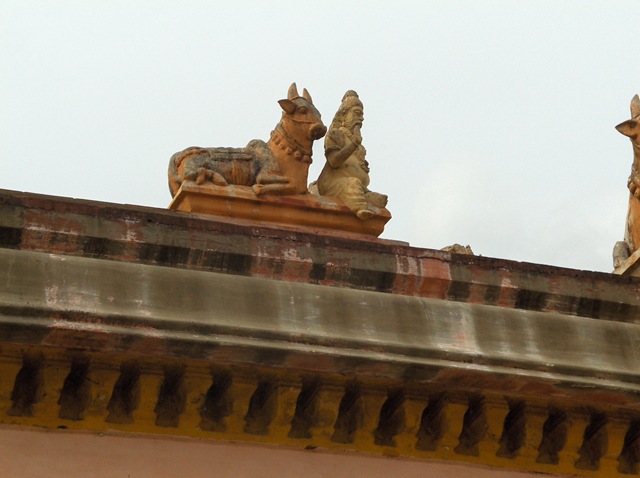
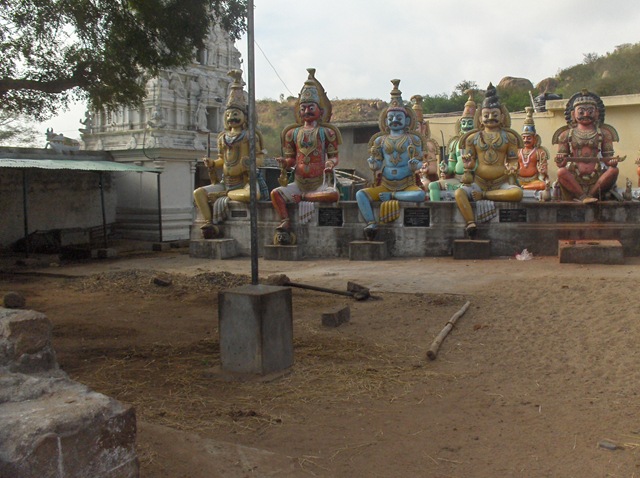
More Vediyappan mounts and guardians.

HPIM2404

This group also has an elephant as a mount.

HPIM2406

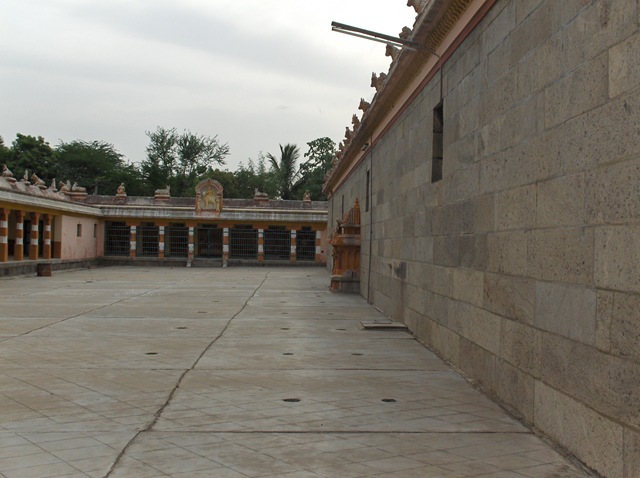
In front of Panchaiamman Koil are two rows of Guardians. If you look closely, the two on the left are resting their feet on heads.

HPIM2409

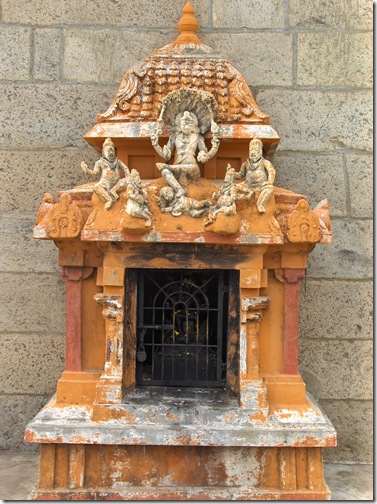
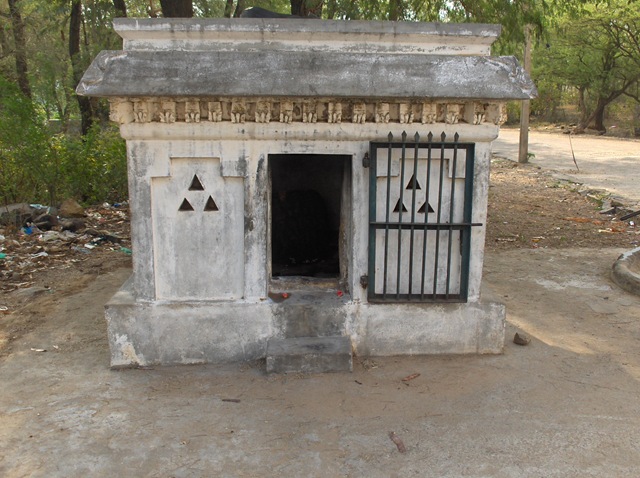
Outside Panchaiamman Koil is a small shrine.

HPIM2415

Inside is an ancient figure of a male and female. Siva and Parvati, maybe?

HPIM2414

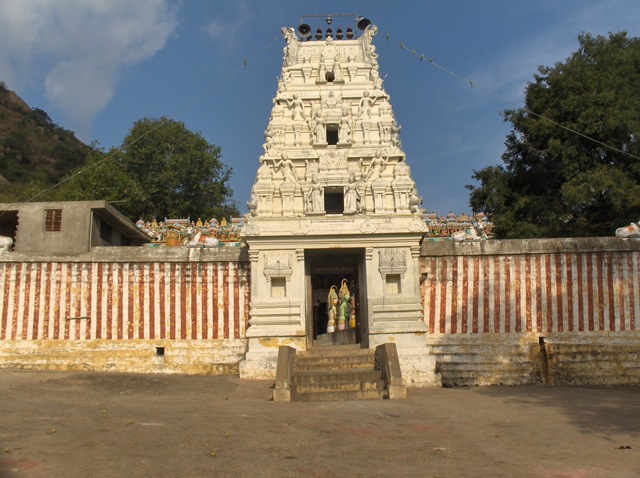
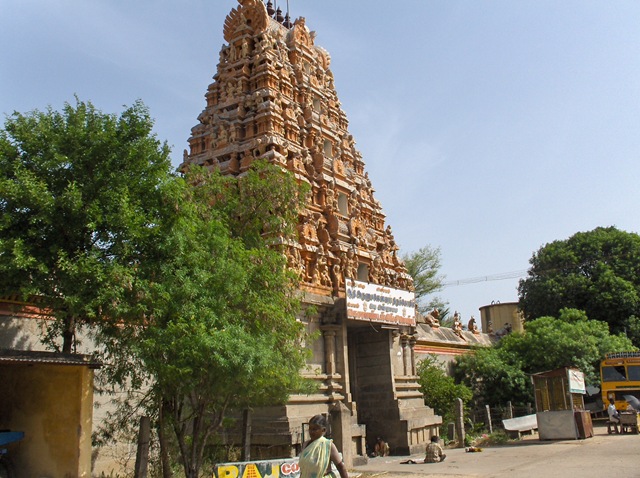
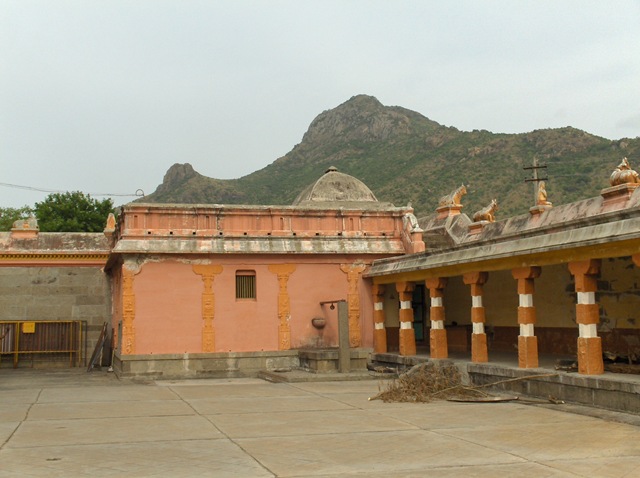
Here is the front of Panchaiamman Koil. The vertical red and white stripe indicate that it is is temple. You will see these many times in South India, marking temples.

HPIM2417

The Arunachala peak is  entirely hidden here.

HPIM2421

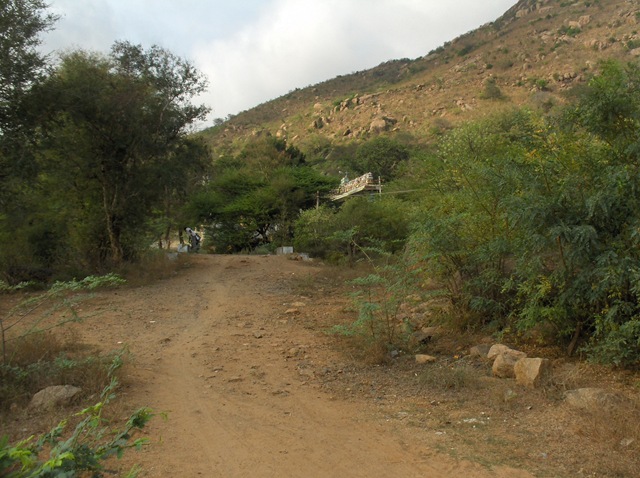
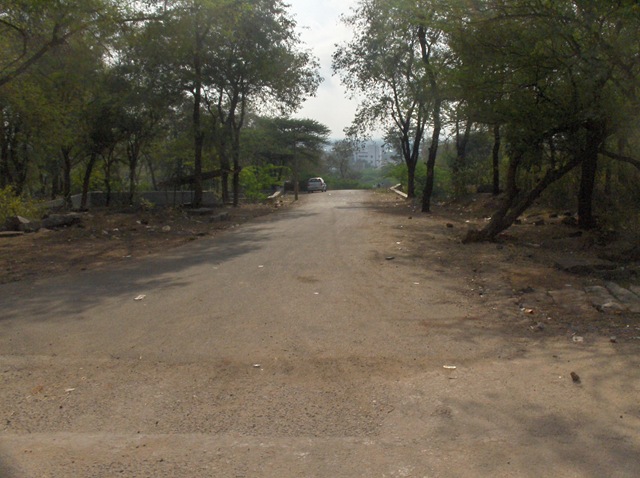
The road down the hill to the main street.

HPIM2419

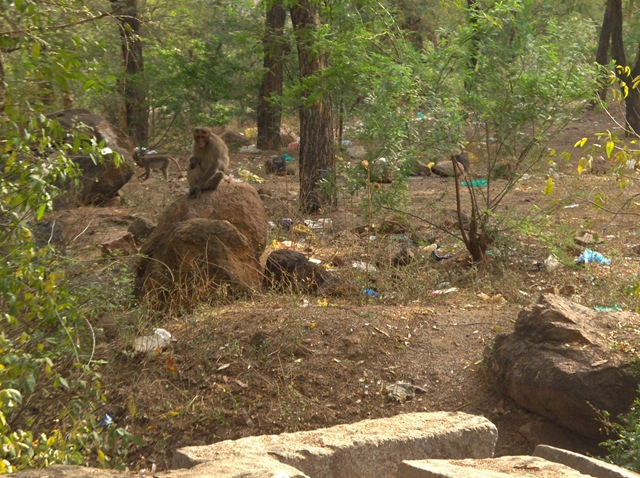
There are monkeys here today. This  one is sitting on a rock. I wonder if monkeys meditate.

HPIM2425

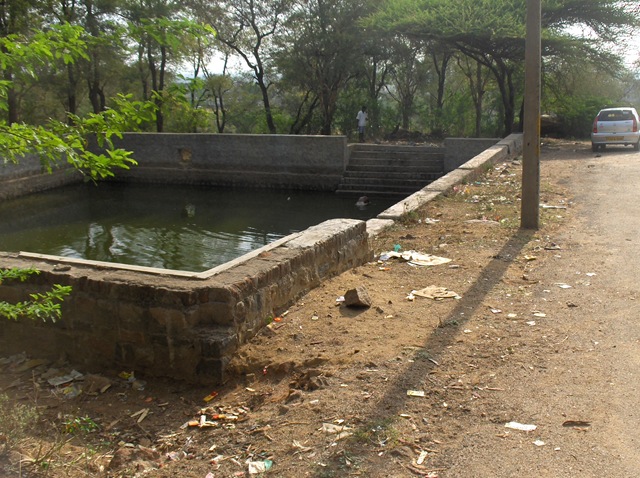
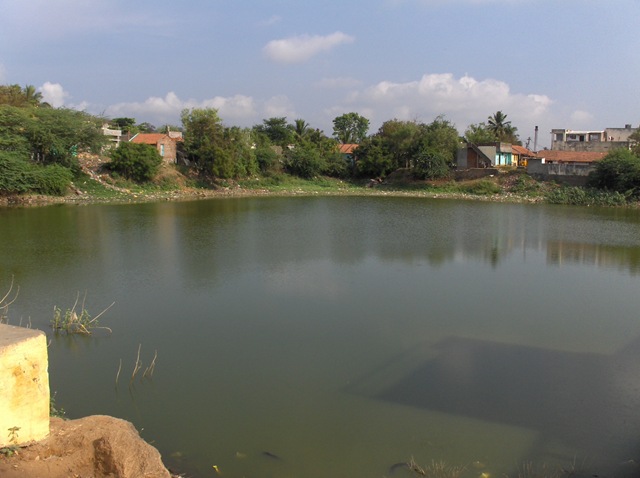
There is a tank down the hill from the temple. Usually in the morning there are men bathing in the tank.

HPIM2427

On the other  side of the road through the trees is another temple. There is a path here that goes a bit further around the mountain. After a rough bit and a scramble up a rock face, you come out to a small village built on the face of a very large hillside.

HPIM2429

Down the road.

HPIM2430

Often you will see this billy goat along the road  here. He seems like the king of this hill.

HPIM2200

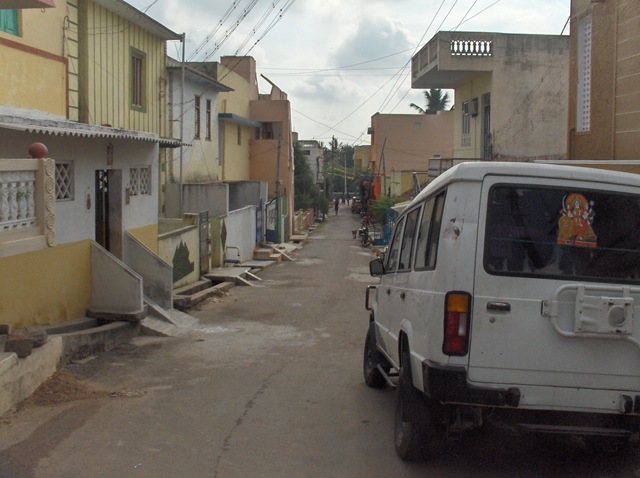
We turn right at the first street. You could keep going straight down this hill. We think  of this as the ‘scenic route.’

HPIM2432

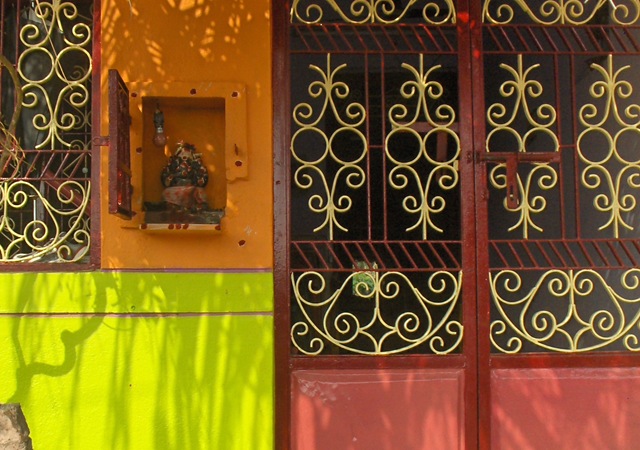
A nice Ganesh shrine in the doorway of this house insures that things go well within the house.

HPIM2434 closeup

In the mornings, many women with water jugs are gathered around this tank, getting their day’s supply of water. This is a hard job. Naturally it  is  mainly done by the women.

HPIM2437

Kids gather, asking, ‘photo, photo, photo.’

HPIM2443

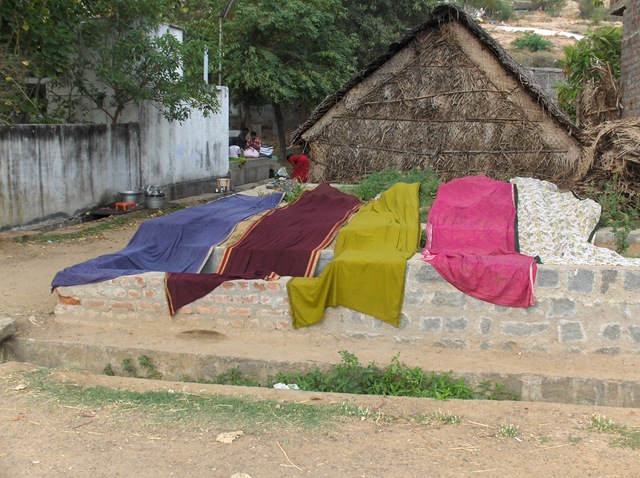
Sarees are spread out to dry.

HPIM2445

They were probably just washed in this community clothes washing area.

HPIM2446

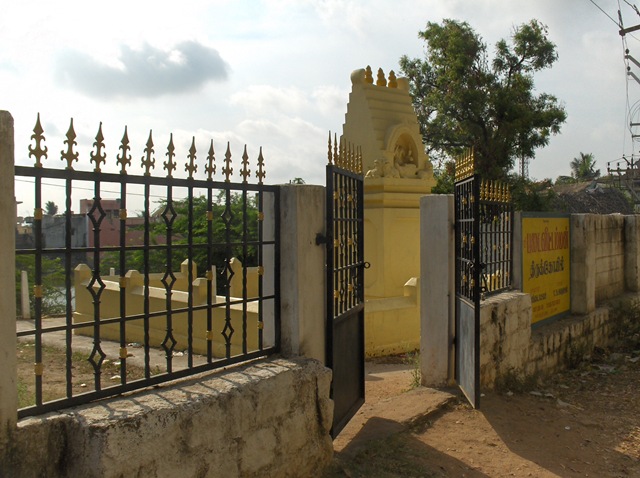
Across the road  is a sweet little shrine.

HPIM2450

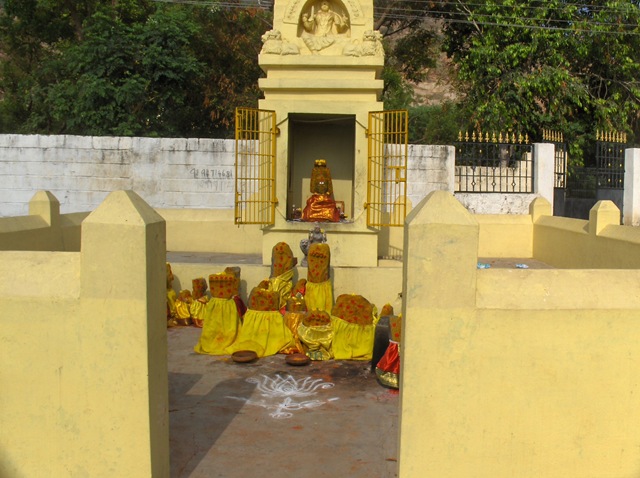
Many primitive Nagas (Snake Gods) are set out in front of the central shrine. All are dressed in their dhotis. This shrine is very well taken care of.

HPIM2452

The road continues on.

HPIM2453

We take the first left turn, down the hill.

HPIM2454

This is a nice clean street to walk down.

HPIM2459

It passes by a large tank. This has water year round.

HPIM2462

A Ganesh shrine is next to the road. It was  recently repainted, and is brightly colored.

HPIM2463

Down the hill we go.

HPIM2464

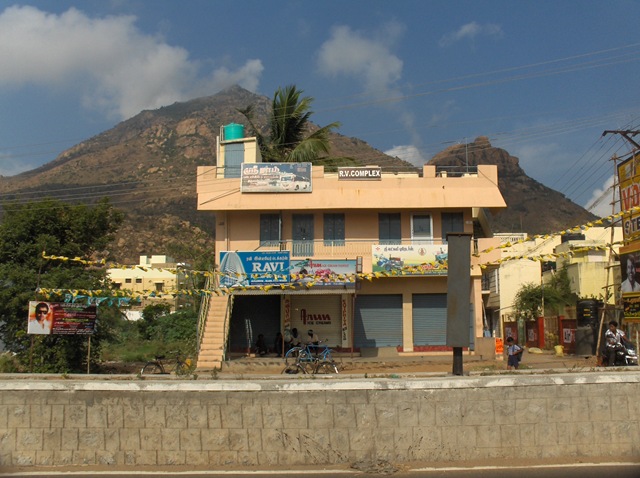
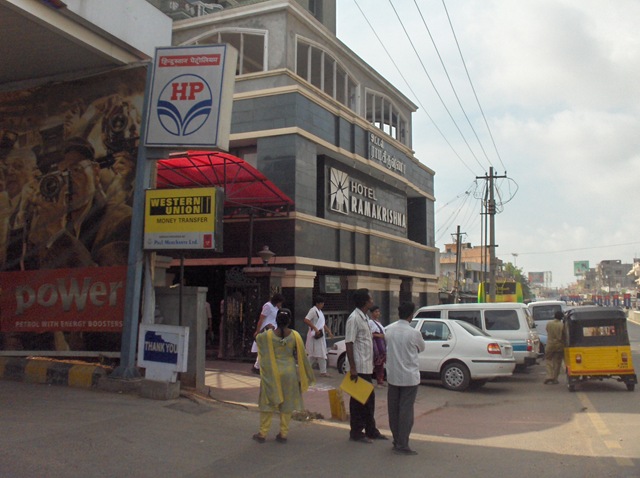
Now we come to the main street. Hotel Ramakrishna rises ahead.

HPIM2465

Arunachala is obscured by the main buildings and phone/electricity lines.

HPIM2467

Almost to the hotel. We can’t wait to eat breakfast!

HPIM2471

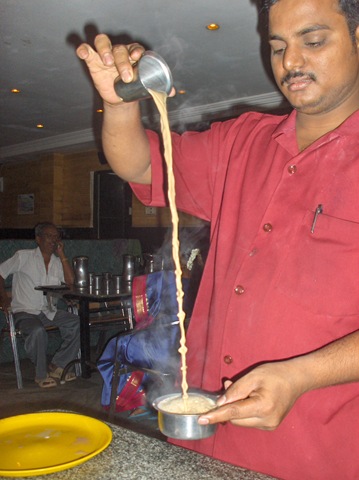
First is coffee. We have coffee before the meal. Indians have it after. The staff here know us, and  know to bring the coffee to begin with.

It is served in a metal cup and small pan. The waiter, Raja, pours it from one to the other to cool the coffee. If I tried it from this height, the coffee would be all over the table.

HPIM7318

Then the dosas and vadas are served. Since the staff knows that we LOVE the chutneys, they bring us big bowls of it.

HPIM2473

This concludes the inner path portion of Arunachala Pradakshina.

From here you can complete it by walking through town on the main street, or on back streets closer to the mountain. We usually have our rickshaw driver, Rajan, pick up us after breakfast and ride through town.

The Inner Path Pradakshina is something that gives many people a deep sense of the holy maintain, and its peace and tranquility. The walk can be made year round. In the summer months start as early as you can (6 am?) and take lots of water. Take your time. Be willing to explore. Near the path are many places of wonder, beauty and  peace. Savor it all, if you can.

Related Posts

Inner Path – Southwest Side
I
nner Path – South Side from Ramanasramam
Inner Path – Around Parvati Hill
Inner Path – The Elephant
Inner Path – Through the Trees

Harsha's avatar

Inner Path – “Trees”

This post continues the series that show Arunachala’s Inner Path, used by devotees of Sri Bhagavan Ramana Maharshi for the sacred walk around this holy hill. This walking is called pradakshina, or in Tamil, girivalam.

Part One shows the path from Ramanasramam. Part Two shows the walk around the southwest side of the hill.  Part Three details the section of the path around Parvati Hill, at the west end of Arunachala. Part Four shows the path on the north side, under the Elephant. This is Part Five.

A map is below. The Trees section of the Inner Path is shown in red.

Arunachala Inner Path Trees

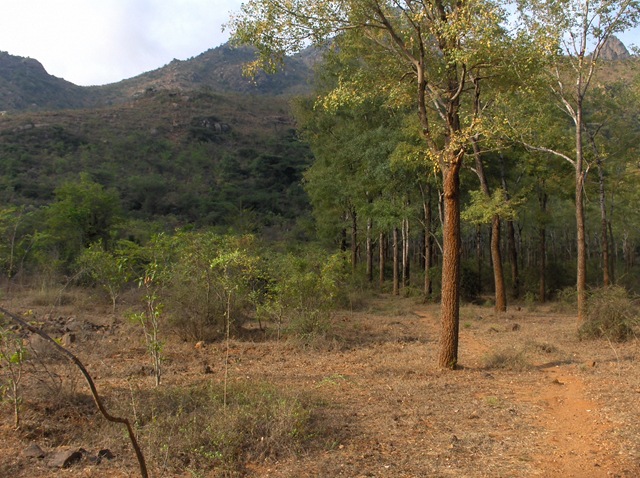
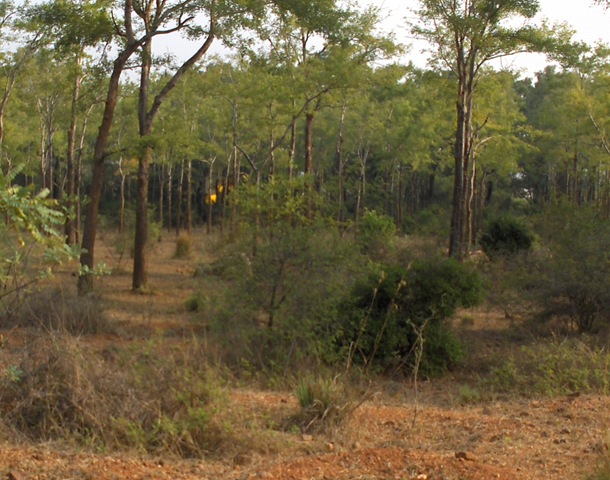
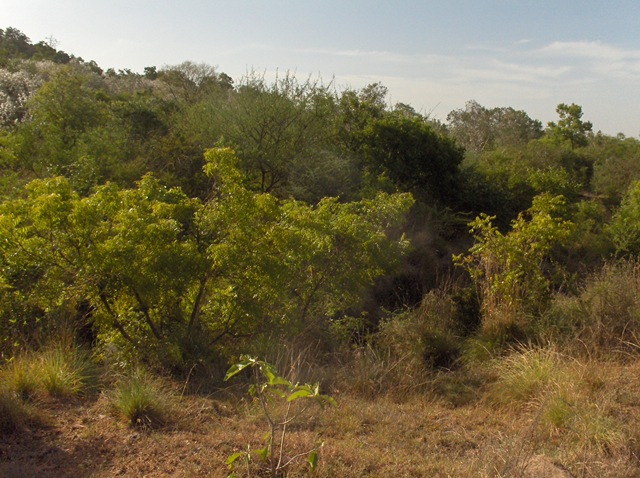
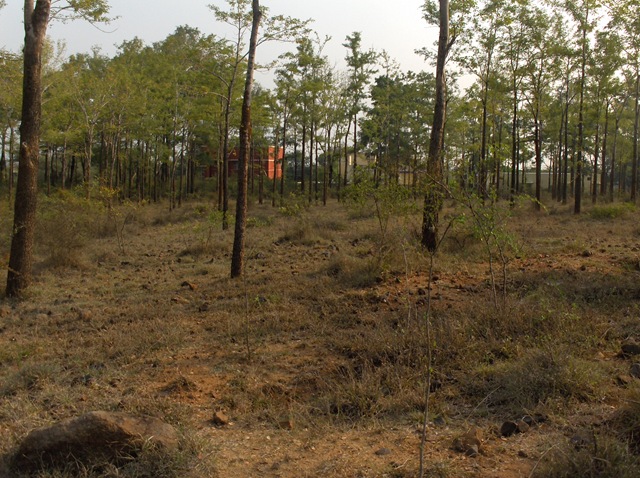
In this section of the Path, tall trees, planted about 20 years ago, are a main feature, first away from the Path, near the road, then next to the Path, then the Path goes through these trees. Also the Path gets closer to the road, and is  less quiet. 

Starting from the Stone Post

It is about 7:30 in the morning when we start from here. There is sunlight on the trail already. It is late March, and moving towards summer, so the plants are drying out. 

At this spot there are paths leading both towards and away from the mountain. Go straight: the Path is marked here.

Sometimes you will see camphor burning in a pit in this marker. If you brought camphor, you might want to light a piece of it here.

HPIM2056

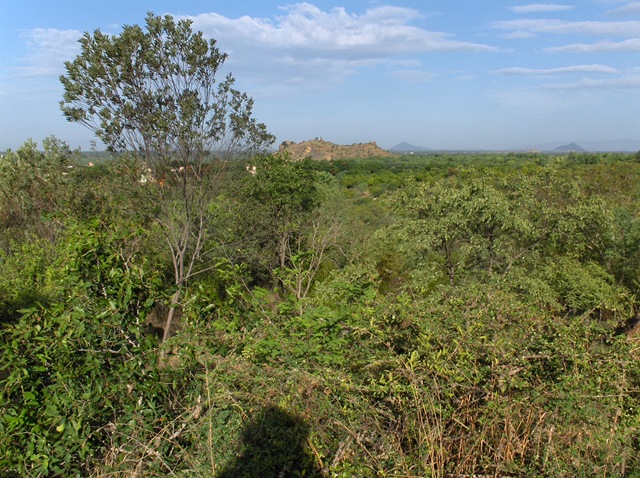
Looking  away from Arunachala, you can see trees rising far away.

HPIM2057

The Elephant ‘compass’ is now pointed almost directly at us.

HPIM2058

Ahead, there is a ridge that slants down towards the Inner Path. This is a landmark on this part of the path. When this ridge comes down to the Path, there is a nice place to sit, rest and have a drink of water. There is also a little-known feature of Arunachala at this spot, called by some the ‘Ringing Rock.’ 

HPIM2059

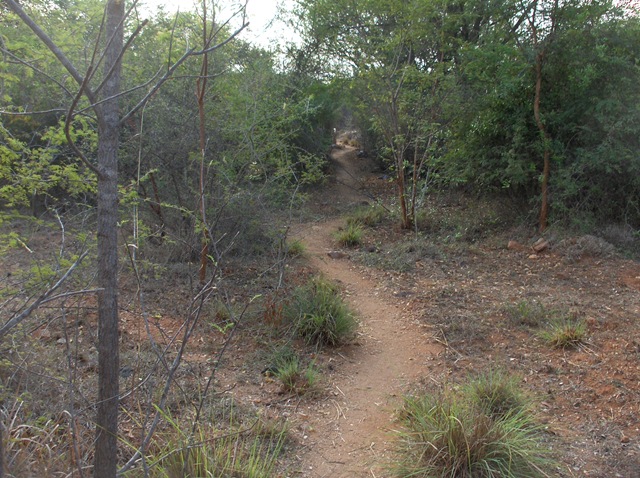
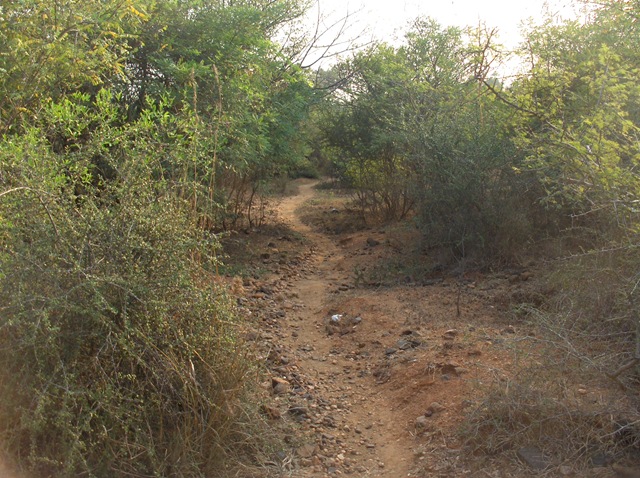
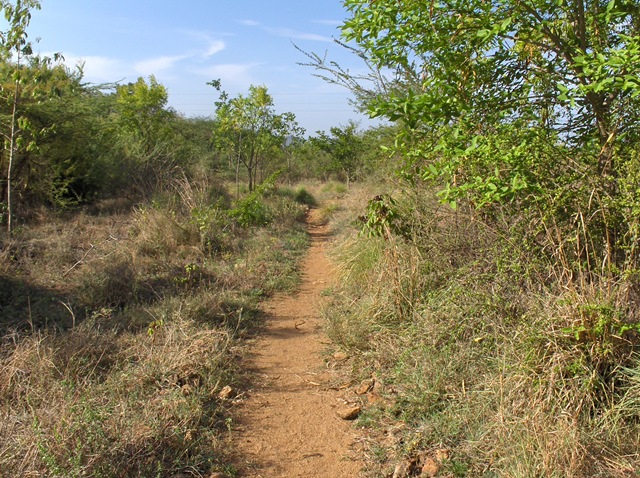
The path is well marked. Sometimes it goes through thickets.    

HPIM2062

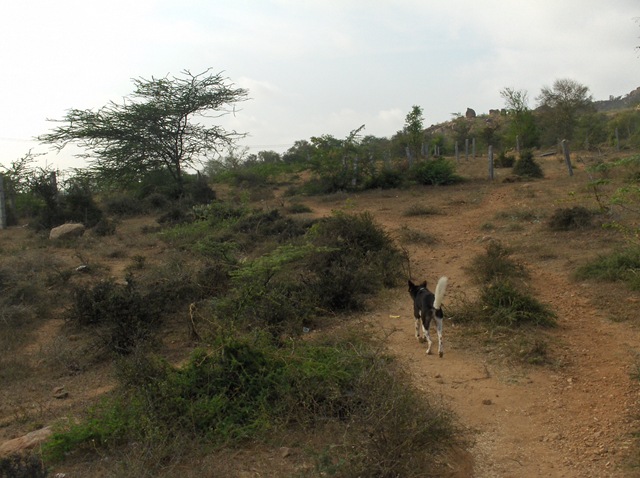
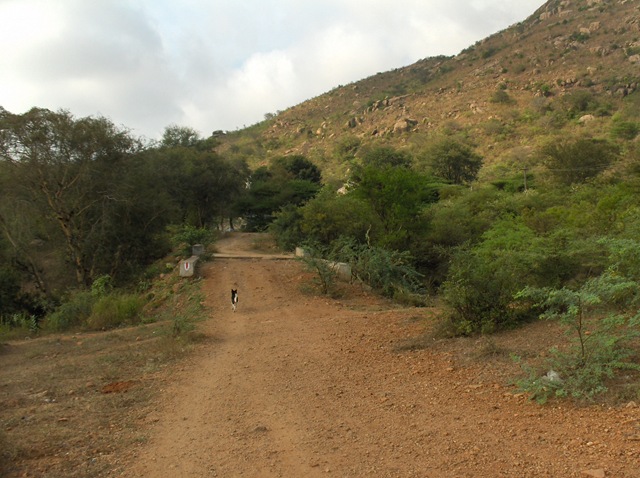
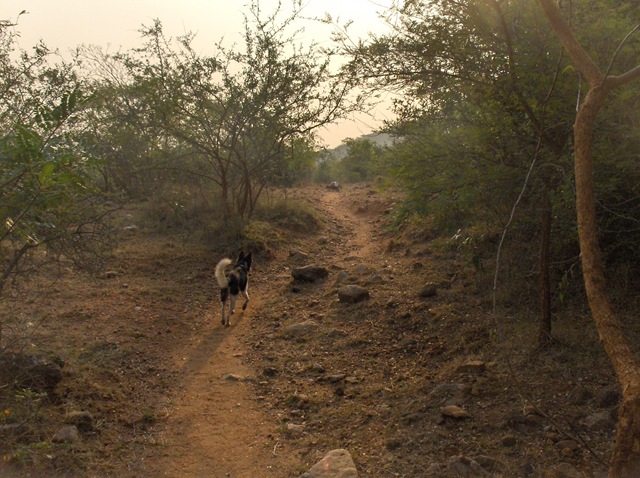
Sometimes through open scrub brush. There is a black and white dog walking with me today. He sometimes joins us on the walk. I bring doggie biscuits for him (and two other dogs that are friends).

HPIM2063

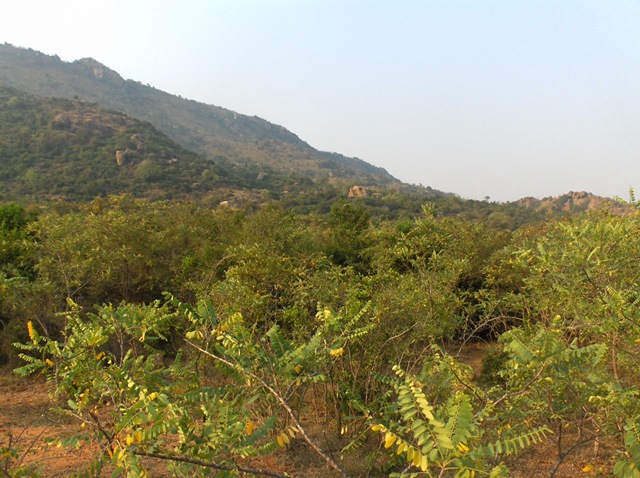
Looking back towards the mountain, the ridge seen when walking The Elephant rises to the right. In the center here you can see a low hill, where it will be worth exploration trips in the future.

HPIM2068

Ahead on the Path we see the ridge angling down to the Path.

HPIM2071

HPIM2075

Trees are now closer to the Path.

HPIM2077

The Path continues through open brush.

HPIM2081

We pass a stone retaining wall intended to reduce erosion during the rainy season.

HPIM2082

Now  it looks  like we are heading into the trees.

HPIM2086

They are closer to the Path here.

HPIM2095

We wind down a small hill.

HPIM2097

And come to a well-made rock-and-cement structure that is part of the system to slow down water running off the Holy Hill.

HPIM2098

Below, we have crossed to the other side of the Elephant ‘compass’.

HPIM2103

The path goes through trees for a short bit, then back into the brush.

HPIM2107

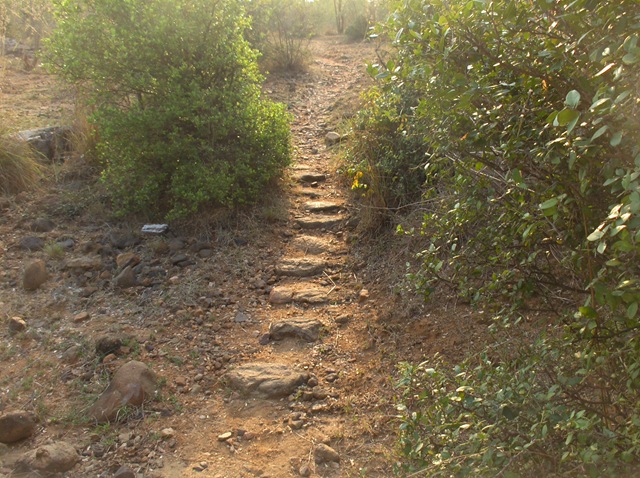
Here is a short set of stone stairs. Again and again we see work that has been done by someone who loves Arunachala, and provided some service to the mountain by working on the Inner Path. 

HPIM2110

Winding through the low trees and brush.

HPIM2116

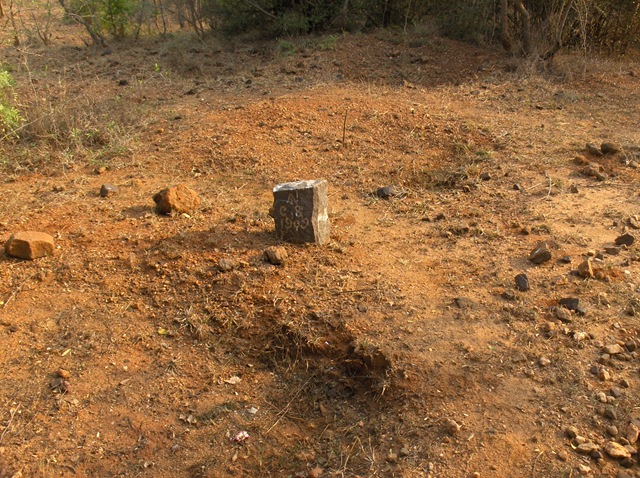
Here is a survey marker. The date is 1909.

HPIM2117

Now the Path is next to the trees.

HPIM2123

The Elephant ‘compass’ shows we are on the north east side of Arunachala.

HPIM2125

We see many trees to the right of the Path.

HPIM2132

In the foreground, notice the green ridge coming down towards the path.

HPIM2137

This two-rock marker also shows where we are. We are near a group of rocks were we can sit and rest.

HPIM2140

To the right, through the trees, we can see a spot of yellow color. This is from a house by the Girivalam Road. You can hear traffic  on the road now.

HPIM2141 crop

Here are the rocks. We usually sit here for a bit, and have a drink of water.

HPIM2153

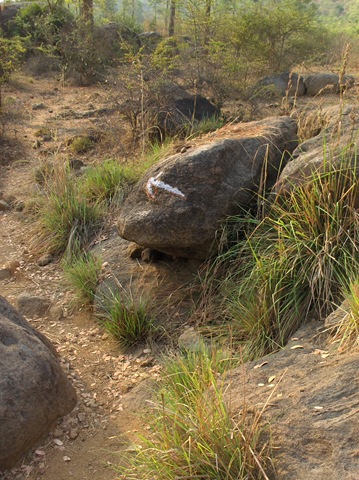
Off the right side of the Path is a rock with an arrow painted  on it. (In the photo above, it’s the rock to the right in the middle ground.) If you look closely, you will see that it is scuffed (above and to the right of the arrow). Grab a hand-sized stone and strike it in the scuffed area.

Listen and know why it is called ‘The ringing rock.’  Have you ever heard anything like this before?

HPIM2157

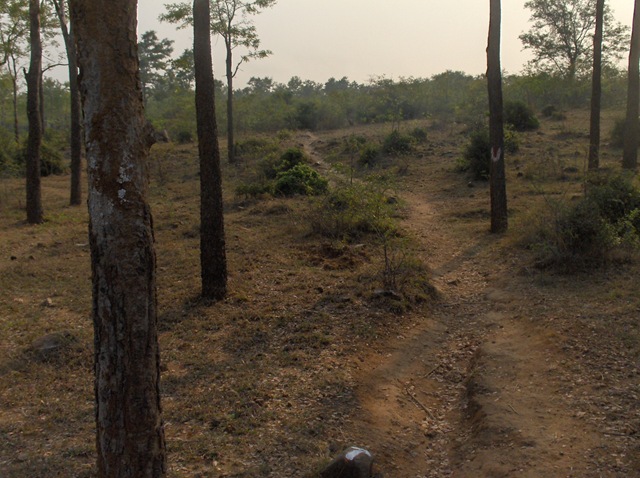
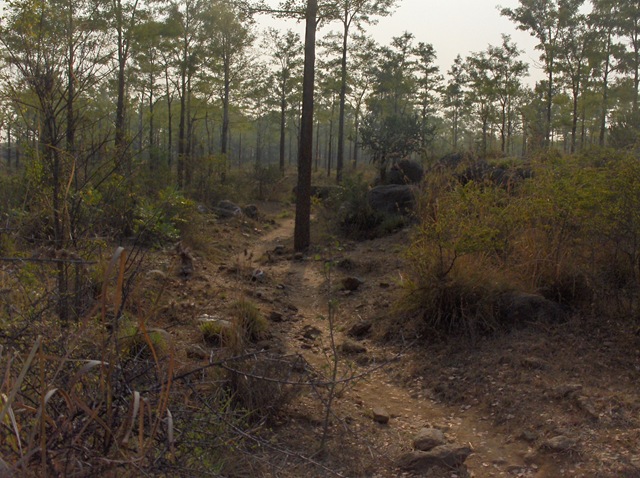
Now the Path continues through the trees.

HPIM2160

More houses and commercial buildings are visible to the right of the Path.

HPIM2164

The peak of Arunachala is behind us. We see The Elephant from the other side now.

HPIM2165

These trees are planted  in rows.

HPIM2175

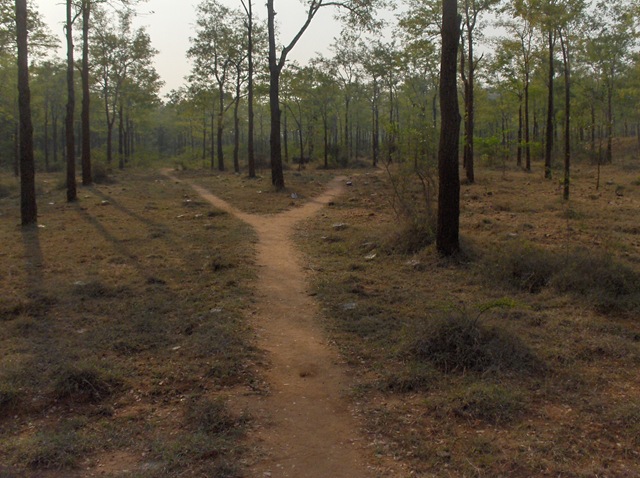
Take the right fork of the Path.

HPIM2176

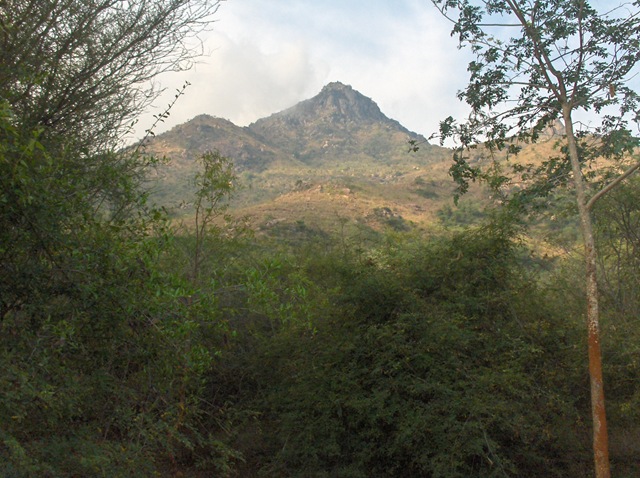
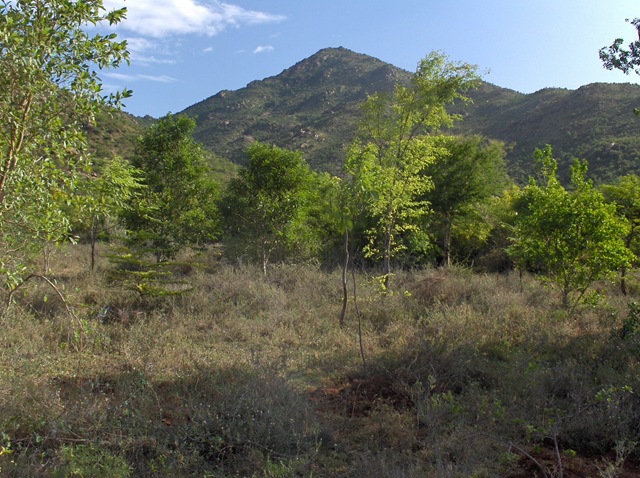
Below is the peak through the trees.

HPIM2180

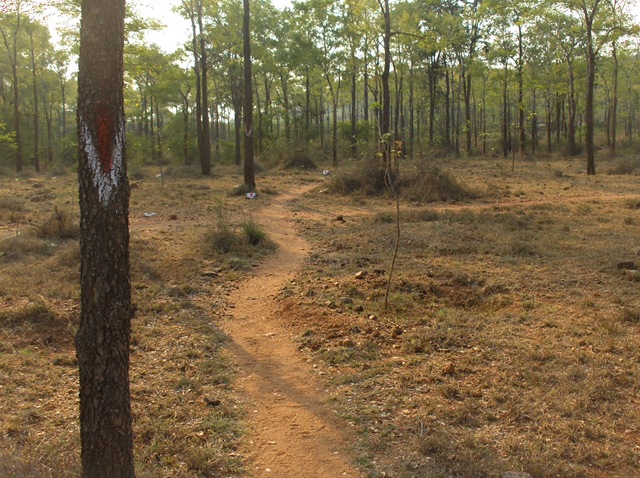
We cross a couple of paths.  The Inner Path is well marked. Go straight.

HPIM2183

Now a rock formation rises to the left of the Path.

HPIM2192

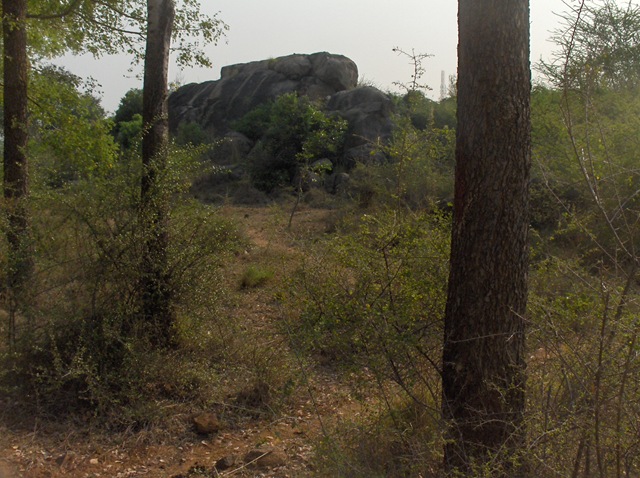
It is maybe 20 feet high. Recentlyl we saw a photographer here, having gone ahead of his group to get a shot from a great angle.

HPIM2197

We cross the path that goes by this rock. This  is the end  of this section of the Inner Path. 

HPIM2196

We will post the next and last section of the Inner Path soon.

Related Posts   

Inner Path – Southwest Side
I
nner Path – South Side from Ramanasramam
Inner Path – Around Parvati Hill
Inner Path – The Elephant

Harsha's avatar

Inner Path – The Elephant

This post continues the series that show Arunachala’s Inner Path, used by devotees of Sri Bhagavan Ramana Maharshi for the sacred walk around this holy hill. This walking is called pradakshina, or in Tamil, girivalam.

Part One shows the path from Ramanasramam. Part Two shows the walk around the southwest side of the hill.  Part Three details the section of the path around Parvati Hill, at the west end of Arunachala. This post is Part Four of the series.

A map is below. The Elephant section of the Inner Path is shown in orange.

Arunachala Inner Path The Elephant

Note from the map that this section of the Path has many small streams that cross it. The terrain here features small ‘hills’ as you enter into and out of the creek bed. These creeks are all pretty small, and only have water when it rains.

It is in one of these that Sri Ramana found the banyan leaf, and followed the stream upstream, only to be stung by hornets, and then abandoned his search for the banyan tree.

Starting from the Frog Pond

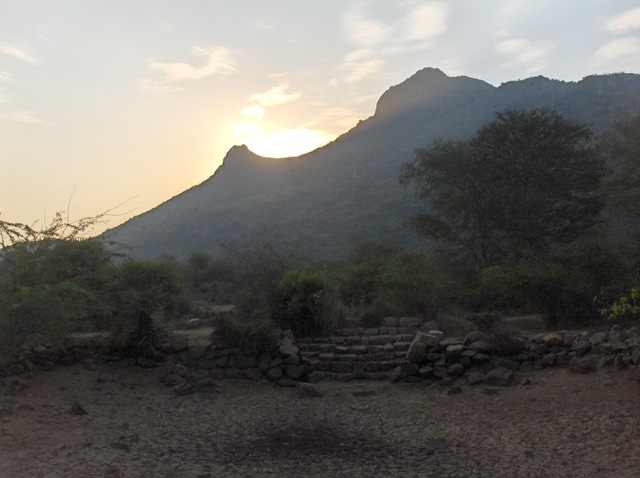
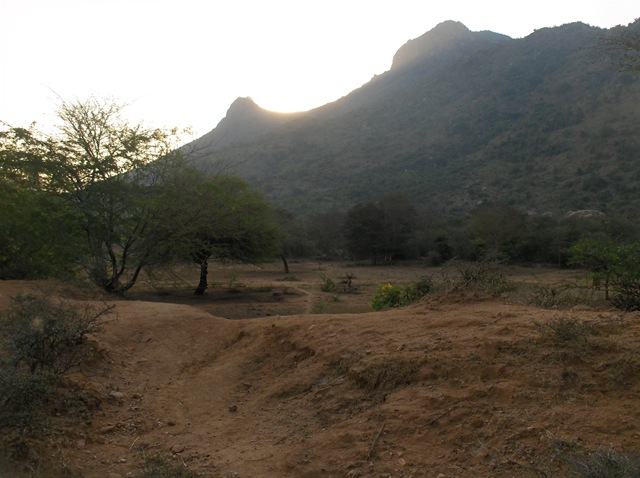
The Frog Pond is dry by mid March when these pictures were taken. The season is getting hot, so  we started early and were here by 7 AM, before the sun rises over Arunachala. The bright sun can be seen behind the ‘trunk’  of The Elephant. We will have sunlight in a few minutes.

HPIM1934

The Path starts off across an area pretty dry and flat.

HPIM1935

Looking to the right side, first you see the gap between Arunachala and a small hill. There is a path over this gap that is shown in A Path Across Arunachala.

HPIM1936

Looking behind is Parvati Hill, and the pass at the other end of the hill. This is where the original Path was. This is shown in the postings: Kattu Siva Path Renewal – Part 1 and Kattu Siva Path Renewal – Part 2 .

HPIM1937

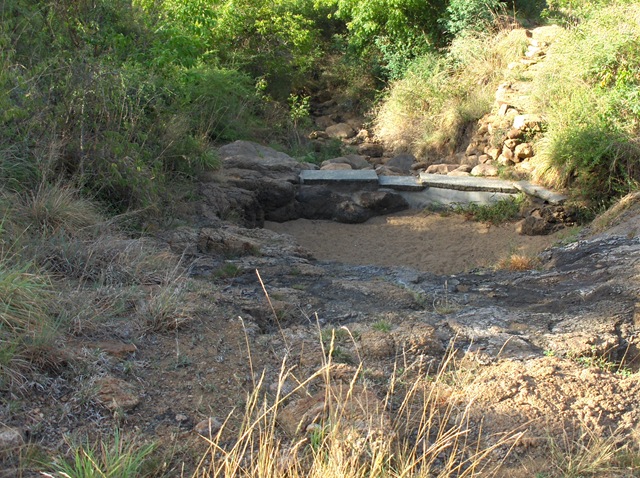
Next the Path crosses the first of many creek beds …

HPIM1938

Then rises up to the Northside Catchment Basin. Notice that there is a path across the basin that is usable much of the year. Some people take this path here.

HPIM1940

The main route of the Path goes to the left, and follows along the dirt berm that makes up the retaining wall for the catchment basin.

HPIM1941

Walking across this berm, farmers’ fields come right up to the path. This is the only place where this occurs.

HPIM1945

In the photo below, looking over the basin, a big rock can just barely be seen rising through the trees. On the other side of the basin here is a trail nexus where a number of paths go towards and along the mountain side. This is shown better in Under the loving gaze of The Elephant.

There is an old small trail next to the mountain in this area that we call ‘The Inner-Inner Path.’ This will be detailed in subsequent postings. Easy exploration can be done here.

HPIM1948

Between the Path and the fields, the farmer has made ‘fences’ of dry thorny branches. This keeps cattle from entering the fields. 

HPIM1950

At the end  of the basin the Path crosses another dry stream bed …

HPIM1952

Then goes off across the gentle hills. 

HPIM1953

In this section a power line crosses the Path. This is the only place where this happens.

HPIM1957

Now the sun is starting to  rise above the Holy Hill, and there is better light for photography.

HPIM1961

The Path lights up …

HPIM1960

And crosses yet another creek bed. We walk down and up the little hill.

HPIM1963

Looking to the left, the gopuram of Adi Annamalai Temple rises through the trees.

HPIM1967 closeup

Often this man will be seen, asking for coins. Sometimes it looks like he is working, clearing rocks off the Path and doing other work to improve the Path. 

HPIM1968 closeup

Looking to the left of the Path, not a house can be seen. More mountains rise up on the horizon. There is no motor noise here; all we hear are bird songs.  

HPIM1974

The Path proceeds across the hillside.

HPIM1976

Looking towards Arunachala, a rocky hill can be seen in the foreground, rising from below. More places to explore. I have seen a group here, up on one of the rocks. It seems they were with a teacher and meditating.

HPIM1979

Past another creek bed. This on has a stone wall to prevent erosion. These are seen in other places as well. This is all a part of the task of protecting the hillside and bringing as much water into the water table as possible.

HPIM1987

The Elephant is in the background. A face of the hill rises in the foreground. Water can be seen flowing down rock faces during the rainy season.

HPIM1990

The Path winds on.

HPIM1992

And on.

HPIM2000

We are getting close to the face of the hill that rises here.

HPIM2007

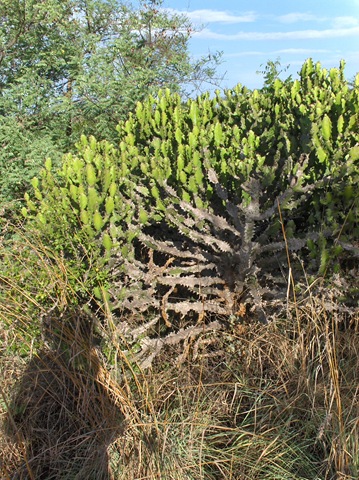
Reminding us of the desert-like environment, here is another cactus, well protected from the heat that is soon to come.

HPIM2010 closeup

Just barely visible here on the hill face is a small white box. This once housed an idol. This idol has been taken by vandals. You can walk up to this spot and get a great overlook of the surrounding area.

HPIM2014

On the other side is a steeper area of the rock face. Back towards this hill it is greener, a sign of better water. There is a trail that leads into this greener area. Sometimes village women can be seen carrying bundles  of dried grasses down this trail.  The local people know the plants that can be used here, and make good use  of everything.

HPIM2020

Now the angle between the trunk and head of The Elephant has  become more acute. This means we are nearing the end this section of the Inner Path. I think of this as the ‘Elephant Compass’ and use the angle as a way to know where I am on the Path.

HPIM2021

The Path continues to wind through the countryside.

HPIM2023

HPIM2034

The ‘Elephant Compass’ gets yet more acute. Getting closer to the end the of the section. 

HPIM2035

Now, through the trees, houses can be seen far away. Road  noise is also sometimes heard.

HPIM2037 closeup

The Path continues through the dry brush. 

HPIM2039

Look at the ‘Elephant Compass’ now. Where are we? We’re reaching the end of this section.

HPIM2045

Looking back, we can see the hill face rising behind us. There is a  big area on this side of the hill that needs to be explored. This will be done in other posting, later.

HPIM2046

Down a bit more of the Path.

HPIM2048

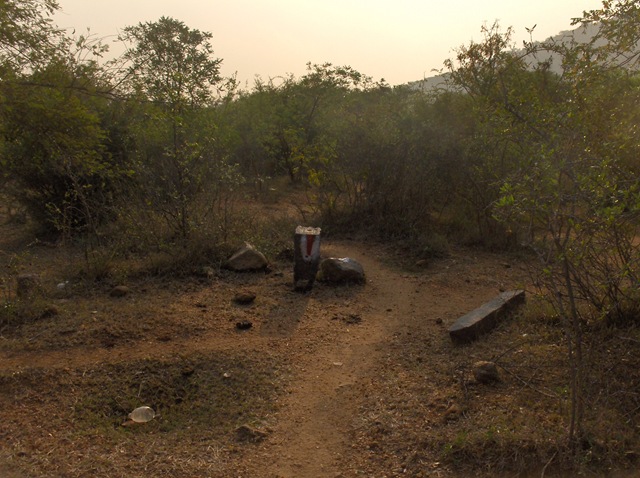
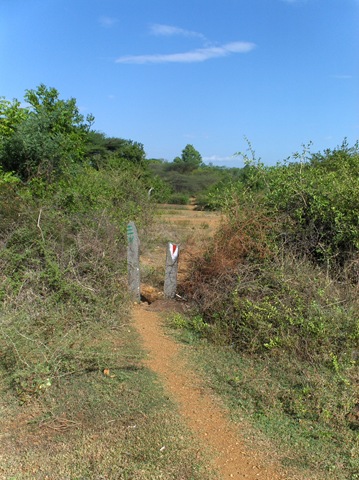
A stone post with a painted Inner Path marker defines the end of The Elephant section of the path. Sometimes camphor will be seen burning in a pit on the top of this post. Notice that there are paths that lead both to the right and the left here. One set goes  towards the road, the other towards the mountain. The Inner Path goes straight, past the post.

HPIM2050 closeup

The next section of the path, we call ‘Trees.’ We will post this soon.                          

Related Posts   

Inner Path – Southwest Side
I
nner Path – South Side from Ramanasramam
Inner Path – Around Parvati Hill 
Under the loving gaze of The Elephant
Adi Anamalai Temple

Harsha's avatar

Wisdom and Action (No. 1): By V. Ganesan

This is the first part of three ‘sharings’ from Ganesan, at his house in Tiruvannamalai.

Today is the Happy Christmas day – 25th December,2008 !

When I opened the computer, the glorious, serene and the saintly picture of JESUS CHRIST blossomed before me, with the following powerful words written beneath Him :

“ TRUST in the Lord, with your Heart; and,
Don’t lean on your own understanding.
In all things acknowledge Him, and
He shall direct your way. ”

—– PROVERBS 3:5. 6

I felt blessed !

The Great Master: JESUS CHRIST thus was “directing” me the way of what with and how I should commence the ‘Morning Sharing’ with fellow-seekers !

In our last session, we quoted FOUR varied sayings of the Great Master : BHAGAVAN RAMANA, on which the mode of sharing would be taking place for a few more sessions. They are :

(1) In 1936, Paul Brunton asked the Maharshi : “Can a man of the world [ viz., one who is involved in worldly activities ] practice this Jnana Marga – Wisdom Path ? “

Sri Bhagavan’s cryptic answer was : “There is no contradiction between Work and Wisdom.”

(2) On another occasion, Sri Bhagavan said : “ The only purpose of life is to realize the SELF. All other activities are waste of time.“

(3) Yet another affirmative statement of Sri Bhagavan is : “ If one identifies oneself with the body, ‘Karma ’ [ destiny ] is inevitable
and unavoidable [ which means, one is ever bound, one is ever in bondage ]. If one’s attention is turned inwards, one is always free. One is ever a Free Man.”

(4) When asked whether his teachings could be put in one word,

Sri Bhagavan answered : “ATTENTION” [ “Unar]

* * * * * * * * * * * *

For clarity in spiritual striving, Sages and Saints of yore had conveniently classified the approach to spiritual attainment into four branches : ‘Jnana’ , ‘Bhakti’, ‘Yoga’ and ‘Karma . The “Bhagavad Gitadeals elaborately on all the four methods. Sri Bhagavan also refers to these four paths in his original composition : “Upadesa Sara . However, Sri Bhagavan’s ‘Direct Teaching ’ is “ To turn the outgoing mind inwards and merge it in the Inner Reality .” Any theory which gave emphasis on the ‘mind’ to move out or go outwards, Sri Bhagavan warned the seeker to be vigilant. He said : “ Constant vigilance is the price a seeker has to pay. ”

In that light, it is interesting to observe that Bhagavan gave greater importance only to TWO of the four methods : ‘JNANA’ and ‘KARMA’ . He further elucidated the reason for doing so. He said that ‘Bhakti’ and ‘Yoga’ are included, imbued into ‘Jnana’ and ‘Karma’.

Attention turned outwards is “KARMA” which is body-based and mind-based [ ‘Destiny’ ] .

Attention turned inwards is “JNANA” which is “Attention paying attention to Attention” [ “Ulladu Unar ” ] .

When one identifies with the body, one is bound by rules, regulations, do’s and don’t’s – that is ‘Karma’ . They are unavoidable if one is the body only. Sri Bhagavan raises the question : “Are you only the body ?”

Body is perceptible in the waking; and, vaguely and differently in the dreaming; and, totally absent in the deep sleep state. But, the inward awareness of “ I AM ” is continuous and uninterrupted.

Body is there, temporarily. Awareness is ever there !

Am I the body only ? The mind only ? Or, am I the awareness ? WHO AM I ? Vichara [ Enquiry ] results. Vichara takes one to the inner depths of Truth – to the threshold of TRUTH itself. All other methods are mind based. Vichara transcends mind. When Paul Brunton reported thus to Sri Bhagavan : “ I have been acquainting myself with the various teachings in India before coming to you.

Every one of them preaches the same truth. You also say the same. So, how is your teaching different from the others ?” Sri Bhagavan replied : “All other teachings are based on the ‘mind’ . Mine does not. It transcends the mind.”

Every spiritual practice is based on body & mind and thus only secondary — including meditation. Vichara alone transcends all borders of conditionings.

Listen to Bhagavan Ramana :

“ Devotee: Will Vichara alone do even in the absence of meditation ?

Sri Bhagavan : Vichara is the practice and the Goal also. “ I AM “ is the Goal and the final Reality. To hold to It with effort is ‘Vichara’ [practice] . When spontaneous and natural It is Realization [Goal] . “

— “TALKS” , No.390

The two paths that Sri Bhagavan emphasized are JNANA and KARMA. He classified them in unmistakable terms as well, which can be grasped from the following dialogue with a devotee :

“ Devotee : What is Aham Sphurana (shining) ?

Sri Bhagavan : Aham, Aham = “I AM” , “I AM” is the SELF. Aham Idam = ‘I am this’ or ‘I am that’ is the ego. Shining [ ‘I AM’ ] is there always. The ego [ body-mind ] is transitory. When the “I AM” is kept up as “I AM” alone it is SELF.

When it flies out at a tangent and says ‘this’ or ‘that’, it is the ego. “

— “TALKS” , No.363

* * * * * * * * * * * * * * * *

Now, let us go back to the last session, in a brief way :

In verses 26 & 27 of the Supplement to the Forty Verses [ Ulladu Narpadu ] Bhagavan translated the instruction given to Sri Rama by his preceptor, Sage Vasishta. The theme is the right relations between awareness and heroic action. In 1944 when the proofs of the third edition of Ulladu Narpadu was being corrected in Bhagavan’s presence, some of the English Professors who had accompanied Prof.K. Swaminathan, found fault with the introductory note by the author, Lakshmana Sarma [ “Who” ] :

“To the question how the sadhaka [aspirant] is to behave in the world till he succeeds in attaining Wisdom, the answer is given in the two following verses, taken from the Yoga Vasishta. “

* * * * * * * * * * * * * *

Verse 26 : Supplement to the Forty Verses on Reality :

“ Having understood, i.e., by consciously experiencing the various states – like, the waking, dreaming and the deep sleep – and yet always holding firmly at Heart to the Supreme State of Inner Silence, play your part, O Hero, ever in the world. Having thus realized the Inner Silence of the Heart as the underlying Truth behind all forms of appearances, never swerve from it. Thus, play your allotted part in the world, O Hero, acting as though attached to them all ! “

Verse 27 :

“ Outwardly pretending to have enthusiasm and delight, excitement and aversion, initiative, effort and perseverance, yet without any inner attachment at all, play, O Hero, in the world. Thus, releasing oneself from all forms of bondage [attachment ] and having equanimity of mind, act outwardly, in all situations, in accordance with the part one is endowed with, play your part as ordained, O Hero, in the world. “

* * * * * * * * * * * * * *

Now, the Professors pointed out to Sri Bhagavan the obvious absurdity of Sarma’s suggestion that Sri Rama – Incarnation of Lord Vishnu – a Self-Realized great soul — needed this teaching.

“Who has these doubts ?” enquired Sri Bhagavan. “Prof. K. Swaminathan !” said some one. The cool bright beam of the Maharshi’s glance of grace pierced through the entire being of Prof. K. Swaminathan. Sri Bhagavan said smiling : “ Look ! It is for you” [ Paar, Unakkuttaan ! ]

The “you” refers not only to Prof.Swaminathan, but so vibrantly to every one of us ! Remember, some time back, we shared how one of the Saints that I had met, had asked me to read “The Bhagavad Gita ” and actively guided me by saying : “To truly understand the import of this great spiritual masterpiece, one should read it assuming oneself to be Lord Krishna and never by identifying oneself with Arjuna !”

Likewise, one should read these two verses from the standpoint of Jnana [ Wisdom ] and never from the viewpoint of Karma. Notice how the verse begins : “ Having understood……and always holding constantly, firmly in the Heart to the Supreme State of Inner Silence, the “I AM ” ” . As a trapeze act in a circus, one is advised to keep a perfect balance between the outward and inward in one’s activities — a coherent unison — which can successfully be effected by one turning within and not having attachments to actions done.

How to do it ? Allow things to happen as it is. Do not “react” , just “act”. The Higher Power will make things happen “through” you and not “by” you. Give up the attitude of “by me”, at all times and under all circumstances ! The Vedas declare : “ Be a channel for the ‘White Light’ [ Higher Power ] to pass through.”

Look at the lives of Great Masters like the Buddha, Jesus Christ and Ramana Maharshi. How did they live ? Were they lazy ? Were they not more active than any one of us ? Was there not perfect correlation between what they taught and how they lived that very teaching themselves ? On the very first day of his arrival at Arunachala, the sixteen year old youth Ramana, declared : “THY WILL BE DONE”. Never after that there was there any ‘action’ done by himself ! “The same Higher Power which brought me from Madurai to here, has brought me from Skandashram to Sri Ramanasramam,” was Sri Bhagavan’s reply to a query: “Is it not ‘you’ who decided to climb down from Skandashram to here in 1922 ?”

In our own lifetime, we saw how Yogi Ramsuratkumar lived; very actively, yet, totally resigned to the Higher Power, which he chose to address as “Father” . Quite often he used to repeat : “This beggar died at the holy feet of his Guru in 1952.” “Yogi Ramsuratkumar is not this beggar’s name – it is Father’s Holy Name. Chant three times : ‘Yogi Ramsuratkumar’ ; my Father will rush to you and help you.” When Yogiji performed remarkable ‘miracles’

for me, as he had done to his innumerable devotees, and I attributed them to him, his invariable response, every time, was : “This dirty beggar knows nothing, does nothing Ganesha. It is Father ! Out of His abundant Grace and Compassion, He responds forthwith whenever His holy name is thus called.” After a few moments of silence, he would add : “Father alone exists here, there and everywhere. Nothing else. Nobody else. It is Father, Father,

Father alone ! ” “ ‘Yogi Ramsuratkumar’ is not this beggar’s name, Ganesha ! It is Father’s Sacred Name ! You know there is the “1008 Names of Lord Vishnu” which all Hindus chant – like that, this Name is also only Father’s Name !”

Plunge within and recognize the Higher Power guiding you and operating ‘through’ you. Giving up the falsehood of “by me” and holding firmly to the truth of Higher Power working “through me”, is to be “newly reborn”. The purport and significance of our celebrating the birthdays of Sages and Saints – like, our celebrating today the Birthday of the Great Master JESUS CHRIST, as “Christmas” – is to remind to ourselves that one has to be reborn to the truth : “God’s living in me and is operating through me” and to dying to the falsehood : “actions are done by a ‘me’ .” Jesus Christ said : “By dying one lives” . Die to the past and the future and live in the NOW !

Be reborn anew by dying to the age-old attachments to Karma [destiny]. Sri Bhagavan said : “ If you say that there is Karma [ prarabdha karma ] , there is Karma. If you say that there is no Prarabdha Karma, take it for certain, there is no Prarabdha Karma. ”

One is ever the SELF ; never either the body nor the mind ! Be a “Hero ” by diving within and being the SELF !

************************************************

Related posts:

Satsang with Ganesan
Self nature, Faith and Attention

V. Ganesan Bio

ganesan-1

Born in 1936, up to the age of 14 years old, Ganesan grew up in the presence and proximity of Bhagavan Sri Ramana Maharshi. His sacred memory of the Great Master is rich in its content; and, even at that tender age he could see Sri Ramana as the greatest compassionate human being.

On April 14, 1950 – the day the Great Master chose to leave the body – the adolescent Ganesan stood near the entrance to the room where Sri Ramana was lying and was fortunate to witness the brilliant flash of Light that later moved towards the top of the Holy Hill – Arunachala.

Ganesan obtained a Master’s Degree in Philosophy; and, then came to stay permanently at “Sri Ramanasramam, Tiruvannamalai” – the sacred abode of Sri Ramana Maharshi – taking care of the Old Devotees of Sri Ramana. He did it as his sole sadhana (spiritual practice). In that way, he collected the reminiscences of Sri Maharshi from those Old Devotees which have never before been recorded.

His close contacts with sages and saints, including Swami Ramdas, Mother Krishnabai, J. Krishnamurti, Nisargadatta Maharaj and Yogi Ramsuratkumar, he says, have deepened and widened his understanding of the ‘Direct Teaching’ of the Maharshi. However, he feels himself to be an insignificant ‘dust’ at the Holy Feet of Bhagavan Ramana.

He has traveled widely and spread the ‘Direct Teaching’ of Sri Ramana Maharshi, in its pristine purity, wherever he was invited to give talks.

He has authored a few books on the life and teaching of Bhagavan Ramana. Among others, “Purushothama Ramana”, “Be the Self”, “Moments Remembered”, “Direct Teaching of Bhagavan Ramana” and “Practising Self-Enquiry” , are very popular.

At the veranda of his cottage – “Ananda Ramana” – he meets earnest seekers, every Monday and Thursday, between 9.30 and 11 a.m., sharing with them the spiritual treasure entrusted with him by all these holy and sacred souls.

Harsha's avatar

Arunachala – On the Inner Path: Southwest Side

This posting is the second in a series in which I will show some of the experience of walking Arunachala’s ‘Inner Path.’

The first posting shows the start of the walk from Sri Ramanasramam.

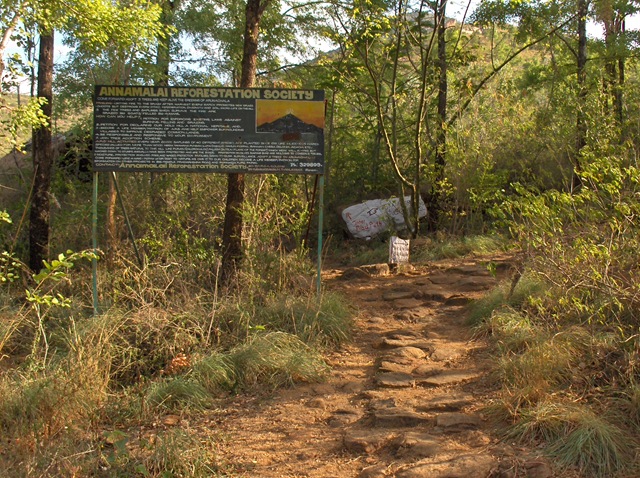
This posting continues with the walk where the initial posting ended, from the path near the access point where Perumpakkam Road meets Bangalore Road. This is the place where many walkers enter onto the Inner Path. This part of the Inner Path goes by the path up to Aum Amma’s and Papaji’s caves, by the Sadhu Tank, and ends at the Arunachala Reforestation station.

Previous postings show areas that can be reached while on this part of the Inner Path. Postings about Papaji’s cave can be found here and here. Aum Amma cave is shown here.  A posting about the ‘Holy Feet of God’, Tiruvadi, South of the Sadhu’s Tank, can be found here.

A map of Arunachala and the Outer Path is below. I have marked this map with a few landmarks we use, and with an approximate map of the first two sections of the Inner Path pradakshina (girivalam in Tamil) shown in this series.

The Southwest section of the path is in blue.

Arunachala markers and inner  path copy 2 copy

The path starts after you go through the stone ‘gate’ leaving the first section. There is a ditch you walk through on the other side where the path starts. If it is full of water, there is an alternate to the right.

HPIM8194

Looking to Arunachala through the trees before we start walking on this section.

HPIM6090

Most of these photos were taken on a Sunday, and there were a few other people walking the path, including an elderly Indian couple that have lived for the last 30 years in Saratoga California, near where I lived, and who have heard of my spiritual teacher, Nome.

Many times during the week we will not see another person walking the Inner Path.

The path start winding through an area where trees provide a canopy.

HPIM8198

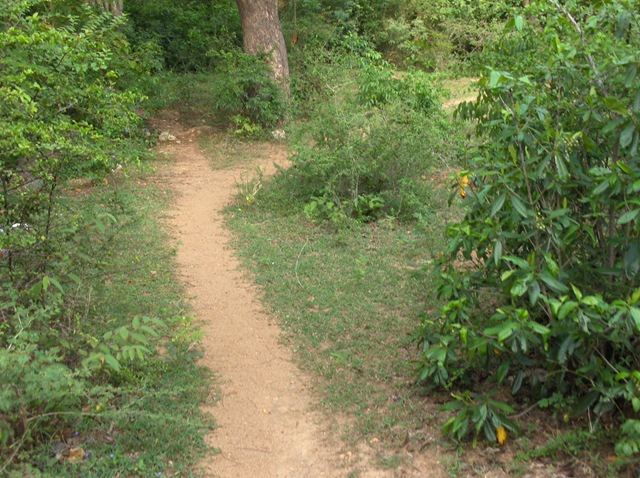
The path branches to the right here. Do no go straight here; you will go back to Bangalore road.

HPIM8202

Arunachala, the peak enshrouded in clouds.

HPIM8203

The path in gentle here, winding through trees towards the mountain.

HPIM8206

Now the path has turned East.  The tall trees on the right were planted I think 10 – 20 years ago. There were many of this kind of tree planted in this area, and on the Northeast side of the hill.

HPIM8208

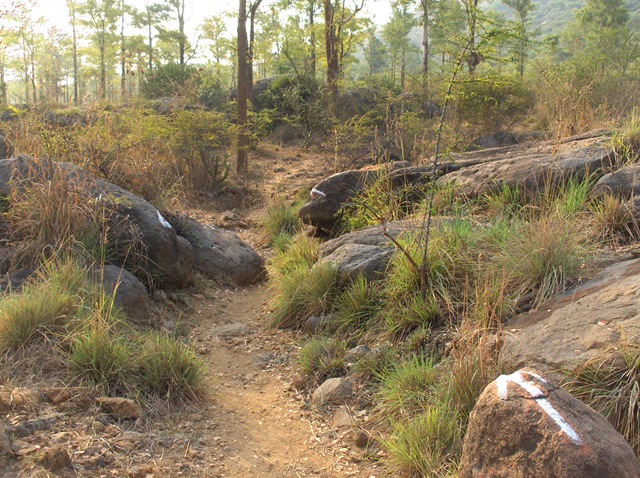
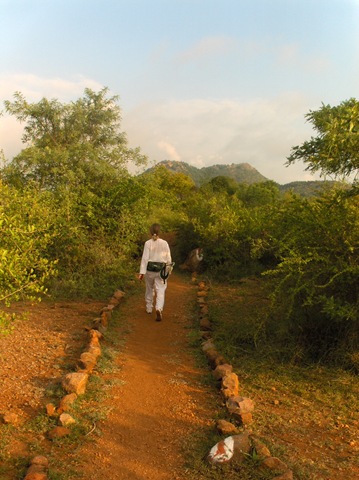
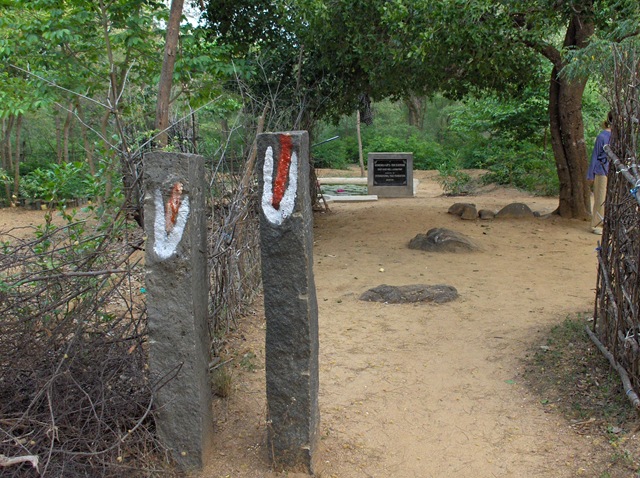
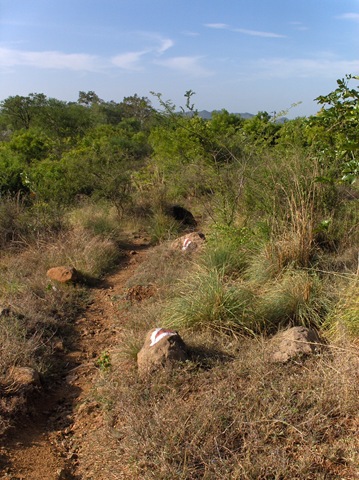
Winding through this countryside. The red and white paintings are trail markers painted on stones. These are found all the way around the mountain to mark the Inner Path. Following these one should not get lost – just keep Arunachala to your right and keep walking.

HPIM8213

Now the path has turned back towards the mountain. It is more rocky here.

HPIM8217

Carol walking ahead of me.

HPIM8234

Arunachala  from the Inner Path, clouds at the top.

HPIM8236

Here is a marker for the path to Aum Amma’s and Papaji’s caves. Follow the path up the hill. Have good shoes, this is rocky and steep in parts.

HPIM5850

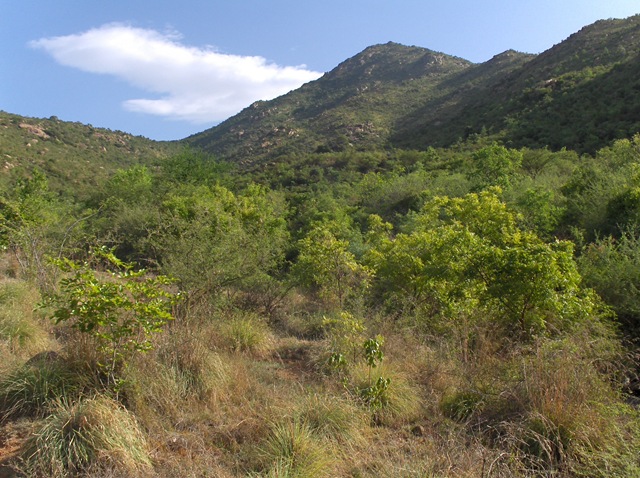
Continuing along the Inner Path. Now Parvati Hill, the small hill on the East end of Arunachala, with its two small peaks, is visible.

Note the stones lining both sides of the path. These are common in this section of the path. You will see them in many of the photos.

HPIM8239

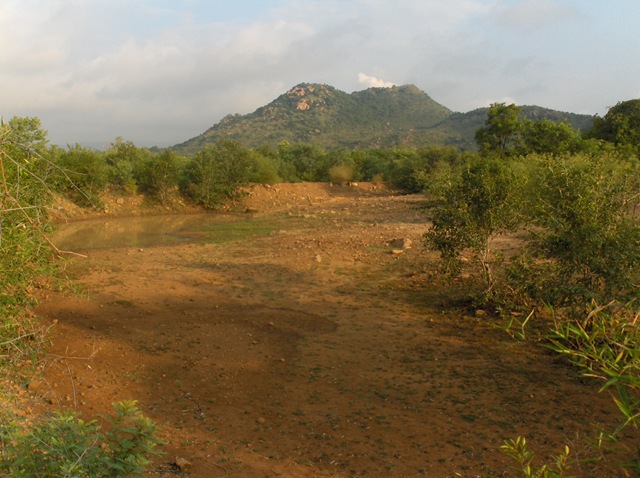
Parvati Hill, looking of one of the several small lakes found in this section of the path. These are behind earth berms, and I think are intended to help bring water back into the underground water table. It is early monsoon season now, and there is some water in this tank, which has been dry for the summer months (starting in April).

HPIM8243

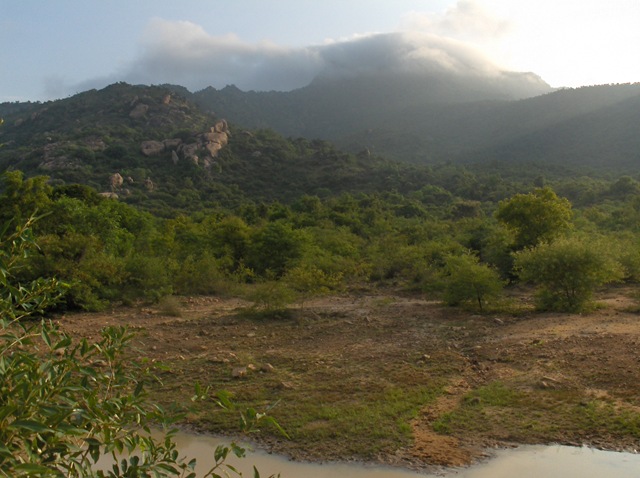
Again Arunachala in the clouds. This is from the berm shown above. Part way up the mountain, on the left side of the photo, a big rock formation is visible. This is where Aum Amma’s and Papaji’s caves are found.

HPIM8248

The path is pretty here, and lined with stones on both sides.

HPIM8258

Now winding through more trees. When the sun is out, these trees are much appreciated. Any shade is welcome. White and red trail markers are visible in the distance.

HPIM8262

Coming out of the trees, Parvati Hill is again visible.

HPIM8269

Back into the trees.

HPIM8274

HPIM8279

Now to the right of the trail is a big rock. Often, in the tourist season, you will see groups, sitting on this rock.

HPIM8282

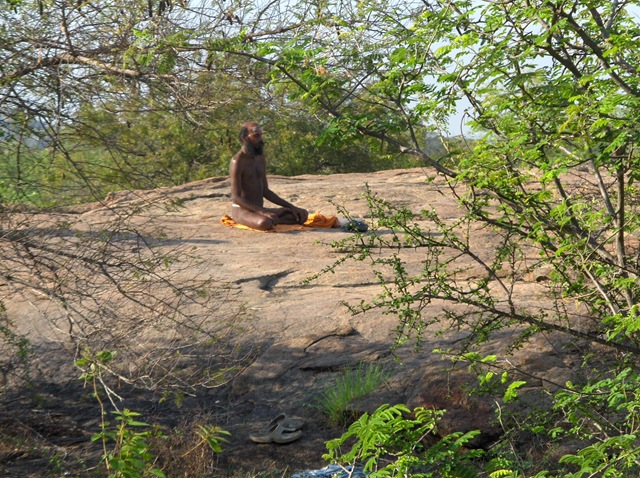
Early in the morning, you also may see a Sadhu, meditating.

HPIM4038

Walking through more trees.

HPIM8284

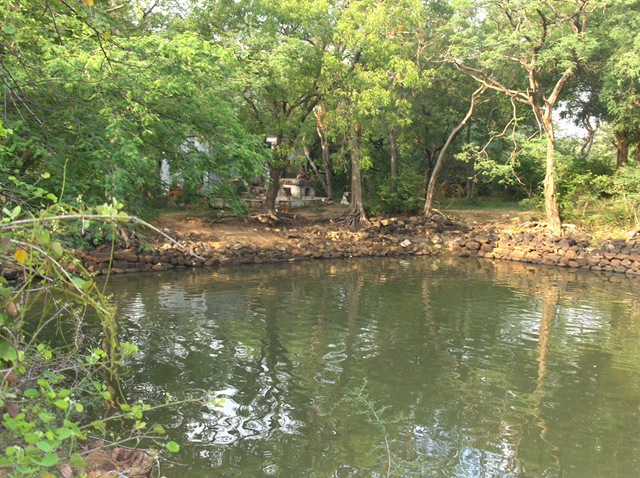
And finally we come to the Sadhu’s tank. This tank is, I am told, spring fed. What I have seen is that it has water all through the year, while most other tanks will dry out.

HPIM8287

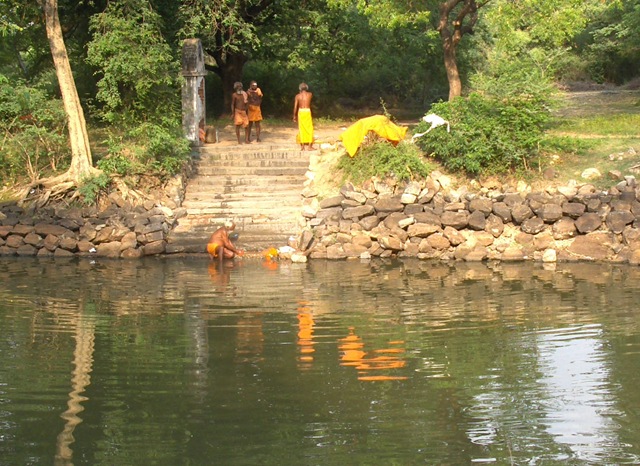
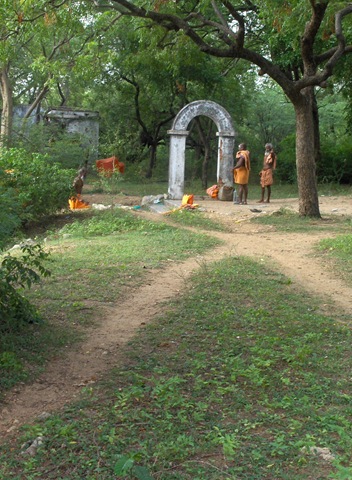
It is early in the morning, and there are Sadhu’s bathing, washing their saffron cloths and spreading them out to dry.

HPIM8286 close up

On the other side of the tank, there is a picturesque masonry arch, and a falling-down building.  This is where we saw the Sadhu bathing in the photo above.

HPIM8289 closeup

Now we follow the path once more through some trees.

HPIM8288

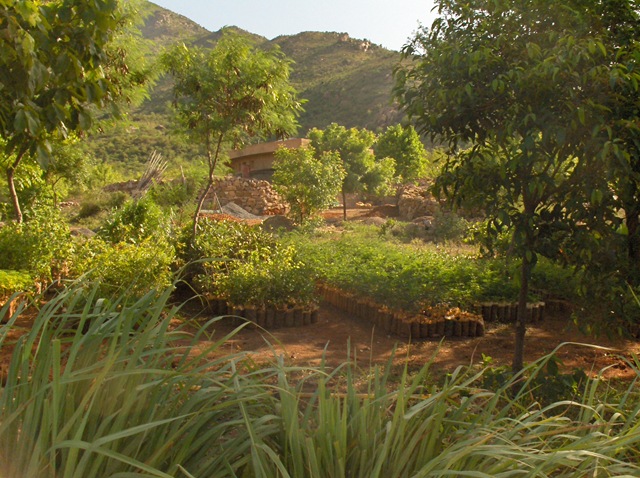
And we get to one of the Reforestation Project’s tree nurseries.

HPIM4197

Here is another stone gate, which marks the end of this section on the Inner Path.

HPIM4199

The next part of this series will start from here.

Harsha's avatar

Arunachala – On the Inner Path: Southside from Ramanasramam: By Richard Clarke

This posting is the first in a series in which I will try to show some of the experience of walking Arunachala’s ‘Inner Path.’ The Inner Path is a pradakshina path that has been maintained by various volunteers for many years. This path is close to the Holy Hill, much less traveled, and many find it to be the most quiet and peaceful way to walk around the mountain.

To give a good sense of the Inner Path, there will be a number of postings, one for each of what I see as ‘sections’ of the path. For many of these sections I will have one or more postings of what we have found near the path. I will call these postings, “Off the Path.” I think this provides a good framework to show you what we are finding as we continue to explore Arunachala.

This first posting covers the path from Sri Ramanasramam to the location near where Perumpakkam Road meets Bangalore Road, and there is a popular walkway from the road to the Inner Path.

This is shown in the map view below, marked in green:

Arunachala markers and inner  path copy

Starting from Sri Ramanasramam

Arunachala from Ramanasramam

HPIM5618

The to back gate

HPIM5621

Through the gate

HPIM5624

Starting up the Path

First, a few steps from the start of the path. Often there are one or two ‘mountain guides’ sitting here who can be engaged to assist newcomers and make sure they can find their destinations.

We started out this day about 7:15 AM, and none were there yet.

HPIM5625

Up the path

HPIM5629

Take the left branch of the path here.

HPIM5920

Starting on the Inner Path

HPIM5923

Looking up the hill.

HPIM5925

Looking away from the mountain. Here we are looking west from the path. A small hill can be seen. This hill is off Bangalore Road, before the turnoff to Girivalam (“Hill-Round”) Road.

HPIM5926

Following the path.

HPIM5934

HPIM5936

Looking up at the hill, the first view of the peak.

HPIM5938

Ahead is one of the ‘arms’ of Arunachala. In the map above, you can see this to the left of Ramanasramam, jutting out from the mountain. This arm is one of the main landmarks of this part of the path.

HPIM5943

Trail markers line the path so walkers can be sure they stay on the path. These markers remind me of the fire in the cauldron at the top of Arunachala each year at Deepam.

HPIM5947

The peak is more visible now.

HPIM5950

Walking the path.

HPIM5951

This type of cactus is found in many places around Arunachala. They remind me just how hot the weather is here most of the year. This cactus is about eight feet high.

HPIM5954

There is a stone wall. Cross it and turn left, down the hill.

We turned right once, to explore a rock formation up the hill here. We found a tribe of Langur Monkeys up the hill. As we approached, the young monkeys and their mothers scampered higher up the hill. The king of the tribe held his ground, and as we approached bared his fangs several times. We “pranamed” him to show that we do not want to give him any trouble, and we turned around.

A bit more about these monkeys can be found at this link to ArunachalaGrace.blogspot.

HPIM5960

We come to a stream, with a water catchment basin. Both are dry now. Sometimes you will see people sitting here.

HPIM5972

Onward on the path.

HPIM5976

Arunachala from this location.

HPIM5978

Carol and Richard, with Arunachala as backdrop.

HPIM5794

We follow the path along the stream. Bear left. The right fork is a shortcut. I will show this in a later posting.

HPIM5982

Following the path.

HPIM5988

The streambed is to the right.

HPIM5990

Another view of Arunachala …

HPIM5998

And we keep walking the path.

HPIM6004

We are approaching the area where one of the major Arunachala Reforestation efforts operates from. Here we get the first view of the Museum/Visitors Centre at the Mountain of Medicine, currently under construction.

HPIM6012

Here is a close up.

HPIM6016

And another view.

HPIM6027

Walking through the area, you can see all the seedlings being grown up to planting size.

HPIM6034

HPIM6035

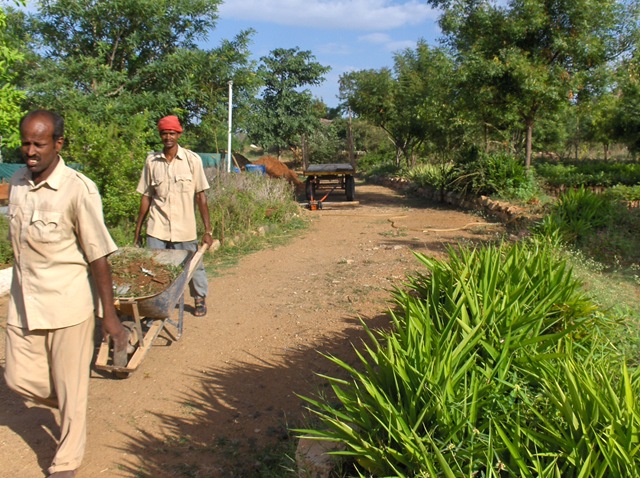
And workers.

HPIM6036

The gate out, to Bangalore Road, and the Children’s Park.

HPIM6037

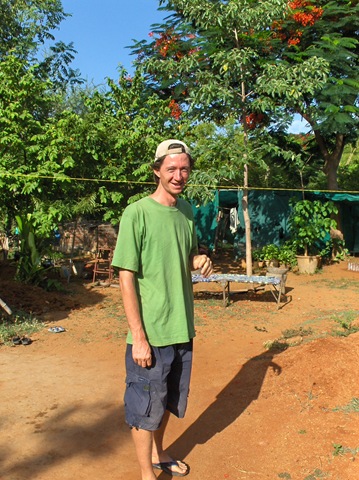
Govind, the Westerner that is behind all this good work.

HPIM6038

Arunachala, from the Mountain of Medicine.

HPIM6039

Leaving the Mountain of Medicine, to continue on the path.

To find our more about this wonderful effort, view this posting by David Godman.

HPIM6041

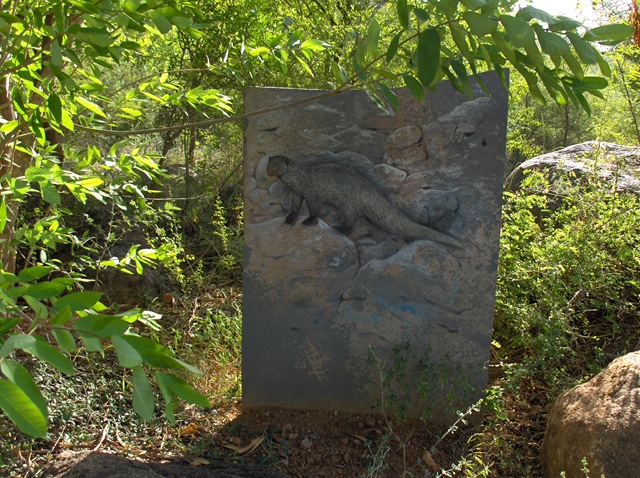
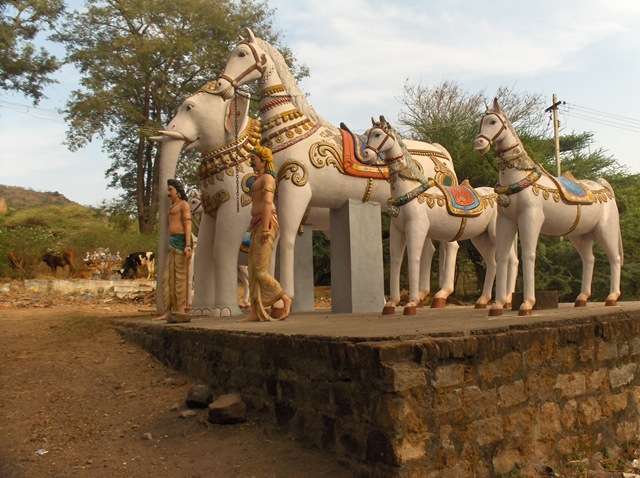
One of many paintings on rock slabs of local birds and animals.
HPIM6044

Back on the path.

HPIM6045

Looking towards the Hill.

HPIM6046

Looking towards the street. Here a housing development can be seen.

HPIM6047

Tree planting, recently done.

HPIM6048

Views of Arunachala.

HPIM6051

HPIM6055

More holes are dug, waiting for rains before doing more planting.

HPIM6067

The view away from the mountain. If you do a close-up of this hill, you will see an ancient altar at the top.

HPIM6071

One last look at Arunachala. Notice in the foreground another of the types of cactus that are to be found around the mountain.

HPIM6078

Then the gate that marks the end of this section of the Inner Path.

HPIM6083

Looking out to the road.

HPIM6089

Looking forward to the next section of the Inner Path.

HPIM6088

Harsha's avatar

Adi Annamalai Temple – North side of Arunachala: By Richard Clarke

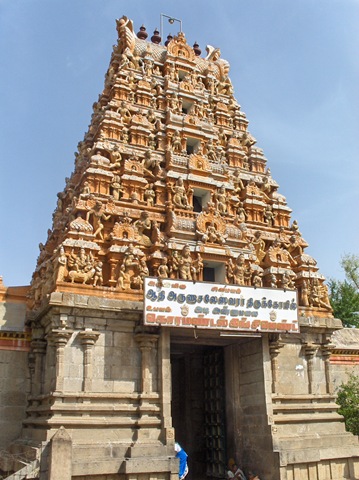
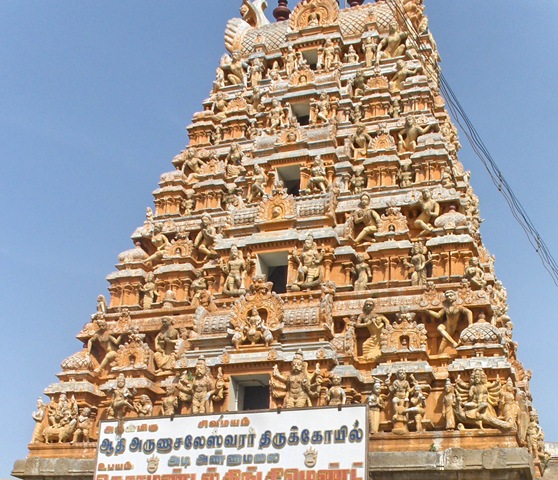
Adi Annamalai is the oldest temple around Arunachala. It was built hundreds of years before Arunachaleswarar Temple, which per Wikipedia, “The earliest known record of the temple is in the works of the poet Nakkirar of the third Tamil Sangam period. At that time, the temple might have been a simple wooden structure. The present masonry structure and gopurams (temple towers) date back approximately 1200 years.”

Adi Annamalai clearly predates Arunachaleswarar Temple, so is older than 2000 years. I suspect the gopuram is also about 1200 years old, from the same period as Arunachaleswarar Temple.
“The name of this Temple, Adi Annamalai means ‘first’ or ‘ancient’ Annamalai (Arunachaleshwarar). Its size is small and it occupies only 1/2 acre in size – compared with the 25-26 acre size of Arunachaleswarar Temple on the Tiruvannamalai side of the Hill. The legend of Adi Annamalai recounts that Brahma, after His dispute with Vishnu about the fiery column, made a lingam and went to the other side of the Hill to worship Shiva. Thus, this lingam is supposed to be the first, ancient and original lingam of Annamalai and hence the name Adi Annamalai.” This quote is from Arunachala Grace Blog. Here is a good article from them on Adi Annamalai.

There are many legends about this temple. The one I like the best is of a secret cave that goes from the temple to inside Arunachala, where all the Siddhis are.

You can see the temple in Google maps, click here.

Turning off the Hill Round Road, going through the small village of Adi Annamalai, you come to the temple, with its tower visible from far away.

HPIM5100n

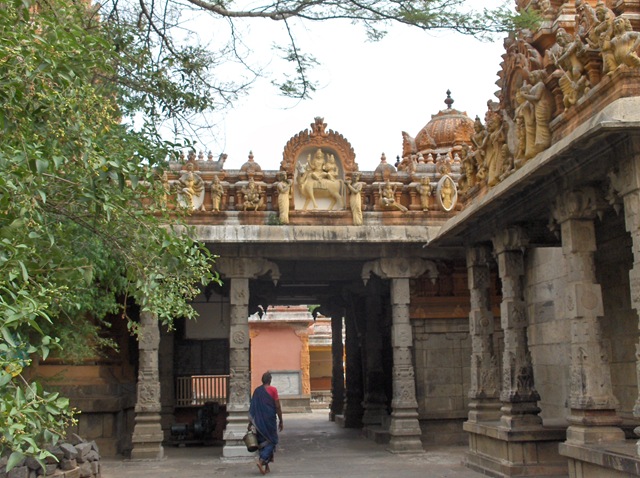
And enter through the gopuram.

HPIM5098

If you look closely at the gopuram, you will see images that illustrate many ancient stories of the gods. A repeated figure is that of a man, straining to hold up the tower. Since the wall has its own support all this effort is not needed. This image is to illustrate the futility of ego-driven action, ‘trying to hold up the universe’ when it is really God, Siva, Brahman, your Self, that is doing ‘all the work.’

Adi Annamalai goporum close up

We are not allowed to take photos inside the main shrine. The photos below were taken walking around within the temple walls.
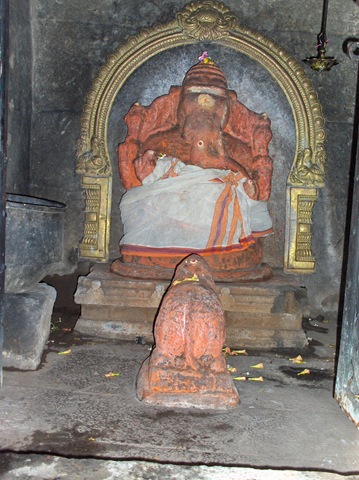
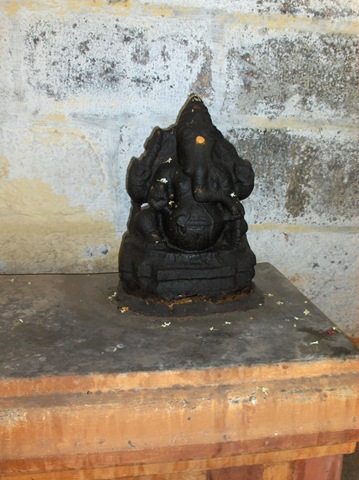
First is Ganesh, the remover of obstacles. This is the first god seen in the Siva temples. Here Ganesh is enclosed in a small shrine that is locked when the priest is not there.
HPIM5076

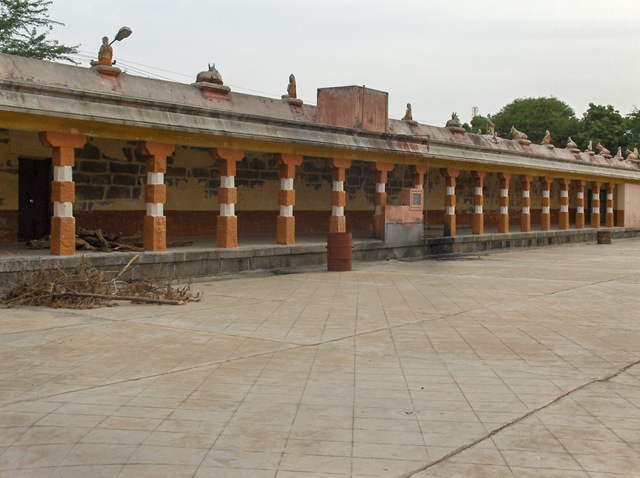
Walking in the usual clockwise direction, here is a hall of pillars. Note all the statues on top of the wall. Similar statues are on all four sides of the temple.

HPIM5077

Here is a close up of one on this wall:

HPIM5088

Looking to the back of the temple, we can see the Dakshinamurthy shrine protruding from the wall.

HPIM5078

Here is Dakshinamurthy, the Southward-facing god. From the Wikipedia entry, “Dakshinamurti literally means ‘one who is facing south (dak?i?a)’ in Sanskrit. South is the direction of Death, hence change. In every Siva temple the stone image of Dakshinamurthy is installed, facing south, on the southern circumambulatory path around the sanctum sanctorum.”

Dakshinamurthy has a special place in our hearts. Dakshinamurthy is said to be the primordial Guru. He is pictured as a young man, with four older disciples sitting with him. Dakshinamurthy taught only in silence. Sri Ramana Maharshi is spoken of comparing him to Dakshinamurthy. It is also said that Arunachala is Dakshinamurthy. Certainly both teach in silence. Ramana says that real silence is when no ego-‘I’ arises.

HPIM5079

Looking back from Dakshinamurthy, one can see Arunachala. Here is the face of ‘The Elephant.’ I wrote an entry about Arunachala in this area, see

.

HPIM5081

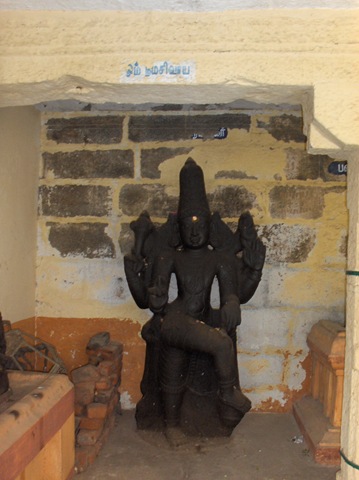
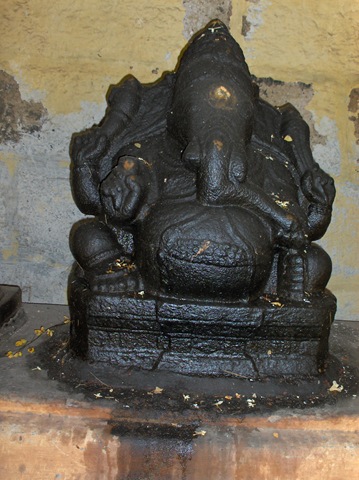
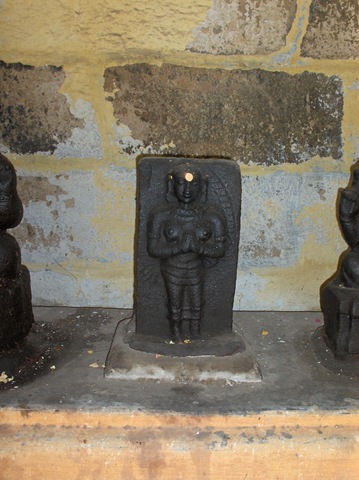
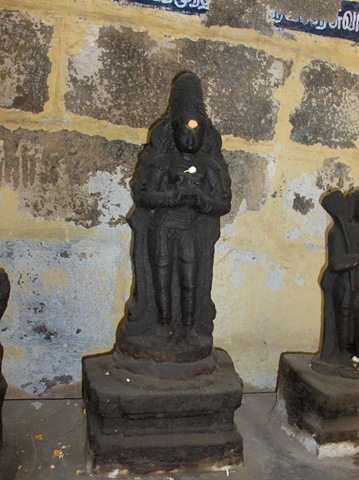
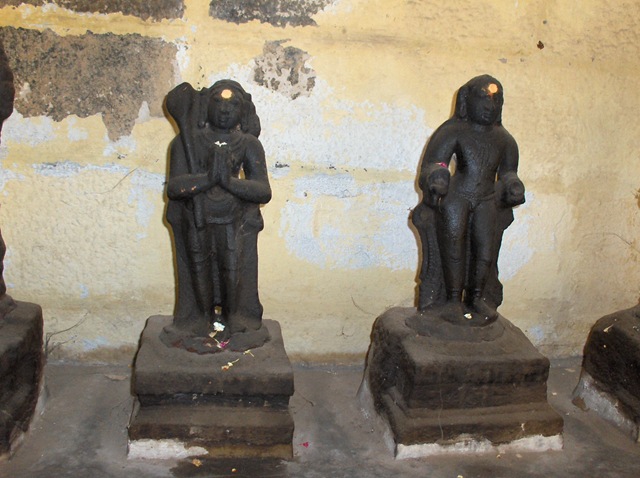
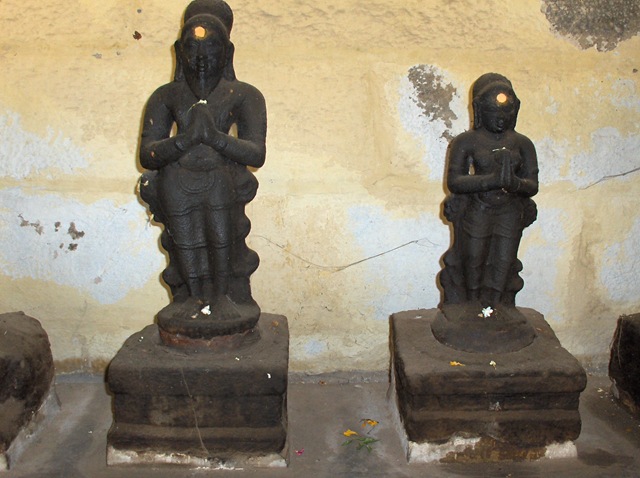
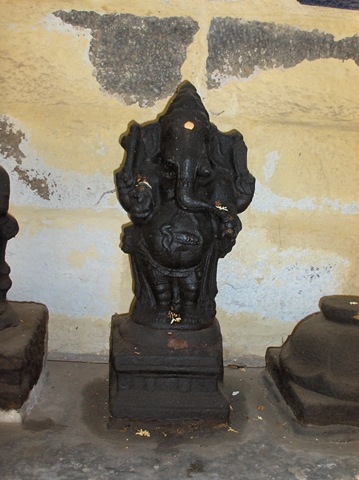
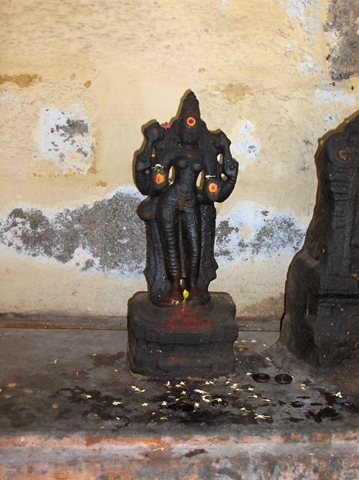
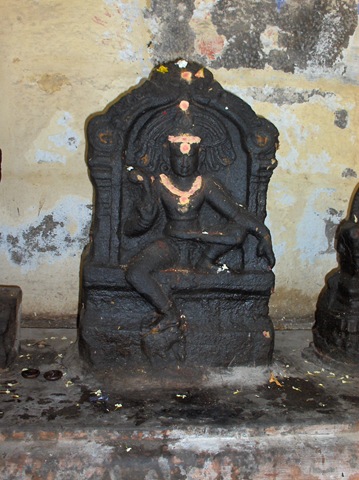
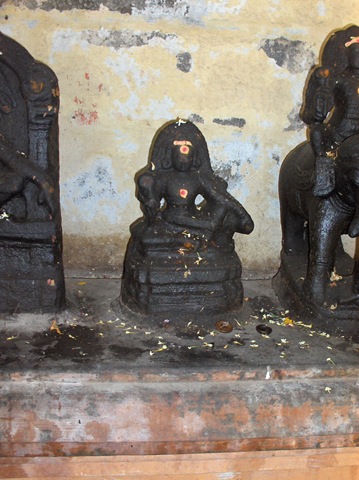
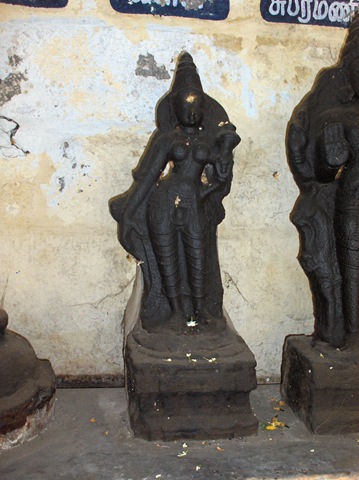
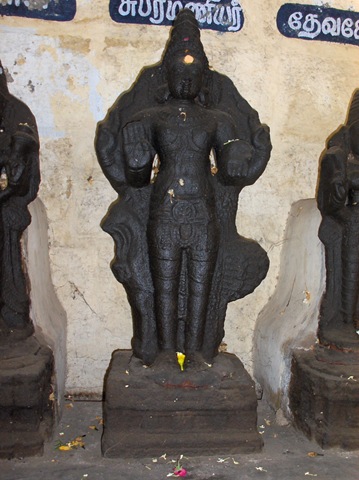
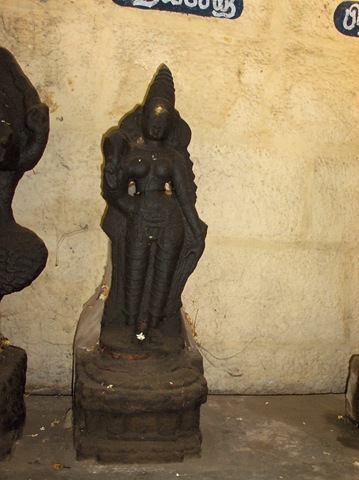
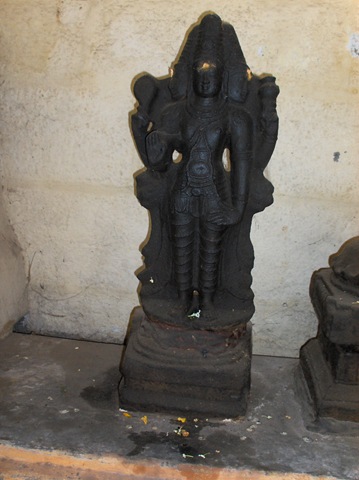
Behind the shrine, behind the pillars on the back wall of the temple, there are quite a number of statues, I think of various local gods, and gods of local significance. You can see, looking at the wear on some of these, just how ancient they must be, hundreds of years, certainly, thousands of years, probably.

Most of them I do not recognize. They have names, written in an archaic Tamil, above each statue. As I find out these names, I will add them to this post. Some are small, just a few inches tall. Others are several feel high.

HPIM5039

HPIM5040

HPIM5041

HPIM5043

HPIM5044

HPIM5045

HPIM5046

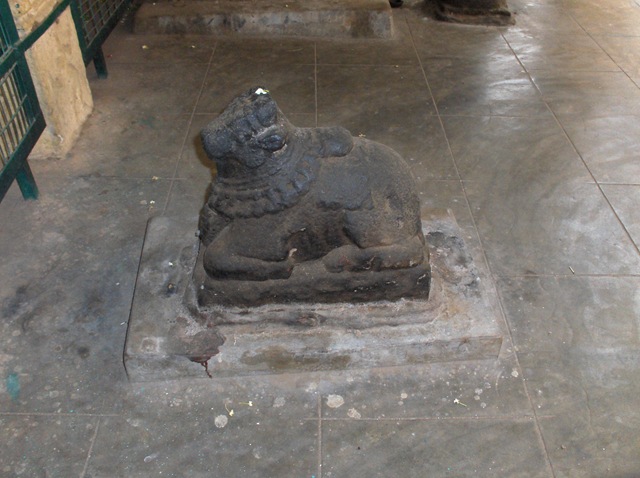
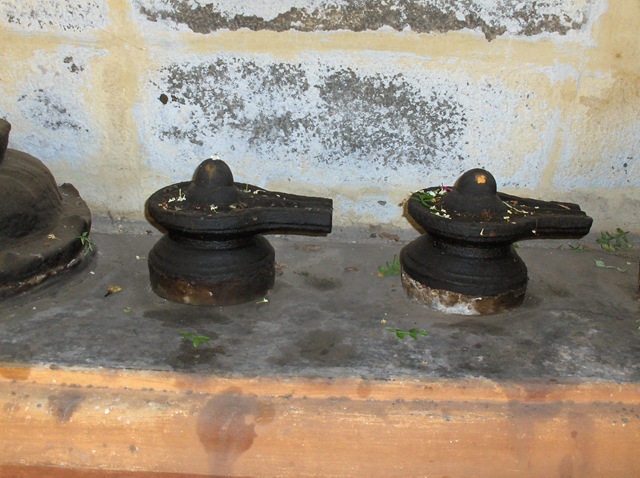
Here is one of three Nandis, guarding several ancient lingams behind the fence.

HPIM5047

Here are the first two lingams.

HPIM5048

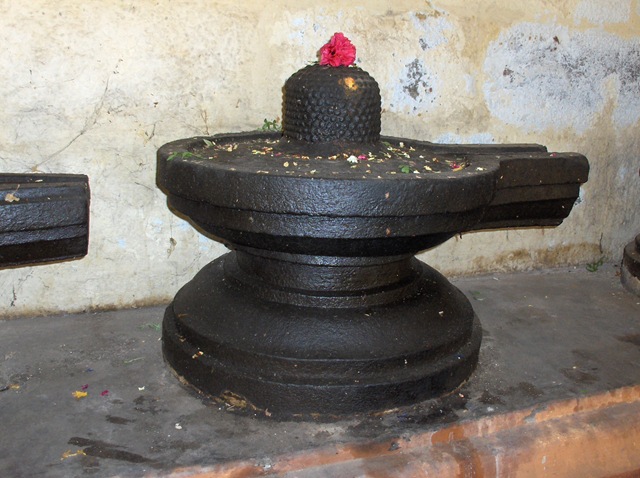
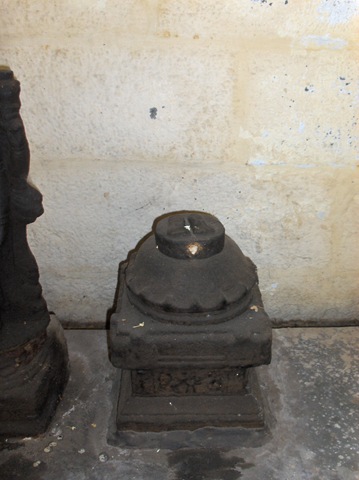
Here is the third. Note the additional carving on the upper part. Someone thought this was special. It is the only one that has a flower placed on top of it.

HPIM5051

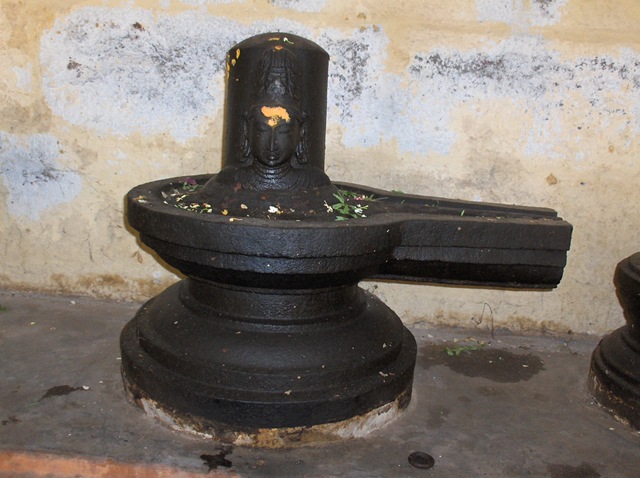
Here is the fourth. Notice that it has a face, surely Siva’s face, carved into it.

HPIM5052

HPIM5053

HPIM5054

HPIM5055

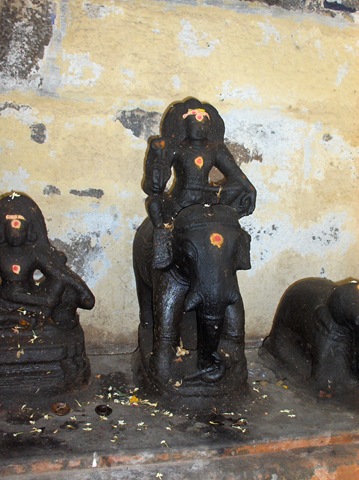
I love this one. Is that Siva on the elephant?

HPIM5056

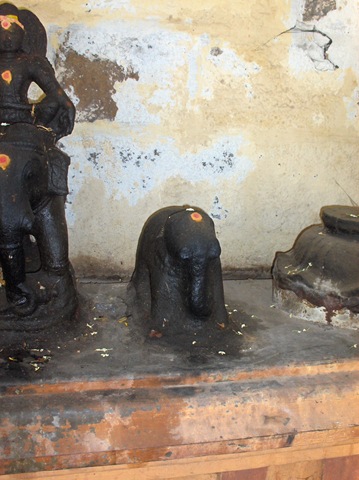
Notice how old this elephant must be. The top of the statue has been rubbed away by countless hands touching it, probably over hundreds of years.

HPIM5057

HPIM5058

HPIM5059

HPIM5060

HPIM5061

HPIM5062

HPIM5064

HPIM5065

HPIM5063

Looking back at the hall of statues.

HPIM5067

We walk back toward the front of the Temple.

HPIM5070

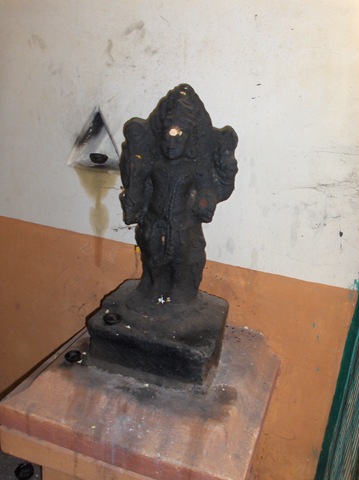
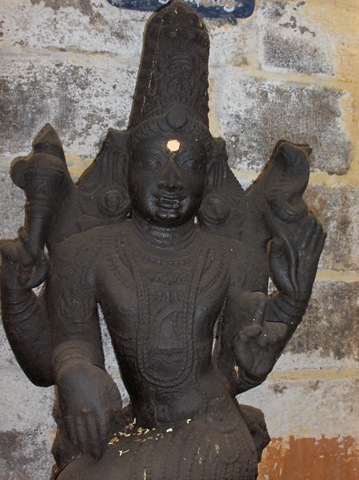
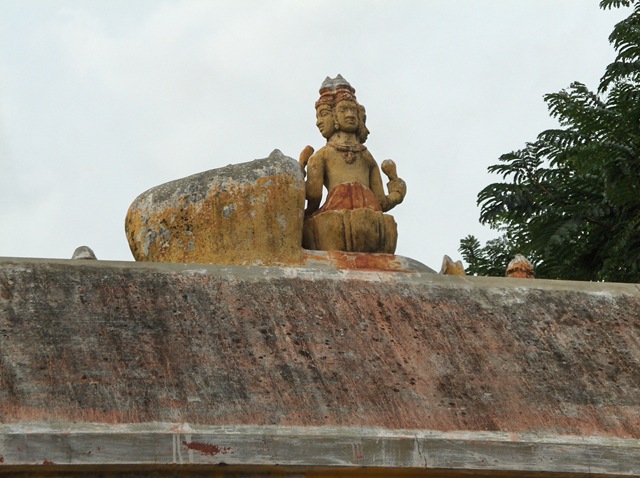
Another statue. This god has three faces (that I can see).

HPIM5069

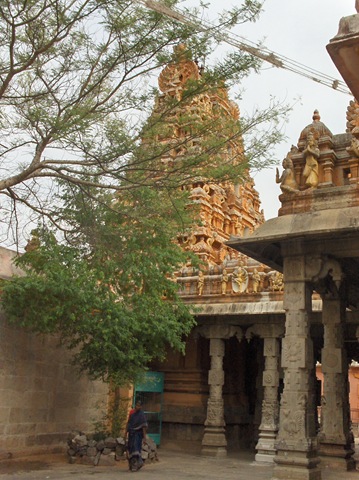
The gopuram, seen from within the temple walls.

HPIM5071

The main entryway, from the North side. To the right is the inner temple. To the left, back outside.

HPIM5073

Harsha's avatar

Arunachala – New Access to Ramana Sites Below Virupaksha Cave: By Richard Clarke

A group of local Tiruvannamalai people have organized themselves and are doing wonderful work to clean up, repair and open up an area on Arunachala that is near to the popular Sri Ramana Maharshi sites of Virupaksha Cave and Skandanasram.

They have organized as a part of “Global Watch Trust.” You can see more about this organization at http://www.globalwatchtrust.com. This site is not yet updated to include this project.

In this area, this project is cleaning trash, clearing brush, repairing and improving paths, planting, and building benches and meditation areas. It improves access to Guhai Namashivaya Shrine and an ancient Ganesh shrine, and provides a way to reach three hillside caves that are said by local villagers to have been frequented by Sri Ramana. The Trust has been given permission to do this work by The Forest Authority, Arunachaleshwar Temple and Sri Ramanasramam.

The Approach

To get to this area, start like you are going to Virupaksha Cave. Below shows where this ‘road’ meets the street, at the northeast corner of Arunachaleshwar Temple.

HPIM4973

Walk up the road until you see, to the left, this street. Notice the blue Global Watch Trust sign on the wall.

HPIM4976

Continue walking up the hill.

HPIM4977

Here they have made a small shrine at the base of a tree.

HPIM4979

Entering the area of the Project

Part of the work done is to clean up trash and clear brush away from the paths. This path is marked with stone borders and shows the effects of trash and brush removal. Keep walking up this path.

HPIM4980

When you get the this banyan tree, this is the ‘hub’ for the improved paths that access the various caves and shrines on this part of the hill.

IF you look closely you will see a man reclining on a branch of the Banyan tree. This is one of the key people behind all the activity, a young man who grew up around this part of the hill, Saravan. I think this project is largely Saravan’s vision. Saravan guided us through this area and showed us the work that had been done.

HPIM4983

To Guhai Namashivaya Shrine

Turn left at the Banyan tree, and take this new path just a few meters to go to Guhai Namashivaya Shrine. I am told this shrine is about 500 years old.

HPIM4984

Here are Saravan and my wife, Carol, outside Guhai Namashiva Shrine. This shrine is an important locale in the history of Sri Ramana Maharshi. This is where he provided answers to questions on slips of paper that became the second of his small books, “Who am I?” This is probably the best known of Ramana’s works.

More information can be found about Guhai Namashivaya at http://www.arunachalasamudra.org/guhainamasivaya.html

HPIM4985

Up to the Caves

Returning to the Banyan tree, looking up the hill, to the right, outside this photo, is the stone path to Virupaksha cave. Directly up the hill is the path to the caves.

When finished, this area will have a nice stone path in the middle, surrounded by flowers and planting on both sides. There will be benches to sit and meditate and to enjoy this place.

HPIM4988

Take the path to caves and a part of the hill that is mainly unseen by visitors.

HPIM4989

Looking from the path, Arunachaleshwar Temple can be seen, with gopurams rising above the trees.

HPIM4990

One of the Caves

On the path, we pass by a small cave, big enough for perhaps two or three people to sit in.

HPIM4991

Old Ganesh Shrine

The next feature is an old Ganesh shrine, with this water tank. This shrine has been vandalized and the Ganesh idol taken. The Global Watch Trust plans to replace this idol.

HPIM4994

Here you can see the back of the shrine and the tank.

HPIM4995

Another small cave near the Ganesh Shrine. This cave is big enough for a person to lie down and sleep, but not big enough to stand up.

HPIM4997

Up the hill to the best of the caves

Climbing further up the path we will get to the crown jewel (I think) of this area.

I would recommend good shoes or sandals and strong legs for the next part of the journey. The path is a bit steep in a couple of places.

Below Carol and Sarsvan are crossing a rock face. Note that they each have clippers in their hands, to work on a bit more brush cutting on the path.

HPIM4998

As the path gets higher, the view of Arunachaleshwar Temple is breathtaking. I think the big rock in the midground is a part of Guhai Namashivaya Shrine.

HPIM5000

The path continues up the hill. Here it is dirt and pretty easy walking. After this there is a section up through more rocks. This is the only section that I think is tricky. The biggest trick right now is that there is a place where the path goes up the hill and to the left. Take the left. This is not presently marked. Hopefully, this will be done.

Some of this path is a ‘fire road’ up the hill.

HPIM5001

Now the cave entrance is visible.

I think this cave is a special place. The people who live on the hill below here say that Ramana stayed in this cave, I guess during what are generally known as the ‘Virupaksha days.’

We have been here just two times and already it is one of our favorite places on Arunachala.

HPIM5004

Here is the cave entrance. Saravan and a helper, over the last few months, have put in the concrete walls, floors and benches, and painted them. Flowing water has left stains that make the walls look older than they are.

HPIM5006

Behind me on the path, Saravan and Carol have pruning clippers and are cutting back brush from the path.

HPIM5015

View from the Cave

Here we are looking east from the Cave across Tiruvannamalai.

HPIM5013

Arunachaleshwar Temple view.

HPIM5007

Looking up from the cave, we see Arunachala. If you look closely maybe you can see about 3/4 up the photo, on the right, a coconut palm. This is Skandanasram.

If you look closely in the foreground, you will see red oleander flowers. Saravan planted these bushes three years ago. These flowers are used as puja flowers, and he wanted them to be available for those who use this cave for worship.

HPIM5019

In the Cave

In the cave, an oil lamp has been lighted.

HPIM5010

Carol sits in the cave, meditating.

We think this is one of the special places on this hill. Peaceful and serene, it is a great place to open your heart to Arunachala.

HPIM5020

Working on the Mountain – Global Watch Trust

Community Development

The first part of this project was a vision from Saravan as to what could be done in this area, with encouragement from the founder of Global Watch Trust, Sathya. Together they put together a plan and a team to clean up and enhance this part of the Arunachala hill to properly respect the sacred heritage that is here.

An important part of the process has been involving the villagers who live on this part of the hill. This started with a ceremony and a ‘gifting.’ School notebooks were gifted to the children in an evening ceremony that included the local villagers. The purpose of this was to educate the villagers on the importance of this area so they might not use it as a trash dump, and to enlist their help in the work to clean up the hill.

Below is a photo of the books that were to be gifted, and the team from Global Watch Trust.

HPIM0433

Here the gifting is being done. Many locals are gathered together here.

HPIM0470

As work started, local officials came to the group. Each interaction was similar, starting with “What are you doing?” and “No, you cannot do this.” After some discussion, permission was granted. First were officials from Arunachaleshwar Temple, then the Forest Authority, the Sri Ramanasramam.

The Crew

One big part of the effort was done with a crew consisting of local volunteers and the Global Watch Trust team, shown below. Together they worked to do the major cleanup of the hillside.

our team

So much cleaning and clearing to do

For many years this area has been used for trash. The first thing needed was to clean up the trash.

cleaning the right side on 16th started

DSC_0199

Brush has overgrown the paths and area around the Banyan tree. All this needs to be cut away, and cuttings disposed of.

cleaning the bush. so no more littering on here planting will be done soon by morning

While the brush cutting is going on, a part of the team gathers to discuss the details of path repair for this area.

pathway repair discussion

More trash to be cleaned.

pathway rightside cornerplastic team two on the right side

The path cleaned and cleared, ready for repair

Here is the approach path with trash cleaned and brush cleared. Now work must be done to repair the path.

before pathway repaired

Clearing around the Banyan Tree

The ancient Banyan tree is to the left, with rocks built up at its base. In the surrounding area, brush and small trees have grown up, crowding each other for space and sun. They need to be cut back so the area can be opened up and a new path built.

DSC_0197

Here they are clearing brush from the base of the Banyan tree.

DSC_0200

Results of the Team’s work

The path is repaired

Here is a part of the path shown above that needed repair. Now it is easy and pleasant walking.

DSC_0211

Standing proudly by Old Tree

Saravan stands by the Banyan tree. Now it is cleaned up, brush cut back, trash picked up, etc.

HPIM4871

What has been shown here is just a part of the job. to continue the job, Global Watch Trust has been sponsoring a small team to work with Saravan to continue with the path building, planting, and improving these areas by adding cement benches to sit and meditate, etc.

There is a need for financial support

Work has stopped for now. Global Watch Trust needs to find people who are able to provide some support for this work.

Global Watch Trust has funded the effort that you see in these pages out of their own funds. Those funds have run out, and for work to continue donations are needed. Evan small donations are a big help. Rs 1000 ($25 or 15 Euros) pays for one day’s work on the project. 40 days work have been done so far, and so much has been accomplished.

If you are able to help, donations can be made through the Global Watch Trust web site. Go to http://www.globalwatchtrust.com/ and click the ‘donate’ button. Credit Cards and PayPal are accepted. Also they ask, until their site is updated, that you also send an email to ceo@levicent.com and let them know that this donation is to be used for the Arunachala Hill project.

Harsha's avatar

Arunachala Pradakshina – June 2008 Full Moon – Part One: By Richard Clarke

After walking ’round Arunachala in April in the moonlight, amidst a crowd said to be 1.5 million people, we celebrated THIS month’s full moon by walking around in the morning. We found this to be much more harmonious, and easier to take pictures than during the crowded night walk.

Shown below are photos taken June 18, 2008. They are all on the ‘Pradakshina road,’ from the junction with Bangalore (Chengam) Road to where this road meets the main road back into Tiruvannamalai, so from the viewpoint of Arunachala, from the South West, to the North West sides of Arunachala.

I have tried to put in names of temples, shrines, etc. I am unsure of the spelling of some of them, so if there are errors, let me know and I will correct them.

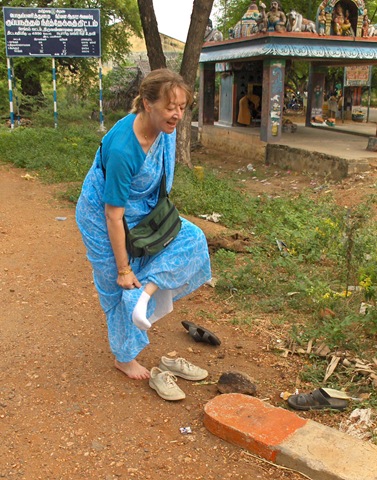
Carol Getting Ready – Removing her shoes

It is the tradition that Arunachala is a temple, and the path around the temple, for good punya (merit) should always be walked barefoot. IF you look closely you will see that most Indians do this. Carol frequently walks barefoot, as she can. I still hold more to shoes or sandals. Even with this, I have had several blisters and foot sores that caused restricted activity for a while as they healed.

HPIM4782

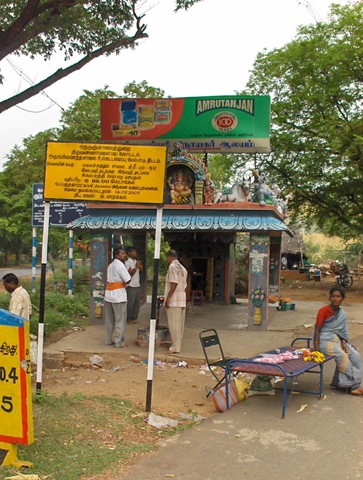
Jyoti Vinayaka Shrine

This shrine is right at the intersection of Bangalore Road and Pradakshina road.

HPIM4783

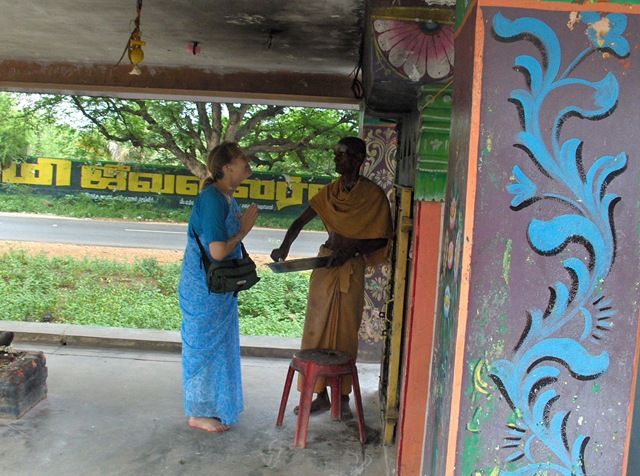
Carol is getting blessed by the priest.

HPIM4786

Along the way

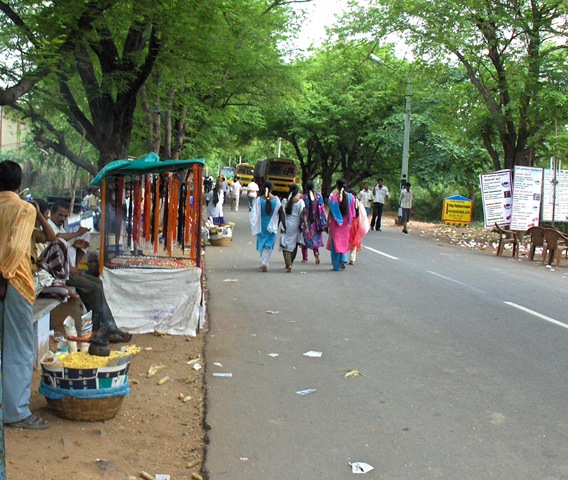
Much of the road is lined with vendors and stalls. There were still many people making pradakshina this morning. In the photo below there is a group of young women walking. You can tell they they are young because they are wearing ‘punjabi’ or ‘salwar’ suits, instead of saris, which is what are worn by most Indian women.

HPIM4787

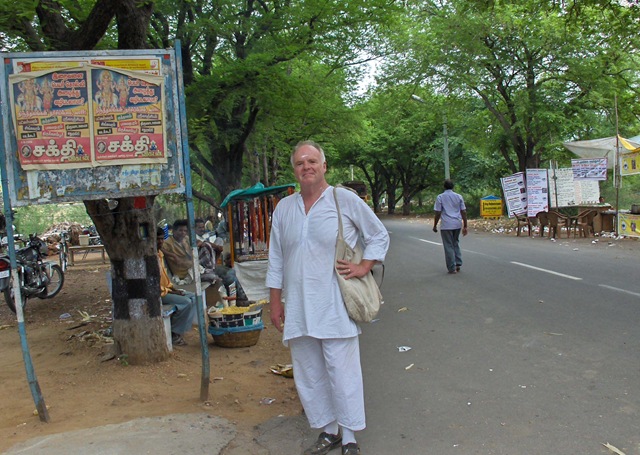
Here is Richard. Note the vibuthi, placed on my forehead by the same priest that blessed Carol.

HPIM4788

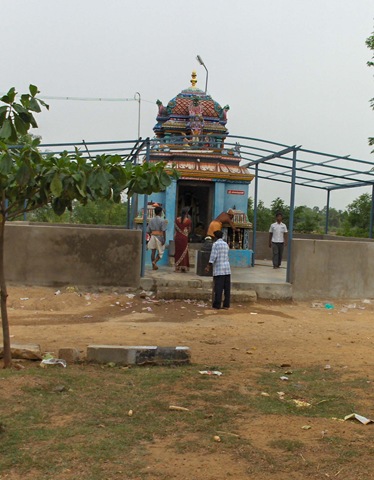
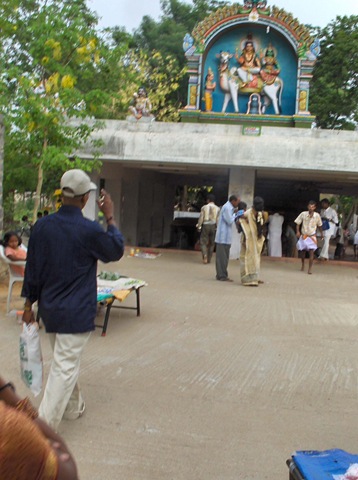
Another Temple

I am not sure of the name of this shrine. To its left is a big building that says it is a ‘Free marriage hall.’ I believe they let sadhus sleep there overnight.

HPIM4798

Om Namo Sivaya

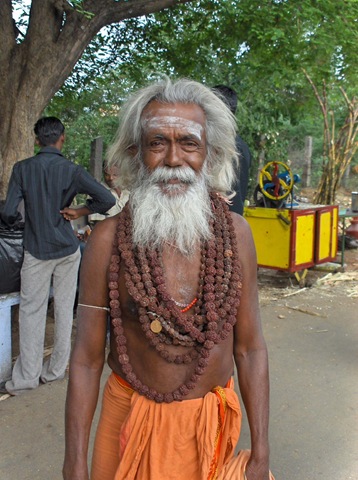
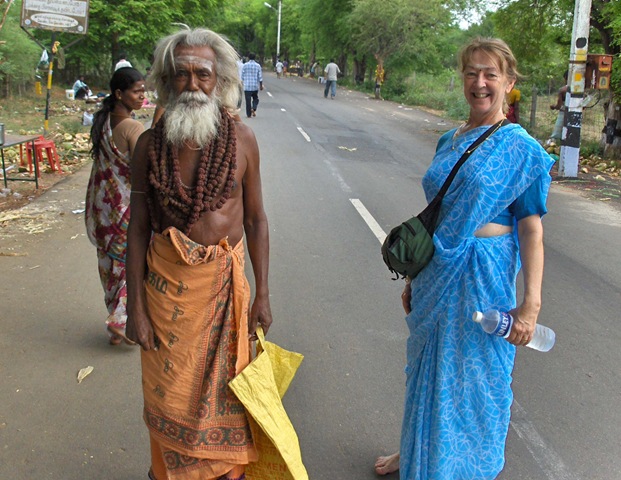
We often meet this sadhu in the morning when we go up the trail to get to the Inner Path. This goes past what we call the Sadhu Tank. I think this is called “Kattu Shiva Hermitage” on some maps. Usually he gives a big smile and says “Om namo Sivaya” as we pass on the trail. This morning he was out on the road, on his way back to “the tank.” We walked together for a bit.

HPIM4800

Here he is with Carol. He put on his Siva dhoti for the picture instead of the plain saffron one.

HPIM4801

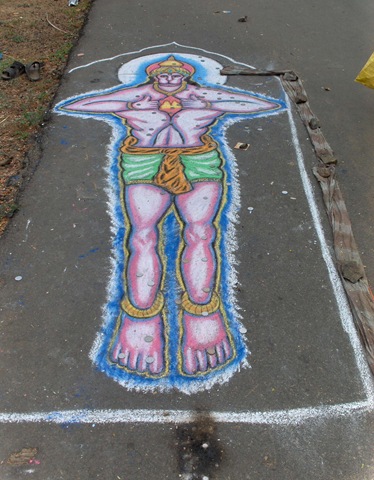
Chalk figure of Hanuman

Note that the artist put cloth boundaries on the pavement, trying to prevent walk-overs.

HPIM4803

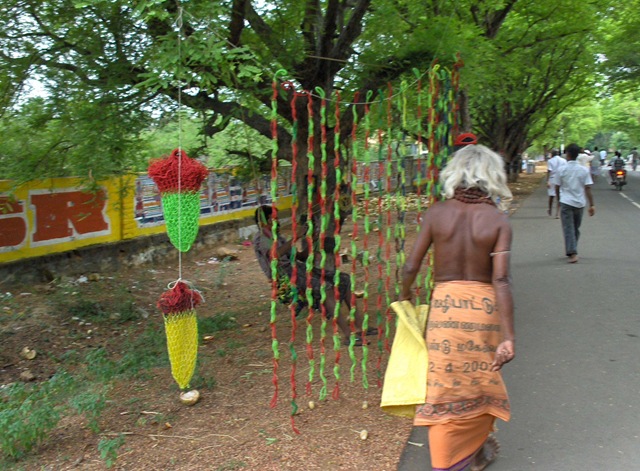
Selling Hammocks

It took some time before we know what the red and green strings were, hanging in this photo. They are hammocks!

HPIM4804

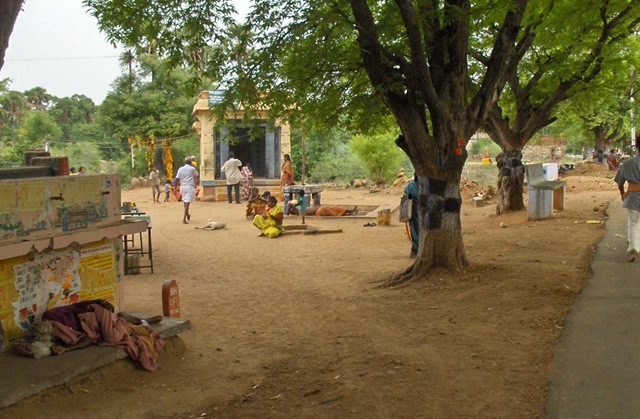
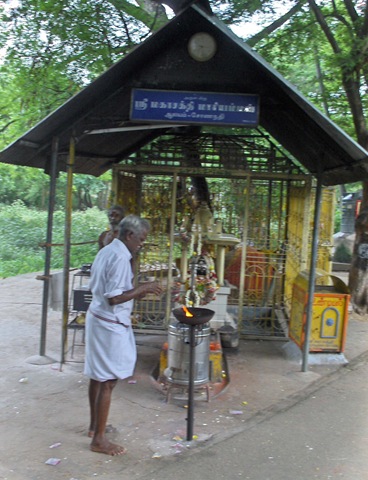
Dourvaas Nama Siva Shrine

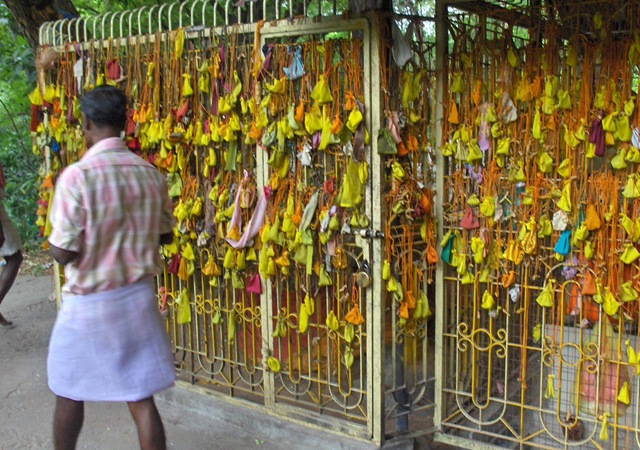
Here they usually used to ask us for ’20 Rupees’ for a “wish bag” to tie on a tree behind the shrine. These wish bags are a common feature in a temple. For example, when a woman wants a child, she will tie a bag onto a tree at a nearby temple.

This is right across the road from where we usually go onto the trail to the Inner Path. This is described in the posting

.

HPIM4805

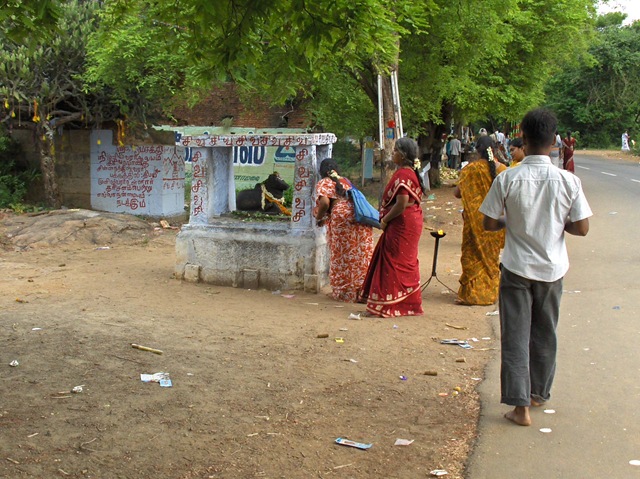
One of many Nandis

There are many Nandis along the road. Nandi the Bull is Siva’s attendant and gate keeper. In a temple, Nandi will face the lingam. Around Arunachala, most face the mountain.

Women visit images of Nandi, bringing floral offerings, and touch the stone. Their prayers are usually for fertility.

HPIM4808

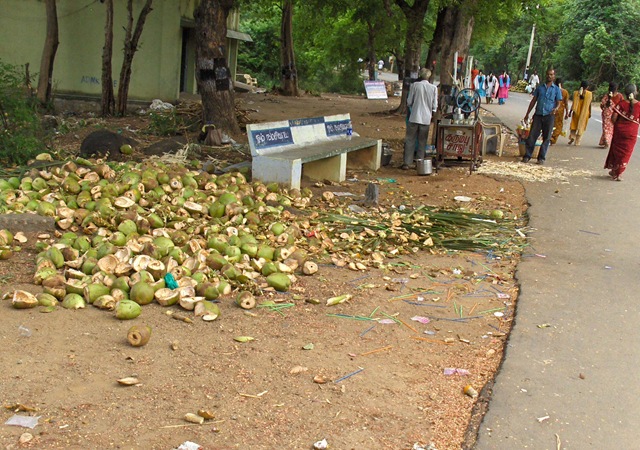
Clean-up after Full Moon night

Empty coconuts, after a night of drinking coconut juice. Cleaning up after the full moon night is an issue. Some vendors do this with care. Many do not. And many of the people will throw trash anywhere.

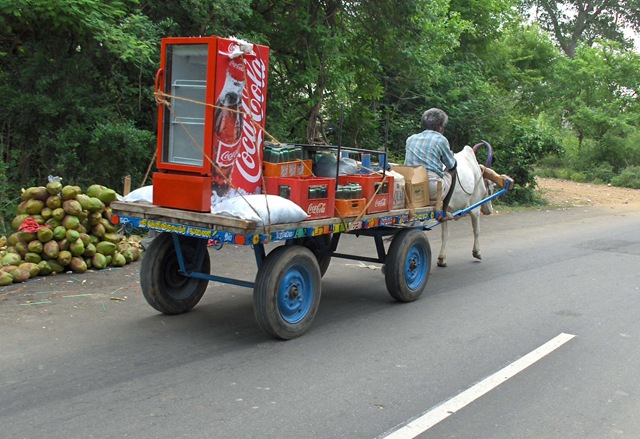
HPIM4809

Supplies from a drink stand, going back on a bullock cart.

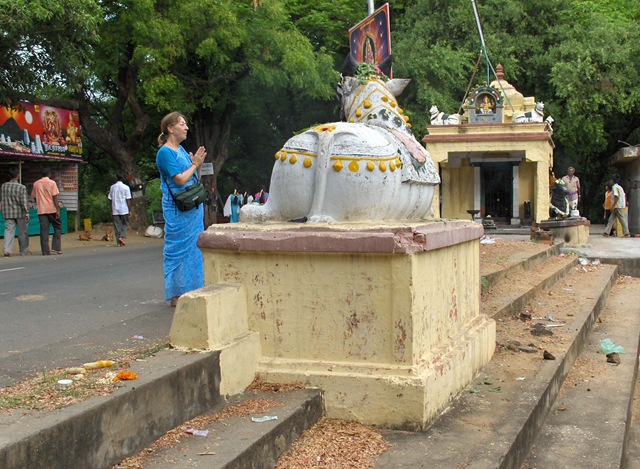
HPIM4811

Another Nandi, by Soma Tirtam (Soma Tank)

HPIM4814

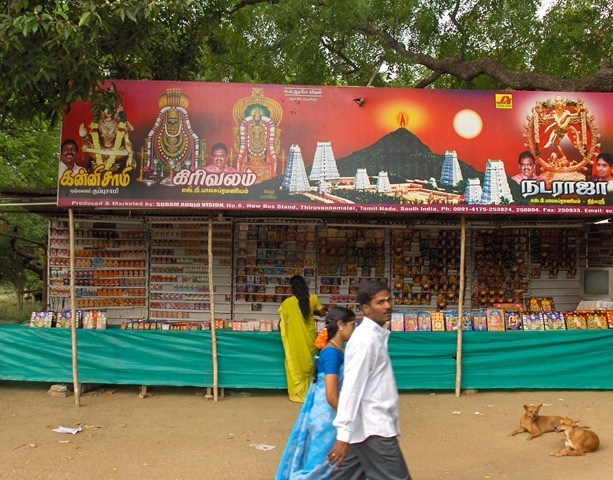
CD and DVD stand

Across from Soma Tirtam. There are a number of these stands, usually blasting out some Siva chant or song.

HPIM4816

Mahashakti Shrine, covered with ‘wish bags’

HPIM4823 HPIM4825

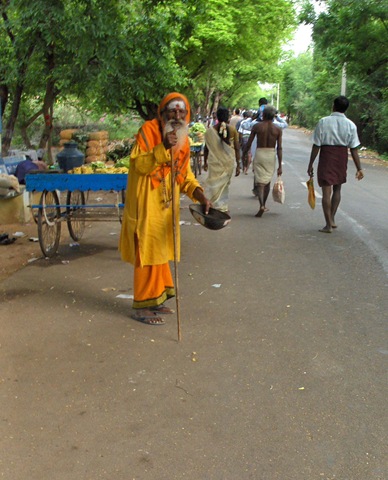
Sadhus

Sadhu with begging bowl

HPIM4827

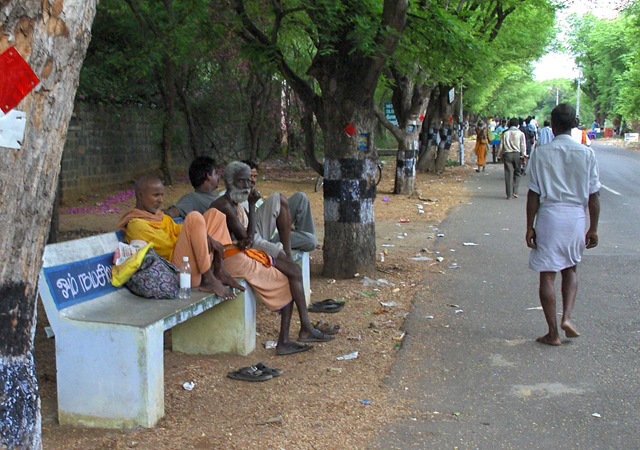
Sitting on bench

HPIM4830

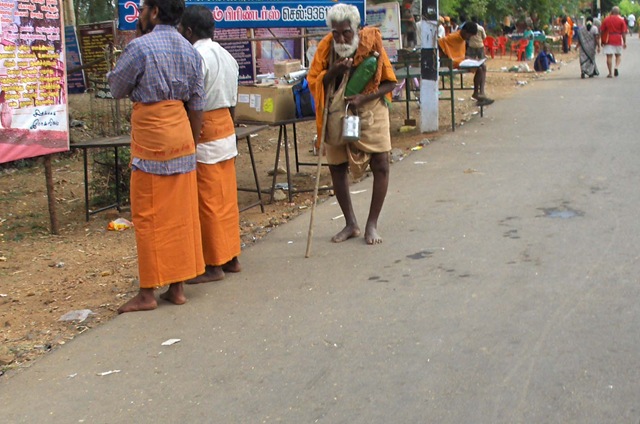
Elderly Sadhu. Just walking seems like a big task.

HPIM4858

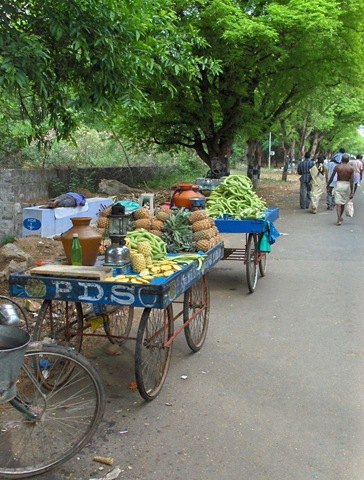
Vendors

HPIM4828

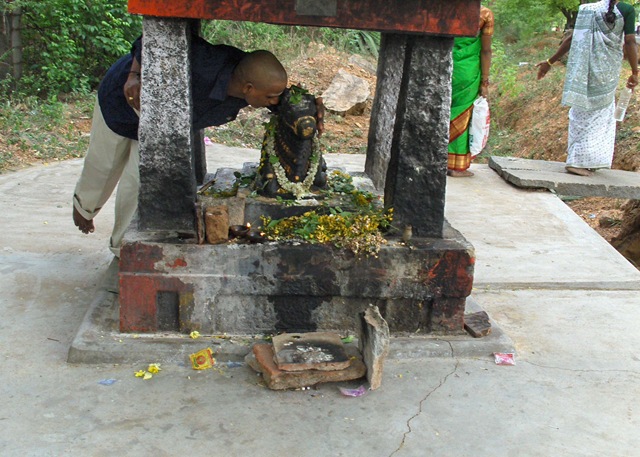
Man whispering secrets into Nandi’s ear

He spent some time whispering to Nandi. Must have had a lot of wishes.

HPIM4832

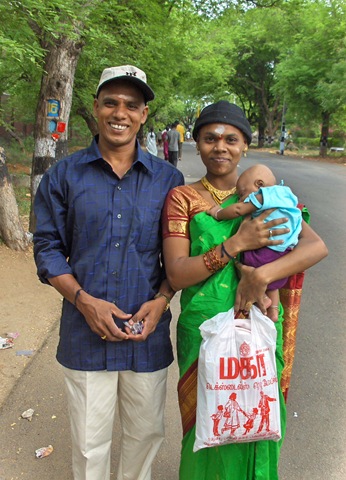
Babies

Young couple with babe in arms. Mother says proudly, “38 days old.” They were very pleased to be taking their new baby on pradakshina around Arunachala.

HPIM4835

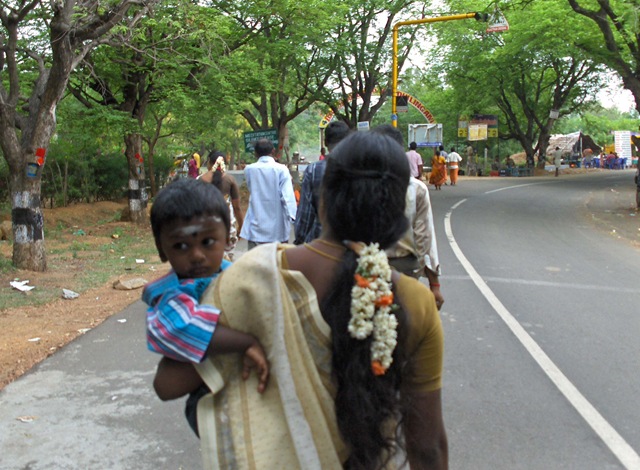
Another baby watching the first baby. You see many babies in the arms of their parents, being carried around the mountain.

HPIM4837

One of the nine Lingams, Nirudhi Shrine

HPIM4839

Carol getting blessed

HPIM4844

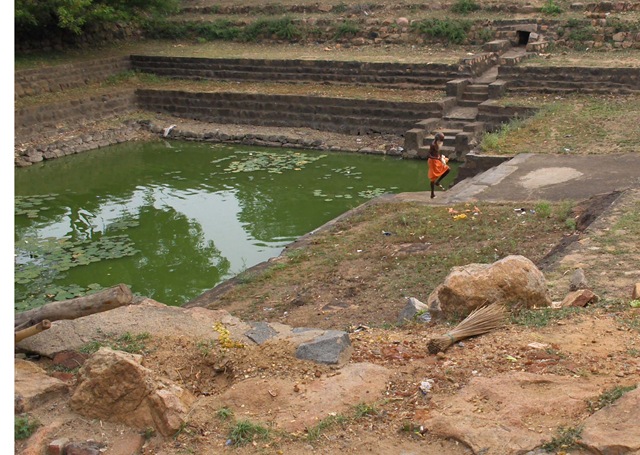
Sadhu taking morning bath in Nirudhi Tank

HPIM4847

More vendors

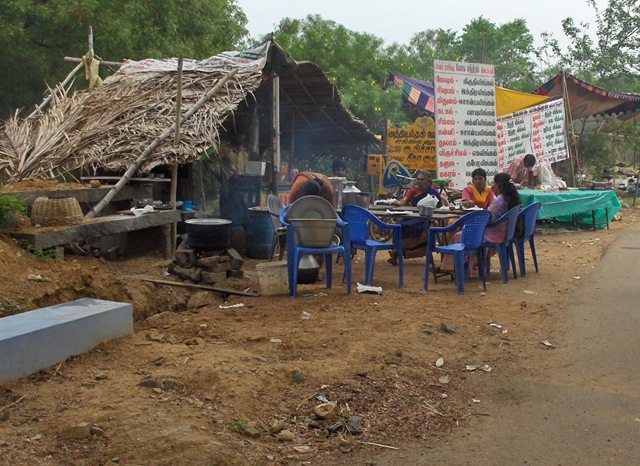
Food stand with thatched roof

HPIM4848

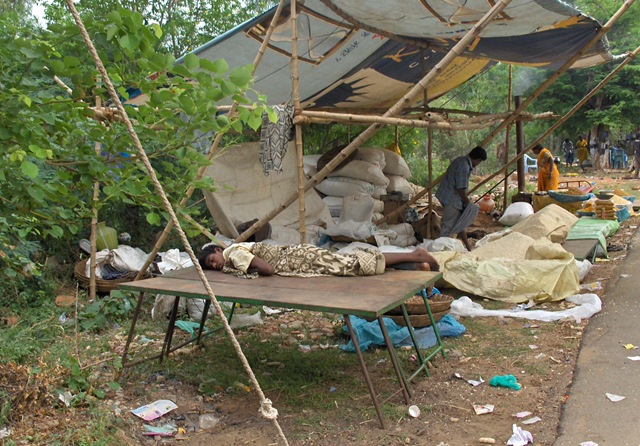
Man sleeping on table after a long night

HPIM4849

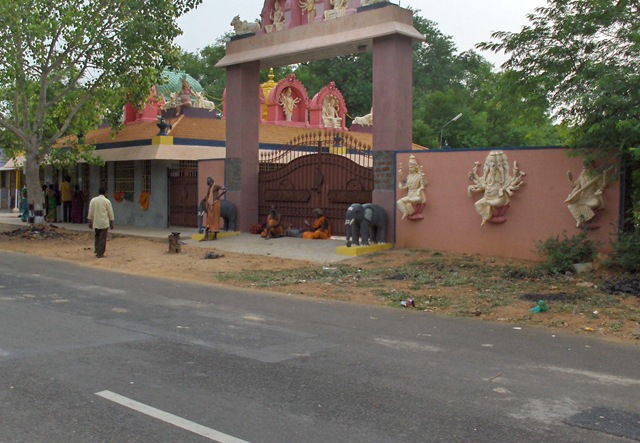
Vallalar Temple with Sadhus

Vallalar Temple features the Nine Planets

HPIM4852

Sadhu in tea stand

HPIM4856

Brightly colored Rudraksha pendants

HPIM4857

For the rest of this article, go to