Meditation, Self-Inquiry, and Self-Realization: By Dr. Harsh K. Luthar
Interfaith Enlightenment Site

(Pictures in this article come from www.toontracker.com/totaltv/underdog.htm)
Underdog and Sweet Polly Purebred
Do you remember that cartoon show “Underdog”? You might have watched it as a kid in the 1960s and early 1970s. Underdog was a “humble and lovable Shoeshine Boy” who had a secret identity.

Whenever there was a serious world crisis or threat to the city, Underdog would turn into a superhero after taking a special vitamin pill from the secret compartment in his watch.
Underdog had a girlfriend named Sweet Polly Purebred. Sweet Polly was sweet on Underdog. Sweet Polly was a reporter, who seemed to get into trouble with the bad guys in every show. When in crisis mode, she would yell, help, help, help, Underdog, help. Sometimes Sweet Polly would actually sing despondently when Underdog was late in arriving. “Oh where, oh where has my Underdog gone?”
Underdog was probably the best boyfriend Sweet Polly Purebred ever had. No matter how far away and how deeply engrossed in shining shoes of his customers, Underdog could always hear Sweet Polly calling out his name. The “humble and lovable Shoeshine Boy” would slip into a phone booth and emerge as the champion of justice and protector of Sweet Polly. Underdog had super sensitive hearing, at least when it came to Sweet Polly. No doubt this would have resulted in a happy marriage if they had ever tied the knot. Underdog would often say, “When Polly’s in trouble I am not slow, it’s Hip, Hip, Hip and away I go !”

Underdog always came to Sweet Polly’s rescue, yelling, “Never fear, Underdog is here!” Sometimes Underdog took his time and Sweet Polly had to yell help for a long time. This was not easy on our ears as kids. But we hung on. We strongly suspected that Underdog would indeed arrive at some point.
When Underdog finally came, it was a great consolation. We did not really want Sweet Polly to get roughed up by the bad guys. Unfortunately, Underdog was no muscle dog. He had a small chest and a big belly. He was a heart attack waiting to happen according to modern medical standards on waist to chest ratio (which were probably not well known when the show started in the 1960s). In fact, Underdog often became exhausted within a few minutes in his fight with the bad guys and looked for his vitamin pill to get his vitality back. Not being able to locate the magical nutrition pill in time posed a serious problem to Underdog’s health.
It was awful to watch and we were full of tears as Sweet Polly looked for Underdog’s backup energy pill in her purse while Underdog was beaten to a pulp by the bad guys. Sweet Polly always found the needed vitality tablet for Underdog at the last minute, but not before giving everyone the distinct impression that she was very disorganized.
The magic pill, once found, was a life giving elixir. As soon as Underdog put it in his mouth, the effect was immediate. The vitality pill always seemed to bypass Underdog’s digestive system and go straight into his muscles. Typically Underdog swallowed the pill in one gulp and regained his energy the next instant. Then he would beat the surprised bad guys quickly before the show ended. Underdog always saved the day including, of course, Sweet Polly.

I was recently thinking that in real life, some people are like Underdog (who don’t have a Sweet Polly), and some are like Sweet Polly (but without their own personal Underdog).
Sometimes we want to act as saviors to people who do not wish to be saved. Other times, we need desperately to be saved but no one except mom seems interested in the job. That perfect match of being the savior and being saved that Underdog and Sweet Polly had is seldom achieved for most people. Underdog and Sweet Polly were made for each other.
We certainly lack that magic vitamin pill that Underdog had in the secret compartment of his watch. But even for Underdog, the effect of the magic vitamin pill was only temporary. He had to keep taking those pills to maintain superhero status.
One wonders where Underdog got his supply and the money to pay for those pills. After all, he could not have made much as a shoeshine boy. Perhaps he got big tips from his customers. Maybe Underdog had really good health insurance and there was low co-pay for those very strong vitality pills.
I wish that there had been some closure to the Underdog show. Underdog could have proposed to Sweet Polly Purebred in the final season of the show. If Underdog was too shy to do it, maybe Sweet Polly could have proposed to Underdog. Given the number of times Underdog saved her, that’s the least Sweet Polly could do.
It would have been nice to have a big wedding for Underdog and Sweet Polly Purebred at the end of the final season. I can just see Sweet Polly saying to Underdog before they went off on their honeymoon, “Underdog darling, make sure to pack some extra energy pills for the next two weeks.”
Maybe there will be an Underdog movie which will show that Underdog and Sweet Polly Purebred got married and lived happily ever after. If they did it right, the Underdog movie would be blockbuster!
Underdog and related characters are © 1997 GBPC, a subsidiary of Golden Books Family Entertainment.
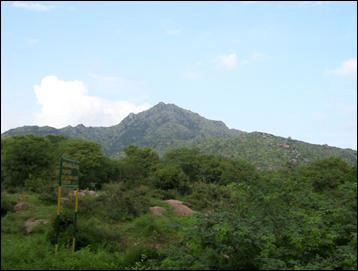
Picture of Arunachala by Gabriele Ebert
I received some excellent and thoughtful comments from Sada-Ji (Dr. K. Sadananda) on the article, “The Method of Deep Body Relaxation.” These comments with minor editing are given below. Thank you Sada-Ji.
Editor
**************************************
Comments on “Deep Body Relaxation” By Dr. K. Sadananda
Harshaiji – PraNAms
Here are some comments on your article about “Deep Body Relaxation.”
Shava Asana is always done at the end of yoga exercises as a relaxation technique.
However, I would like to add a word of caution for going from Shava to Shiva – that is lying down and doing regular meditation. There is a good reason why the Lotus Posture (Padmaasan) is universally recommended for meditation. Shava or the corpse is considered as inauspicious while Shiva means auspiciousness itself
Also, it should be kept in mind that when one is in meditation, the normal breathing process will slow down and mind becomes quiet and calm. These conditions are conducive for the mind to go to sleep easily. Hence for most meditators, sleep becomes a big hurdle to overcome. Therefore, the Shava Asana (Corpse pose lying on the floor or bed) may not be useful for meditation.
Sleep is the opposite of meditation. In meditation one attempts to stay conscious and awake. That is one of the reasons why meditation is not recommended in the night when the mind is tired, but in the early mornings when the mind is fresh and vibrant. The period around 4am in the morning is considered best for meditation (it is called brahma muhurtham in Sanskrit).
The Lotus posture insures that the person who is meditating does not fall forward. Sitting in the lotus pose is recommended so that the student is stable and firm on the ground.
Yogic texts all advise that the vertebral column and the neck be in straight line (without going into the details of kundalini aspects).
This way one can stay in meditation for any length of time – awake-vigilant and meditative. Indeed that is the state of mind in meditation to be aimed at.
As Harshaji states, one can easily go to sleep in the Shava Asana. In fact one should go to sleep in that pose thinking of the Lord.
Then one can have Yoga Nidra and blissful heavenly relaxation.
But for Vedantic inquiry, the mind has to be sharp. Our own experience is that we can read stories or popular magazines lying down. But for any serious work, we have to sit up and study. Knowledge can take place only when the mind is sharp. Then, what to talk about the subtlest knowledge about one’s own self. So the recommendation is to do meditation in the sitting pose – if you can.
If you cannot, then alternate poses are recommended.
Now the question is whether one should do meditation in a lying down pose such as Shava Asana! Of course you can do! It is like a drunkard who went to ask a priest, “Sir, can I drink while praying to God?” Priest of course said, “No. you should not drink while praying.”
The drunkard thought about this and re-framed his question and asked again, “Sir, can I pray while drinking?” “Yes of course”, said the priest. So, can one meditate while lying down? The answer is, “of course you can meditate any time and anywhere.” No problem!
Should one lie down to meditate? No, that is not advisable. Sri Krishna himself recommends sitting down and meditating in the 6th Chapter of Bhagavad Gita.
Of course for relaxation – what Harshaji says is correct.
But For a meditator, relaxation is not the goal, but it is only a by-product. Vedantic meditation requires a calm, quiet, and vigilant mind. It is a subtle inquiry within of the very essence of life itself. If relaxation becomes a goal, the meditative mind will only long for that. If the mind settles in that groove, it will not be ready to take a higher flight.
Deep Body Relaxation
I used to teach Yoga, relaxation, and meditation classes in the late 1970s in NYC to make a living. After the Hatha Yoga sequence was done, students were led through a guided deep body relaxation in Shava Asana (the corpse pose where everyone lies down and relaxes each part of the body). After teaching Yoga for many years, it seemed to me that for most students, the guided meditation while lying down was absolutely the most favorite part of the class. Many students would continue in the Shava Asana for half an hour or more after the class was over. Some became so relaxed that they would fall asleep.
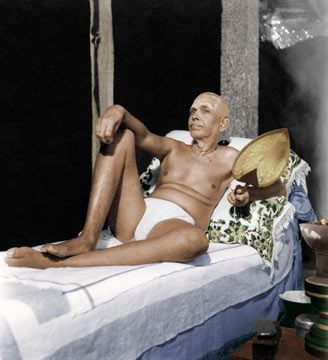
Over the years, I have come to feel that the best posture for meditation is not always the Lotus posture as many Yoga traditions claim, but simply lying down in Shava Asana. The sleeping posture is universal and sets no high bar for anyone to have to overcome. Therefore, it is the perfect posture for attaining Self-Realization. In fact, we know that the Sage of Arunachala, Sri Ramana Maharshi, became Self-Realized in that posture.
Deep body relaxation can be mastered by anyone slowly and many people experience physical, mental, and spiritual benefits from it. I have personally found it to be immensely useful in a variety of ways. My own experience of the Heart, Oneness of Being, came when I was very young. I had been meditating for many hours, sitting straight in a cross-legged position, and my back was aching and so tired that I lay down to rest for a few minutes. I was not trying to relax but it was in that resting posture that this deep conscious relaxation came over me and the truth of being revealed itself with complete clarity.
The Relaxation Method
The relaxation method I use is easy. I simply bring attention to every part of the body and consciously experience it and relax it. I start with each individual toe on both feet and relax these. I also focus on the bottom of the feet and relax these. Then I focus on the upper feet and relax these. Then I come to the ankles and relax these and keep moving up to the legs and other parts of the body and so on.
Sometimes, in my teaching, I have combined this method with visualization of white light filling the different parts of the body from the head to the toes. This is a beautiful way to use the intelligence and imaginative and visual faculty of the mind to fill the body with deep relaxation and to create a sanctuary of peace for one self.
Of course, Hatha Yoga is important for many people and sitting in meditation with a straight spine has its own health and energy oriented benefits. Meditation on energy centers along the spine is facilitated by sitting straight in a cross-legged posture. It also helps in doing certain pranayama and deep breathing exercises.
For many people who cannot sit cross- legged, sitting straight on a chair with support for the elbows is helpful. There are many ways to meditate. The main thing is that one should be comfortable in one’s posture.
Sincere Practice Leads to Self-Discovery
One, who is serious about meditation and relaxation and practices it with sincerity, slowly discovers what postures and exercises are the most helpful for her/his body and mind. Each person is unique in terms of what they find useful.
Finding a good yoga teacher is much easier today than it was when I was teaching. Back in the 1970s, in the U.S. and other Western countries, Yoga was popular only in big cities like Manhattan and Los Angles among the actors and actresses and the elite. But now it has become more mainstream and one can find Yoga classes in virtually any city.
Deep body relaxation seems to be universally attractive to people, because it allows for letting go of accumulated tension. It is easy to learn and do and with practice and experience becomes natural.

Philosophy of Sri Raj Mata-Ji
Sri Raj Mata-Ji is one of my earliest spiritual advisors and counselors. Here are some of her sayings in Hindi and Punjabi that I have translated into English.
*******************************************************
Life is fleeting. Do something for yourself as well as others.
Grab some happiness when you can.
Happiness is having a caring family and cooking for them.
Happiness is having good friends and good neighbors to talk with.
Happiness is a state of mind.
Some people have everything but they are not happy. It’s a pity.
The secret to happiness is in giving.
If you serve others sincerely, you will be happy.
Nobody cares for the weak. Be strong.
You can only help and serve others if you are mentally strong.
Pray and ask God to make you strong.
If you eat too much, don’t complain afterwards.
Go take a walk after a big meal.
Take care of yourself. Nobody else can in the same way.
Make an appointment with the doctor and get a complete check-up.
Help others who need it. It will be good for you.
Give to charity whatever you can afford.
Make friends with your neighbors. Go shopping with them.
Stay active getting older and be part of a community.
Look for friends. They are looking for you.
Don’t look for perfection in others.
Life is a compromise.
You are better off than a lot of people.
Do the best you can and trust in God.
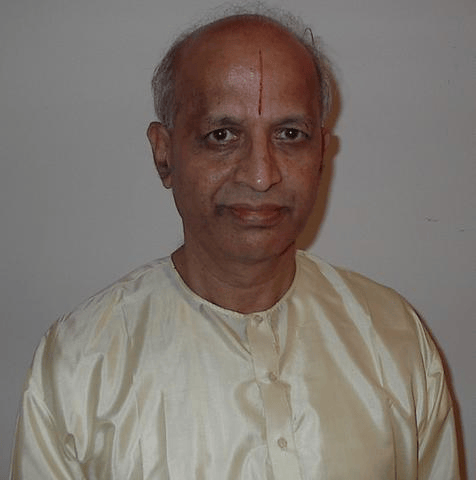
Editor’s note: Sada-Ji (Dr. K. Sadananda) is well known to the Hindu community in both the U.S. and in India. He is one of the most brilliant and thoughtful exponents of the Bhagavad Gita as well as the ancient philosophy of Advaita-Vedanta.
In this article, Sada-Ji discusses a practical question that frequently comes up among many students of Hinduism as well as many Westernized Hindus. The question is, “Should I become a vegetarian?”
I took the liberty to edit and restructure Sada-Ji’s original e-mail answer to this question for the purpose of this article to give it an easier reading flow. I hope that justice has been done to Sada-Ji’s explanations and that I have stayed within the limits of editorial license. Of course, any errors are mine and as soon as these are pointed out will be promptly corrected. Thank you for your understanding and patience.
***************************************************
Should I Become a Vegetarian?
Recently two questions were asked – Does Hinduism require one to believe in God? Does Hinduism require one to be a vegetarian?
In a recent article, I have addressed the first question. Here I will provide some thoughts for the second question. In relation to the first question, I have discussed what Hinduism stands for and who is truly a Hindu. In essence, Hinduism is Sanatana Dharma, and that Dharma is from time immemorial; it involves pursuit of Moksha through self-reflection, inquiry, and Self-Knowledge. Self-Knowledge in Hinduism is synonymous with Moksha (Liberation from the cycle of birth and death).
Therefore, the one who is seeking to understand the ultimate mystery of existence and thereby gaining salvation or release is a true Hindu, irrespective of the nationality, caste, creed or gender. With that catholic understanding, one can see that Hinduism becomes a way of life because the pursuit of the essential purpose of life is the goal of the ideal Hindu life. If you ask most Hindus whether they believe in God, you will get a firm “Yes”, in response.
With this perspective, it is easier to analyze all other questions including whether Hinduism requires one to be a vegetarian. Since the purpose of life is securing liberation or Moksha, until we reach that we need to maintain our body. Keeping the body healthy through proper nourishment is the Hindu Dharma. The human body is considered a temple of God. Therefore, it is sacred and should be treated with respect.
You asked whether a Hindu has to be a vegetarian. Well, it is a fact that not all Hindus are vegetarians. Hindu kings and princes and the warriors have eaten meat for thousands of years. So your question is not whether a Hindu should eat but whether you should eat meat. Since such a question has already arisen in your mind, perhaps you have developed a degree of sensitivity about harming other living forms to satisfy your physical hunger. If that is true, you may be better off not eating meat. That way you will be at peace with yourself. Since you are sensitive to this issue, your intellect may be directing you towards being a vegetarian. It is a possibility. However, your mind wants the pleasure of eating meat and your body may crave it due to past habits. So you have to reflect on this. Why has this question come up for you? What is the right thing for you to do?
Follow Your Self-Nature
When you go against your own intellect and good understanding of life you commit a sin. An act that is contrary to your SWADHARMA (your own nature) creates a conflict within you. So you have to reflect on whether being a vegetarian is natural to you or not. Now, of course, even the traditional non-vegetarians are choosing vegetarianism not because of any compassion to other animals but they are recognizing that meat is not good for their health.
I have already mentioned that Hinduism does not say to you “don’t do this and don’t do that”. You must determine your own actions based on your intellectual values, culture, education and primary goal in life. You will find that following your Swadharma (your own nature) will make you comfortable with yourself. It is not for others to judge what food is right for you! It is for you to decide.
While you are trying to decide whether to be a vegetarian do this experiment. Imagine your self to be a chicken or cow who is about to be slaughtered for food. Would you not advise the guy who wants to make a dinner out of you to be a vegetarian instead? The golden rule of “Do unto others as you would have them do unto you” can sometimes help shape our analysis.
Life Lives on Life
Life lives on life. That is the law of nature. Whether I eat an animal or plant, I am destroying a life in some form. Among all life forms, Man is different from the rest. He has the capability to discriminate right from wrong. That gives him the freedom of choice which animals and plants lack.
According to ancient teachings and our observations, plants have just a body and perhaps a rudimentary mind. Animals have both body and mind to express their feelings and suffering, but rudimentary intellect. Man has not only body and mind but also a well developed intellect to discriminate between good and bad, and to choose.
Man always has three choices: He can choose to do something, not to do it, or find another alternative way to do it that is more satisfactory. For animals and plants there is no freedom of choice. They are instinctively driven. The cow does not sit down before meals and inquires whether it should be a vegetarian or non-vegetarian. Same with the tiger or the eagle. They don’t say prayers before eating like we do. They just act according to their nature. No one can hold that against them.
Man and Sin
For a Man the discriminative intellect is much evolved. Plants and animals do not commit sin in their actions because there is no will involved in their actions. For a human, the story is different.
You may wonder why I brought sin in the argument. Let me explain. Sin is nothing but agitations in the mind. It is these agitations that prevent me in my journey to Moksha. Mind has to be pure (meaning un-agitated) for me to see the truth as the truth. (Bible also says blessed are those whose minds are pure).
To define sin more scientifically: It is the divergence between the mind and intellect. Intellect knows right from wrong. But we feel like doing things even though we know they are wrong . That is, the intellect says something but mind which should be subservient to the intellect rebels and does whatever it feels like. This divergence is sin.
After a wrong action is performed there is a guilt feeling. Intellect, although it was overruled, does not keep quiet. It keeps prodding “I told you it is wrong. Why did you do it?” With peace of mind gone, Man goes through a “Hell”. Man is not punished for the sin; he is punished by the sin! Think about it. All the Yoga schools, if you analyze clearly, are bringing this integration between the body, mind, and intellect so that there can be harmony. With harmony, there is peace.
For a true Yogi, what he thinks, what he speaks, and what he does are in perfect alignment. In our case, we think something but have no guts to say what we think. Our lips say something different from what we are thinking. Sometimes people say, “Watch My Lips or Read My Lips “. They mean to emphasize that what they say can be counted on. However, if you watch their lips as requested and follow their actions these are again different! There is no integration anywhere. Our lips and our hips have divergent paths. We live a chaotic life of freestyle dancing! Besides deceiving others, we deceive ourselves, and the worst thing is sometimes we don’t even realize that.
Animals and Sin
Now, when a tiger kills and eats, it does not commit a sin. Because its intellect is rudimentary, it does not go through any analysis before it kills and asks “should I kill or not kill this cute deer”? A tiger does not ask itself, “Should I be a non-vegetarian or a vegetarian?”. When it is hungry, to fill the natures demand, it kills its prey and eats what it needs and leaves the rest when it is full. A tiger does not overeat. There are no fat tigers in nature.
A tiger is not greedy either. It does not seek luxury beyond satisfying its needs. Animals and plants and birds and bees and insects and all living things follow a beautiful ecological system. It is only man who destroys the ecology by being greedy. But Man also has the beautiful instrument of the intellect and the ability to develop it and to meditate on the reality of the universe.
Should I be a vegetarian or non-vegetarian?
So yes, “Should I be a vegetarian or non-vegetarian?” is asked only by a man. Why does that question come? It comes due to reflection. Because man has a discriminative intellect, he can reflect on the nature of pain and suffering. Perhaps a man may think at some point in his life whether it is justifiable to harm and kill an animal to fill his belly. A person may reflect whether eating animals is consistent with the golden rule of “Do unto others as you would have them do unto you”. A man may consider whether this maxim applies to all forms of life or just other human beings.
Plants are life forms too. “Should one hurt them?” you may ask. If one can live without hurting any life forms that is the best, but that is not possible. Life lives on life – that is the law of nature. My role as a human being with discriminative intellect is to do the least damage to the nature for keeping myself alive and well.
At least, I am not consciously aware of suffering of the plants. That is why eating to live and not living to eat is the determining factor. In Bhagawad Geeta, Sri Krishna emphatically says that a Sadhaka (one who is in pursuit of Moksha) should have a compassion for all forms of life. There may come a point when it is advisable to be a vegetarian – only taking from nature what you need to keep the body in optimal health.
In one’s spiritual growth, one develops subtler and subtler intellect. That is, the mind becomes more sensitive, calmer, and self-contented. Your sensitivity to suffering of others also grows. Hence, the thought about becoming a vegetarian may come. Only you can decide what is right for you and not someone else. Any decision that is imposed on you from the outside does violence to your nature.
Many young people are now becoming vegetarians. They all have their own reasons. Fortunately vegetarianism is mainstream now and accepted. Most schools and universities offer vegetarian and even vegan meals and so the option to become a vegetarian is easier today than ever before.
Flowers grow in their own time. Whether you are vegetarian or not does not matter ultimately.
You are all flowers blooming in the light of the divine.
Hari Om and Tat Sat. – Sadananda
A newly released study has found that a diet rich in omega-3 fatty acids may help lower a person’s blood pressure. Omega-3 fatty acids are typically found in larger quantities in certain types of fish, nuts such as walnuts, and flax seeds.
http://www.cnn.com/2007/HEALTH/conditions/06/05/heart.pressure.reut/index.html?eref=rss_health
The study examined the diets of 4,680 men and women, ranging from ages of 40 to 59 from four different countries (Japan, China, Britain and the United States). Research on the benefits of omega-3 fatty acids has been ongoing for a number of years and the Internet is full of references to such literature.
This particular study interestingly concluded that people who got their omega-3s from vegetarian sources (such as Walnuts, flaxseed, and canola oil) had just as much benefit as those who get them by eating fish. This is probably reassuring news for vegetarians who do not eat fish.
Vegetarianism has become more mainstream in the West since the 1970s. People are vegetarian or become vegetarian due to a variety of reasons including their religion, cultural upbringing, and the desire to not eat meat.
Most vegetarians in India include dairy products as part of their diet. Some include eggs as well.
Veganism is a more strict form of vegetarianism in which no animal products are included in the diet at all.
For a list of famous vegans, see the following link.
In the 1960s, my Gurudev, Sri Chitrabhanu- Ji, wrote a poem called “Matiri Bhavanu” on friendship and universal love in his native tongue (Gujrati) that became famous in India. It was eventually recorded as a song by a well known Indian singer named Mukesh and was set to music by an eminent Indian composer. The poem was translated into English by Gurudev Chitrabhanu- Ji and that is the version of the poem that I was most familiar with. However, at the meditation center where Gurudev taught and lectured in the 1970s, we sometimes sang the poem Maitri Bhavanu in Gujrati with great feeling.
The scene shifts now to almost 30 years later to 1994. In 1994, the thought came to me that I should read the original Gujrati version of the poem by my teacher. Gujrati is not my native tongue and, in fact, I do not understand it at all. I cannot speak in Gujrati and cannot read it. However, the Gujrati alphabets are similar to Hindi which I do know. So somehow the feeling came over me and I started to try to read and understand my teacher’s poem. It was hard but I was staring at the Gujrati words as if through will power alone I could decipher them. After some difficulty, I switched to the English description of the Gujrati sounds that you can see on the Jain Meditation Center website.
http://www.jainmeditation.org/pages/song.html
After many attempts, I actually started to understand the first stanza, and then the second, and then the third, and then the fourth. It was so beautiful and full of the universal feeling that I went into ecstasy. The result was the following poem, “Let this feeling never part!” In a very real sense this poem is the spiritual offspring of that original poem written by my teacher in his youth as a Jain monk. Recently, I came across the poem again on my old computer files and had to smile. I was just a “kid” when I wrote it. Of course, it cannot reach the same level of poetic artistry as my teacher’s poem in original Gujrati which is a true masterpiece. But I tried because something came over me. Perhaps what I lacked in talent, I was trying to make up in enthusiasm and feeling. I dedicate this poem to my Gurudev, Sri Chitrabhanu-Ji, who taught me the meaning of Ahimsa, the philosophy of nonviolence.
Let This Feeling Never Part!
The sacred stream of love divine
sweeter than the sweetest wine
flowing into this vast sunshine
springs eternal from my heart.
I pray no one should be left out
from life’s blessings in their glory
and give way to tortured doubt
with unhappy endings to their story.
Never should they be turned away
suffering from the blows of life
the poor, the wretched of this world
caught helplessly in endless strife.
If ever anyone should be in need
of comfort or help in getting up
let me not run away from them
but plant kindness as my living seed.
Let me give hope where there is despair
and mend hearts considered beyond repair
like the gentle ocean breeze that
heals all wounds and gives a fresh start
Let this feeling never part!
I should always find delight
in the warmth of universal light
but if my heart must bleed at all
let it be so in the dark of night.
No one should see the tears that come
when the wicked and cruel come in my sight
let this hand forever be raised in peace
and the violence around us come to cease.
Always this thought should be kept alive
every sinner is a future saint
there should be a place for everyone
to swim in the pouring love divine
that flows eternal from my heart
Let this feeling never part!
Unaware, if someone is unkind
let forgiveness be on my mind
until no trace is left behind
of ill will, anger, or hostility.
If I should ever slip and fall
and no one to catch me is around
let me come down gently like a leaf
so other life is unhurt on the ground.
If I have to lay for some time
contented should be my smile
composing songs of love and friendship
and resting all the while.
I will be picked up by love divine
which springs eternal in my heart
for all the beings everywhere
Let this feeling never part!
Sages have sung the song of friendship
walking with them and in their shoes
the same melody plays on my lips
the feeling of reverence for life continues.
Involuntary poets, there have been many
who felt the thrill and saw the sign
whose hearts sang out in ecstasy
as their fountain bubbled with love divine.
The blessings of nature are bestowed
on those who are firm in their belief
who are harmless to others and easily bow
before anyone, seeing only divinity.
If I should be granted just one thing
let it be the vision of love
always rising from the spring
sacred and eternal in my heart
Let this feeling never part!
**********************
NAMASTE
I bow to the light in you
which is the same light in me.
—


You must be logged in to post a comment.