
What Is Enlightenment?
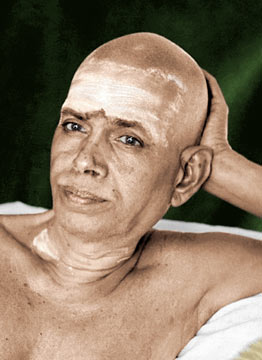


The Guru Vachaka Kovai, the Garland of Guru’s sayings, is a comprehensive collection of the Maharshi’s Sayings, composed and strung together by the great Tamil Poet Muruganar.This translation is by Professor K.Swaminathan.
In Part 1, after the invocation there is a long section called ‘The Quest’, and part 2 is entitled the Unreality Of The World, and continues from verse 63 to 70.. Verse 69 states
The world perceived by the poor jiva
Lapsed from its own Being true,
Buried in darkness, and believing
That it is but the body, alas,
The world thus seen is non-existent;
Yes, it is indeed unreal.
The thrust of this verse, and those like it is underlined by the often quoted passage in Letters from Sri Ramanasramam, 24th August, 1946, quoted in the marvelous book Muruganar’s Padamalai, edited by David Godman. On page 283 of the Chapter entitled The Reality Of The World Appearance we read.
Bhagavan:” In the sadhak stage [the stage of being a spiritual seeker] you have got to say that the world is an illusion. There is no other way. When a man forgets he is Brahman, who is Real, permanent and omnipresent, and deludes himself into thinking that he is a body in the universe which is filled with bodies that are transitory, and labours under that delusion, you have got to remind him that the world is unreal and a delusion. Why? Because his vision which has forgotten its own Self is dwelling in the external material universe. It will not turn inwards into introspection unless you impress on him that all this external universe is unreal. When once he realises his own Self, and also that there is nothing other than his own Self, he will come to look upon the whole universe as Brahman.”
Like very many sadhak’s I found it difficult to be convinced that the world we perceive is ‘unreal’. I realised that the concepts of space, time, and causality are inherent in the organ ofcognition and create the screen of consciousness on which the world stage, actions and pictures are projected.Also that quantum physics has confirmed that what we see, feel, smell , touch and taste is not what it appears to be, but subtle energies in constant movement. But, It was not until I read the Advaita Bhoda Deepika, The Lamp of Non-Dual Knowledge, a short work, highly spoken of by Bhagavan that I followed the complete logic of this point of view.
I summarise my findings as follows, largely based and inspired by Chapter 1 of this marvellous treatise, entitled On Superimposition.
1. All is Absolute, pure, infinite Consciousness, non-dual, Supreme Intelligence, the Self-Existent Self or Brahman.
2. Maya or Illusion, the powers of veiling and projection are inherent powers in Brahman.
3. These powers manifest an apparent, but unreal Universe. Unreal because it was NOT before manifestation and will NOT BE after dissolution. Therefore it is likened to a dream in the Supreme Intelligence or Mind of Brahman. Thus the apparent Universe is but an appearance based on Brahman. It does not exist apart from Brahman. It could be termed, therefore, a confusion between the Real and the Unreal, or neither Real nor Unreal, or both Real and Unreal. In the Vedanta, the term Real is applied to the Immutable or Unchanging. The apparent world is constantly changing, in a state of flux, becoming and decaying, so it cannot be termed Real in this sense, whereas Brahman is immutable, unchanging and eternal.
4. The ignorant ‘jiva’ (the ajnani) or individual soul is reborn and dies continuously through many lifetimes, until Self Realisation. It carries forward from each life the seeds of many latent tendencies from previous lives, although its True Nature is also the Absolute Pure Consciousness of Atman-Brahman. But because of the implicit Maya, projection and veiling, inherent in the Self of Pure Consciousness or Brahman, it identifies with its insentient body and creates a Universe from its latent tendencies (vasanas) through the mind, (organ of cognition, the brain and sensorial adjuncts). The mind is a wondrous power in the Self. The world it sees, composed of latent tendencies , and thoughts is therefore of the nature of a dream, even an hallucination, and may be termed ‘unreal’.
5. The latent tendencies inherent in each jiva at the time of each life, are selected by Isvara, an adjunct of Brahman, for its spiritual development. So all is benign, based on Love, essentially. This is stated By Bhagavan in answer to a question by Paul Brunton quoted in the book Conscious Immortality on Page 130 , Chapter 10.
6. The mind-body complex, personal individuality, other sentient beings, and the Universe of multiplicity, are therefore a superimposition on the Self which is now living from reflected Consciousness, mirrored by egotism and the latent vasanas.
7. Through Grace, the jiva receives the teachings of Advaita from a Jnani, and when fit, through assimilation of this Knowledge and mental purification through right intellectual discrimination, spiritual practice and devotion, he or she is shown the way to awaken from the dream of suffering and transient joy (samsara). The means are through Self Enquiry into the source of the ego, the Self and the illusory nature of the Universe.
8.At the same time one lives one life as if it was real, knowing it to be unreal, and accepting all that happens as ultimately for the best.
9. When there is an awakening from the dream of life, the transmigration of the jiva is over. The immortal Self of infinite Consciousness is Realised directly and one lives from that state of ‘sahaja’ until the mind-body falls off in death, and one is absorbed into Brahman or Infinite Consciousness, no longer a separate individual identified with its body-mind. All is the Self, and the world is seen to be Real because its substratum is now known to be Brahman.
I hope this essay, into a difficult metaphysical question may be helpful to seekers baffled by the world illusion.
Final comments:
Re-reading Bhagavan’s Eight Stanzas to Arunachala, a marvelous poem, I came across this verse which sums up my Essay. I add it as an addition, as it seems to sum the whole question up, very succinctly.
6. Thou art Thyself, the One Being, ever aware as the Self-luminous
Heart! In Thee there is a mysterious power (Shakti) which without Thee is nothing. From it proceeds the phantom of the mind
emitting its latent subtle dark mists, which illumined by Thy light (of consciousness)
reflected on them, appear within as thoughts whirling in the vortexes
of prarabdha, later developing into the psychic worlds and projected
outwardly as the material world transformed into concrete objects which are
magnified by the outgoing senses and move about like pictures in a cinema show.
Visible or invisible, oh hill of grace, without Thee they are nothing!
Alan Jacobs
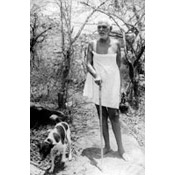
Sri Ramana Walking
As we have been exploring Arunachala we keep finding ‘caves,’ some already widely known, and some not. A friend suggested that we put this onto the blog. This seems a good idea, and this is the first attempt in so doing. We can find nothing like this available now.
Our exploration of Arunachala is ongoing, and any more caves we find will be added to this. I will often refer to other postings where there may be more photos and information about specific caves.
I put quotes around the first instance of ‘caves’ since what are called caves here are often nothing more than a sheltered space under a big rock.
Is some cases the individual caves already have names in common use. Most do not, and for the purposes of this listing I am calling these by names that I made up. If other caves are known, or names of caves shows are known, I ask that you let me know, and I will update this listing.
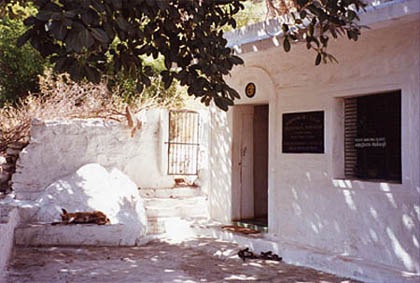
Virupaksha is, for most, deeply associated with Sri Ramana Maharshi. Ramana lived where he lived for 17 years [1899-1916].
Below is a famous photo of the young Ramana at Virupaksha cave.

The cave is named for a famous saint, Virupaksha, who lived in this cave in the 1500’s, around the same time as Guhai Nama Shivaya lived nearby (see below). At Virupaksha’s demise, called here ‘maha samadhi,’ it is said that his body was transformed into vibhuti (sacred ash). In the interior of this cave there is a mound in the shape of Arunachala. It is said to be made of this vibhuti.
More on Skandashram is in the post Walking up to Skandashram.
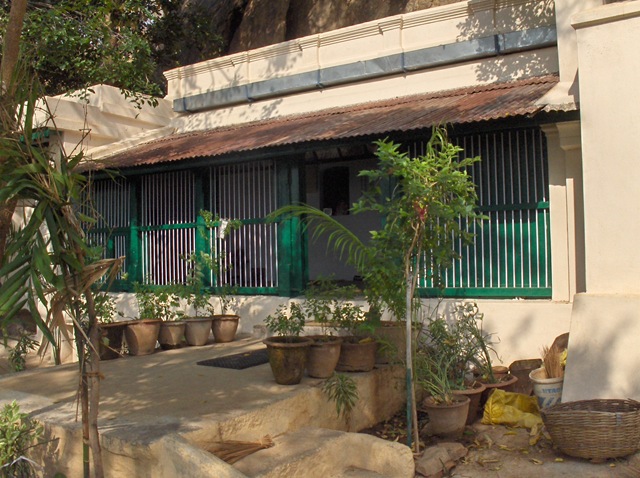
Sri Ramana lived at Skandashram from 1916 to 1922. His mother joined him during this period, and for the first time cooking was done there. This is where the mother had her maha samadhi in 1922. Her room is now a shrine.
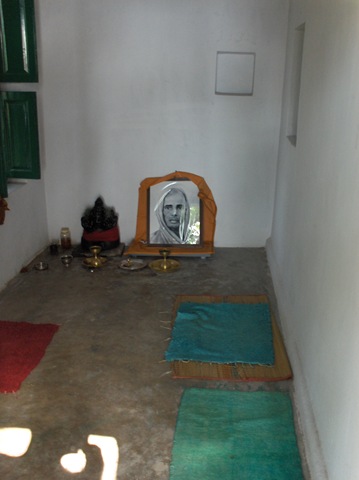
Sri Ramana lived here during the summer during the Virupaksha days. I do not yet have a photo. This will be added soon.
This is another cave in which Ramana lived in 1899. It is here that he wrote the notes which later because the pamphlet, Who am I?
A bit more on this cave is in the post New Access to Ramana Sites below Virupaksha.
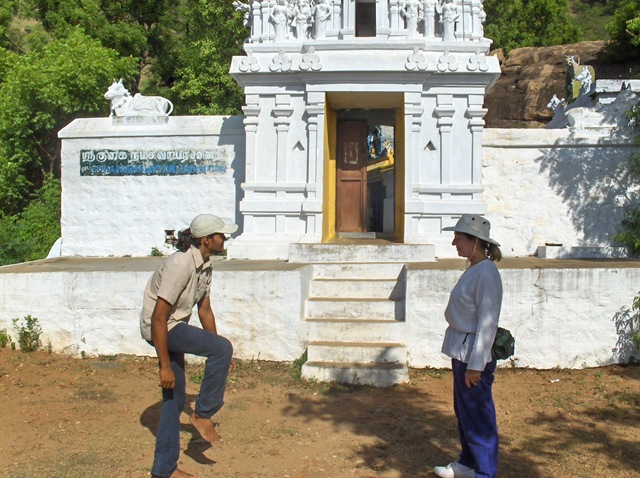
A short clip from Arunachala Grace Blog:
Guhai Namasivaya is known to have been born around the year AD 1548 in Karnataka to a pious Saiva couple. His spiritual nature became evident at an early age: he was virtuous in his conduct, adept at his studies and evinced no attachment to worldly matters.
He practised his system of yoga for many years and as a result of the dream guidance of Lord Mallikarjuna, the presiding deity of Sri Sailam, Guhai Namasivaya came to Arunachala and remained as a Guru, giving teachings to mature disciples who approached him.
The next four caves are shown in the Seven Springs posting. They are all located on the hill above Skandashram, one of the paths that goes to the top of the hill.
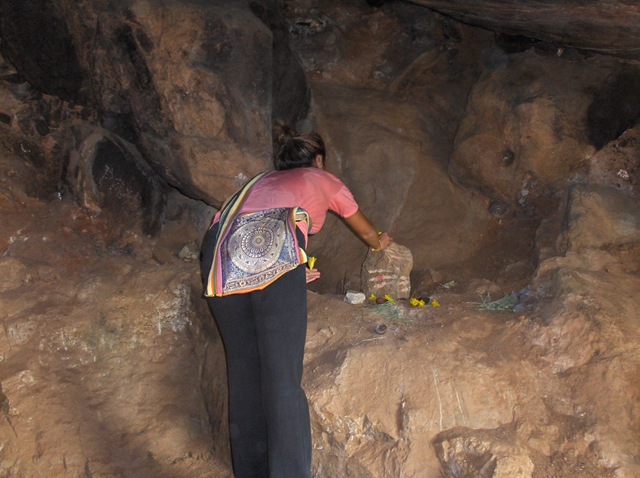
This is a cave, said to be greatly improved by the work of David Godman in the 1980s. Maybe ten people can fit into this cave.

Altar in the cave.
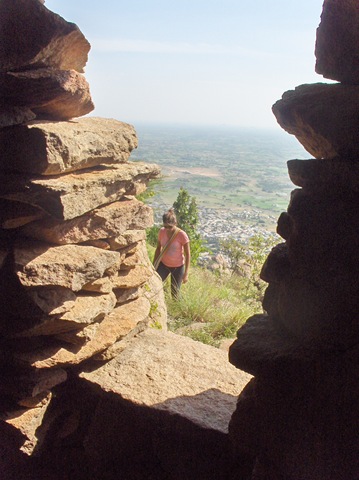
Looking out the entrance. John, the archivist at Ramanasramam, stands outside the entrance.

This is first of three caves found at Seven Springs. There is a stone entrance built, and a good altar in the cave. Maybe four people can fit in here.
Up the hill you can see stonework.

The entrance, from the inside.
Richard, offering incense to the altar.

Carol, exiting the cave.

This is a small cave, behind Seven Springs 1. Maybe two people fit inside. Many stone and concrete improvements have been made.
Richard, meditating in the cave.
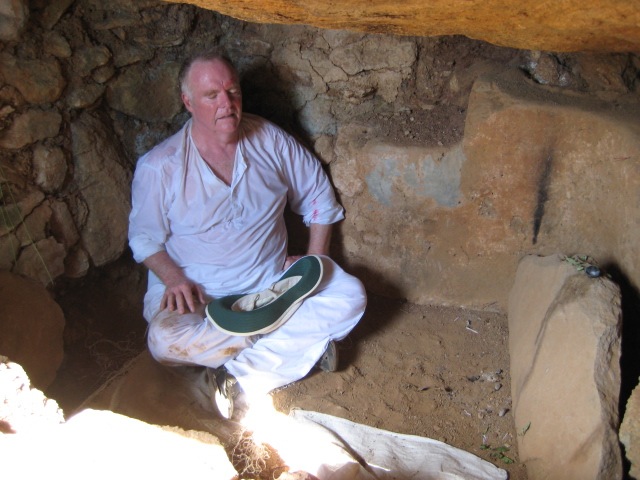

I call it ‘Ramana’s Resting Cave’ since this is the cave that is documented in writing about Ramana where he was known to rest, while others made the climb up to the top of Arunachala.
It is in the shade all day with a nice breeze through it, and a view out through green trees.
The entrance is a bit tight, though.
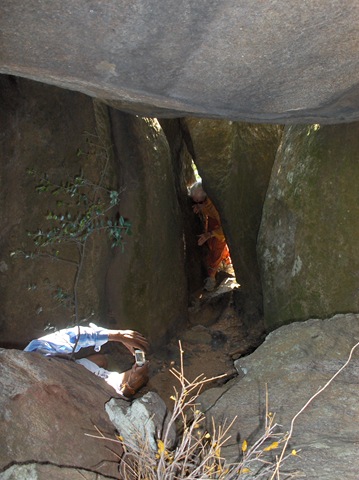
These caves are described in the post New Access to Ramana Sites below Virupaksha.
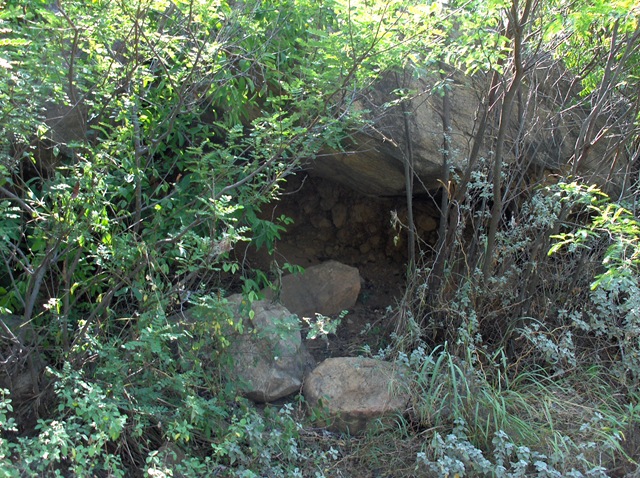
This cave is big enough that one or two people can sit in it.
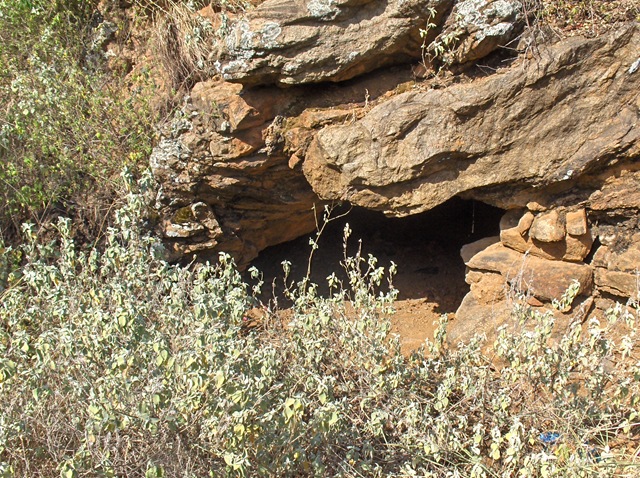
This cave is very small. One person can lie down in it.
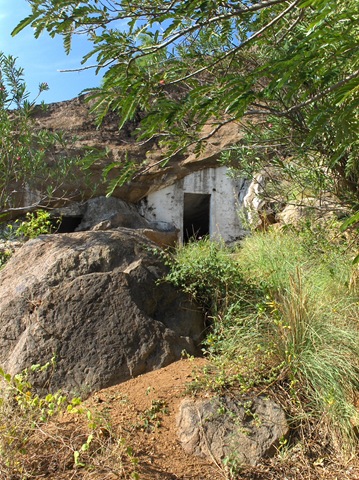
This cave is said by local villagers to be one used by Ramana in the early days. Recently, people have built walls and a door and an altar in it.
The altar.

These caves are shown in the posts Papaji’s Cave and Aum Amma’s Cave.
The first ‘cave’ of Papaji’s is in the area where part of his ashes were scattered. This is a nice place to sit and meditate at the altar that has been set up there.


The next of the caves named for Papaji, and one that he is said to have lived in, is near the first cave, down the rock and a bit up the path.
Carol enters the cave from the path.

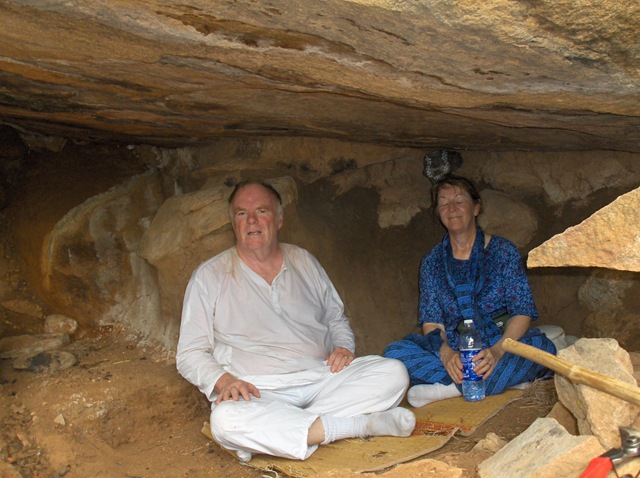
Richard and Carol, meditating in the cave.
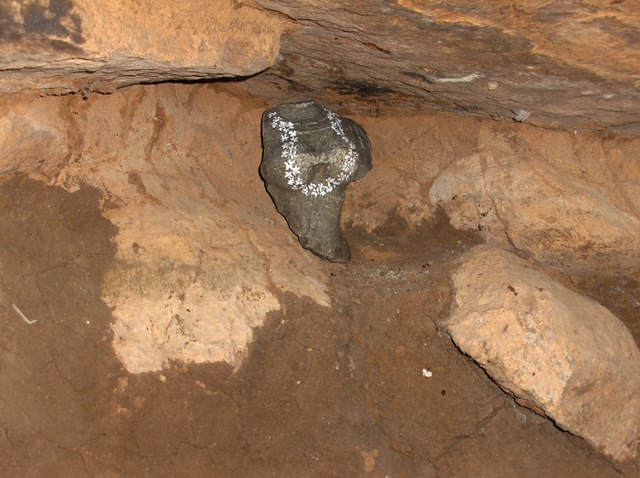
Below is part of a mother goddess statue, placed in this cave.
Aum Amma’s cave is the most developed of any cave we have found so far (except for those, like Virupaksha, which have had buildings constructed around them).
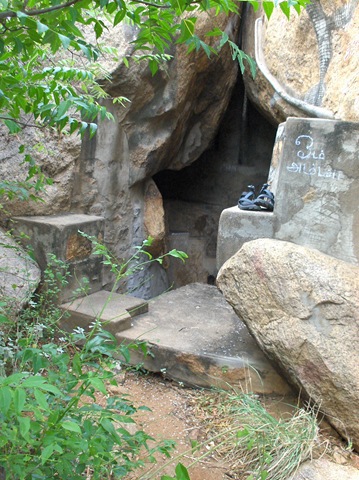
Many bags of cement were carried up the hill to make these cave improvements. Aum Amma lived her for several years until just a few years ago.
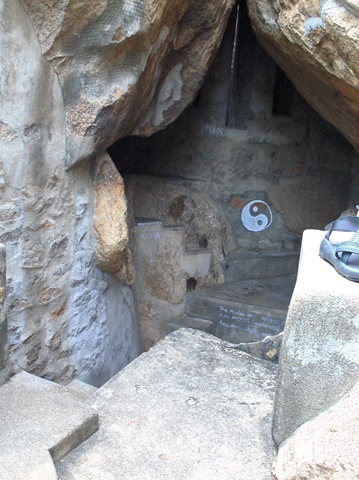
Stairs lead down into a main room.
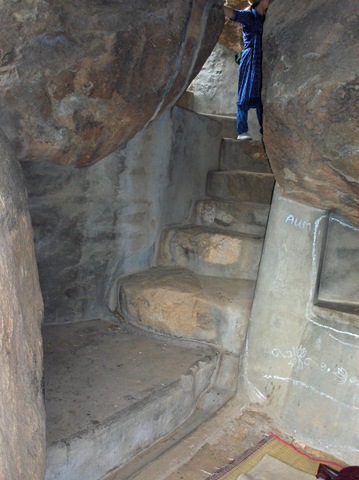
There is a good view out the “window” in the main room. It looks like sometimes that people sleep in this cave, though you are not supposed to, and if you stay too long, the Forestry Department people will chase you out.

This cave is shown in the post Kattu Siva Cave.
There is a nice cleared area around the cave. this is good place to come during the heat of the day. There is plenty of shade.

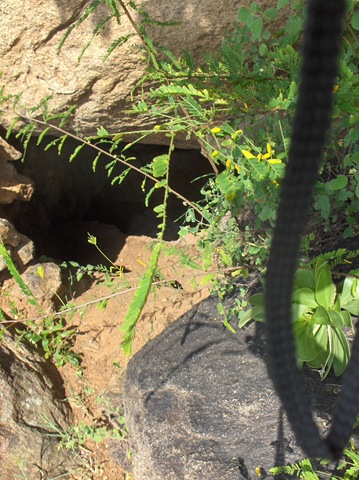
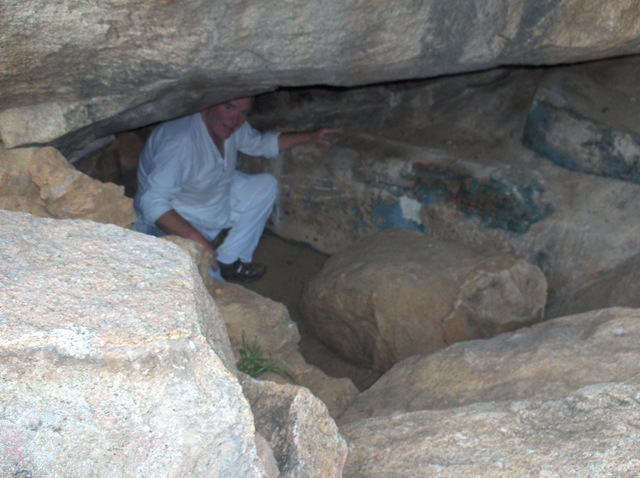
Climbing over the rocks at the end of the clearing, a hole in the rock appears.

This is Kattu Siva’s cave. A big rock, in front of Richard, has fallen into the cave. Will someone be able to remove it?
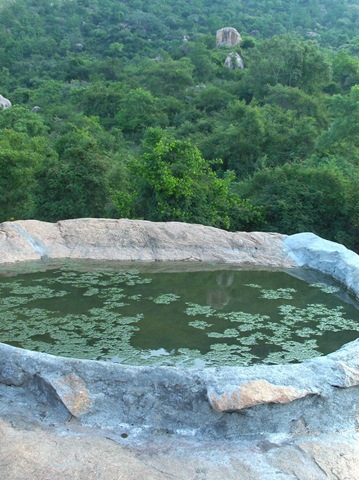
On the top of the rock over the cave, a cement water catching area was made. The photo below looks over this to the Arunachala hillside behind Kattu Siva’s cave.
Related posts are: Kattu Siva Meditation Perch and Kattu Siva path Renewal – Part 1.
This is a small unused cave. Rocks need to be cleared from the floor to make a good sleeping area.
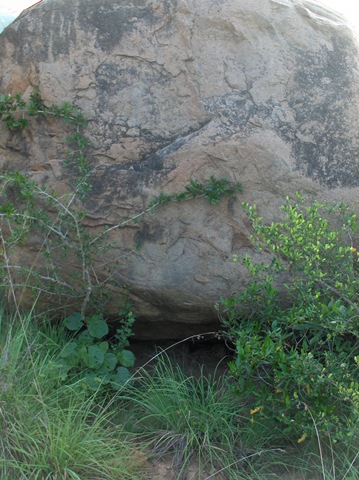
This cave is shown in the post Kattu Siva path Renewal – Part 1. It is under a rock that looks like a natural lingam as you approach this cave.
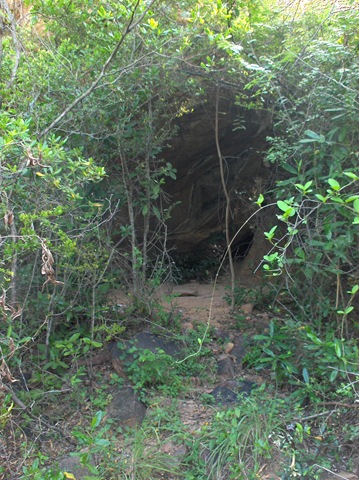
This cave is shown in the post Inner Path – Around Parvati Hill.
A path leads to it from the Inner Path.

This cave was improved with a stone and cement wall in front.

A nice cement floor has been put in the cave.

I have heard of more caves. I have been told:
What else is there? We have to explore to know more. If you know of any more caves that haven’t been listed, please let me know.
 Each year cosmeceutical companies and consumers alike search for the next big thing in anti-aging discoveries. This year, with everyone going “green” and searching for natural ingredients, pomegranate definitely is “in” in the anti-aging cosmeceutical industry. Dr. Carl Thornfeldt, MD in his March 2008 article in the Journal of Cosmetic Dermatology states “Mucocutaneous inflammation as the final common pathway of many systemic and mucocutaneous diseases including extrinsic aging has been established at the molecular and cellular levels.”[1] Pomegranate has known antioxidant and anti-inflammatory activity and has been documented in double-blind clinical trials to significantly improve signs of skin aging. Of the over 8000 known antioxidant ingredients, pomegranate is 1 in less than 20 have been incorporated into topical formulations which have been documented in human clinical trials to reverse signs of aging of the skin.
The status of the Pomegranate goes back as far as the history of agriculture itself, 10,000 years. Allusions to the pomegranate are readily found in the oldest cultures of the Indus Valley, ancient China, and classical Greece, as well as in the Old Testament. It has a long history of medicinal use, with the peel well regarded for its astringent use.
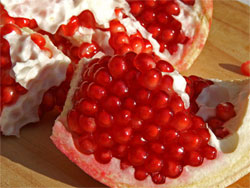
Anthocyanins account for the red-purple color of the pomegranate’s skin, flesh, and seed. More importantly, pomegranate juice made from squeezing the whole fruit is a rich source of punicalagin, a large polyphenol antioxidant. Pomegranate seeds are a good source of punicic acid, similar to conjugated linoleic acid.
Research has shown that the physiological effects of pomegranate juice constituents are remarkable in their preventive potential against two of the major chronic diseases of aging – heart disease and cancer. There is evidence of the pomegranate’s impact on heart disease, including its ability to enhance nitric oxide production in endothelial cells.[2]
There is also significant antiproliferative effects attributed to the pomegranate [3] in battling several breast cancer[4] and prostate cancer[5], and it has been shown to retard tumor growth in animals. One can also hypothesize that pomegranate juice may work the same way on skin cells.
In a study carried out at the University of Michigan Medical School, aqueous fractions prepared from pomegranate peel, fermented juice and lipophilic fractions of the pomegranate were examined for effects on human epidermal and dermal cell function.
Pomegranate seed oil was shown to stimulate epidermal call proliferation, and a mild thickening of the epidermis was observed! In contrast, pomegranate peel extract stimulated type I procollagen synthesis by dermal fibroblasts, These results indicate the potential of pomegranate fractions for facilitating skin repair by promoting regeneration of the dermis and epidermis.[6]
Three oral supplements containing a pomegranate mix have been documented in double-blind clinical trials to effectively improve signs of aging. Additionally, pomegranate demonstrated efficacy in improving signs of extrinsic skin aging in open label trials when topical and oral administration were combined. [7]
In Jan 2008 Dr. Seeram reported his study which applied 4 tests of antioxidant potency of polyphenol-rich beverages available in the marketplace. Pomegranate juice had the greatest antioxidant potency composite index among the 12 beverages tested and was at least 20% greater than any of the other 11 beverages tested.
In Navindra Seeram’s comparative study published in the Journal of Agricultural Food Chemisty, he demonstrated that the antioxidant potency and total polyphenol content were consistently greatest in pomegranate juice as compared to apple juice, acai juice, black cherry juice, red wine, blueberry juice, cranberry juice, Concord grape juice, orange juice, black tea, green tea, and white tea capacity. Although in vitro antioxidant potency does not prove in vivo biological activity, there is also consistent clinical evidence of antioxidant potency for the most potent beverages including pomegranate juice. [8]
Thus, it would be surprising if many cosmeceutical companies don’t add pomegranate to their mix of anti-aging ingredients, with its clinically proven anti-inflammatory, anti-oxidant, and anti-aging properties.
1. Carl R Thornfeldt, MDFAAD, “Chronic inflammation is etiology of
extrinsic aging,” Journal of Cosmetic Dermatology 7(1), 78-82, March
2008
2. De Nigris F et al. “Beneficial effects of pomegranate juice on
oxidation-sensitive genes and endothelial nitric oxide synthase
activity at sites of perturbed shear stress.” Proc Natl Acad Sci USA.
102, 13:4896-901, 2005, http://www.pnas.org
3. Seeram NP et al. ” In vitro antiproliferative, apoptotoic and
antioxidant activities of punicalagin, ellagic acid, and a total
pomegranate tannin extract are enhanced in combination with other
polyphenols as found in pomegranate juice.” J Nutr Biochem. 16,
6:360-7, 2005. http://www.elsevier.com/locate/nutbio
4. Mehta Re, Lansky EP. “Breast cancer chemopreventive properties of
pomegranate ( Punica granatum) fruit extracts in a mouse mammary organ
culture.” Eur J Cancer Prev.13, 4:345-8, 2004.
5. Lansky EP el al. “Pomegranate ( Pumica granatum) pure chemicals show
possible synergistic inhibition of human PC-3 prostate cancer cell
invasion across Matrigel.” Invest New Drugs.23, 2:121-2, 2005.
6. Aslam, MN, Lansky EP, et al. “Pomegranate as a cosmeceutical source:
pomegranate fractions promote proliferation and procollagen synethsis
and inhibit matrix metalloproteinase-1 production in human skin cells,
J Ethnopharmacol , 20,103(3): 311-318, 2006.
7. Carl R. Thornberg, “Cosmeceuticals containing herbs: fact, fiction
and future,” Dermatol Surg.31(72):873-80, Jul 2005
8. Navindra Seeram, [My paper] “Comparison of antioxidant potency of
commonly consumed polyphenol-rich beverages in the United States.” J
Agric Food Chem.56(4):1415-22, Feb 2008
 Board-certified Dermatologist Dr. Jeanette Jacknin has distinguished herself as a well-respected physician and author whose passion is nutricosmeceuticals and holistic dermatology.
Dr. Jacknin’s credentials are many and start with the medical degree she earned from Medical College of Virginia in 1983. There she completed her Dermatology Residency and served as Chief Resident. Dr. Jacknin’s education and vast experience have led her to become a published author of the classic book, Smart Medicine for Your Skin, published by Penguin Putnam in 2001. For easy access, the book is now published in e-Book format, at http://www.drjacknin.com for instant download on the internet.
In addition, Dr. Jacknin has contributed to an abundance of articles published in numerous high profile magazines, such as Alternative Medicine, Body and Soul, Better Homes and Gardens, Reader’s Digest, Men’s Health, Natural Health, Shape, and Women’s World Magazine. She is a regular contributor to In Cosmeceuticals, Natural Solutions, Carefair.com and AZSpaGirls.com. She has been featured on radio programs like: Health Talk, The Deborah Ray Show and the Wealth of Health Nutrition Hour.
To find out more about Dr. Jacknin and her skin care philosophy and products, please visit her website.
India is a lotus land,
In full bloom, all white and red.
We begin our days
Saluting the Lord of the Day,
Who rises holding a white lotus
On a chariot of seven horses.
Our Goddesses of Word and Wealth
Are seated on lotuses,
One white and the other red
Oh, ours is land of lotuses.
We beat our chest
And say “I, I, I am the best”,
Our Sage says:
“That “I” is not you,
Look underneath
What you beat,
There is a lotus,
Lotus of the heart,
Your sacred retreat,
The divine habitat.”.
India is a lotus land,
In full bloom, all white and red.
I was a boy in teens
In my native Kerala,
A land full of ponds,
Who once swam a silver pool
In the early morning sun
To pluck a lotus
For his blushful girlfriend.
His feet got caught
In the mesh underneath,
In the netty knottiness
Of intricate roots.
He struggled hard to extricate
Himself in anguish and panic.
For the first time in life
Fear of death he tasted.
Lotuses all around
Looked and smiled,
They gave him hope
And enthused him to fight.
When at last the Lord
Helped him back to land
To hand the flower to the anxious lass,
He saw bees in her lashes
Hovering over red lotuses –
Her blushful cheeks,
And forgot all about
The struggle just bygone
Swinging to and fro,
Between pain and smile,
He grew up to learn
About the six circles
Of the Kundalini.
Each one was a lotus again
Of different number of petals,
The last one on the crown
In full bloom with thousand leaves
Where his Ma resides
As his resplendent Self.
And when he slept
He knew he was a pond
Of countless lotuses,
In full bloom, all white and red –
A body of shining water
With blossoms smiling all over.
Oh India is a lotus land,
In full bloom, all white and red,
Listening to the lullaby of the stars.
Madathil Rajendran Nair
ShrIgurubhyo namaH
 Luthar.com
You must be logged in to post a comment.